
Real Estate CRM Dubai: Built for Off-Plan, Escrow and Handover
We build custom CRM for Dubai property brokerages, designed around DLD registration, Oqood, RERA compliance and the commission structures your deals actually use. Eight years, 730+ systems, delivered from our engineering centre in Pune.
- DLD registration, Oqood and RERA compliance built into the workflow, not managed in a parallel spreadsheet
- Commission structures, split rules and agent statements calculated by the system on your rules
- Reverse-charge VAT and 0% UAE withholding tax, so the invoice costs you nothing beyond the price
- Built around your pipeline, not adapted from a generic CRM that was not designed for property
30 minutes. We respond within one business day. Bring the deal type that broke your current system.
Reviewed by Mr. Sumeet Katariya, Founder and Chief Executive Officer, Accucia Softwares Pvt. Ltd.
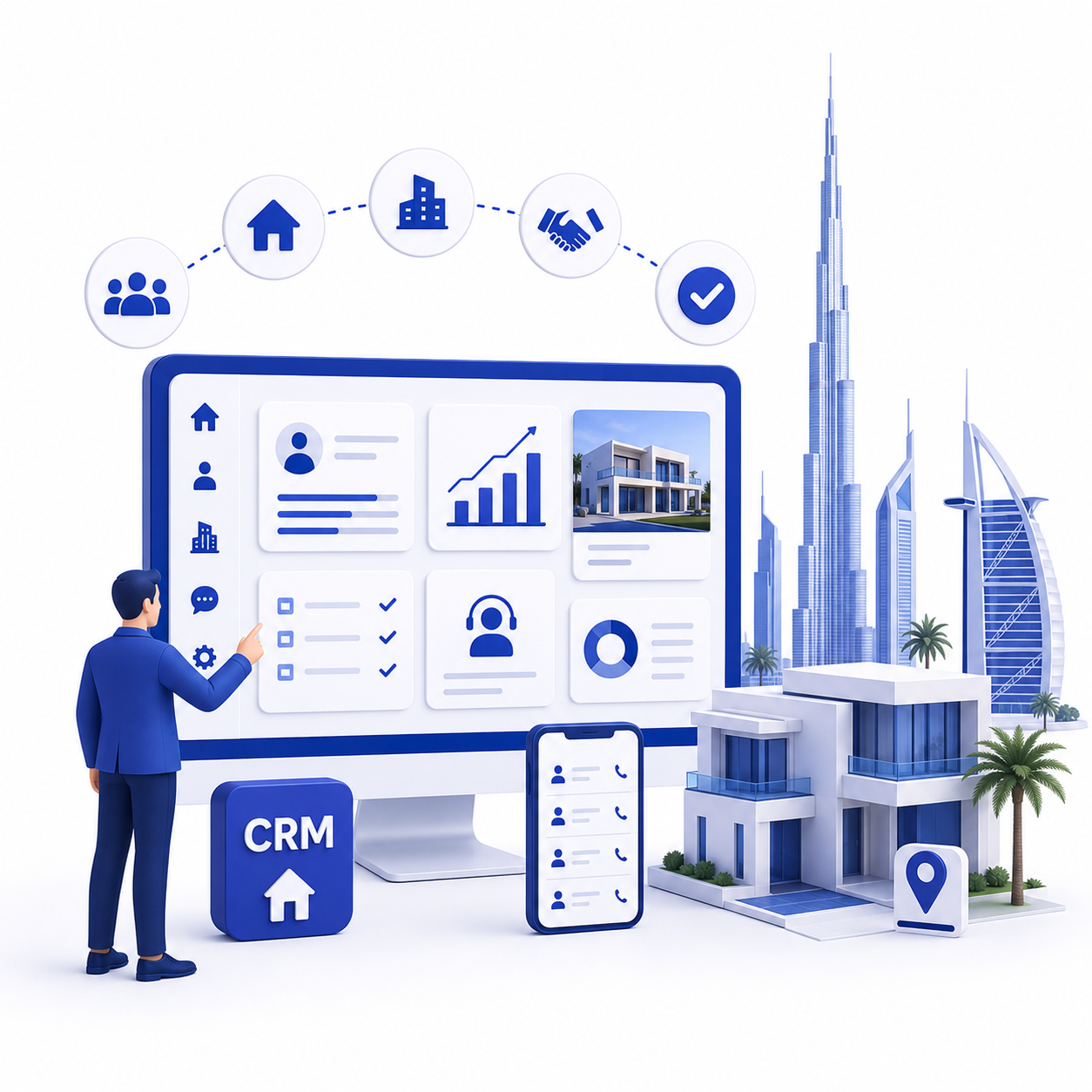
A real estate CRM for Dubai is a sales and compliance system built around the property transaction lifecycle, covering lead management, listing, viewings, offer, MOU, DLD registration and post-handover, rather than a generic CRM the brokerage reshapes itself to fit.
Most general CRM products handle pipeline stages and contact records well enough. What they do not handle is Oqood, the DLD fee schedule, RERA compliance documentation, or commission splits that depend on the deal structure. Those are the parts that end up in spreadsheets - and the spreadsheet is where the data that matters most lives outside your CRM.
What we keep hearing before the first call
Compliance documentation lives outside the CRM
Oqood, DLD forms, RERA filings and MOU documents are managed separately and attached manually. The CRM shows you the deal stage but not whether the deal is actually compliant.
Commission is calculated in a spreadsheet the night before payday
Agent splits, referral fees and tiered structures are too complicated for the CRM. Finance rebuilds the calculation manually each month, and the argument about the numbers happens every time.
The pipeline does not reflect how property actually sells
Generic pipeline stages do not map to an off-plan deal, a secondary market sale and a rental renewal in the same way. The team adapts the process to the CRM instead of the other way around.
The three questions every UAE buyer asks a supplier outside the country
Most vendor sites leave these to the first call. We would rather answer them here.
7.5 hours of shared working day
What we build
Pipeline for property deal types
Off-plan, secondary, rental and commercial, each with their own stages, documents and compliance checkpoints - on the same platform.
DLD, Oqood and RERA workflow
Required documents prompted at the right stage, DLD fee calculation built in, and a compliance status on every deal record rather than in a separate tracker.
Commission engine
Agent splits, referral fees, tiered structures and deductions calculated by the system on your rules, with a statement each agent can read.
Lead capture and attribution
Website, portal feeds, WhatsApp Business API and referral channels, each carrying its source through to the closed deal so your cost per transaction is a report.
Listing and inventory management
Available, reserved and sold status across your portfolio, with the listing linked to the deal and the deal linked to the developer or owner record.
Reporting your managers will open
Pipeline value by agent and deal type, conversion by source, commission liability and deals pending compliance sign-off.
We build the system and then we put it into service
We have built lead management and sales systems where the hard part was not the pipeline stages; every product has those. It was multi-source lead capture with attribution that survives to the closed deal, approval rules that reflect who can actually commit, and role-based visibility so an agent sees their pipeline and a branch manager sees the branch.
Our operational systems run across the Gulf today: at EPIC ME Technical Works LLC in the United Arab Emirates, at Triolift in Saudi Arabia, and at Gulf Integrated Vertical Solutions in Bahrain. All three run ElevatorPlus, which we built and implement ourselves, and which is live with more than 2,000 users across 20+ countries.
Across eight years: 730+ systems shipped, 500+ clients worldwide, 25+ industry verticals.

EPIC ME Technical Works LLC
United Arab Emirates
Triolift
Saudi Arabia
Gulf Integrated Vertical Solutions
Bahrain
Generic CRM or property-specific build? The honest version
Most CRM vendors answer this according to what they sell. These four questions decide it in practice.
| Decision point | Generic licensed CRM | Custom real estate build | Which fits you |
|---|---|---|---|
| DLD and RERA compliance | Manual process alongside the CRM | Built into the deal workflow as a named deliverable | If compliance documentation lives in a separate tracker today, that is your answer |
| Commission calculation | Spreadsheet rebuilt monthly | Calculated by the system on your split rules | Model how many hours finance spends on this per month |
| Deal type flexibility | One pipeline adapted for all deal types | Off-plan, secondary, rental and commercial each with their own stages | Count how many fields your team leaves blank because they do not apply to this deal |
| Cost over five years | Per-user per month, rising with headcount | Build cost then support - does not scale with agent headcount | Model it at your team size in year three, not today |
For a small brokerage with a standard pipeline, a licensed CRM is usually the better buy and we will say so. The case for a build appears when compliance, commission or deal-type complexity makes the product cost you a spreadsheet.
How the engagement works
A 30-minute call
Bring one deal type that your current system handles badly. We tell you whether a build is justified.
Discovery, then a fixed-scope proposal
Named deliverables, a fixed price, a timeline you can hold us to.
Build, with weekly demos on your data
Your real pipeline and deal types, loaded early, so the compliance gaps and commission edge cases surface while they are still cheap to fix.
Migration and go-live
History moved across, a period of parallel running, training, then support under a named agreement.
Questions we get asked
It depends on scope. What moves the number is how many deal types you need to support, how complex your commission and split rules are, how many lead sources need attribution, whether DLD and RERA compliance workflows are in scope, and what the system integrates with. We publish indicative ranges on our cost guide and give a fixed price after discovery.
Yes. DLD fee calculation, Oqood filing requirements and RERA compliance documentation can be built into the deal workflow as named deliverables. We scope the specific compliance requirements during discovery and price them explicitly rather than leaving them under a general heading.
Your split rules, referral fees, tiered structures and deductions are configured into the system. The commission is calculated on the closed deal record, not in a downstream spreadsheet, and each agent can see their statement in the system.
Yes. Leads from portal feeds, website forms, WhatsApp Business API and referral channels are captured with their source attached and carried through to the closed deal.
Possibly, if your pipeline is close to standard and your compliance requirements are met by the product. The case for a build appears when commission structures are genuinely complex, when you need deal-type flexibility that the product cannot accommodate, or when the per-seat cost at your agent headcount becomes the largest line in the budget.
For most commercial data, yes, under contractual safeguards including a data transfer agreement we provide with the proposal. If your project touches data that falls under specific UAE regulatory localisation requirements, the system runs in-country. We raise this during scoping.
No, for private-sector work. Nothing in UAE commercial contract law prevents a foreign supplier from contracting directly with a UAE private company, and we invoice you directly under the reverse-charge mechanism.
You do. Repository access, a full database export, documentation and a handover are written into every contract. There is no per-user licence and no lock-in mechanism.
Related pages
Gulf Hub
How we work with UAE companies - commercial mechanics, VAT, withholding tax, data residency.
Learn moreCRM Software Dubai
Custom CRM for Dubai companies whose sales process does not fit a licensed product.
Learn moreERP Software UAE
If you need more than a CRM: production, inventory, procurement and costing alongside your sales pipeline.
Learn moreBring the deal type your CRM handled badly
Book a 30-minute call. We will look at one real deal - the commission structure, the compliance steps, the pipeline stages - and tell you whether a custom build is the right answer.
Book a callWorking from Pune with clients across India, the US, the UK, Europe, the Middle East, Australia and Southeast Asia.