
Most ERP projects do not fail at go-live. They fail in month seven, when the team goes back to the spreadsheet.
We build custom ERP for UAE companies whose operation does not fit the template, and we build it around the exceptions rather than pretending they will go away. Eight years, 730+ systems, delivered from our engineering centre in Pune.
- Built to your process, not configured against someone else's and then worked around
- Your exceptions tested before you sign, on an export of your real data
- Reverse-charge VAT and zero UAE withholding tax, so the invoice costs you nothing beyond the price
- An AI layer on the system, when you want one
30 minutes. We respond within one business day. Bring your messiest process, not your cleanest.
Commercial and regulatory information reviewed by Mr. Sumeet Katariya, Founder and Chief Executive Officer, Accucia Softwares Pvt. Ltd.
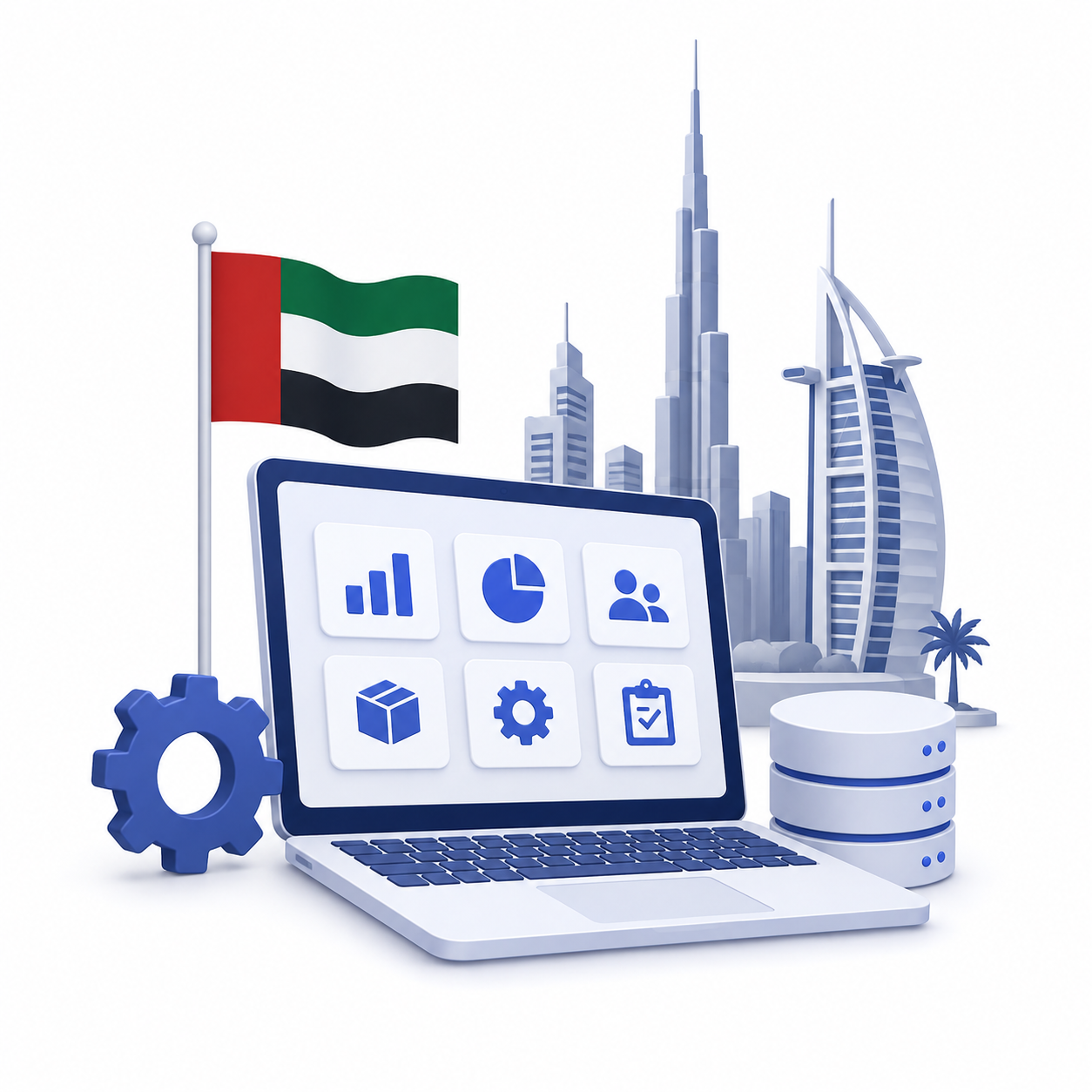
Custom ERP software is a system built around one company's actual operation, covering production, inventory, procurement, quality and costing in a single record, rather than a licensed product the company reshapes itself to fit.
A licensed ERP asks what your process is and then asks you to change it. A custom ERP starts from the process you already run, including the parts of it that are strange, because the strange parts are usually where the money is made. That is the whole difference, and it is why companies with a genuinely non-standard operation end up here after a licence has already been tried once.
What we keep hearing before the first call
The report is always three days old
The data is in the system. Getting a usable answer out of it means asking one person, who rebuilds the same sheet by hand every week. When that person is on leave, the business runs blind.
Every site has its own version of the truth
You have opened locations faster than your systems could follow. Each one keeps its own spreadsheet, and the version that reaches head office has already been edited twice on the way.
The licence fitted, then it did not
The demo matched. Eighteen months and several change requests later you are paying a licence fee and a customisation bill, and the team still keeps a parallel sheet for the parts the system will not do.
The three questions every UAE buyer asks a supplier outside the country
Most vendor sites leave these to the first call. We would rather answer them here.
7.5 hours of shared working day
What goes into an ERP we build
Production and planning
Work orders, capacity, scheduling, shop-floor capture. What was made, when, on which line, by whom.
Traceability
Batch and serial genealogy from goods-in to dispatch. When a buyer or a regulator asks where a component came from, the answer takes seconds.
Quality
Inspection plans, non-conformance, corrective actions, certificates of analysis. Recorded where the work happens, not typed up afterwards.
Inventory and procurement
Multi-location stock, reorder logic, supplier performance, purchase approvals with thresholds.
Costing
Actual against standard, by job, by product, by site. The number your finance team currently rebuilds by hand.
An AI layer, when it earns its place
Agents that read and act on the system through a controlled integration, with role-based permissions and a citation on every answer.
We do not only build these systems. We put them into service.
The hardest part of an ERP is not writing it. It is the eight weeks after go-live, when the people who have run the operation on paper for a decade decide whether to trust it. We do that part too, and it is the reason we still talk about systems we shipped years ago.
ElevatorPlus is the clearest example. We built it as a full operating system for elevator companies, covering maintenance contracts, breakdown dispatch, technician scheduling and statutory inspection records, and we run the implementation ourselves: data migration, parallel running, technician training, and the follow-through until the old spreadsheets are switched off. It is live with more than 2,000 users across 20+ countries.
In the Middle East it is running today at EPIC ME Technical Works LLC in the United Arab Emirates, at Triolift in Saudi Arabia, and at Gulf Integrated Vertical Solutions in Bahrain. Three named companies across three GCC states, on a system built in Pune and implemented remotely.

EPIC ME Technical Works LLC
United Arab Emirates
Triolift
Saudi Arabia

Gulf Integrated Vertical Solutions
Bahrain
Licence, or build? The honest version
Most vendors answer this according to what they sell. These are the questions that actually decide it.
| Decision point | Licensed ERP | Custom build | Which fits you |
|---|---|---|---|
| How standard is your process | Close to standard, and you can change how you work | The way you make money is the part that does not fit a template | If a licence has already been tried and worked around once, that is your answer |
| Time to first use | Faster to start, slower to fit | Slower to start, fits on arrival | Weigh this against how long you can run two systems in parallel |
| Where the cost lands | Licence fee, then customisation, then per-seat growth | Build cost, then support. The price does not grow when the team does | Ask for a five-year total, not a first-year quote |
| Integrations | What the vendor supports | What you need, including equipment and customer systems | This is where most ERP budgets quietly go |
There is no universally right answer here. For a lot of UAE trading and distribution companies a licensed product is genuinely the better buy, and we will tell you when we think that is the case.
How the engagement works
A 30-minute call
You bring one process. We tell you whether it is ready and whether we are the right team. A fair share of these calls end with us saying no.
Discovery, then a fixed-scope proposal
Named deliverables, a fixed price, a timeline you can hold us to. Discovery is not a delay, it is the cheapest part of the project.
Build, with weekly demos on your data
You watch the exceptions break things and get fixed while it is still cheap to fix them.
Implementation and year three
Migration, parallel running, training, then support under a named agreement. Shipping is the easy part.
Questions we get asked
It depends on scope, and any vendor quoting before they understand your process is guessing. What we can tell you is what drives the number: how many sites, how many integrations, how much of your process is genuinely non-standard, and how clean the data is that has to migrate. We give a fixed price after discovery.
For a single-site core scope, plan on a few months to first production use, then a phased rollout. Multi-site and heavy integration work takes longer. We would rather give you a date we can hold than one that sounds good in a proposal.
Both are possible and they are very different projects. If the ERP broadly works and the problem is that nobody can get answers out of it, adding a layer on top is faster and cheaper than replacing it. We will tell you which one your situation actually calls for, including when that means a smaller project for us.
Usually yes. Integration is where a large share of ERP budgets quietly goes, so we scope it explicitly and price it as a named line rather than leaving it as an item called "integrations".
For most operational data, yes, under contractual safeguards including a data transfer agreement we provide. If your project touches UAE health data, or banking or telecommunications data under those regulators' rules, the system is built to run in-country. We raise this during scoping, not after.
No, for private-sector work. There is no restriction in UAE commercial contract law on a foreign supplier contracting directly with a UAE private company. Some government and semi-government procurement does require a UAE-licensed supplier, and we will tell you when that applies to your project.
You do. Repository access, documentation and a full handover are written into every contract. We would rather be kept because the work is good than because leaving is difficult.
Yes. We work from Pune with clients across India, the US, the UK, Europe, the Middle East, Australia and Southeast Asia. ElevatorPlus, which we built and implement, runs with more than 2,000 users across 20+ countries including named clients in the UAE, Saudi Arabia and Bahrain.
Operating in more than one country?
Gulf Hub
UAE, Saudi Arabia, Bahrain - how we work across the region and the compliance differences.
Learn moreERP Software Saudi Arabia
The Saudi-specific version - ZATCA Phase 2, 15% VAT engine, Arabic interface.
Learn moreSoftware Development Company Dubai
The full commercial picture for any software project with a UAE buyer and an India-based supplier.
Learn moreReady to see this on your own process?
Book a 30-minute call. We will work through one of your processes, not a generic demo, and tell you honestly whether a custom build is the right answer for it.
Book a callWorking from Pune with clients across India, the US, the UK, Europe, the Middle East, Australia and Southeast Asia.