AI for Government & Public Sector

AI that moves citizen services forward, and actually gets adopted.

AI for government applies machine learning, agents, RAG and computer vision to public-sector work: delivering citizen services digitally, processing cases and documents faster, securing premises, and automating compliance reporting , while meeting the security, privacy and auditability standards the public sector requires.

AI for Government & Public Sector services by Accucia Softwares – Pune, India

Quick Answer

Section 12 of the Maharashtra Artificial Intelligence (AI) Policy-2026 states that "All State departments shall undergo an annual AI readiness audit." Accucia Softwares Pvt. Ltd. runs that audit as a fixed-scope two-week engagement priced between Rs 2 lakh and Rs 5 lakh, and then builds what the audit recommends. Accucia has delivered 730+ systems over 8 years across 7 industries including government, with live government work spanning a government organization in Maharashtra and a Mumbai housing authority.

730+
Projects Delivered
500+
Clients Worldwide
8
Years
25+
Industry Verticals
Overview

What is AI for government?

AI for government applies machine learning, agents, RAG and computer vision to public-sector work: delivering citizen services digitally, processing cases and documents faster, securing premises, and automating compliance reporting.

Done right, it removes office dependency for citizens and manual load for staff , while meeting the security, privacy and auditability standards the public sector requires.

Key areas

Citizen engagement & service delivery

Case management & document intelligence

Physical security & visitor management

Process & reporting automation

Why it matters now

Paper-based processes and office dependency slow everything down: citizens make repeat visits, staff are buried in manual case handling, and reporting is a scramble. The bigger failure mode is adoption: most vendors deliver a system and disappear, so it never gets used. Public bodies that pair the right AI with real on-the-ground adoption support are the ones that actually move the needle.

Section 12 of the Maharashtra AI Policy 2026 makes an AI readiness audit an annual obligation

"All State departments shall undergo an annual AI readiness audit."

Section 12, Maharashtra Artificial Intelligence (AI) Policy-2026

The policy was approved by the state cabinet on 29 April 2026 and issued on 6 May 2026 by the Electronics, Information Technology and Artificial Intelligence Department under Government Resolution POLICY-2026/C.R.64/IT (E-1604501). It runs for five years.

Section 12 does not ask departments to consider an audit. It says all State departments shall undergo one, annually. That turns AI readiness from a discretionary exercise into a recurring compliance item with a named owner inside every department.

An AI readiness audit answers three questions for a specific department. What does the department actually do, step by step, in the processes citizens and staff touch. Which of those steps have the data, the volume and the rule structure to be handled or assisted by AI. What has to be fixed first, because most AI work in government fails on data quality, process ambiguity and ownership rather than on the model.

How Accucia runs it. Two weeks. Fixed scope agreed in writing before we start. Fixed price between ₹2 lakh and ₹5 lakh depending on department size and the number of processes in scope. You receive a written readiness position, a ranked list of candidate use cases with the effort and the risk against each, the data and access gaps that block them, and a phased plan with what can be delivered inside 45 days. The audit stands on its own. You are not obliged to build with us afterwards, and the document is yours.

Book the two-week AI readiness audit Or email services@accucia.com with your department's requirement

The seven policy pillars, and what a department can put out for delivery under each

The policy sets out seven pillars. The left column is the pillar as written in the policy. The right column is Accucia's reading of what is buildable against it, not policy text.

Policy pillar What a department can commission
5.1 AI Infrastructure Development for State-wide AI Enablement Compute and hosting decisions for departmental AI, including where data sits and who can reach it. The policy provides for Compute as a Service as state-backed Digital Public Infrastructure, so a department can plan workloads against state compute rather than build its own.
5.2 Local Datasets and Platforms for AI Innovation and Interoperability Getting departmental records into a usable state: phased historical data migration, records digitisation, and one structure so two systems can talk to each other. The policy places specific weight on Marathi and local-language datasets for citizen-facing AI, which matters for any grievance or service bot a department intends to run in Marathi.
5.3 Local Talent Development and Skilling Capacity building for officials, delivered under the policy with YASHADA and through the Maharashtra Centre for Advanced AI Training. At department level this becomes internal training assets and an assistant trained on the department's own SOPs, so new staff stop consuming senior officers' time with repeat questions.
5.4 Startup-First Adoption and Financing for Public Sector Innovation The policy sets a startup-first approach for public sector innovation, with AI adoption support for MSMEs. Departments can scope smaller, faster engagements with Indian firms rather than only large multi-year contracts.
5.5 Applied AI Accelerator for Pilot-to-Scale Deployment This pillar names the pilot-to-scale problem directly, which means the state has already recognised that demos do not become production systems on their own. A department can commission a pilot with the scale path written into the same scope: the success number, the rollout phases, the migration of existing records and the handover, all agreed before the pilot starts.
5.6 Centre of Excellence for Research for Applied AI Innovation Six AI Centres of Excellence are to be created. Departments can route research-heavy or first-of-kind problems there and keep their own delivery scope on proven work.
5.7 Ethical AI and Compliance Framework The policy encourages testing and validation practices before deployment, particularly in government contexts. In practice this is a test plan, a sign-off gate before anything touches citizens, an agreed fallback when the system is wrong, and a record of what the system was trained on.

Departments are encouraged under the policy to adopt AI across citizen service delivery, grievance redressal, inspections and compliance, decision support, forecasting and planning, records management and workflow. Every one of those is a scope we have built against.

For the full sector overview, see AI in the government and public sector.

2,000+ → <700
Daily footfall
A government organization in Maharashtra
Under 45 days
From start to live
Same engagement
10 to 15
Projects on one platform
A Mumbai housing authority

What We Build

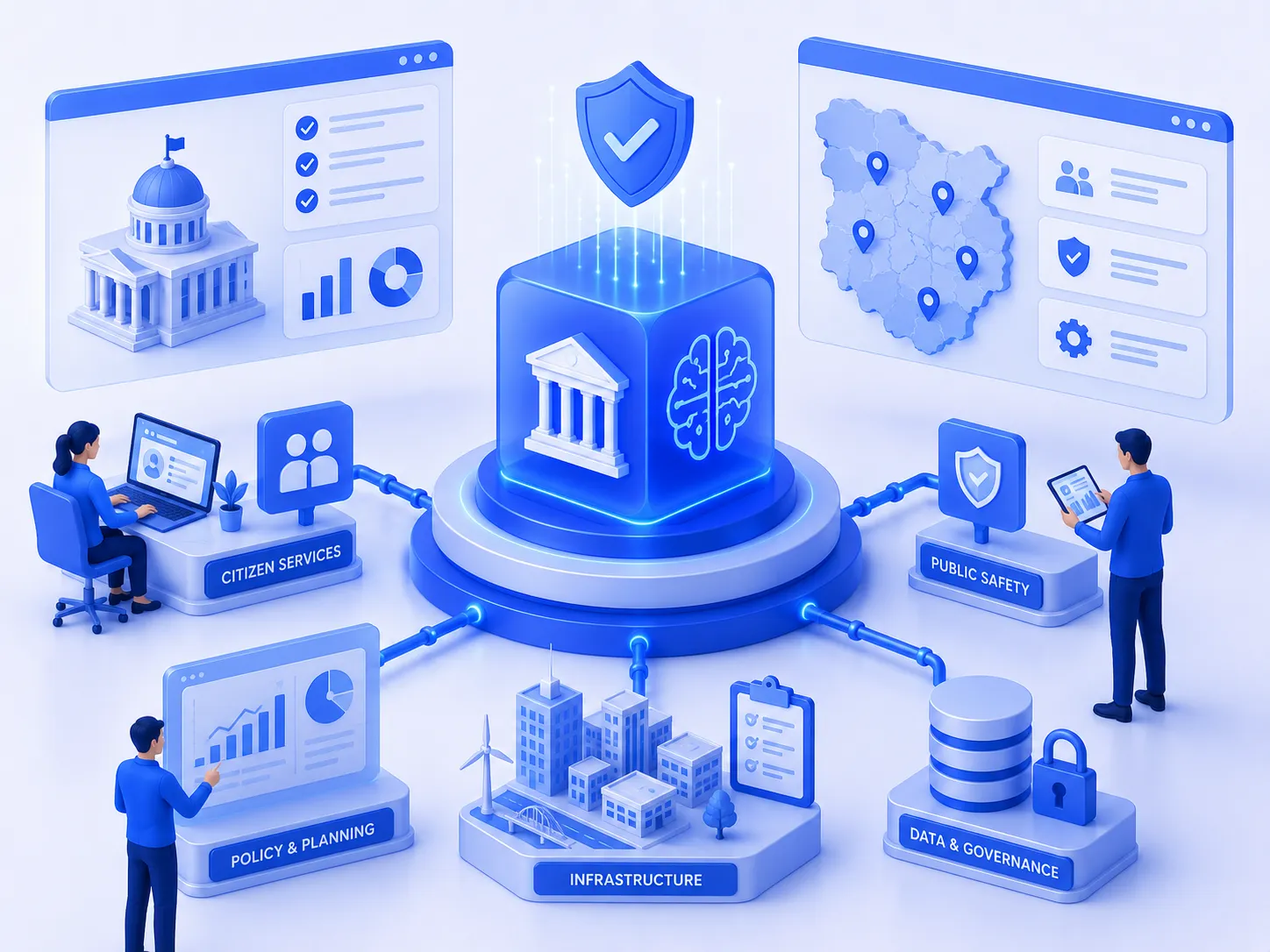
Six AI capabilities purpose-built for government and public-sector needs

AI Citizen-Service Platforms

Services delivered digitally, without office visits, across web, mobile and WhatsApp channels, accessible around the clock.

Case & Legal Intelligence

Instant, AI-assisted access to case information, processing faster, with legal teams surfacing relevant precedents and status in seconds.

Visitor Management & Security

Computer-vision anomaly and intruder detection for government premises, with automated reporting and mobile/tablet access control.

Automated AI Reporting

Compliance and operational reports generated automatically: MIS, grievance dashboards and inter-department data without manual assembly.

WhatsApp Citizen Channels

Meet citizens where they already are, via AI-powered WhatsApp interfaces for service requests, status updates and grievance handling.

RAG Over Government Documents

Accurate, cited answers for staff and citizens drawn from your department's own policies, circulars and case records, with role-gated access.

Solution Areas

01

Citizen engagement & service delivery

Web, mobile and WhatsApp access to government services without office visits.

02

Case management & document intelligence

AI-assisted case processing and document retrieval.

03

Physical security & visitor management

Computer-vision anomaly detection for government premises.

04

Process & reporting automation

MIS, compliance and inter-department reporting on autopilot.

05

Secure knowledge assistants (RAG)

Role-gated AI assistants for departmental policy and case documents.

Where Government AI Is Used

By function

Citizen services & grievance handling Legal / case processing Premises security Records digitisation Compliance & MIS reporting Inter-department knowledge access

By industry

  • State & local government
  • Civic bodies & smart-city programmes
  • Public-sector undertakings
  • Regulatory and administrative departments

Government AI Technology Stack

AI: RAG, LLMs (model-agnostic), computer vision, document AI/OCR · Channels: web, mobile, WhatsApp · Deployment: on-prem / private-cloud as an Accucia delivery standard, not a policy requirement

O

Our Government AI Process

From briefing through on-site adoption: six stages for secure, compliant public-sector AI

1

Briefing & Discovery

Map the citizen/staff journey, mandate and constraints: what the system must do, who uses it, and what a successful outcome looks like.

2

Security & Compliance Scoping

Define data residency, access controls, auditability requirements and any sovereignty constraints before any build begins.

3

Build & Integrate

Develop the AI system and integrate with existing government databases, case management and identity systems via secure APIs.

4

Pilot

Run a controlled pilot with a defined department or service, validating accuracy, processing time and citizen/staff experience.

5

Deploy Securely at Scale

Full rollout with monitoring, audit logs and escalation paths, meeting government security and compliance standards.

6

Embed On-Site & Measure Adoption

We stay until staff and citizens are actually using the system, tracking utilisation and resolving friction on the ground.

Three delivery rules we do not bend on government work

The continuity trap

This is the most common way a government digital programme dies, and it has nothing to do with technology. One officer understands the system, drives it and defends it in reviews. That officer is transferred. The programme stalls, because the knowledge walked out with them. The successor inherits a login, not an understanding.

The fix is to put the SOPs and the workflow into the platform rather than into people. Every process step, every approval and every exception path is encoded in the system, and an AI knowledge bank sits on the department's own internal documents so the answer to "how is this normally done here" is available to anyone with access.

Here is the test we hold ourselves to. The incoming officer opens one screen on day one and sees the full state of operations: what is pending, with whom, for how long, and what the department committed to. If they need a briefing from their predecessor to understand it, we did not build it correctly.

On the Mumbai housing authority programme, two full-time Accucia staff stationed on site are why adoption survived transfers. A support ticket queue does not survive a transfer. A person sitting in the building does.

One number, agreed upfront

Before we start, we agree one number that decides whether the project worked, and we agree how it will be counted. For the visitor management work it was daily footfall, counted the same way before and after. Not "digital transformation", which nobody can measure and everybody can dispute.

When the measure of success is a number both sides agreed in advance, the project survives reviews, audit questions and a change of leadership, because nobody has to take anyone's word for anything.

Speed is a feature, not a boast

We delivered the visitor management system in under 45 days for a reason. A system that goes live inside 45 days proves itself within a single administrative season, before officers transfer and before budget cycles turn. A programme that needs eighteen months to show anything has to survive events that have nothing to do with its quality. In government delivery, slow is not just slow, slow is fragile.

The practices below are Accucia's own delivery standards and credentials. They are not requirements of the Maharashtra AI Policy 2026, and we do not present them as such. The policy does not mention data residency, dashboards or UX4G. UX4G is a separate MeitY standard, and we build to it because departments and citizens benefit from it, not because this policy asks for it. We are explicit about the difference so that nothing on this page falls apart when you check it against the policy text.

Why Accucia for Government AI?

Real public-sector delivery: security-grade and adoption-first

Real Public-Sector Delivery

We built a connected digital ecosystem spanning 10 to 15 projects for a Mumbai housing authority. The citizen-facing platform was built to UX4G standards and earned recognition from the Chief Minister of Maharashtra.

Security & Data Sovereignty

Enterprise and government-grade controls: encryption, role-based access, audit trails, and on-prem options for data that cannot leave your jurisdiction. Data hosted on Indian soil is an Accucia delivery standard, not a policy requirement.

Adoption-First

We embed on-site until the system is genuinely in use. On the Mumbai housing authority programme, two full-time Accucia staff stationed on site is why adoption held through officer transfers, not a support email address.

Full AI Range Under One Partner

Agents, RAG, computer vision and automation: the full range of AI for public-sector work, without stitching together multiple vendors.

Citizen-Centred Design

Services designed for the citizens who use them, via web, mobile and WhatsApp access so anyone can reach government without visiting an office.

Proven at Scale

Live production AI for a government organization in Maharashtra reduced daily footfall from over 2,000 to under 700 visitors in under 45 days, measured the same way before and after.

Shipped in Production

A Mumbai housing authority: connected digital ecosystem, 10 to 15 projects

We built a connected digital ecosystem spanning 10 to 15 projects for a Mumbai housing authority. Two full-time Accucia staff were stationed on site. That is the reason adoption held through officer transfers, because the people who knew how the system worked were in the building rather than on a support email address. The citizen-facing platform was built as a responsive platform to UX4G standards, and it earned recognition from the Chief Minister of Maharashtra.

A government organization in Maharashtra: daily footfall from more than 2,000 to under 700, in under 45 days

The office was absorbing more than 2,000 visitors a day. Many were arriving without an appointment, many were repeat visits for the same matter, and nobody could say how many of either, because the record was a paper register at the gate.

We built a QR-code online appointment flow with an AI-powered visitor management platform behind it. Daily footfall came down from more than 2,000 visitors to under 700. It was live in under 45 days.

Two decisions did most of the work. First, no app to download and no account to create, so a citizen scans a code and books. Second, one number agreed before we started, which was daily footfall counted the same way before and after.

Leadership also gained something the paper register never gave them: live analytics on visitor volumes, purposes and repeat patterns. That is the difference between knowing the office is crowded and knowing which four reasons are bringing people back.

Read the full footfall case study

Engagement Models

Fixed-Scope Audit

Two-week AI readiness audit at a fixed price between ₹2 lakh and ₹5 lakh, a stand-alone engagement you are not obliged to extend.

Phased Programme

Audit, then build: pilot a high-confidence use case, roll out department-wide, then scale, each phase with a written sign-off.

Dedicated Team

An embedded team for large, complex public-sector AI programmes requiring on-site presence across multiple departments.

AI readiness audit: two weeks. Pilot to production: typically 45 to 90 days for a defined scope.

Frequently Asked Questions

Everything you need to know about AI for government and public-sector projects

Yes. Section 12 of the Maharashtra Artificial Intelligence (AI) Policy-2026 states that "All State departments shall undergo an annual AI readiness audit." The policy was approved by the state cabinet on 29 April 2026 and issued on 6 May 2026 under Government Resolution POLICY-2026/C.R.64/IT (E-1604501) by the Electronics, Information Technology and Artificial Intelligence Department, and it runs for five years. The obligation is annual and it applies to all State departments, so it is a recurring item rather than a one-time exercise. Accucia Softwares Pvt. Ltd. runs the audit as a fixed-scope two-week engagement priced between ₹2 lakh and ₹5 lakh, and the output is a written readiness position, a ranked list of candidate use cases with effort and risk against each, the data and access gaps that block them, and a phased plan showing what can be live inside 45 days.

Pillar 5.4 of the policy sets a startup-first approach to adoption and financing for public sector innovation, together with AI adoption support for MSMEs, so engaging an Indian firm is consistent with the policy direction. The fixed-scope two-week audit is normally the easiest first engagement to process, because the scope, the duration and the price are all defined in writing before it begins, which means there is nothing open-ended to justify at review. On the compliance side, Accucia works to its own practice standards, which include hosting data on Indian soil, role-based access, government-grade cloud and phased rollouts with a written sign-off at the end of every phase. Those are Accucia standards, not policy requirements, and we state the difference plainly rather than letting the two blur together.

It means the system survives the things that kill government software, which are officer transfers, audit questions and a data migration that goes wrong. In practice that is: SOPs and workflows encoded in the platform rather than held in people's heads, so an incoming officer opens one screen on day one and sees what is pending, with whom and for how long. Role-based access that changes with the posting rather than with the person. Phased rollout with a written sign-off at the end of each phase, so there is a documented trail of what was approved, by whom and when. Phased historical data migration with no break in field continuity. Data hosted on Indian soil. AI assistants trained only on documents the department has approved. Full-time Accucia staff stationed on site during rollout, which on one Mumbai housing authority programme is why adoption held through officer transfers.

Yes, including a citizen-services platform for a Mumbai housing authority and a visitor management system for a government organization in Maharashtra that reduced daily footfall from over 2,000 to under 700 in under 45 days.

To enterprise and government standards: encryption, controlled access, audit trails and on-prem options. Data hosted on Indian soil is an Accucia delivery standard.

Yes, via secure, API-first integration.

We support on-prem/private-cloud deployment so data stays within required boundaries.

We stay on-site after go-live and measure utilisation until the system is genuinely in use.

Citizen-service platforms, case/document intelligence (RAG), visitor security (computer vision) and automated reporting.

Yes, through web, mobile and WhatsApp channels, which is exactly what our Maharashtra deployments enabled.

Planning a Public-Sector AI Initiative? Book a Briefing

Tell us your department's mandate and the biggest bottleneck in your citizen service delivery. We will outline what AI can realistically achieve, with what security posture, in what timeframe.

Chat With Us