
AI Visitor Management in Government: 2,000+ Daily Visitors Down to Under 700 (Case Study)
Quick Answer
A government organisation in Maharashtra cut daily footfall from over 2,000 visitors to under 700 by pairing QR-code online appointments with an AI visitor management platform, delivered in under 45 days. This AI visitor management government case study shows routine visits moving to scheduled, pre-verified slots, returning officer hours to casework. By Mr. Sumeet Katariya, CEO, Accucia Softwares Pvt. Ltd.
Walk past a busy government office at 10 am and you can read the whole day off the pavement. The line starts outside the gate. It thickens by 11. Officers spend their sharpest hours managing a crowd instead of clearing files. Most offices treat that queue the way they treat the weather, as a condition rather than a decision.
One government organisation in Maharashtra stopped treating it that way. It was receiving more than 2,000 visitors a day. Within 45 days of going live with a QR appointment flow and an AI visitor management platform, daily footfall was under 700. The client stays anonymous, permanently, by agreement. The mechanics do not have to.
The queue at the gate, and what it actually costs
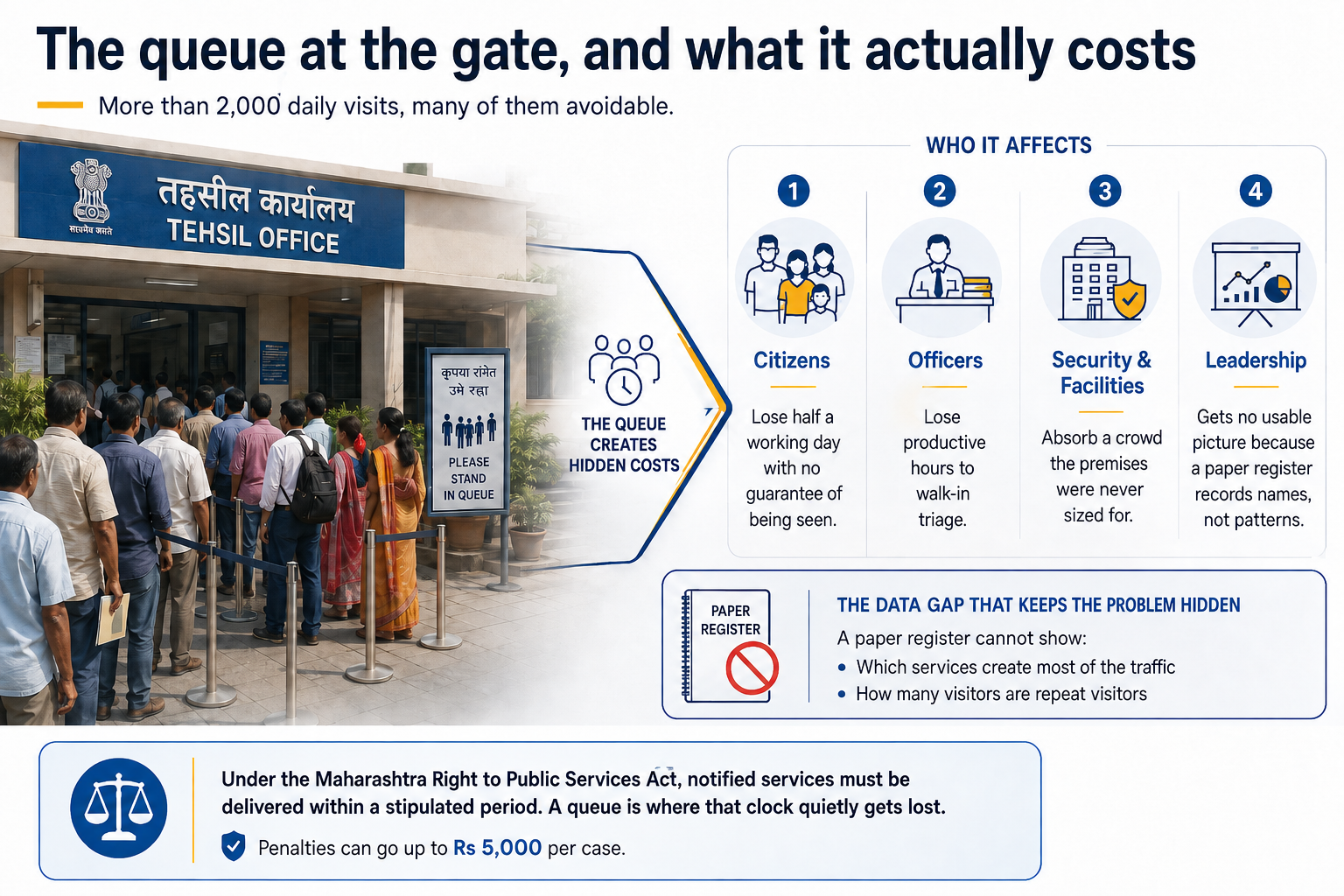
Some of those 2,000 daily visits genuinely needed a person in the building. Many did not. Status enquiries. Document submission. People coming back a third time about the same pending matter because nobody could tell them where it stood.
The cost lands on four groups at once.
Citizens lose half a working day with no guarantee of being seen. Officers lose their most productive hours to walk-in triage. Security and facilities absorb a crowd the premises were never sized for. And leadership gets no usable picture of any of it, because a paper register records names, not patterns. It cannot tell you which three services generate a third of your traffic, or how much of your queue is the same twenty people returning.
There is a statutory edge to this too. Under the Maharashtra Right to Public Services Act, 2015, notified services must be delivered within a stipulated period, citizens can escalate through a three-tier appeal, and an erring officer is liable to a penalty of up to Rs 5,000 per case, as the state government's own guidance sets out. A queue is exactly where that clock quietly gets lost. Nobody is tracking whether the person who waited from 9 am left with the service or left to come back tomorrow.
What we built: appointments in front, AI visitor management at the door
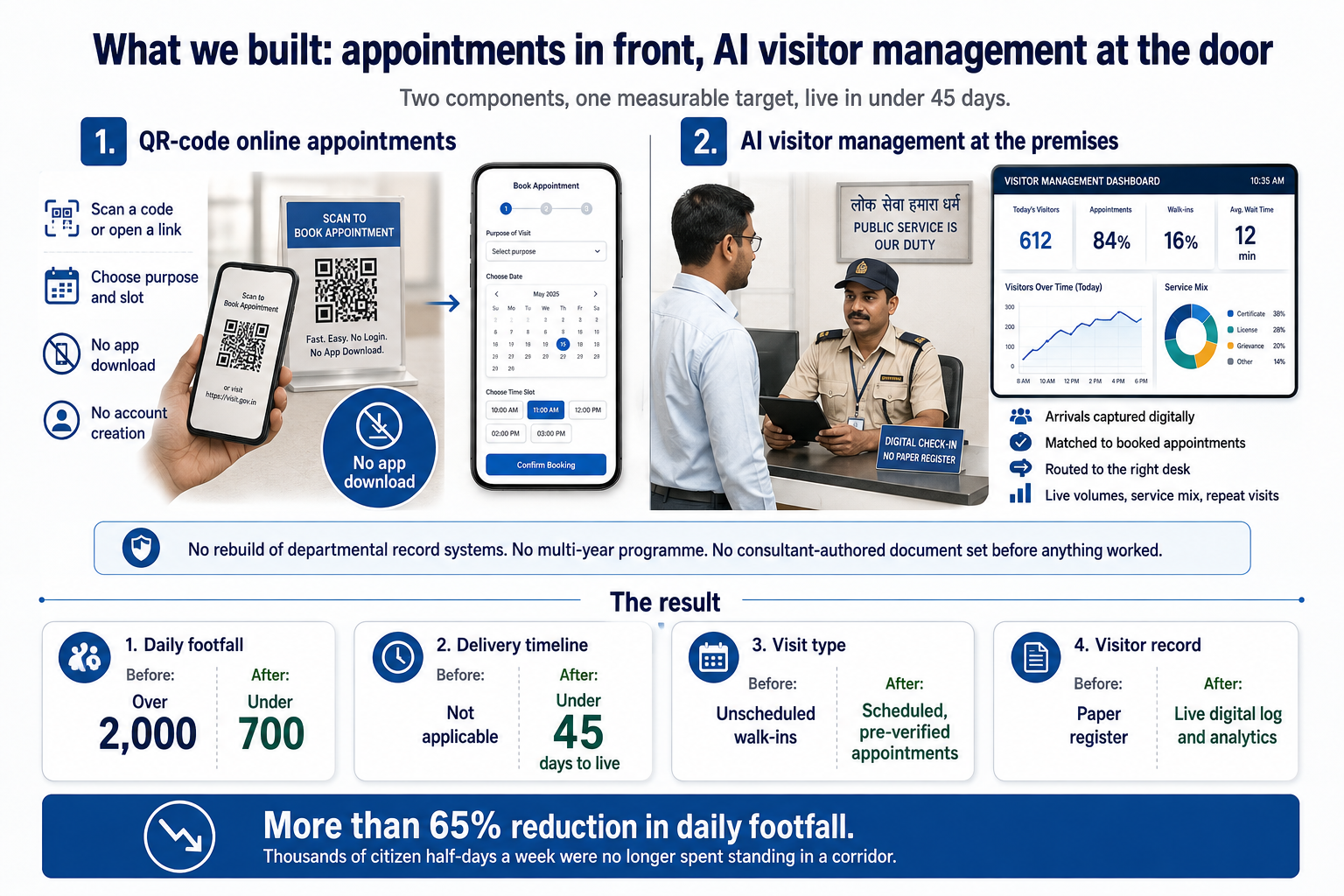
Two components, one measurable target, live in under 45 days.
1. QR-code online appointments
A citizen scans a code or opens a link, states the purpose of the visit, and books a slot. The question "when will I be seen" moves from the corridor to the phone.
There is deliberately no app to download and no account to create. That decision looks small and is not. Every install step and every OTP-plus-password wall you put in front of a citizen channel removes a share of the people you built it for, and the people it removes first are the ones with the oldest handset and the weakest data plan. A scan and a short form was the whole flow.
2. AI visitor management at the premises
Arrivals are captured digitally, matched against booked appointments, and routed to the right desk. The register stops being paper. For the first time the organisation could see live volumes by hour, purposes by service, and repeat-visit patterns by person.
That last one changed the conversation. Once you can see that a particular service produces repeat visits, you stop arguing about whether the office is busy and start fixing the service that made it busy. The build detail behind the premises-side platform sits in our government visitor management system case study.
Worth naming what was not required. No rebuild of departmental record systems. No multi-year programme. No consultant-authored document set arriving before anything worked.
The result
Daily footfall — Before: Over 2,000. After: Under 700.
Delivery timeline — Before: Not applicable. After: Under 45 days to live.
Visit type — Before: Unscheduled walk-ins. After: Scheduled, pre-verified appointments.
Visitor record — Before: Paper register. After: Live digital log and analytics.
Over 2,000 down to under 700 is a reduction of more than 65 per cent, held on the organisation's own daily counts. In plain terms, that is several thousand citizen half-days a week not spent standing in a corridor, and a working day at the office that starts with casework rather than crowd control.
What officers got back
We do not publish an hours-saved figure for this deployment, because the organisation did not instrument officer time before the change and we are not going to reverse-engineer a number that nobody measured. What we can describe is the mechanism, which is the part that transfers.
Three things changed for the officers.
Their day became predictable. A booked slot list is something you can plan against. A queue is not.
Their conversations became shorter. When a visitor arrives against a stated purpose that was captured at booking, the first two minutes of "what is this regarding" disappear.
Their escalations became evidence-backed. When a section head asks why a desk is overloaded, the answer is now a chart of arrivals by purpose and hour, not an impression.
The compliance floor a government visitor system has to clear
A visitor management platform in a government office is not a low-stakes internal tool. It collects names, mobile numbers, photographs and movement records of citizens. That puts it squarely inside India's data and security regime.
CERT-In Directions, 28 April 2022 — What it requires: "All service providers, intermediaries, data centres, body corporate and Government organisations shall mandatorily enable logs of all their ICT systems and maintain them securely for a rolling period of 180 days", plus reporting of listed cyber incidents to CERT-In within 6 hours. Why it matters here: Sets log retention and incident response design before go-live, not after.
Digital Personal Data Protection Act, 2023 — What it requires: "Person" expressly includes the State, so a department is a Data Fiduciary. Section 8 requires reasonable security safeguards and erasure once the specified purpose is no longer served. Why it matters here: Visitor records need a stated purpose, a retention rule and a real deletion path.
Digital Personal Data Protection Rules, 2025 — What it requires: Notified on 14 November 2025. The Press Information Bureau states the Rules "introduce an eighteen-month period for phased compliance". Why it matters here: Gives departments a fixed window to bring existing citizen data flows into line.
GIGW 3.0 — What it requires: Government bodies are told to assess their websites and apps against the guidelines and to obtain CQW certification from the STQC Directorate. Why it matters here: The citizen-facing booking page is a government interface and is judged as one.
On security audit specifically, our position is unchanged across every public sector engagement. The client commissions the CERT-In empanelled auditor. We build to that auditor's requirements and implement every finding they raise. We do not hold empanelment ourselves and we do not tell departments otherwise.
On hosting, we deploy in-region on request across AWS, Azure or GCP with the region chosen to meet the department's requirement and infrastructure billed to the client at cost, or on the department's own on-premise servers. Those are the only sub-processors involved.
Why this AI visitor management government case study transfers to other offices
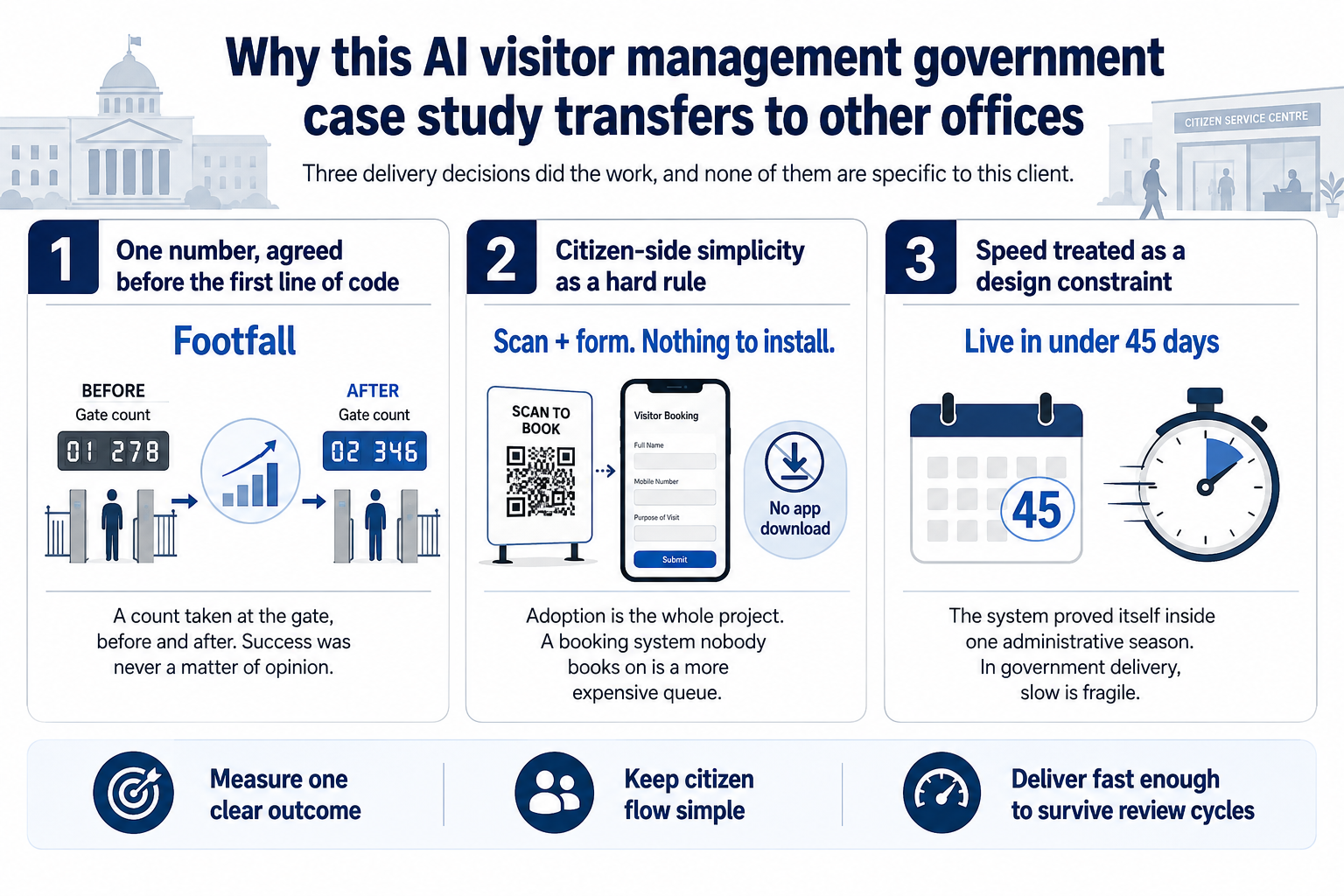
Three delivery decisions did the work, and none of them are specific to this client.
One number, agreed before the first line of code. Footfall. Not "digital transformation". A count taken at the gate, before and after. Success was never a matter of opinion, which is what carried the project through review meetings where opinion is usually the currency.
Citizen-side simplicity as a hard rule. A scan and a form. Nothing to install. Adoption is the whole project. A booking system nobody books on is a more expensive queue.
Speed treated as a design constraint. Under 45 days meant the system proved itself inside one administrative season, before a transfer, a budget cycle or a change of priority could strand it half-built. In government delivery, slow is not merely slow. Slow is fragile.
Accucia's view
Accucia's view is that the fastest credibility a department can build, upward to leadership and outward to citizens, is a visible queue that disappears. Large programmes earn announcements. A footfall count that halves earns trust, and trust is what funds phase two.
That view costs us work, and we will say so plainly. When a department asks us to scope a full citizen services platform in the first engagement, we usually argue them down to one queue and one number. The smaller piece of work is the one we recommend, even when the larger brief is on the table, because a department that has shipped one measured win negotiates its next phase from strength. A department that has spent eighteen months on a platform nobody has used yet negotiates from apology.
Two things we would not recommend. Do not lead with biometric identification at the gate. It raises the compliance burden and the political cost in the same move, and it solves a problem most offices do not have. And do not buy a department-wide platform before you have measured a single queue for a fortnight. You will pay for modules that describe a workflow nobody follows.
Frequently Asked Questions
How did a government organisation in Maharashtra cut daily footfall from over 2,000 to under 700?
By deploying a QR-code online appointment flow alongside an AI visitor management platform at the premises. Routine visits moved to scheduled, pre-verified slots, and arrivals were logged digitally and matched to bookings instead of a paper register. The system went live in under 45 days and daily footfall fell to under 700.
How long does a government visitor management system take to deploy?
This deployment was live in under 45 days, covering both the citizen-facing appointment flow and the premises-side visitor management platform. Timelines vary with the number of service desks, the security review the department requires, and whether hosting is in-region on public cloud or on the department's own on-premise servers.
Do citizens have to install an app to book an appointment?
No. The appointment flow runs through a QR scan or a link, with no download and no account creation. Install steps and login walls remove a share of the citizens a public channel exists to serve, usually the ones with older handsets and weaker data plans, so the design avoids them entirely.
What compliance obligations apply to a government visitor management system in India?
CERT-In's 28 April 2022 directions require ICT system logs to be maintained for a rolling 180 days and listed cyber incidents reported within 6 hours. Under the Digital Personal Data Protection Act, 2023, the State is a Data Fiduciary owing security safeguards and erasure. GIGW 3.0 governs the citizen-facing interface.
Ready to reduce queues and simplify citizen visits? Talk to Accucia.