
Hospital management software built around how your wards actually run
Custom hospital management software for Indian hospitals and clinic groups, built to your clinical and billing workflows rather than a licensed template. ABDM integration, DPDP Act compliance, multi-facility capability - all scoped explicitly before the build starts.
- OPD, IPD, ward management and discharge in one system, not split across paper and three applications
- ABDM/ABHA integration built as a named deliverable, not a Phase 2 addition
- GST-compliant billing with separate handling for cash, insurance, TPA and government scheme patients
- Mobile app for ward rounds and prescriptions that works on the hospital wifi without internet dependency
30 minutes. Bring the workflow that your current system handles badly.
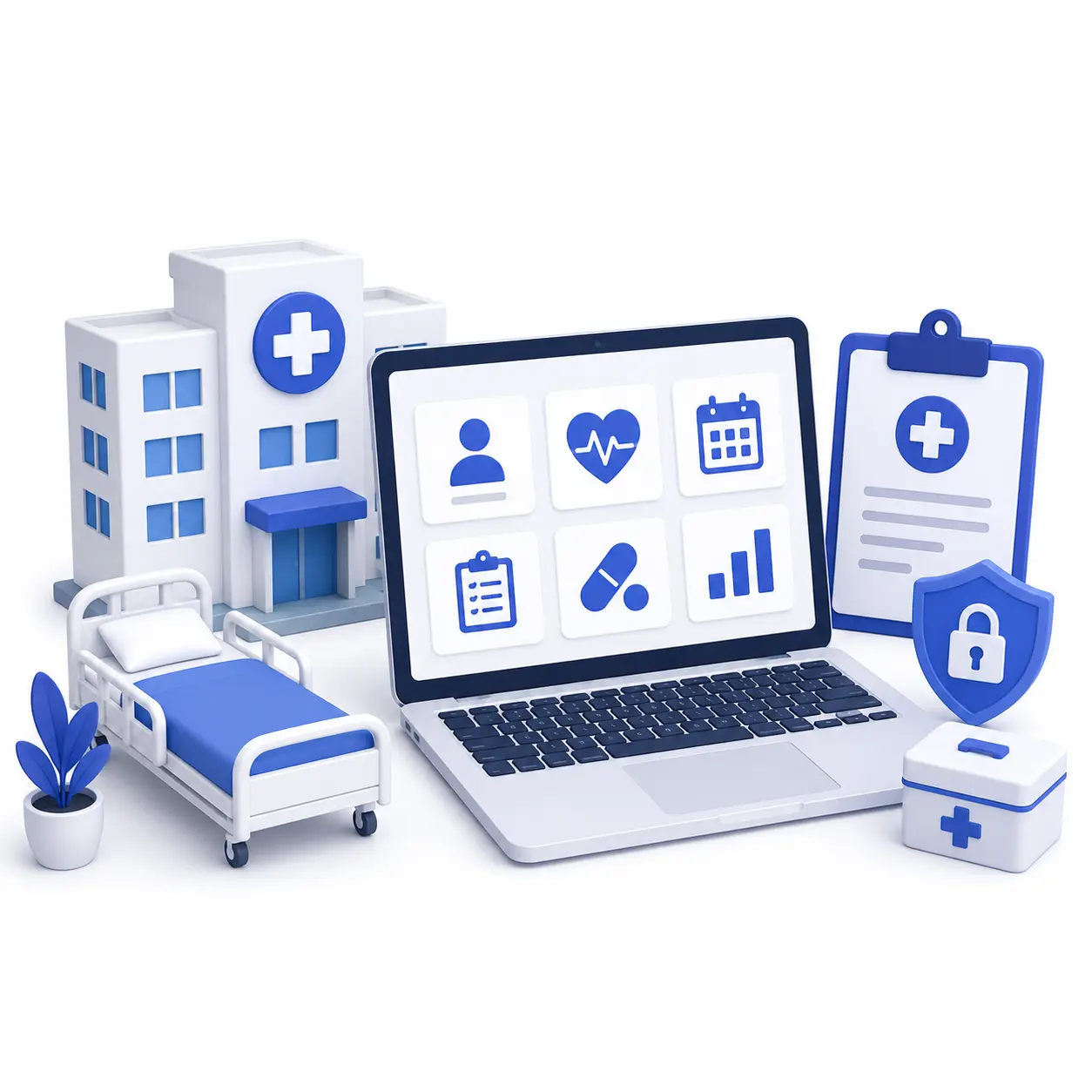
A hospital management system built for your facility means the OPD workflow matches how your front desk actually runs, the ward round captures what your doctors actually write, and the billing handles the combinations your payer mix actually creates - not a configuration of what the vendor assumed.
What we keep hearing before the first call
Common bottlenecks and operational breakdowns we encounter before modernizing the workflow.
The regulations that change what your HMS has to do
What goes into an HMS we build
OPD and appointment management
Appointment scheduling by doctor and department, OPD registration, consultation records, prescription. Queue management for high-volume OPDs.
IPD and ward management
Admission, bed allocation, transfer, clinical notes, nursing notes, diet orders, vital signs. Discharge summary generated from the record, not retyped.
Pharmacy and dispensing
Drug prescription to dispensing to patient, with expiry management, reorder alerts, controlled drug log, and return-to-stock. One record from doctor to patient.
Billing - cash, insurance, TPA, government
Each payer type in the same system with the correct format, GST treatment and reconciliation workflow. Revenue does not leave via the manual reconciliation spreadsheet.
Lab and radiology management
Test request from the consultation record, result entry, result delivery to the requesting doctor, with reference ranges and flagging. Integration with lab analysers where the analyser exposes an interface.
ABDM integration and digital health
ABHA ID creation and linking, health record sharing in PHR format, consent lifecycle management. Scoped as a named deliverable.
Hospitals we have built for
Lotus Hospital is a name we can use. We have also built HMS for a women's hospital and a multi-specialty hospital in Ahilyanagar, Maharashtra. A fourth client has asked not to be named at this time.
Across eight years: 730+ systems, 500+ clients worldwide, 25+ industry verticals. Healthcare is one of the three sectors we have gone deepest in.
Lotus Hospital
India
A women's hospital in Ahilyanagar, Maharashtra
India
A multi-specialty hospital in Ahilyanagar, Maharashtra
India
How the engagement works
A 30-minute call
You bring your billing complexity or your ABDM requirement. We tell you whether it is ready and whether we are the right team.
Discovery, then a fixed-scope proposal
We walk through your OPD, IPD, pharmacy and billing flows. Fixed scope, fixed price, a date you can hold us to.
Build, with weekly demos on your data
You see your payer types handled, your drug formulary loaded, your ward layout configured - from the first few sprints.
Implementation and go-live
Data migration, parallel running, staff training. We do not hand over and walk away.
Questions we get asked
For a single-facility core scope - OPD, IPD, ward management, pharmacy, billing - plan on a few months to first production use. Lab, radiology and advanced integrations extend the timeline. We give you a date after discovery, not a range from a brochure.
Yes. ABDM integration - including ABHA ID creation and linking, Health Facility Registry registration and PHR-compliant data sharing - is a buildable named module. We scope it explicitly and price it as a line item, not a Phase 2 aspiration.
Yes. GST-compliant billing with separate handling for cash, cashless insurance, TPA and government scheme patients, including the different receipt formats each requires. Insurance reconciliation is a module we scope if it is in scope - it is not assumed to be included.
Yes. Multi-facility setup with separate billing and pharmacy per branch, shared patient records and central management reporting. Each branch can have its own configuration where the clinical workflows differ.
The Digital Personal Data Protection Act 2023 requires a legal basis for processing personal data, data minimisation, purpose limitation and a clear process for responding to data principal rights. Health data in India does not yet carry a specific sector law at the standard of GDPR health data, but DPDP Act obligations apply. We configure consent capture at registration, data access logging, and the data deletion workflow as part of the core build rather than as an afterthought.
Controlled substances require a separate record trail: the purchase register, the issue register and the balance on hand. We build the narcotics module to the Narcotic Drugs and Psychotropic Substances Act requirements, with access restricted to named pharmacists and a complete audit log. If CDSCO inspection is a concern this is the part to scope explicitly.
Yes. Ward rounds, prescription writing, lab result review and discharge summaries can be done on a tablet or phone with an offline-capable app. The data syncs to the main system when the device is back on the hospital network.
You do. Repository access, documentation and a full handover are written into every contract from day one. You are not dependent on us staying in business.
Related pages
Homeopathy Clinic Management Software
Specialised clinic management for homeopathic practices - case taking, repertorisation, long-term patient records and follow-up.
Learn moreAI Readiness Audit
Two weeks, fixed scope. We review your systems and data and report where AI and automation would pay back in a clinical setting.
Learn moreReady to see this on your own workflow?
Book a 30-minute call. Bring the billing workflow that does not close cleanly, or the ABDM integration you have been asked to implement. We will tell you honestly whether we are the right team.
Working from Pune with hospitals, clinics and diagnostic centres across India.