
CRM Software in Dubai: When to Configure, and When to Build
Most UAE businesses should buy a CRM and configure it. A smaller number should have one built, because the deal itself is complicated and the product keeps losing the interesting part. We build custom systems and will still tell you which of the two you are.
- Built around your pipeline, your approvals and your commission rules, not configured against someone else's and then worked around
- Reverse-charge VAT and 0% UAE withholding tax, so the invoice costs you nothing beyond the price
- The price does not grow every time you hire a salesperson
30 minutes. We respond within one business day. Bring the deal that broke your current CRM.
Reviewed by Mr. Sumeet Katariya, Founder and Chief Executive Officer, Accucia Softwares Pvt. Ltd.
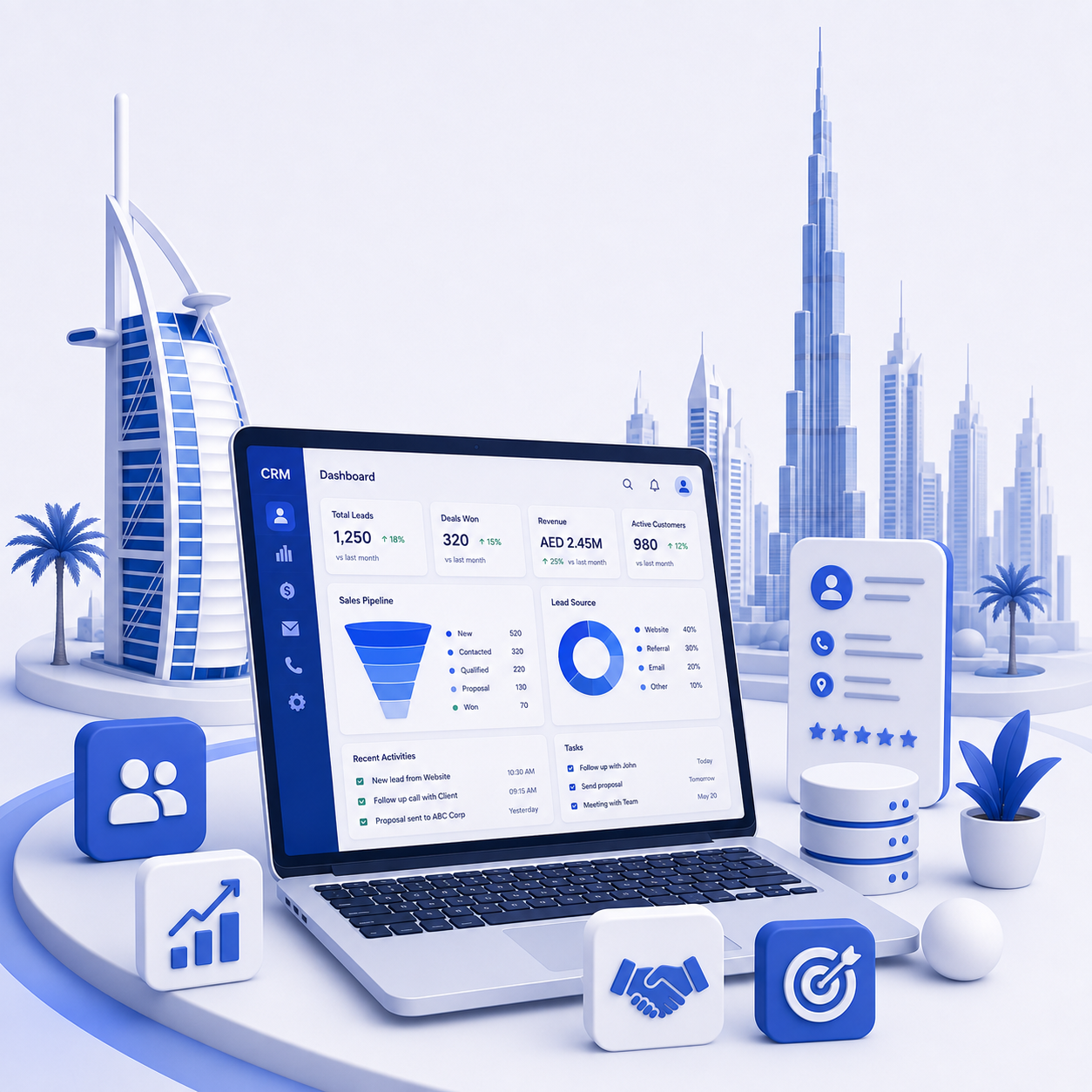
Custom CRM software is a sales and customer system built around one company's own pipeline, approvals and pricing rules, owned outright by that company, rather than a licensed product priced per user that the company adapts itself to fit.
Most companies do not need a custom CRM. If your sales process is a normal pipeline with normal stages, a licensed product is cheaper, faster and better supported, and we will tell you so. The case for a build appears when the deal itself is complicated: approvals that depend on margin, pricing that changes by customer and volume, or a handover into an operation that the CRM has to talk to. That is when a product starts costing you a spreadsheet.
What we keep hearing before the first call
The pipeline in the CRM is not the real pipeline
The real one lives in a sales manager's head and a spreadsheet updated on Sunday. The CRM holds whatever was tidy enough to enter, which is why the forecast is always a conversation rather than a report.
The quote leaves the system
Pricing needs an approval, a discount rule and a signature, so it gets built in a spreadsheet and emailed. Nothing that happens after that is in the CRM, including the version the customer actually accepted.
The bill grows with the team
Per-user pricing means every hire raises the subscription, and every module you needed later raised it again. You are paying more each year for a system your team routes around.
The three questions every UAE buyer asks a supplier outside the country
Most vendor sites leave these to the first call. We would rather answer them here.
7.5 hours of shared working day
What we build
Pipeline that matches how you sell
Your stages, your qualification rules, your handover points, including the branch that only happens on large deals.
Quote, discount and approval
Pricing rules, margin thresholds and approvals inside the system, so the accepted version is the one on the record.
Lead capture from every source
Website, WhatsApp Business API, campaigns and inbound calls, each carrying its source through to the closed deal so cost per customer is a report.
Commission and targets
Calculated by the system on your rules, reconciled once, read the same way by sales and finance.
Handover into operations
The point where a won deal becomes a job, a project or an order, connected to the system that does the work rather than emailed to it.
Reporting your managers will actually open
Forecast, activity and conversion by source, built for the three questions your leadership asks every week.
We build the system and then we put it into service
We have built lead management and sales systems where the difficult part was never the pipeline stages, which every product has. It was multi-source lead capture with attribution that survives to the closed deal, approval rules that reflect who is actually allowed to discount, and role-based visibility so a salesperson sees their book and a manager sees the branch.
Our operational systems run across the Gulf today: at EPIC ME Technical Works LLC in the United Arab Emirates, at Triolift in Saudi Arabia, and at Gulf Integrated Vertical Solutions in Bahrain. All three run ElevatorPlus, which we built and implement ourselves, and which is live with more than 2,000 users across 20+ countries.
Across eight years: 730+ systems shipped, 500+ clients worldwide, 25+ industry verticals.

EPIC ME Technical Works LLC
United Arab Emirates
Triolift
Saudi Arabia
Gulf Integrated Vertical Solutions
Bahrain
Licensed CRM or custom build? The honest version
We sell one of these two and we still think the licence is the right answer for most companies. Here is how to tell.
| Decision point | Licensed CRM | Custom build | Which fits you |
|---|---|---|---|
| How standard is your sales process | Close to standard, and you can adapt to the product | The complicated part of the deal is where you make your margin | If your team already keeps a parallel spreadsheet, that is your answer |
| Cost over five years | Per user per month, rising with headcount and modules | Build cost, then support. It does not scale with headcount | Model it at your headcount in year five, not year one |
| Time to first use | Days to weeks, then months of fitting | Weeks to months, fits on arrival | Weigh this against how long you can run two systems in parallel |
| Connection to the work after the sale | Through whatever integrations the vendor supports | Direct into the system that delivers the job | This is where most CRM value is actually lost |
For a straightforward pipeline under about ten salespeople, a licensed CRM is usually the better buy and we will say so on the call. The economics turn when headcount grows or the process stops being standard.
How the engagement works
A 30-minute call
Bring one deal that your current system handled badly. We tell you whether a build is justified.
Discovery, then a fixed-scope proposal
Named deliverables, a fixed price, a timeline you can hold us to.
Build, with weekly demos on your data
Your real pipeline, loaded early, so the awkward deals break things while it is cheap.
Migration and go-live
History moved across, a period of parallel running, training, then support under a named agreement.
Questions we get asked
It depends on scope. What moves the number is how many user roles, how complex your quoting and approval rules are, how many lead sources need attribution, what the system integrates with, and how much history migrates. We publish indicative ranges on our cost guide and give a fixed price after discovery, not before.
Probably, if your sales process is a standard pipeline and your team is small. A licence is cheaper and faster in that case and we will say so. The economics turn when per-user pricing grows with headcount, or when quoting, approvals and the handover into operations stop fitting the product.
Yes, through the WhatsApp Business API. Enquiries arriving on a business number become leads with the source attached, the conversation stays on the customer record, and templated follow-ups are sent from the system. That keeps the conversation with the company rather than on an individual salesperson's personal phone.
Usually yes, through a documented API or a scheduled exchange, depending on what your accounting product exposes. We confirm what is available during discovery and scope it as a named line item rather than leaving it inside a general heading called integrations, which is where integration budgets usually disappear.
For most commercial data, yes, under contractual safeguards including a data transfer agreement we provide with the proposal. If your project touches UAE health data, or banking or telecom data under those regulators' rules, the system runs in-country. We raise this during scoping rather than after the architecture is fixed.
No, for private-sector work. Nothing in UAE commercial contract law prevents a foreign supplier from contracting directly with a UAE private company, and we invoice you directly under the reverse-charge mechanism. Some government and semi-government procurement does require a UAE-licensed supplier, and we tell you when that applies.
You do. Repository access, a full database export, documentation and a handover are written into every contract. There is no per-user licence and no lock-in mechanism, because we would rather be kept for the quality of the work than for the cost of leaving.
Yes, and it is often the more valuable half. A won deal becomes a job, a project or an order, and most CRM value is lost at exactly that handover. We build both sides, which means the sale and the delivery read from the same record rather than from two systems that reconcile monthly.
Related pages
Gulf Hub
How we work with UAE companies - commercial mechanics, VAT, withholding tax, data residency.
Learn moreReal Estate CRM Dubai
If your CRM has to handle DLD registration, Oqood, RERA compliance and commission structures for property.
Learn moreERP Software UAE
If you need more than a CRM - production, inventory, procurement and costing alongside your sales pipeline.
Learn moreBring the deal your CRM handled badly
Book a 30-minute call. We will look at one real deal and tell you whether a licence would serve you better than a build. We say that more often than you would expect from a company that sells builds.
Book a callWorking from Pune with clients across India, the US, the UK, Europe, the Middle East, Australia and Southeast Asia.