The app your Dubai crew will actually use is the one that still works when the signal does not.
We build custom mobile apps for Dubai businesses, shipped under your own developer accounts, designed around the job your team does rather than the demo the agency already had built. Eight years, 730+ systems, delivered from our engineering centre in Pune.
- Offline first where the work happens offline, with a sync that survives a lift shaft, a basement car park and a site with no coverage
- Released under your Apple and Google developer accounts, so the app is yours on day one and on the day we part
- Reverse-charge VAT and 0% UAE withholding tax, so the invoice costs you nothing beyond the price
- A back office behind the app, because an app without a system behind it is a form that emails you
30 minutes. We respond within one business day. Bring the process the app is meant to replace, not a feature list.
Reviewed by Mr. Sumeet Katariya, Founder and Chief Executive Officer, Accucia Softwares Pvt. Ltd.
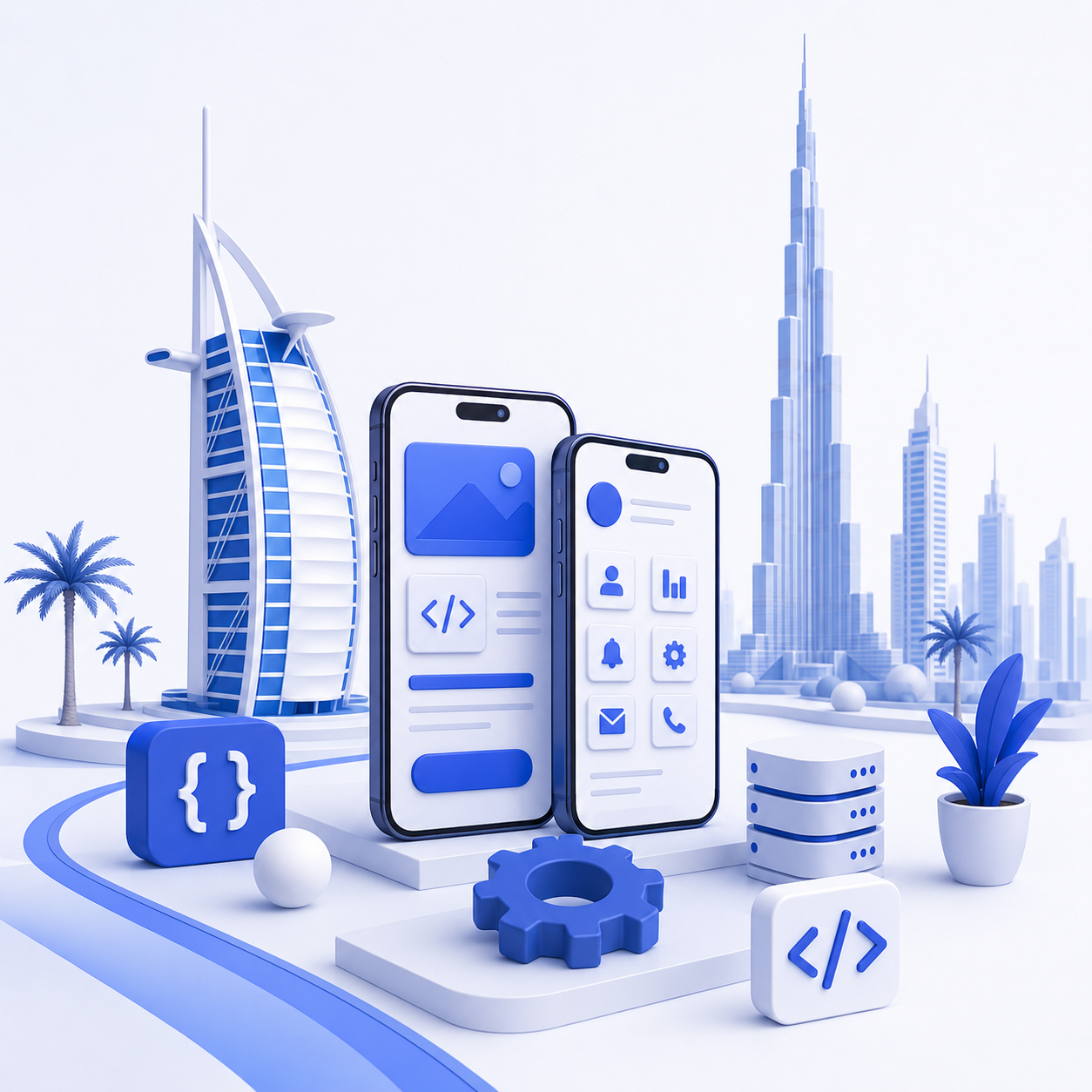
Custom mobile app development is the design, build and release of an application shaped around one company's own workflow and published under that company's own developer accounts, rather than a licensed product the company configures and rents.
The difference shows up in two places. It shows up on the store listing, where a custom app is published under your developer account and your name, so it does not disappear when a supplier relationship ends. And it shows up in the field, where a custom app is built for the conditions your team actually works in rather than for a boardroom with full coverage. Most app disappointment in this market traces back to one of those two things.
What we keep hearing before the first call
The app stops at the edge of the coverage
The app works in the office and fails at the site. The crew photographs the job on their own phones, sends it on WhatsApp, and someone types it into the system that evening. You bought an app and kept the paper.
Nobody at your company owns the app
The listing sits under the agency's developer account. The signing certificates are theirs. Changing supplier means republishing, losing the reviews, and asking every user to install something new. You are renting your own product.
It was a screen, not a system
The app captures data beautifully and then puts it somewhere nobody uses. There is no back office, no permissions model, no export your finance team trusts. Six months later the app is one more place the truth is kept.
The three questions every UAE buyer asks a supplier outside the country
Most vendor sites leave these to the first call. We would rather answer them here.
7.5 hours of shared working day
What we build
Offline first field capture
Jobs, checklists, photographs, signatures and meter readings captured with no connection and synced when signal returns, with conflict handling that does not silently overwrite the technician who was underground.
One codebase, both stores
Cross-platform where it saves you money and native where the hardware demands it, with the choice explained in the proposal rather than decided by what we happen to prefer.
The back office behind the app
Roles, approvals, dispatch, reporting and export. The app is the capture surface. The system is what makes the capture worth having.
Integrations that carry the workflow
WhatsApp Business API for notifications your customers will actually read, payment gateways, maps and routing, and your existing accounting or ERP system through a documented API.
Permissions and audit
Role-based access down to the field, a full audit trail on every action, and device level controls for shared handsets that pass from one shift to the next.
Release, store submission and the accounts
We publish under your Apple and Google developer accounts, hand over signing certificates and repository access, and document the release process so your next developer inherits a working pipeline.
The apps we are proudest of are the ones used in bad conditions
The test of a field app is not the demo. It is the third Thursday, when the technician is in a basement plant room with no coverage, running late, and decides in about two seconds whether to use the app or the notebook in his pocket. Everything we do on mobile is built around winning that two seconds.
ElevatorPlus is the clearest example. We built it as a full operating system for elevator companies, with a technician mobile app covering breakdown dispatch, job checklists, parts used, customer signature and statutory inspection records. Lift shafts and basement machine rooms are among the worst signal environments in any building, which is why the app was designed to work offline and reconcile afterwards. It is live with more than 2,000 users across 20+ countries.
In the Middle East it runs today at EPIC ME Technical Works LLC in the United Arab Emirates, at Triolift in Saudi Arabia, and at Gulf Integrated Vertical Solutions in Bahrain. Three named companies across three GCC states, on a system built in Pune and implemented remotely.

EPIC ME Technical Works LLC
United Arab Emirates
Triolift
Saudi Arabia
Gulf Integrated Vertical Solutions
Bahrain
App builder, off the shelf, or custom? The honest version
Most vendors answer this according to what they sell. These four questions decide it in practice.
| Decision point | No-code app builder | Off-the-shelf app | Custom build |
|---|---|---|---|
| Works without a connection | Rarely, and usually read only | Depends entirely on the product, and it is the first thing to test | Designed for it from the first sprint when the work happens offline |
| Who owns the store listing | The platform, under its own account in most cases | The vendor | You, under your own Apple and Google developer accounts |
| What happens at 200 users | Per-seat pricing becomes the largest line in the budget | Per-seat pricing, plus modules you did not want | Support cost, which does not scale with headcount |
| Fit to a non-standard process | You reshape the process to the builder | You reshape the process, then pay for customisation | The process is the specification |
There is no universally right answer. If your workflow is close to standard, a licensed product is often the better buy and we will say so on the call rather than sell you a build you do not need.
How the engagement works
A 30-minute call
You bring the process the app is meant to carry. We tell you whether it is ready, and whether we are the right team. A fair share of these calls end with us saying no.
Discovery, then a fixed-scope proposal
Screens listed, integrations named, a fixed price and a timeline you can hold us to. Discovery is the cheapest part of the project and skipping it is how apps end up rebuilt.
Build, with a working build on your device every week
Not a slide, an install. Your team uses it in the conditions it is meant for, and the awkward cases surface while they are still cheap to fix.
Store release and support
Submission under your accounts, rollout, training, then support under a named agreement with a response time written into it.
Questions we get asked
It depends on scope, and any vendor quoting from a feature list is guessing. What drives the number is the count of user roles, whether the app has to work offline, how many systems it integrates with, whether both platforms launch together, and how much back office sits behind it. We publish indicative ranges on our cost guide and give a fixed price after discovery.
A single-platform app with one or two user roles and a modest back office typically reaches first production use in a few months. Offline sync, multiple roles, hardware integration and a second platform each extend that. We give a dated plan after discovery rather than a number that sounds good in a proposal.
You do. We publish under your Apple Developer and Google Play accounts, not ours, and we hand over signing certificates, repository access and documentation at the end of the project. If you do not have developer accounts yet we help you open them in your company name, which takes a few days and is worth doing before build starts.
Yes, where the work needs it. Records, checklists, photographs and signatures are captured and stored on the device, then reconciled with the server when the connection returns, with rules for what happens when two people changed the same record. We build this whenever the job happens in basements, plant rooms, sites or vehicles.
Both. We recommend cross-platform when it saves money without costing capability, and native when the app depends on hardware, background behaviour or performance that cross-platform handles poorly. The recommendation and the reason for it are written into the proposal, so you are not taking it on trust.
For most operational data, yes, under contractual safeguards including a data transfer agreement we provide and attach to the proposal. If your app touches UAE health data, or banking or telecom data under those regulators' rules, it is built to run in-country. We raise this during scoping rather than after the architecture is fixed.
No, for private-sector work. Nothing in UAE commercial contract law prevents a foreign supplier from contracting directly with a UAE private company, and we invoice you directly under the reverse-charge mechanism. Some government and semi-government procurement does require a UAE-licensed supplier, and we tell you when that applies to your project.
Support under a named agreement, with a response time written into it and a named engineer rather than a shared inbox. That covers operating system updates, store policy changes, defects and small enhancements. Larger changes are quoted separately so you always know which budget a piece of work is coming from.
Related pages
Gulf Hub
How we work with UAE companies - commercial mechanics, VAT, withholding tax, data residency.
Learn moreERP Software UAE
If the app needs a system behind it - production, inventory, procurement and costing alongside field capture.
Learn moreCRM Software Dubai
Custom CRM for Dubai companies whose sales process does not fit a licensed product.
Learn moreReady to see this against your own field process?
Book a 30-minute call. We will walk one of your processes end to end, tell you which parts belong on a phone and which do not, and say honestly whether a custom build is the right answer for it.
Book a callWorking from Pune with clients across India, the US, the UK, Europe, the Middle East, Australia and Southeast Asia.