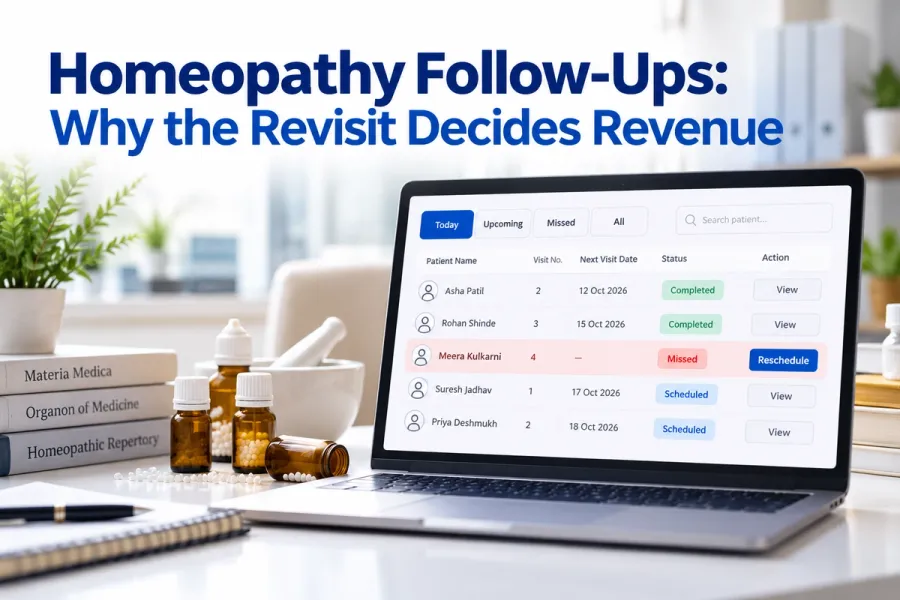
Homeopathy Software: What a Multi-Branch Clinic Needs
Quick Answer
Homeopathy software has to carry a patient record that grows for years, follow the patient between branches, and chase the revisit that chronic care depends on. That means one shared record, a receptionist dashboard, a doctor dashboard with missed appointments, and reports by scheme, city, branch and disease. A booking app does none of this. By Mr. Sumeet Katariya, Accucia Softwares Pvt. Ltd.
Why homeopathy does not fit generic clinic software
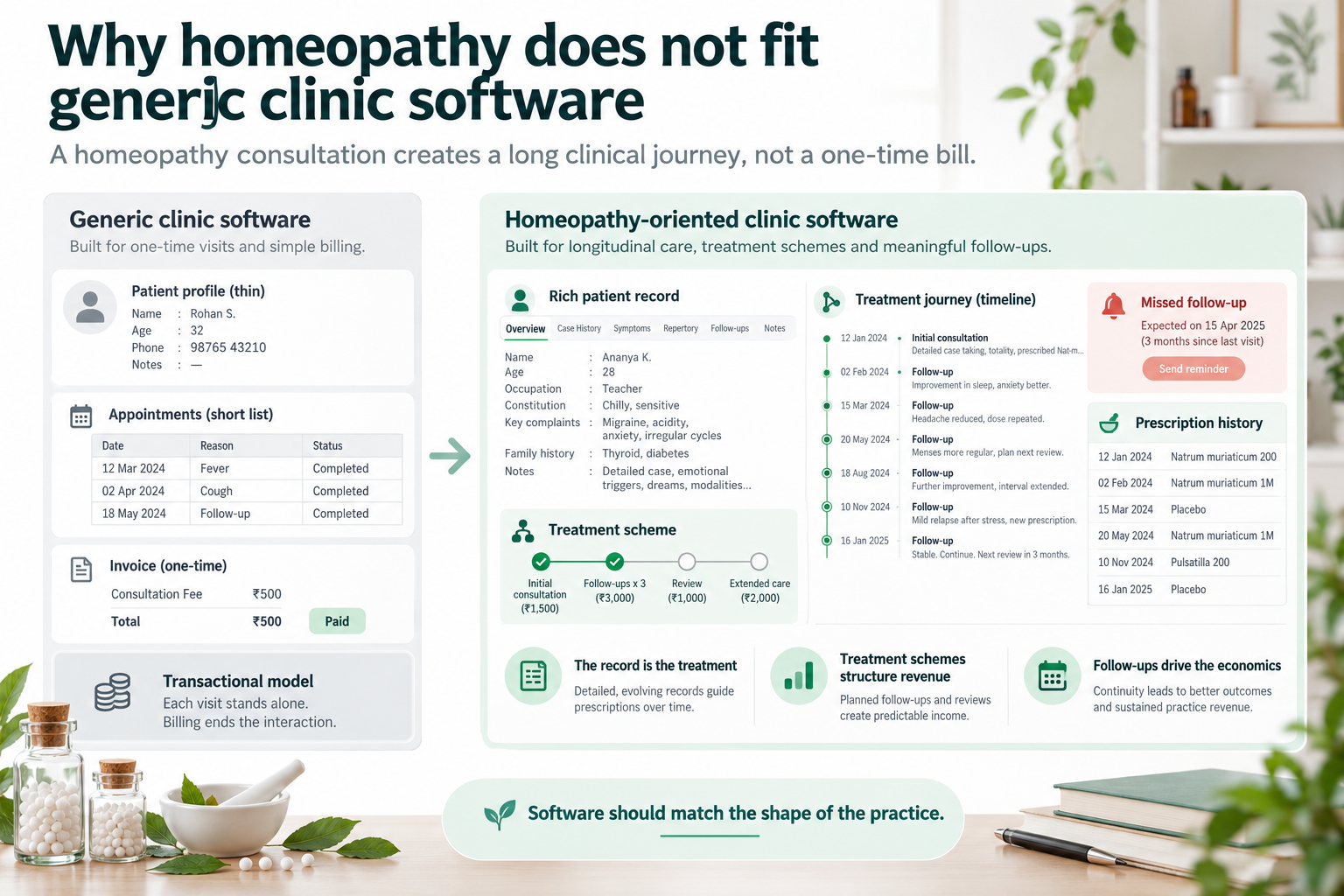
A homeopathy consultation produces a record that keeps growing for years. Most clinic software treats it like a one-time bill.
That single mismatch explains most of the frustration owner-doctors describe when they try generic clinic tools. The generic tool assumes a transaction: patient arrives, gets seen, pays, leaves, and the record is essentially a receipt with a name on it. Homeopathy does not work that way. Treatment runs in long arcs. A chronic case can span dozens of visits, and the doctor's decision at visit ten depends on what was recorded at visits one through nine.
Three features of homeopathy practice put particular strain on generic software:
The record is the treatment. Case taking in homeopathy is detailed, and the prescription history matters at every subsequent visit. Software that stores a thin profile and a billing trail loses exactly the information the doctor needs most.
Treatment schemes structure the revenue. Many practices organise care into schemes with planned durations and planned revisits. A generic tool has nowhere to put a scheme, so it cannot report on one either. The owner ends up tracking the commercial heart of the practice in a side spreadsheet.
Follow-ups drive the economics. In chronic care, the practice earns on the revisit, and a missed follow-up is both a clinical gap and lost revenue. Generic booking tools record appointments that happened. They are usually silent about the ones that did not.
None of this makes homeopathy exotic. It makes it a speciality with a specific shape, and software either matches that shape or fights it. We go deeper on the fit on our homeopathy clinic software page.
The multi-branch problem: the history has to travel
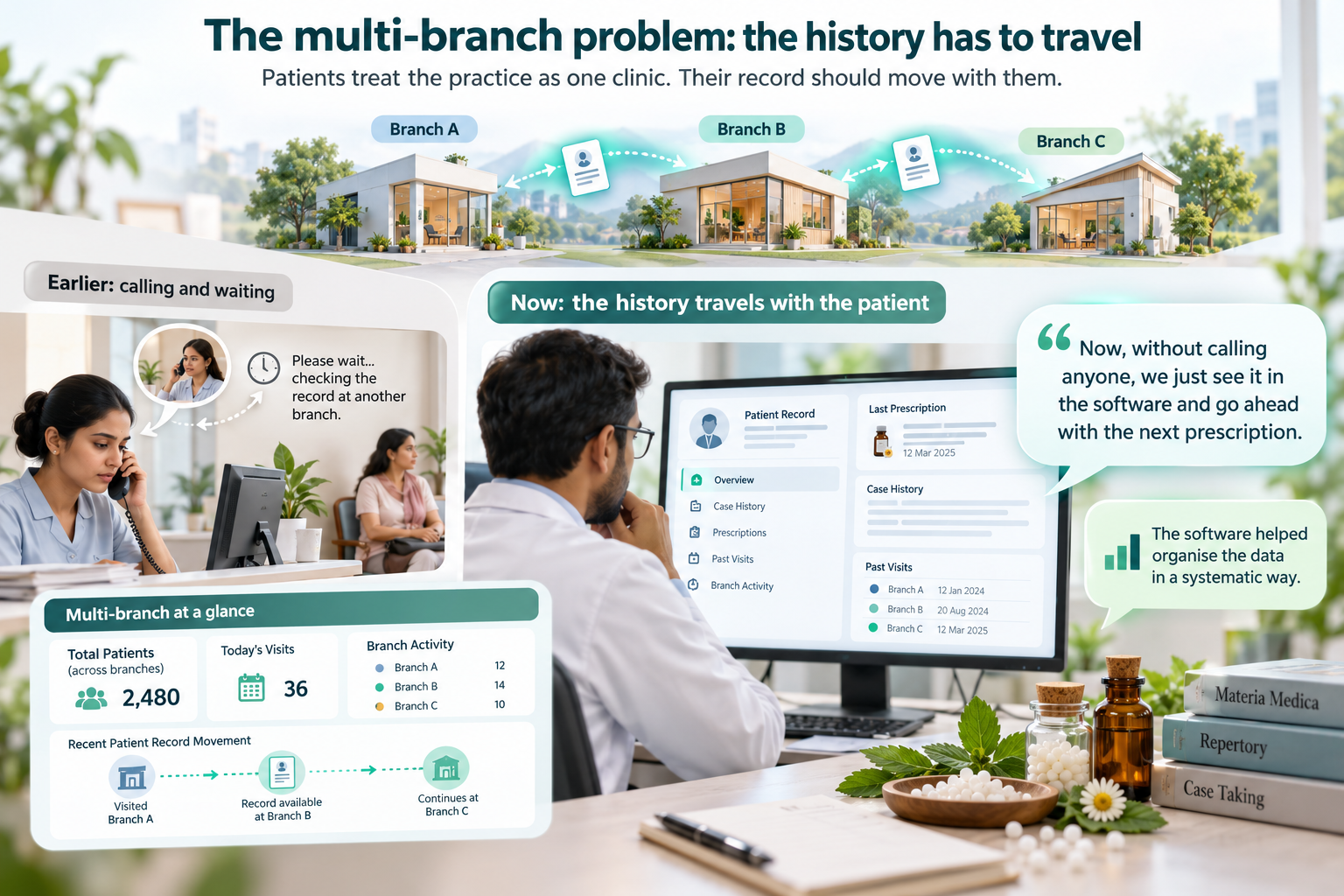
Now add a second branch, then a third. Patients treat the practice as one clinic and go wherever is convenient this week. The paperwork does not travel with them, and suddenly reception is on the phone to another branch asking what was prescribed last time while a patient waits.
We did not learn this from market research. We learned it inside Dr. Tathed's Homeopathy And Healing Center, a 25+ year practice in Pune running three branches, where the clinic operating system we now offer was originally built. Dr. Pratik Jain, Chief Homoeopath there, puts the before and after better than any feature list:
"Patients can go from one branch to another. Earlier we had to call and find out what the last prescription was. Now, without calling anyone, we just see it in the software and go ahead with the next prescription."
Read that again as a buying checklist. The test of multi-branch homeopathy software is one question: can a doctor at any branch open the full record, including the last prescription, without calling anyone? If the answer is no, the product is a collection of single-branch tools wearing one logo.
And the coordination cost is not only clinical. As Dr. Jain describes the management side: "We are running three branches, so it was very difficult to manage and coordinate with all the teams. What this software has really helped is to organise the data in a systematic way."
The full story of that build is on our Dr. Tathed's case study page.
What to look for, module by module
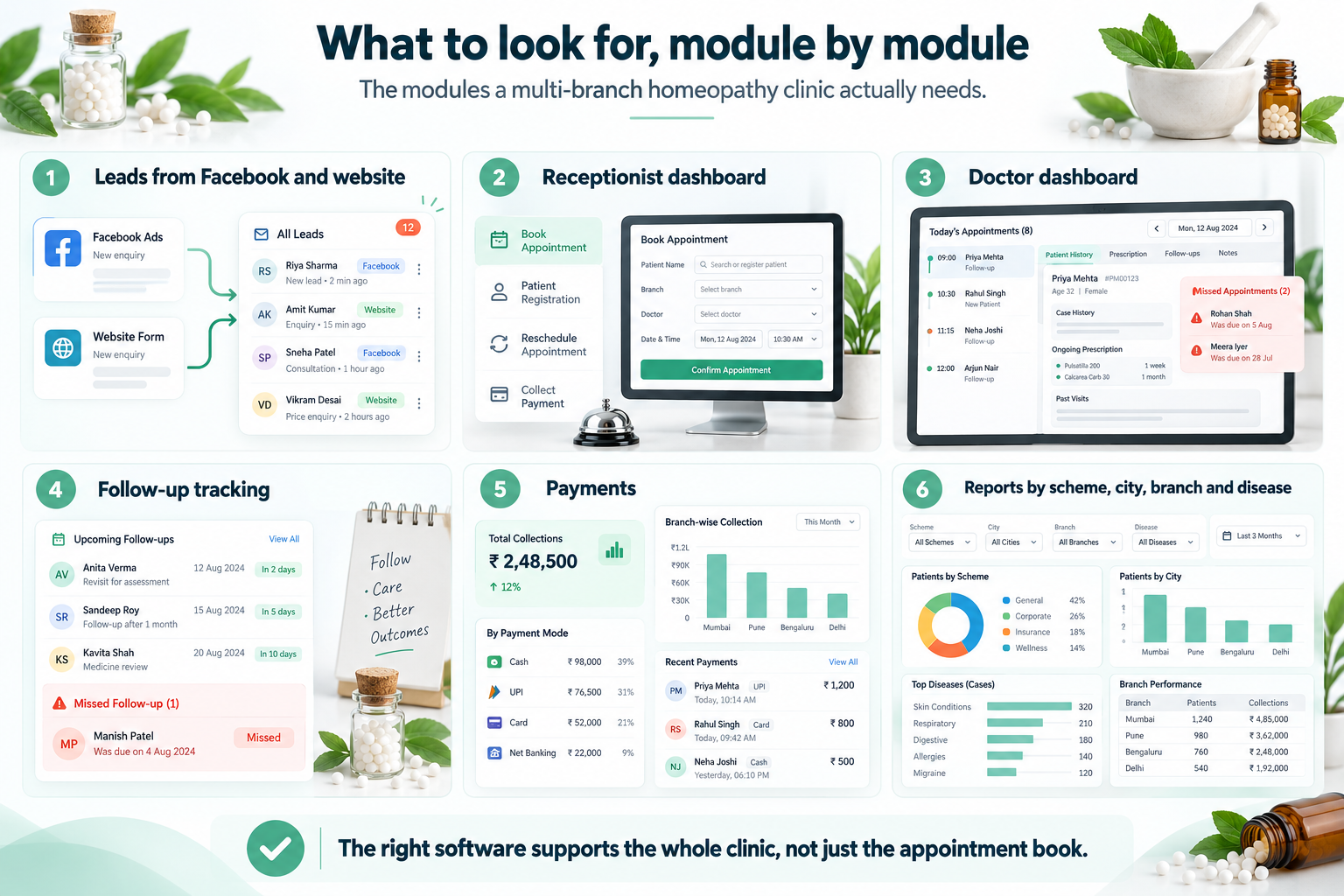
Here is the module list we would hold any homeopathy software against. It mirrors the system running live at the practice above, so every line has been tested by an actual reception queue.
Leads from Facebook and the website. Enquiries are the top of the practice funnel, and most clinics lose them in a phone inbox. The software should capture leads from Facebook campaigns and website forms directly, so reception works the list inside the same system that books the first appointment. A lead that has to be retyped is a lead that sometimes is not.
Receptionist dashboard. Registration, appointment booking, rescheduling and payment collection at the desk, fast enough for a busy morning. The receptionist is the heaviest user in the building. If the desk workflow is clumsy, the whole system fails regardless of what else it does.
Doctor dashboard. Today's appointments, each patient's complete history across branches, and two things generic tools skip: missed appointments surfaced where the doctor sees them, and rescheduling handled without a walk to the desk. The doctor should also see medication history at a glance, because in homeopathy the prescription thread is the case.
Follow-up tracking. Planned revisits recorded against the treatment, and missed ones flagged rather than silently absent. This is where the revenue protection lives.
Payments. Collections recorded where they happen, at any branch, visible centrally without a day-end phone round.
Reports by scheme, city, branch and disease. This is the owner-doctor's layer. Which schemes are patients on? Which branch is growing? Where do patients come from? Which conditions dominate the caseload? A practice that can answer these from a dashboard makes different, better decisions than one that answers them from memory.
The delivery shape matters too: a web dashboard for the desk and management, with a mobile app so the owner's view is not chained to a desk. This clinic work sits within the wider healthcare software portfolio we have built.
Configured to the practice, not the other way around
Every established practice has habits that are older than any software vendor. The scheme names, the way case papers are organised, who is allowed to see what. Software that arrives with a rigid workflow asks a 25+ year practice to behave like a startup, and the practice, reasonably, refuses.
The build at Dr. Tathed's went the other way. The system was shaped around the practice's own way of working, and kept being shaped as the practice asked for changes. Dr. Jain again: "The team has always been very cooperative to our changes. They customised it as per our liking."
An operator note from our side of that relationship: the customisation requests that matter are rarely glamorous. A field renamed to match what staff actually call it. A report cut the way the owner reads it on Sunday evening. Small changes, but they decide whether staff adopt the system or quietly keep the paper register going underneath it. Ask any vendor how change requests are handled after go-live, and listen carefully to the answer.
For practices in Pune, PCMC, Mumbai MMR, Nashik and Nagpur
We are rolling this out practice by practice, starting close to home. Accucia is a Pune company, and the first phase covers Pune, PCMC, Mumbai MMR, Nashik and Nagpur. That is deliberate. A clinic system touches reception, doctors and accounts, and the setup conversations go better when we can sit in the clinic, watch the morning rush, and configure against what we see rather than what a form says.
If your practice runs in one of these cities and more than one branch, you are exactly who this was built for. If you are elsewhere in Maharashtra, talk to us anyway and we will tell you honestly where you sit in the rollout.
Accucia's view
Homeopathy software succeeds or fails on one design decision: whether the patient record is treated as a living clinical document that follows the patient everywhere, or as a billing entry with a name attached. Everything else, dashboards, schemes, reports, hangs off that choice. We built on the first assumption inside a working three-branch practice, and we would not trust any system for chronic care that was built on the second.
If you run a homeopathy practice and want to see this working on real workflows, message us on WhatsApp and we will walk you through it.
FAQ
What should homeopathy software do that generic clinic software does not?
It should carry a detailed case record that grows across years and visits, organise treatment into schemes, track planned revisits and flag missed ones, and report by scheme, branch, city and disease. Generic clinic software is built around bookings and bills, so it stores a thin profile and loses the treatment thread.
How does multi-branch homeopathy software keep patient history together?
All branches work on one shared patient record in the same system. When a patient visits a different branch, the doctor there opens the same case, sees every past consultation and the last prescription, and continues treatment without phoning another branch. Reports combine all branches, so owners see the whole practice at once.
Can clinic software capture leads from Facebook and the website?
Yes, and in a growing practice it should. Enquiries from Facebook campaigns and website forms land directly in the receptionist's dashboard, where they are followed up and converted into first appointments inside the same system. Without this, leads sit in inboxes and phones, and nobody can say how many became patients.
What does the doctor see in a doctor dashboard?
Today's appointment list, each patient's complete history across branches, prescription and medication records, missed appointments that need attention, and rescheduling tools. The point is that the doctor walks into every consultation with the full case in front of them, including visits that happened at other branches of the practice.
Which cities does Accucia currently serve for homeopathy clinic software?
The first phase covers Pune, PCMC, Mumbai MMR, Nashik and Nagpur. Accucia is based in Pune, and early rollouts are kept close enough for the team to configure the system inside the clinic against real workflows. Practices elsewhere in Maharashtra can still start a conversation about timing.
Grow Your Homeopathy Clinic with RevisitPlus. Book a Demo Today!