Homeopathy Follow-Ups: Why the Revisit Decides Revenue
Quick Answer
In homeopathy, treatment runs across many visits, so the practice's revenue and the patient's outcome both depend on the revisit actually happening. Follow-ups leak through paper registers and per-branch apps that never show who missed an appointment. A doctor dashboard that surfaces missed appointments and handles rescheduling closes the leak. By Mr. Sumeet Katariya, Accucia Softwares Pvt. Ltd.
The economics of the revisit in chronic care
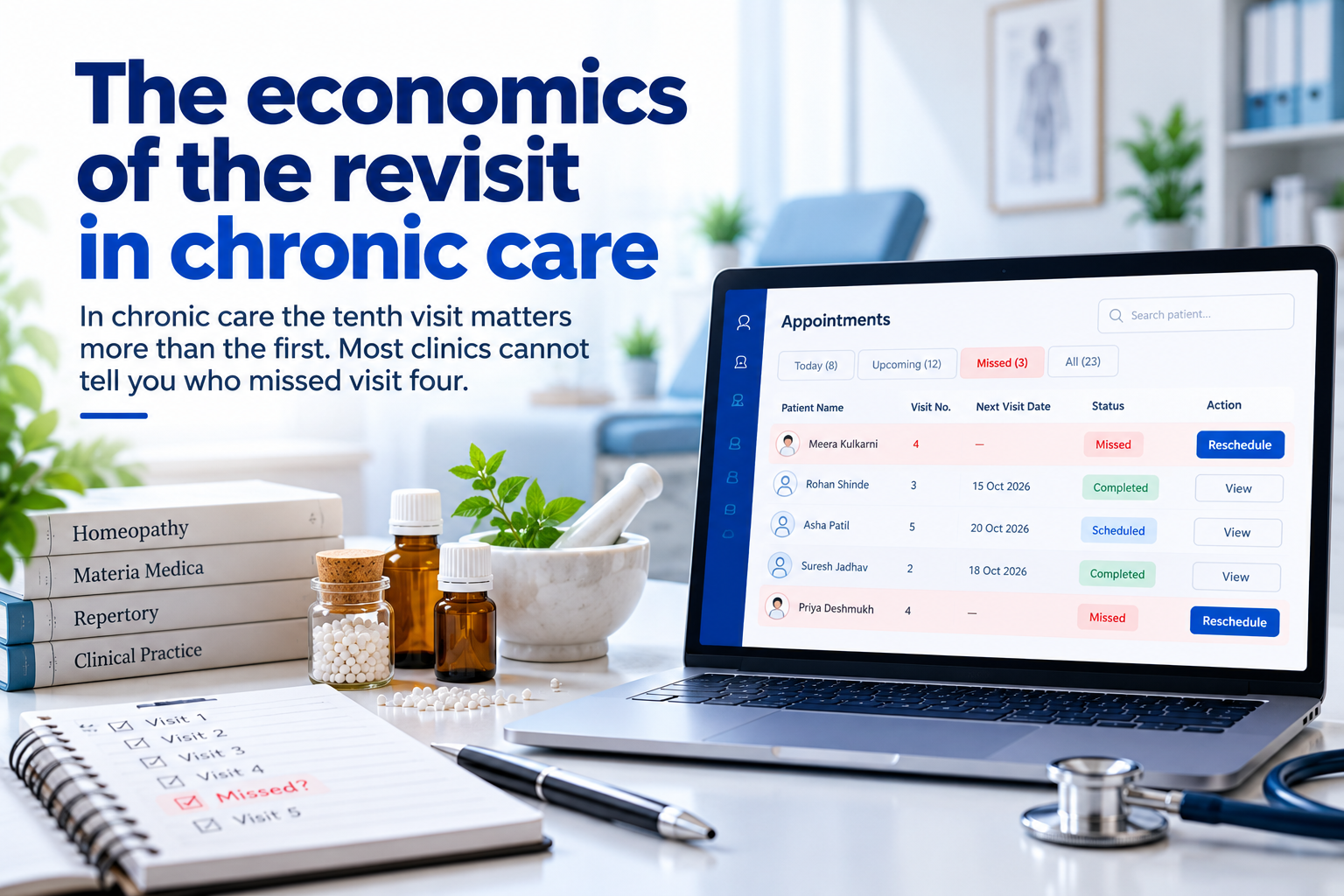
In chronic care the tenth visit matters more than the first. Most clinics cannot tell you who missed visit four.
That is the whole argument of this piece, so let me unpack it slowly. Homeopathy treatment is built around long arcs. A patient starts a treatment scheme, and the scheme assumes a sequence of visits: assessment, adjustment, continuation. The clinical logic depends on the sequence, because each prescription responds to what the previous one did. The commercial logic depends on it too. A practice built on schemes earns as treatment continues, visit after visit, not in one transaction at the front door.
Now look at where most practices spend their attention: the first visit. Marketing brings new patients in, reception registers them, everyone celebrates a busy waiting room. But the new patient is the most expensive patient the practice will ever serve, because acquiring them cost effort and the relationship has produced exactly one visit. The patient on visit nine of a scheme is the practice working as designed.
Which means a missed follow-up is a quiet double loss. Clinically, the treatment arc breaks. Commercially, the revenue the scheme assumed simply does not arrive. And unlike a slow month at the front desk, nobody sees it happen. A patient who stops coming does not announce it. They just become a gap in a register that nobody reads backwards.
No invented statistics here, deliberately. You do not need a percentage to act on this. You need one honest question: can your practice, today, produce the list of patients who missed a planned revisit this week? If the answer involves flipping through registers, the rest of this article is for you.
Where follow-ups leak
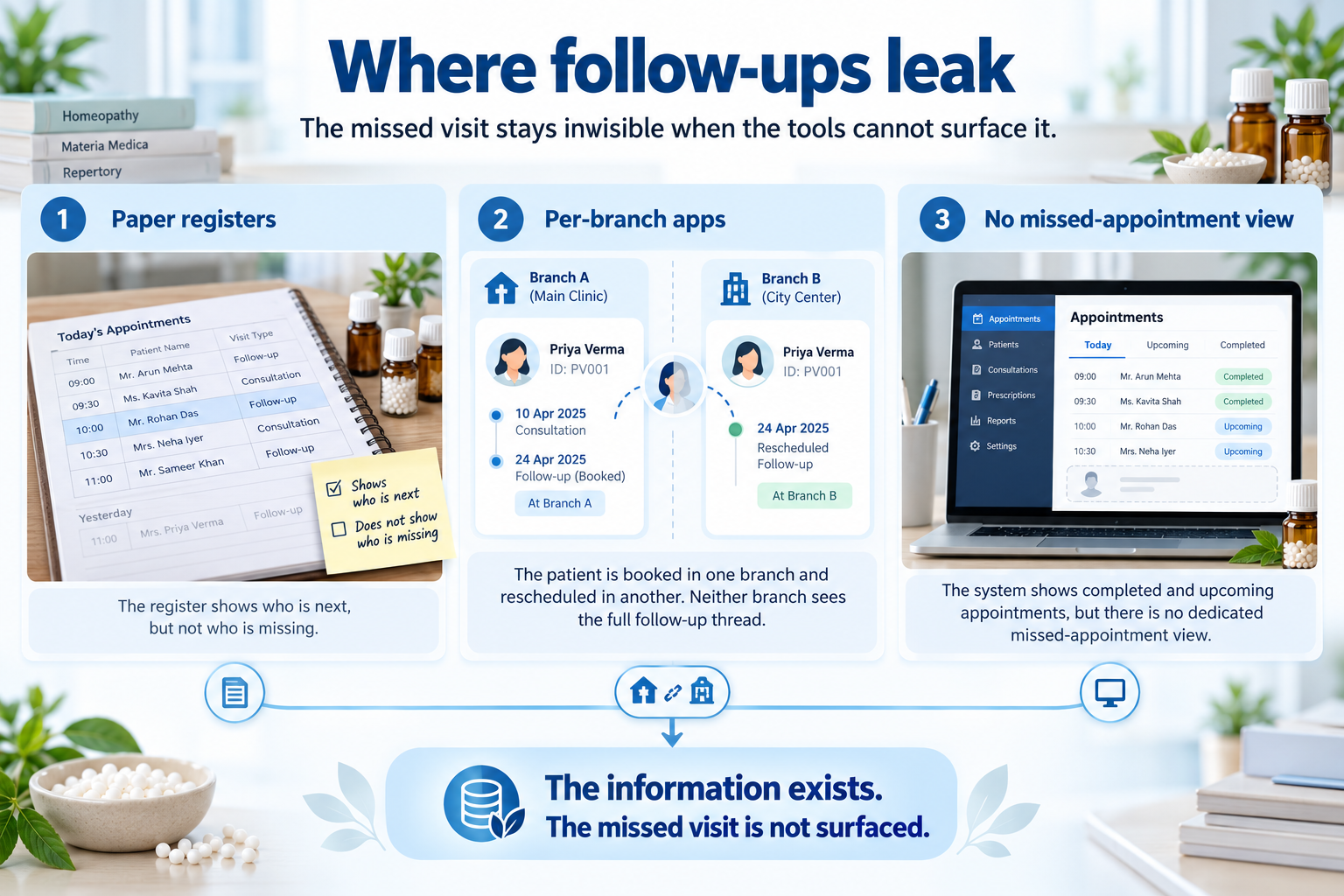
Follow-ups do not leak because staff are careless. They leak because the tools make the missed visit invisible. Three leak points come up in almost every practice we sit with:
Paper registers. The appointment diary records who is expected today. It has no view of who was expected yesterday and did not come. Reading a register backwards to find no-shows is real work, so it happens rarely, usually when someone already suspects a problem. The register answers "who is next" and stays silent on "who is missing."
Per-branch apps. A practice with two or three branches often runs a separate booking tool, or a separate copy of the same tool, at each one. A patient booked at one branch and rescheduled at another exists twice, as two half-records. Neither branch sees the full thread, so neither branch notices when the thread stops. Multi-branch practices in Pune, PCMC, Mumbai MMR, Nashik and Nagpur, the belt where we are rolling out first, run into this one constantly.
No missed-appointment view anywhere. Even where software exists, most clinic tools treat an appointment as something that either happened or silently expired. There is no screen where missed appointments accumulate and demand action. What no screen shows, no one owns. The follow-up call that would have taken two minutes never gets assigned, because the need for it was never visible.
Notice what all three have in common. The information technically exists, in the register, in the booking tool, somewhere. What is missing is the surfacing: the system's willingness to push the missed visit in front of a person whose job is to act on it.
What tracking looks like when it works
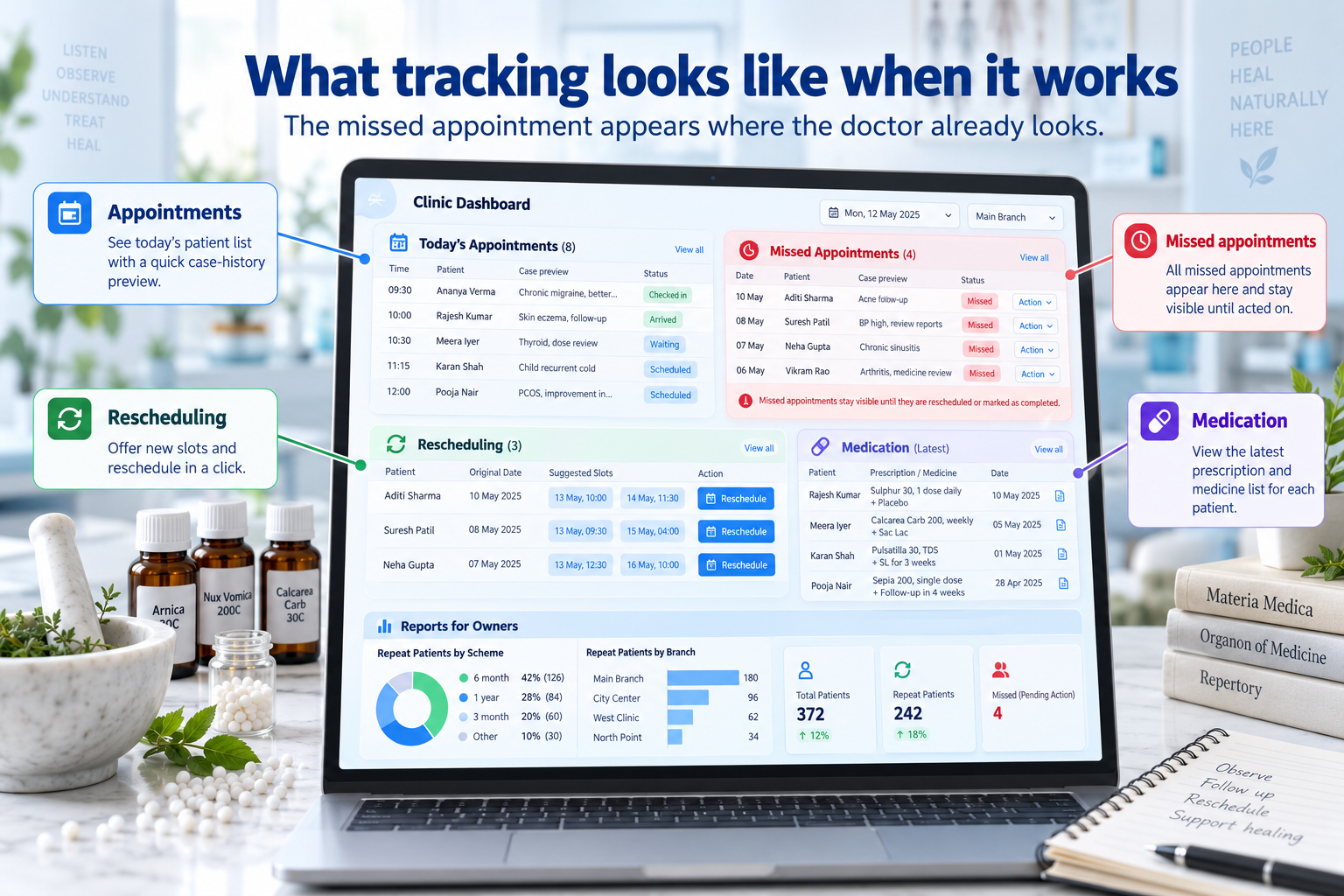
The system we built for homeopathy practice runs follow-up through the doctor dashboard, and the design choice matters: the missed appointment appears where the doctor already looks, not in a report someone might run at month-end.
Concretely, the dashboard carries four things:
Appointments. Today's list, each patient opening to the full case history, so the revisit is a continuation rather than a re-asking.
Missed appointments. The patients who were due and did not come, sitting in view until acted on. This single screen is the difference between follow-up as a system and follow-up as a hope. The missed visit stops being an absence and becomes an item.
Rescheduling. A missed visit usually needs a new slot, not a shrug. Rescheduling happens in the same view, in moments, so the fix is as visible as the problem.
Medication. The prescription thread alongside, because when the patient does return, the doctor continues treatment from the record rather than from memory.
Above the daily workflow sits the reporting layer: repeat-patient reports cut by scheme and by branch. The owner sees which schemes hold their patients, which branch's follow-ups are drifting, and whether the leak is closing, without any register archaeology. We detail the full module set on our homeopathy clinic software page.
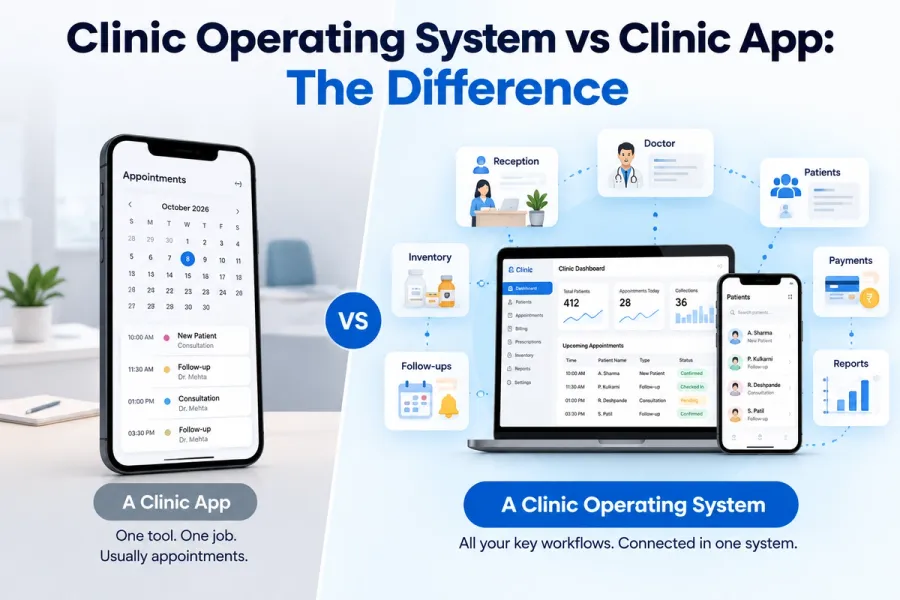
None of this was designed in a conference room. It took shape inside the clinic operating system built at Dr. Tathed's, a working multi-branch homeopathy practice, where "who missed visit four" was a daily operational question long before it was a software feature. It now sits within our broader healthcare software work.
A small operator aside: the first week a practice turns on a missed-appointment view is usually uncomfortable. The backlog that was invisible becomes a list, and the list is longer than anyone guessed. Push through it. The list shrinks fast once someone owns it, and the discomfort was always there, just unmeasured.
The owner-doctor's day-end question, answered without phone calls
Every owner-doctor we work with runs some version of the same evening ritual: how did the practice do today? In a multi-branch practice without a shared system, answering that means phone calls. Call each branch, ask for appointments, collections, no-shows, write it all on a pad, hope nothing was missed, repeat tomorrow.
With follow-up and appointments running through one system, the ritual collapses into a glance. Appointments by branch, who came, who missed, what was rescheduled, how the schemes are holding, on one screen, from a web dashboard at the desk or the mobile app from anywhere. The phone round disappears, and something subtler changes too: the owner starts asking better questions. Not "what were today's numbers" but "why does one branch hold its revisits better than another," which is a question that actually improves the practice.
That shift, from collecting numbers to reading them, is what the follow-up system ultimately buys. The revisit stops being something the practice hopes for and becomes something it manages.
Accucia's view
Follow-up is the revenue system of a homeopathy practice, and any clinic software that lacks a missed-appointment view is ignoring the speciality's economics regardless of what else it offers. The fix is not reminders bolted onto a booking app. It is the missed visit surfaced, daily, in front of the doctor, with rescheduling one tap away and scheme-wise reports above it. We built exactly that inside a working practice, and the day-end phone call is the first thing it kills.
If your practice cannot name this week's missed revisits in under a minute, message us on WhatsApp and we will show you the dashboard that can.
FAQ
Why do follow-ups matter more in homeopathy than in other practices?
Homeopathy treatment runs across long arcs of visits organised into schemes, and each prescription builds on the last. The practice earns as treatment continues, so a missed revisit breaks both the clinical sequence and the expected revenue. Single-visit specialities lose less when a patient fails to return.
How does a doctor dashboard reduce missed appointments?
It makes them visible where the doctor already works. Patients who were due and did not come appear on a missed-appointments view, stay there until acted on, and can be rescheduled in the same screen. Repeat-patient reports by scheme and branch then show owners whether the leak is actually closing.
Can follow-up tracking work across multiple clinic branches?
Yes, provided every branch runs on one shared system rather than separate apps. A patient booked at one branch and rescheduled at another stays one record, so the full visit thread is visible everywhere. Owners see follow-up performance for all branches together instead of phoning each one at day end.
Never Miss a Follow-Up. Book Your RevisitPlus Demo Today!