
Clinic Operating System vs Clinic App: The Difference
Quick Answer
A clinic operating system runs the whole practice on one shared patient record: enquiries, reception, doctor consultations, follow-ups, payments and management reports, across every branch, through a web dashboard and a mobile app. A clinic app covers one task, usually appointment booking. A practice with two or more branches needs the operating system. By Mr. Sumeet Katariya, Accucia Softwares Pvt. Ltd.
What a clinic app covers and where it stops
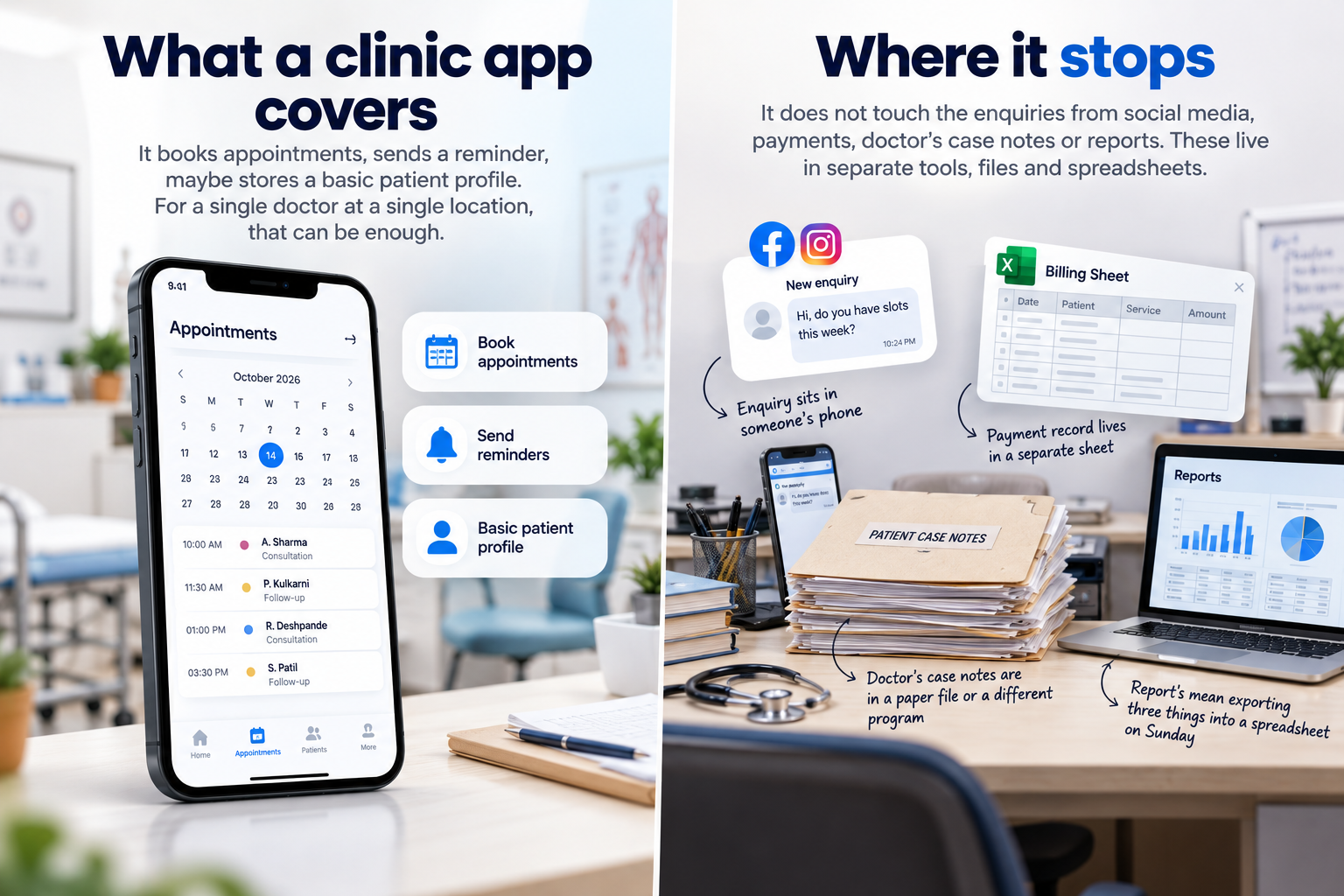
Most clinic software sold today is an app. It books appointments, sends a reminder, maybe stores a basic patient profile. For a single doctor at a single location, that can be enough. The queue moves, the diary fills, nobody complains.
Look at what the app does not touch, though. The enquiry that came in from Facebook last night sits in someone's phone. The payment record lives in a separate billing sheet. The doctor's case notes are in a paper file or a different program. Reports, if they exist at all, mean someone exporting three things into a spreadsheet on Sunday.
None of this hurts much at one branch, because one reception desk can hold the whole picture in its head. The receptionist knows the regulars. The owner can walk the floor and feel how the day went. The app is a diary, and a diary is fine when the practice fits in one room's line of sight.
The stopping point is structural. An appointment app is built around a calendar. A practice is built around a patient record that grows for years, touches reception, the doctor, the pharmacy counter and the accounts book, and increasingly spans more than one address. Those are different shapes of software, and no amount of add-ons turns the first shape into the second.
What breaks at branch two and three
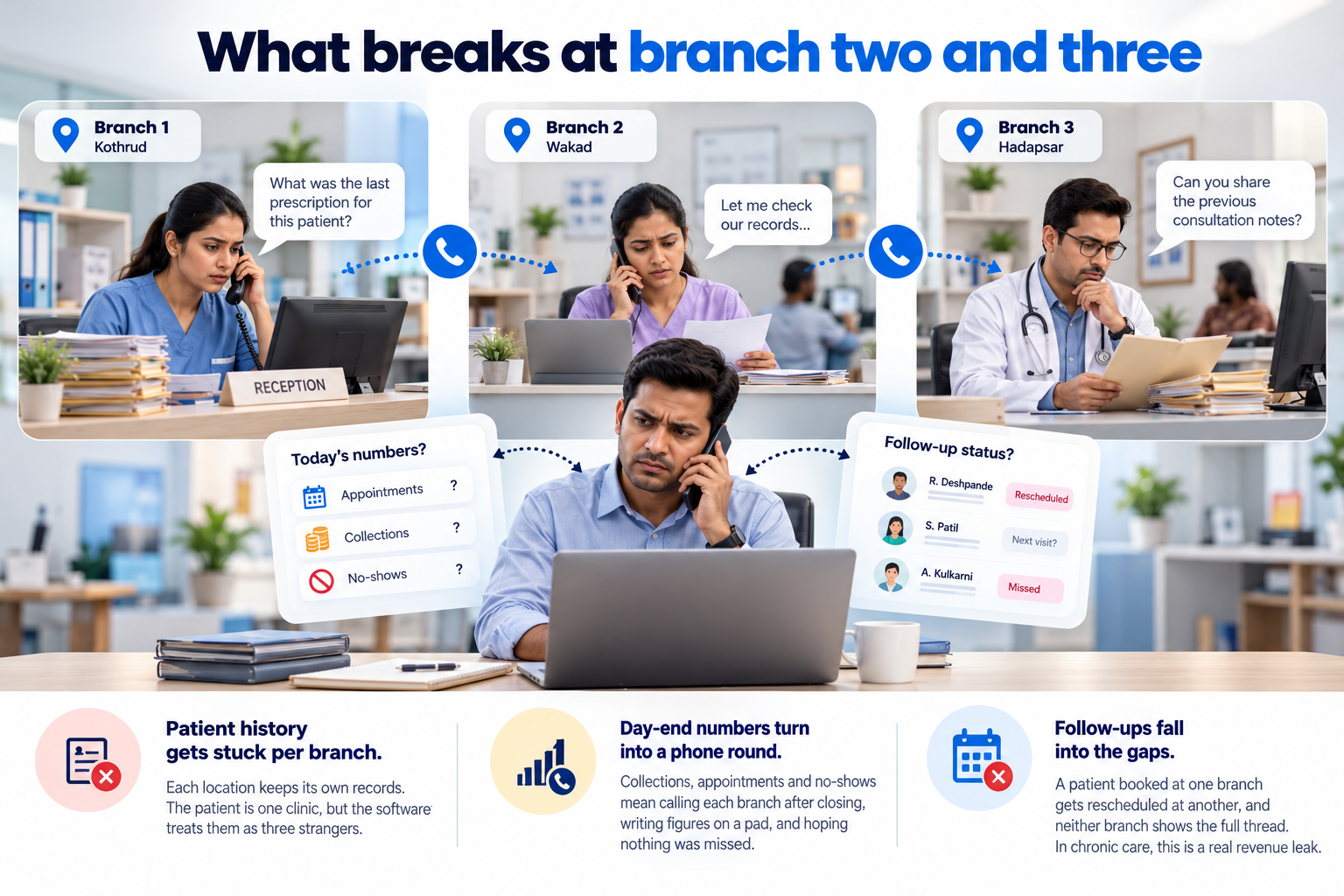
The third branch is where the phone calls start. We have watched this happen from the inside. Reception at one branch calls reception at another to ask what the last prescription was, because the patient turned up at the nearer location this week. The doctor waits. The patient waits. Somebody reads a case file over the phone.
Three things break at once:
Patient history gets stuck per branch. Each location keeps its own records, on paper or in its own copy of an app. The patient thinks of the practice as one clinic. The software treats them as three strangers who share a name.
Day-end numbers turn into a phone round. The owner wants to know collections, appointments and no-shows across the practice. With per-branch systems, that means calling each branch after closing, writing figures on a pad, and trusting that nothing was missed. Every evening.
Follow-ups fall into the gaps. A patient booked at branch one gets rescheduled at branch two, and neither branch's register shows the full thread. In chronic care, where revenue depends on the revisit, this is not an inconvenience. It is a leak in the main pipe.
An appointment app cannot fix any of this, because the problem is not booking. The problem is that there is no single record of the patient and no single view of the practice.
What a clinic operating system covers
A clinic operating system takes the opposite starting point: one patient record, shared by every branch and every role, with the day's work flowing through it.
In the system Accucia runs for healthcare practices, that means:
- Leads. Enquiries from Facebook and the website land in the same system reception works in, so a lead becomes a booked first visit without being retyped from a phone screen.
- Reception. A receptionist dashboard for registering patients, booking and rescheduling appointments, and collecting payments, at any branch.
- Doctor dashboard. The doctor opens today's list and sees each patient's full history, including consultations and prescriptions from other branches, plus missed appointments that need chasing.
- Follow-ups. Planned revisits are tracked, and missed ones surface instead of disappearing into a register.
- Payments. Collections recorded where they happen, visible centrally.
- MIS and reports. The owner sees appointments, collections, follow-ups and patient numbers by branch without calling anyone.
It runs as a web dashboard for the desk and management, with a mobile app alongside, so the owner's view travels.
The honest comparison looks like this:
<table>
<thead>
<tr><th>Capability</th><th>Clinic app</th><th>Clinic operating system</th></tr>
</thead>
<tbody>
<tr><td>Appointment booking</td><td>Yes</td><td>Yes</td></tr>
<tr><td>One patient record across branches</td><td>No</td><td>Yes</td></tr>
<tr><td>Lead capture from Facebook and website</td><td>No</td><td>Yes</td></tr>
<tr><td>Doctor dashboard with full history</td><td>Rarely</td><td>Yes</td></tr>
<tr><td>Missed-appointment and follow-up tracking</td><td>No</td><td>Yes</td></tr>
<tr><td>Payments and collections in the same system</td><td>No</td><td>Yes</td></tr>
<tr><td>Branch-wise MIS and reports</td><td>No</td><td>Yes</td></tr>
</tbody>
</table>
If your shortlist conversation keeps returning to features a calendar cannot hold, you are shopping for an operating system, whatever the vendor calls it. For homeopathy practices specifically, we have written up how this looks module by module on our homeopathy clinic software page.
Built at a working practice, not in a lab
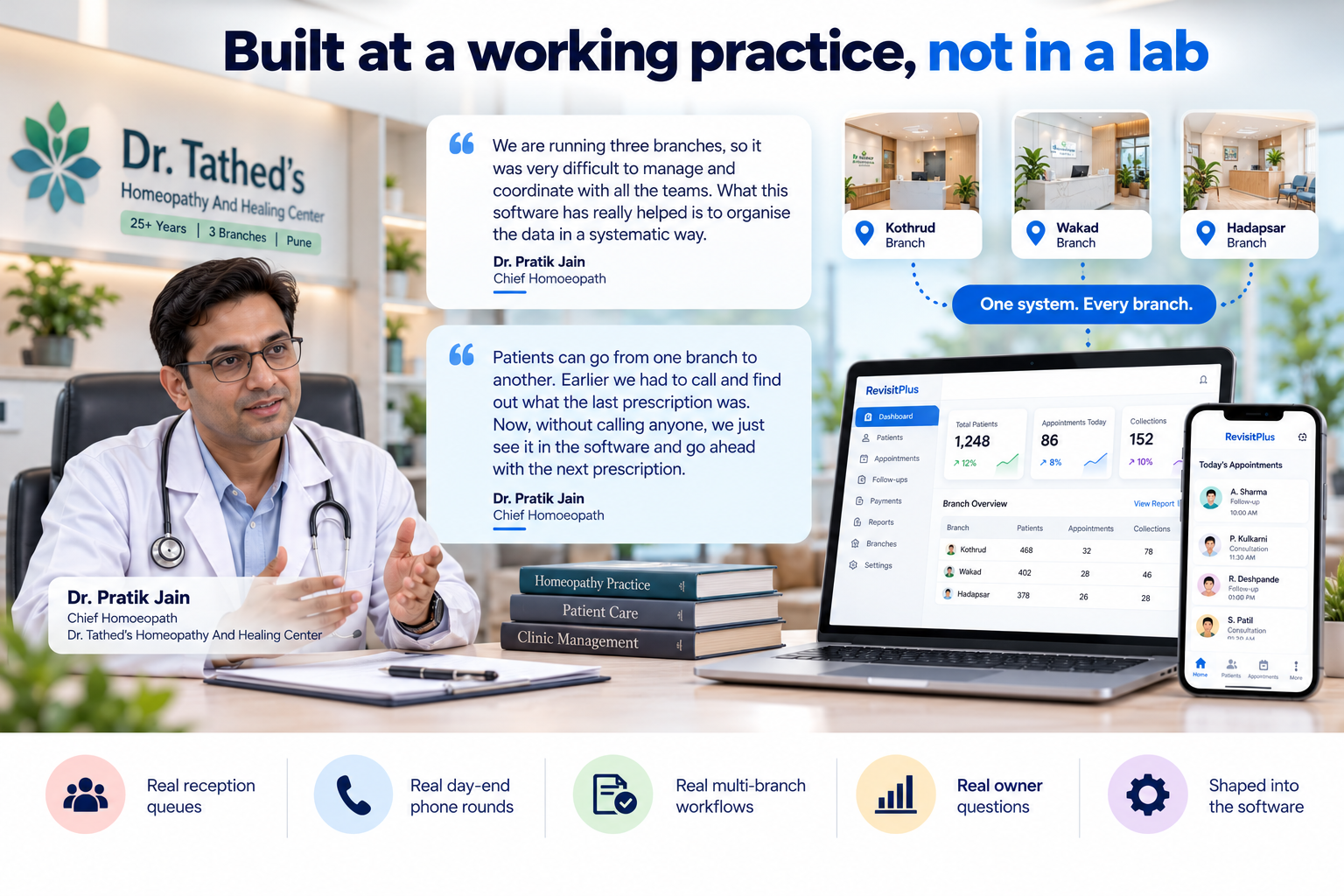
Category definitions are cheap. What makes ours concrete is where the system was built: inside Dr. Tathed's Homeopathy And Healing Center, a 25+ year practice in Pune running three branches. The software took shape against real reception queues and real day-end phone rounds, which is a harsher test environment than any requirements document.
Dr. Pratik Jain, Chief Homoeopath there, describes the starting problem plainly: "We are running three branches, so it was very difficult to manage and coordinate with all the teams. What this software has really helped is to organise the data in a systematic way."
And on the branch-to-branch record, the part no app solves: "Patients can go from one branch to another. Earlier we had to call and find out what the last prescription was. Now, without calling anyone, we just see it in the software and go ahead with the next prescription."
That second quote is the whole category difference in two sentences. Not a feature list. The phone call that no longer happens.
The full build story is on our Dr. Tathed's case study page, and it sits within the broader healthcare work we do, which spans clinic systems and other care-delivery software.
One operator aside worth passing on: the practices that get the most from a system like this are the ones that put the owner's day-end questions on the table during setup. Which numbers do you currently collect by phone? Those become your first reports.
Accucia's view
A clinic app is a diary and a clinic operating system is the practice itself in software, and conflating the two is the most expensive confusion in clinic software buying. The moment a practice signs the lease on branch two, the patient record has to move faster than the patient, and only a shared system does that. Buy for the practice you are becoming, not the branch you started with.
Running more than one branch and still making day-end phone calls? Message us on WhatsApp and we will show you the system working.
FAQ
What is a clinic operating system?
A clinic operating system is software that runs every function of a clinic on one shared patient record: enquiries, reception, doctor consultations, follow-ups, payments and reports. It works across branches through a web dashboard and a mobile app, so any authorised user sees the same patient history from any location.
Is a clinic app enough for a single-branch practice?
Often, yes. A single branch with one reception desk can manage bookings through an app and keep records in one place. The gap appears when the practice adds a second branch, because the app has no way to share patient history, payments and reports across locations on one record.
How does a clinic operating system handle multiple branches?
Every branch reads and writes the same patient record. A patient can visit any branch and the doctor there sees the full consultation and prescription history at once. Owners see payments, appointments and follow-ups for all branches in one report instead of calling each branch for day-end numbers.
Was this system built for homeopathy specifically?
It was built inside Dr. Tathed's Homeopathy And Healing Center, a 25+ year practice in Pune with three branches, so homeopathy workflows like long treatment records and planned revisits shaped it from the start. The same structure of one record, follow-ups and branch reports applies to other specialities as well.
See how one system can connect your entire clinic.