AI Readiness Assessment for Manufacturers: A Field Guide
Quick Answer
What an AI readiness assessment finds inside a manufacturing business: where production data actually lives, which processes can automate first, and what blocks the rest.
Every plant we walk into has production data. The question the assessment answers is where it lives and what refuses to talk to what. That answer is different in every factory, which is exactly why a generic AI pitch deck tells a manufacturer so little about their own next step.
Where manufacturing data actually lives
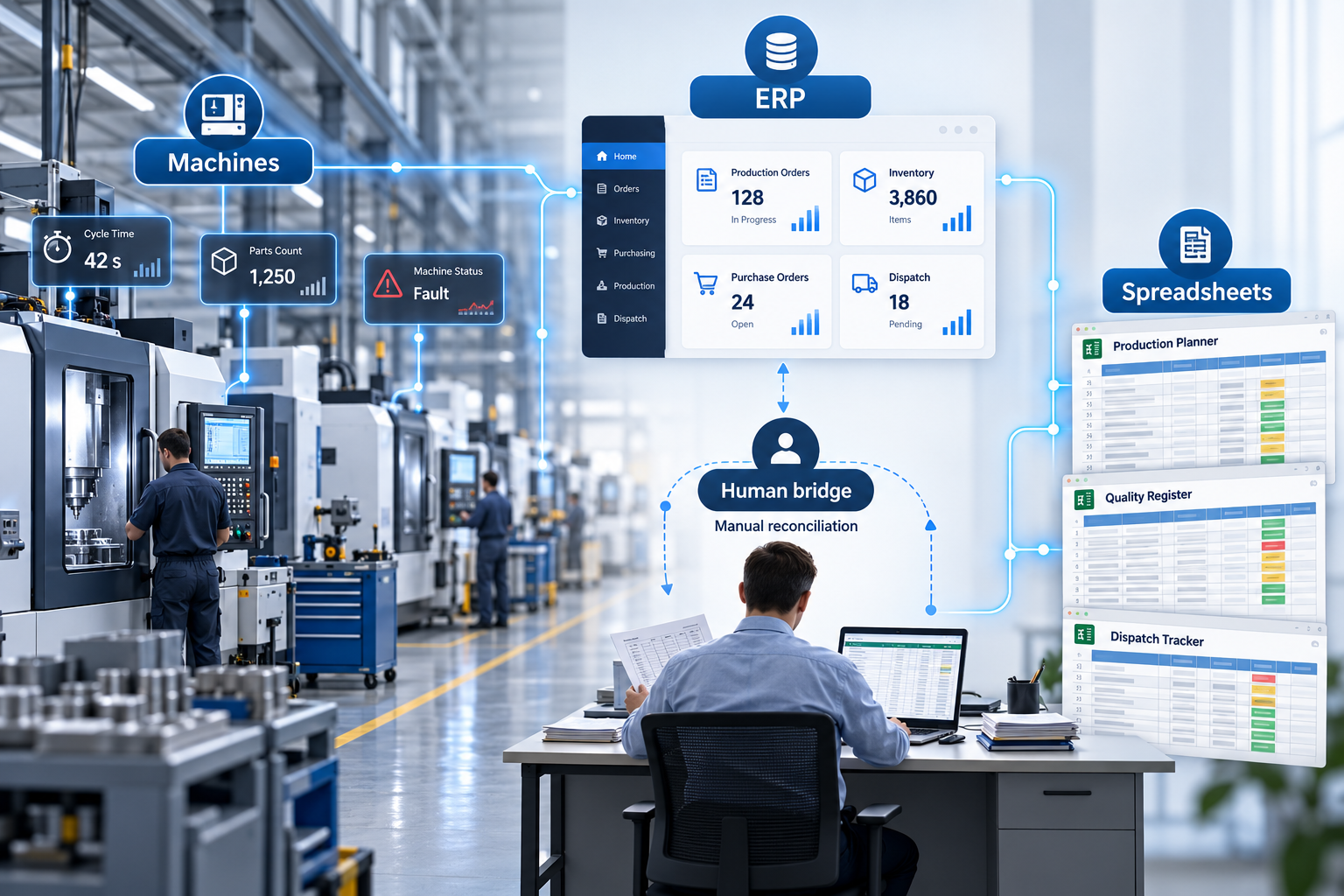
Ask a plant owner where their production data is and the first answer is usually the ERP. Walk the floor and a longer list appears.
Machines hold some of it. Modern CNC equipment and production lines log cycles, counts and faults, though what each machine exposes and in what format varies wildly by make and age. The ERP holds another layer: orders, inventory, purchase records, dispatch entries. Our ERP for manufacturing work starts from that layer because it is the system of record most manufacturers already trust.
Then there is the third place, the one nobody names in the first meeting. Spreadsheets. The production planner's Excel file that reconciles what the machines did with what the ERP thinks happened. The quality register maintained on one specific laptop. The dispatch tracker someone built years ago that the whole plant quietly depends on. These files exist because two systems did not connect, and a person became the connection.
An assessment treats those spreadsheets as evidence. Each one marks a spot where data flows through a human instead of a system, and each of those spots is a candidate for something better.
The gap between the machine and the ERP
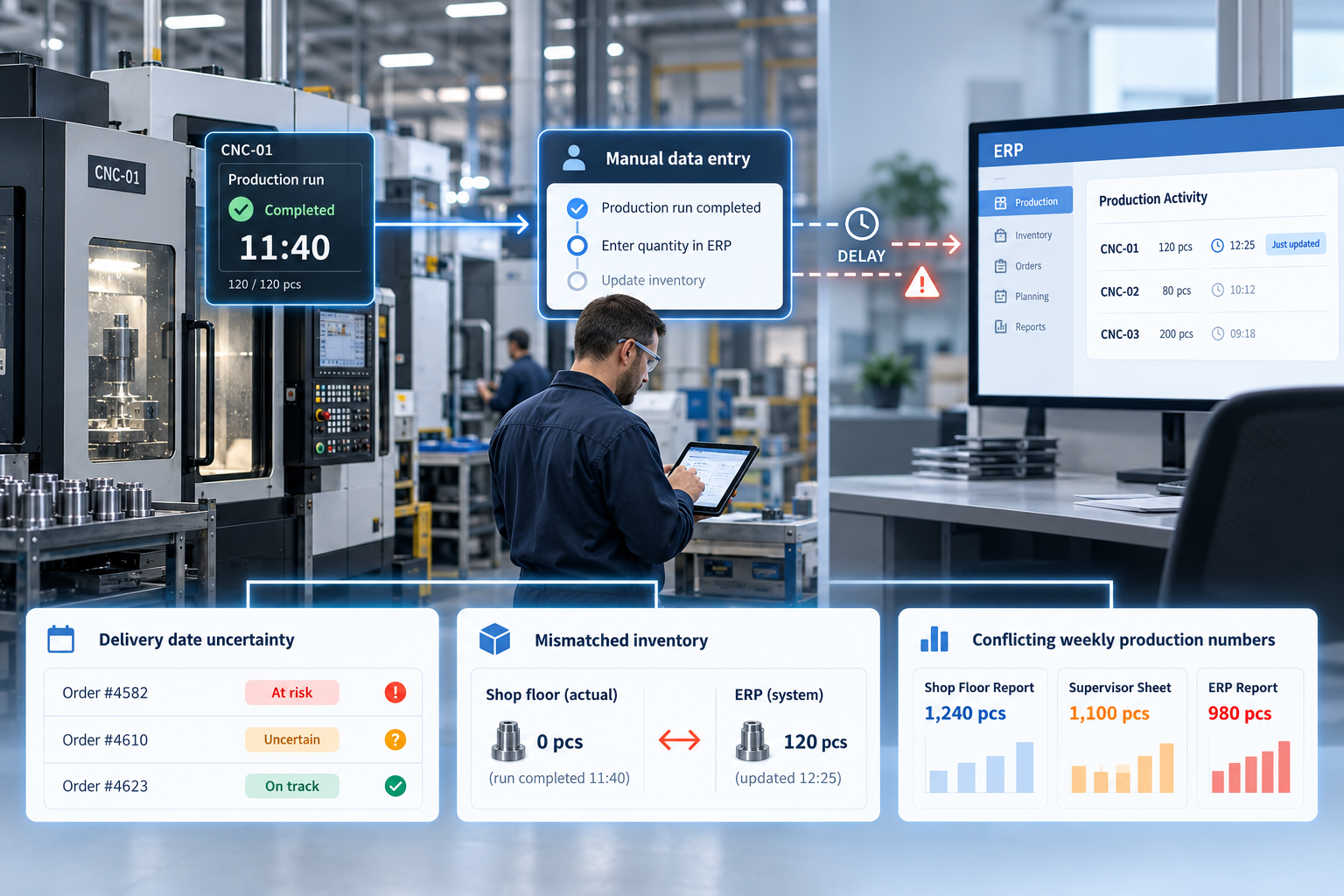
The single most common finding across manufacturing businesses is the disconnect between what the machines know and what the ERP records. The machine finished a run at 11:40. The ERP learns about it when someone enters it, which might be that afternoon or might be Thursday. In between, the business is making decisions on stale information.
The consequences are familiar to anyone running a plant. Sales commits to a delivery date based on inventory the ERP shows, not inventory that exists. The owner asks a simple question, how much did we produce this week, and gets three different answers from three different people, each technically correct according to the system that person looks at.
None of this means the ERP failed. It means the connection between the floor and the record was never built, and people have been papering over the gap with effort. The assessment measures that gap precisely: which data is born on the machines, how it currently reaches the ERP, how long that takes, and what it costs in retyping and reconciliation hours along the way.
What the assessment checks in a manufacturing business
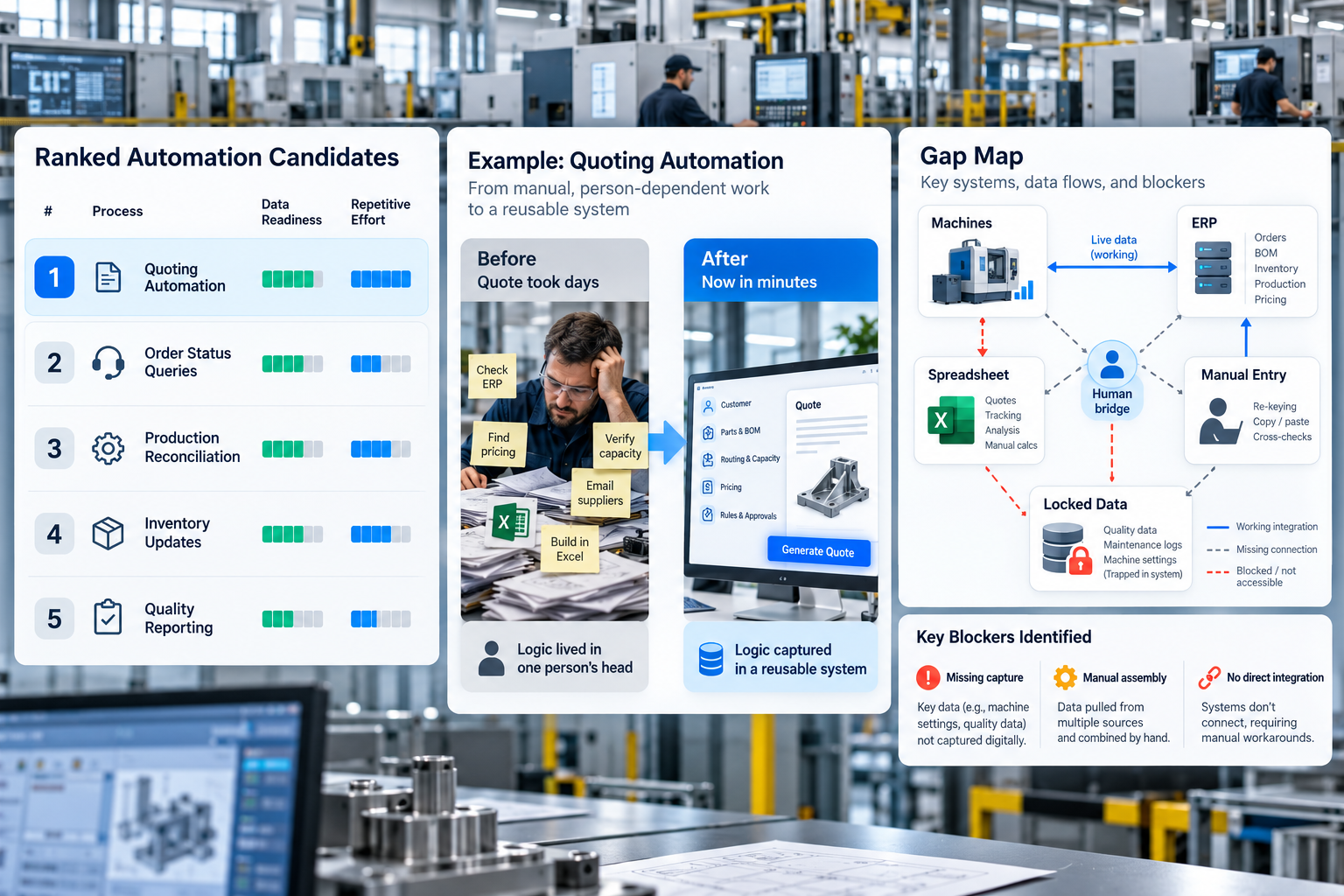
The structure of the assessment follows the structure of the operation. In a manufacturing context, as described on our AI for manufacturing page, it works through four questions.
First, what systems exist. ERP, accounting, any planning tools, machine software, and the full census of spreadsheets bridging between them. The census takes longer than owners expect, and it is worth every hour, because the bridges are where automation lands first.
Second, what data each system will give up. A machine that logs everything but exposes nothing over a usable interface is, for integration purposes, a filing cabinet. An ERP with proper APIs is an open door. The assessment tests each system rather than trusting the brochure, because vendor claims about integration and the reality of integration are frequently different documents.
Third, which processes consume the most repetitive human attention. Quoting is a regular finding, especially where quotes involve many variables and one experienced person holds the calculation method in their head. Order status queries are another: count how many times a day someone in your office answers where is my order by looking it up and typing a reply.
Fourth, who would own an automated system day to day. A plant where supervisors already work inside the ERP can adopt new capability quickly. A plant where the ERP is a back-office tool the floor never touches needs a different rollout path. Honest reading of this question early prevents the most expensive kind of failure, the system that works and still goes unused.
We frame this as capability deliberately. Every plant is different, and the assessment's job is to read yours as it is, not to force it into a template from someone else's industry profile. Manufacturing and industrial work sits squarely in the sectors we serve, documented on our manufacturing and industrial page.
What the assessment typically finds
The headline deliverable is a ranked list of automation candidates, ordered by data readiness and by the volume of repetitive effort each process currently absorbs.
Quoting tends to rank high in manufacturing, and one engagement shows why. At Utech Waterproofing, a quote took days because of the number of variables involved. After the quoting logic was built into a system, the same work moved from days to minutes. The variables had not gone anywhere. What changed was that the calculation stopped living in one person's head and started living somewhere the whole business could use it.
That pattern repeats in plant after plant: the processes that automate well are the ones where the inputs already exist in some system and a person is currently doing the assembly by hand. The assessment finds them, names them, and ranks them. It also names the blockers honestly. A candidate that depends on data nobody currently captures goes on the list with a note about what must change first, not quietly to the top because it sounded impressive in the kickoff meeting.
The gap map comes alongside the ranking: a drawn view of your systems, the connections that exist, the connections that are actually a person with a spreadsheet, and the data that is locked where nothing can reach it.
From findings to first integration
The question after the assessment is always the same. Do we have to replace what we run?
Almost always, no. The integration path we recommend most often adds an AI layer on top of the existing ERP through MCP integration, so the systems your team already knows keep doing their jobs while the new layer reads from them and answers through them. No rip and replace, no retraining the whole plant on new screens, no migration project eating a year.
The first integration should be small and should be the top-ranked candidate from the assessment. Small matters. A first project scoped to one process produces a working system the team can touch, and that working system does more to build internal confidence than any presentation. The second and third candidates then follow a path that is already proven inside your own walls, on your own data.
This sequencing is the real value of assessing before building. Without the assessment, first projects get chosen by whoever speaks loudest. With it, they get chosen by evidence.
Accucia's view
Manufacturers do not have a data shortage. They have a data location problem, and it is solvable without replacing the systems the plant already runs. Accucia Softwares Pvt. Ltd. was founded in Pune in 2018, and across the software projects delivered since 2018 the pattern has held: the wins come from connecting what exists, not from demolishing it. Our position for manufacturing is direct. Assess first, rank the candidates by evidence, then put an AI layer inside your existing ERP and prove it on one process before scaling to the next.
Book a free AI Readiness Assessment for your plant on WhatsApp: https://wa.link/1bwdd2
FAQ
Does an AI readiness assessment require stopping production?
No. The assessment reads systems and interviews the people who run them. It does not touch production equipment or interrupt live operations. Most of the work happens in your ERP, your data exports and your team's working hours, scheduled around the plant's normal rhythm rather than against it.
Our plant still runs on spreadsheets. Is an assessment pointless for us?
The opposite. Spreadsheets are evidence of where your processes actually flow, and the assessment uses them to map exactly that. Its recommendations will likely start with establishing a reliable system of record, which is the correct first step and cheaper to learn now than after an AI purchase.
Do we need to replace our ERP before adding AI?
Usually not. An AI layer can connect to most existing ERPs and work with the data already inside them. The assessment confirms whether yours exposes what the layer needs. Replacement only enters the conversation when the current system genuinely cannot support the business, which is rarer than vendors suggest.
What should a manufacturer automate first?
Whatever the assessment ranks first for your plant, which is usually a process where data already sits in your systems and a person spends hours assembling it by hand. Quoting with many variables and answering order status queries are frequent winners, but the ranking should come from your evidence, not a generic list.
Book Your Free AI Readiness Assessment.