AI Readiness Assessment: What It Is and What It Covers
Quick Answer
An AI readiness assessment is a structured review of your systems, data and workflows carried out before any AI spend. It inventories the software you already run, tests how accessible your data really is, maps the processes worth automating, and produces a ranked gap map so you build on evidence instead of assumption. By Mr. Sumeet Katariya, Accucia Softwares Pvt. Ltd.
Most companies ask what AI can do. The better first question is what your current systems will let it do. That sounds obvious written down, yet we keep meeting businesses that bought a tool before anyone checked whether the data it needed was reachable. The assessment exists to answer that question before money moves.
What an AI readiness assessment actually checks
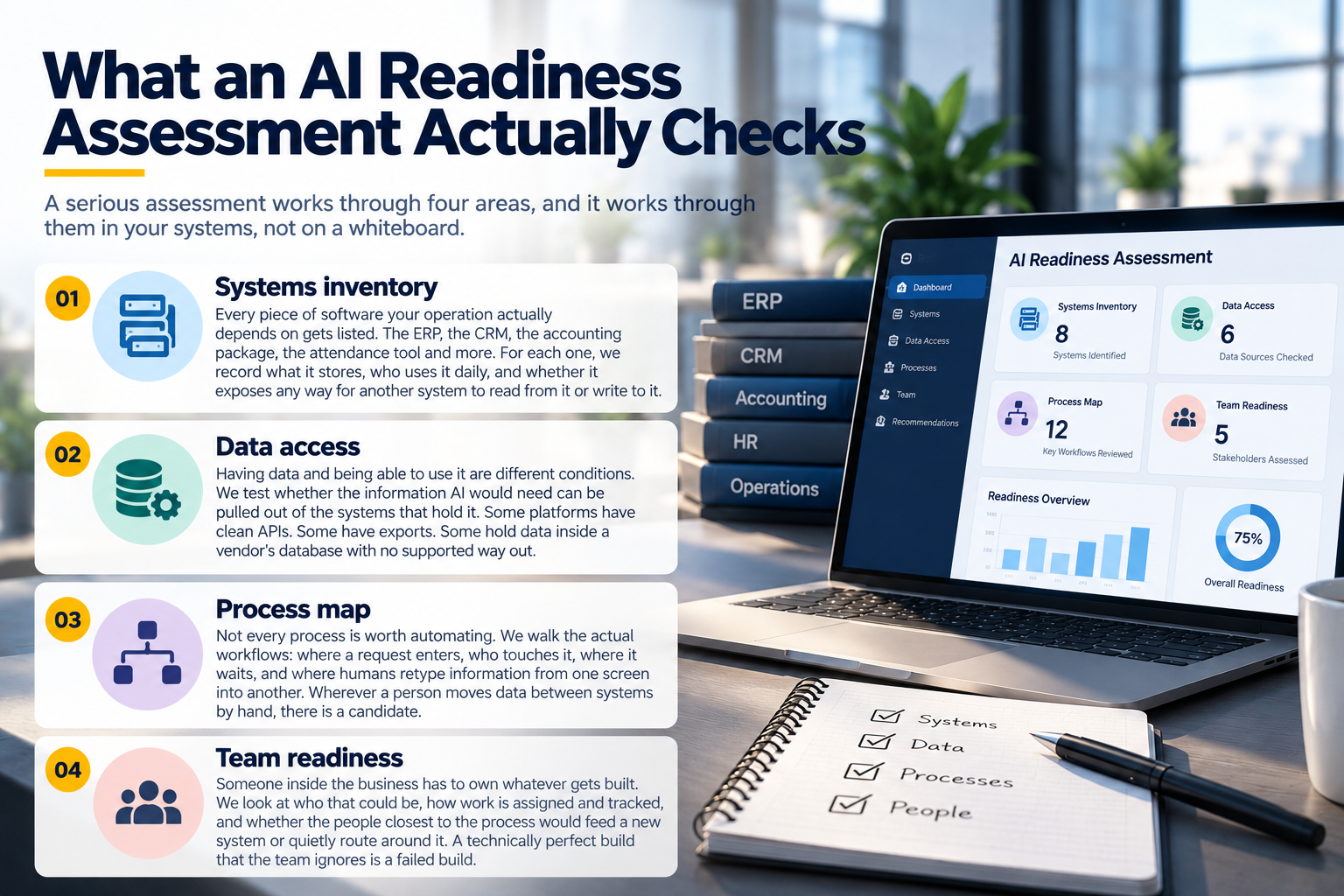
A serious assessment works through four areas, and it works through them in your systems, not on a whiteboard.
Systems inventory. Every piece of software your operation actually depends on gets listed. The ERP, the CRM, the accounting package, the attendance tool nobody remembers buying. For each one, the assessor records what it stores, who touches it daily, and whether it exposes any way for another system to read from it or write to it. The inventory usually surprises the owner. Software accumulates quietly over years, and the list of systems people think they run is almost never the list they do run.
Data access. Having data and being able to use it are different conditions. The assessment tests whether the information AI would need can be pulled out of the systems that hold it. Some platforms have clean APIs. Some have exports that work if a person remembers to run them. Some hold data hostage inside a vendor's database with no supported way out. Each case changes what is feasible and in what order, which is exactly the kind of detail covered on our AI development and automation page.
Process map. Not every process is worth automating, and the ones worth automating first are rarely the ones management names in the first meeting. The assessment walks the actual workflows: where a request enters, who touches it, where it waits, where humans retype information from one screen into another. Retyping is the tell. Wherever a person moves data between systems by hand, there is a candidate.
Team readiness. Someone inside the business has to own whatever gets built. The assessment looks at who that could be, how work is currently assigned and tracked, and whether the people closest to the process would feed a new system or quietly route around it. A technically perfect build that the team ignores is a failed build. We have watched that happen, and it is avoidable if you check early.
What an AI readiness assessment is not
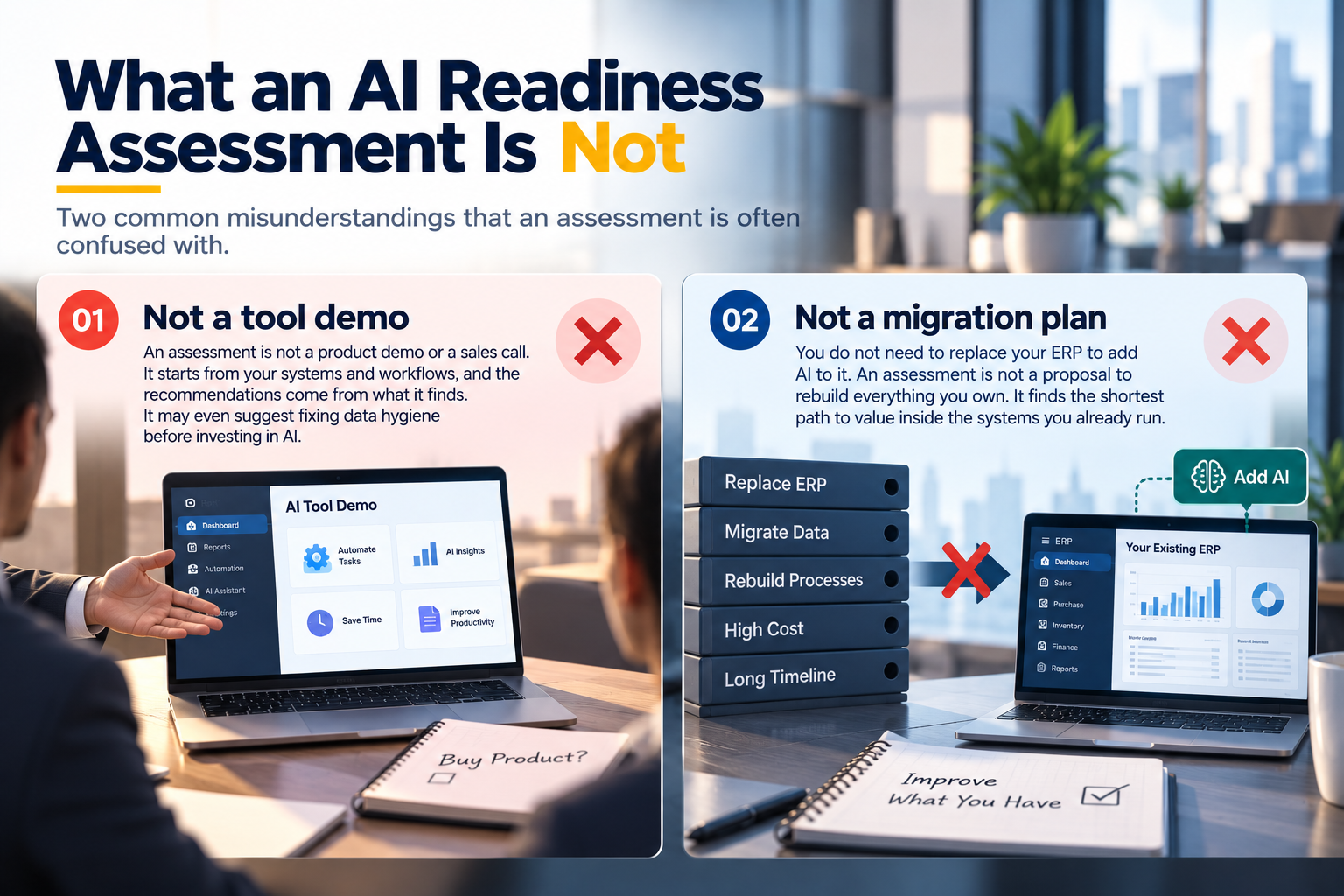
Two things get confused with an assessment often enough to be worth naming.
It is not a tool demo. If a meeting ends with someone showing you a product and the conclusion is that you should buy the product, that was a sales call. An assessment starts from your systems and your workflows. The recommendations fall out of what it finds there. On some engagements the honest finding is that a business should fix its data hygiene before touching AI at all, and a real assessment will say so.
It is not a migration plan either. You do not need to replace your ERP to add intelligence to it. The approach we describe in MCP for ERP: add AI to existing software without replacing it exists precisely because rip and replace is usually the wrong answer. An assessment that concludes with a proposal to rebuild everything you own deserves a second opinion. The point of assessing is to find the shortest path to value inside what you already run, and our MCP integration work is built on that premise.
What the output looks like
The deliverable matters because it is the thing you can act on, with us or with anyone else. Three documents, in practice.
The first is a gap map. It shows each system you run, what state its data is in, and where the breaks are. A break might be a platform with no API, a spreadsheet that exists only on one laptop, or two systems holding conflicting versions of the same customer record. Seeing the breaks drawn out is usually worth the exercise on its own, because it converts a vague sense that things are messy into a specific list of named problems.
The second is a ranked list of automation candidates. Ranked is the operative word. Anyone can brainstorm twenty things AI might do. The assessment orders them by two factors: how ready the underlying data is, and how much repetitive human effort the process currently burns. Candidates that score well on both go to the top. Candidates that need data you do not yet capture go to the bottom with a note on what would have to change first.
The third is an integration path. For the top candidates, it sketches how a build would connect to your existing systems, what has to be prepared, and in what order the work should happen. This is the document that stops a project from starting in the wrong place.
Take the output and act on it with whoever you trust. It is written to be useful independently, not to lock you in.
Who needs an assessment first
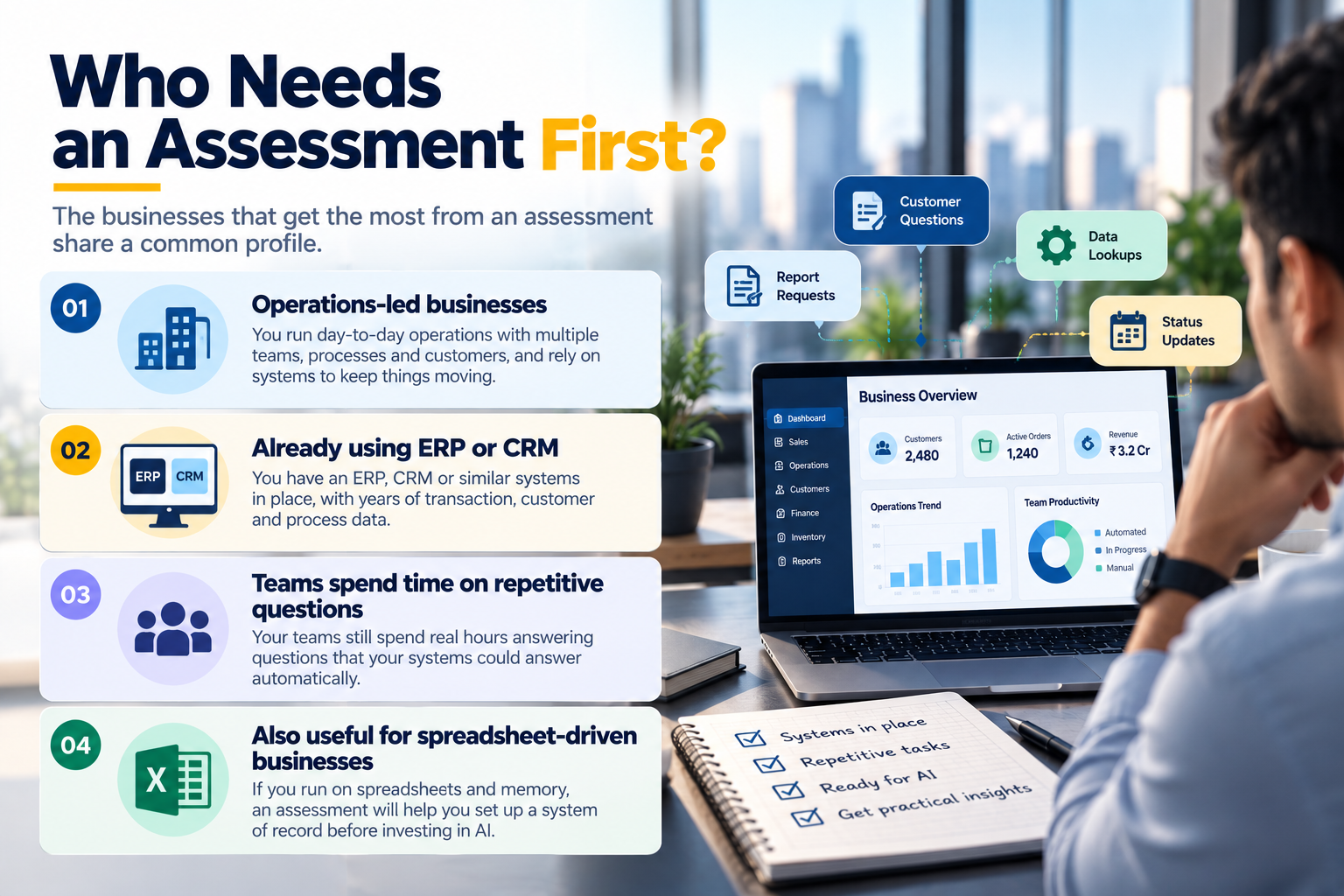
The businesses that get the most from an assessment share a profile. They are operations-led, they already run an ERP or CRM, and their teams spend real hours every week answering questions the systems could answer themselves.
If that describes you, the raw material is already in place. Your systems have been accumulating transaction history, customer records and process data for years. What is missing is the layer that puts it to work, and the assessment tells you where that layer should land first.
If you run your business on spreadsheets and memory, an assessment will still help, but its first recommendations will be about getting a system of record in place. That is useful truth, delivered early, before anyone has spent on the wrong layer.
There is also a timing argument. The companies that assess now, while their competitors are still in the demo-watching phase, get to make their mistakes small and early. The pattern we documented in why 95% of enterprise AI pilots fail traces most failures back to skipped groundwork. The assessment is the groundwork, done deliberately instead of discovered painfully.
Accucia's view
Assess before you build. Accucia Softwares Pvt. Ltd. has been delivering software from Pune since 2018, and the clearest lesson from the software projects delivered since 2018 is that AI succeeds where it lands inside the systems a business already runs and trusts. We do not start engagements with a product pitch. We start by reading your systems, mapping your data, and ranking what should automate first, because the companies that skip that step pay for it in stalled pilots. Deliver AI inside the systems you already run. That is the position, and the assessment is how it starts.
Book a free AI Readiness Assessment for your business on WhatsApp: https://wa.link/1bwdd2
FAQ
How long does an AI readiness assessment take?
Duration depends on how many systems you run and how accessible they are. A business with one ERP and a CRM moves faster than one with a dozen disconnected tools. The assessment ends when the gap map, the ranked candidate list and the integration path are complete and reviewed with you.
Do I need to prepare anything before an assessment?
Very little. Access to the people who use your systems daily matters more than documentation. The assessor needs to see real workflows, not the official version of them. A list of the software you pay for helps, though building that list is often the first thing the assessment does anyway.
Is an AI readiness assessment only for large companies?
No. Any operations-led business already running an ERP or CRM can benefit, whatever its size. Smaller companies often gain more, because their gaps are fewer and their first automation candidate is usually obvious once the data access question is answered. The method scales down as well as it scales up.
What happens after the assessment is done?
You receive the gap map, the ranked automation candidates and the integration path, then you decide. Some businesses fix data gaps first. Some proceed straight to a first build on the top-ranked candidate. The output is yours to act on, with Accucia or with any team you choose.
Assess Your AI Readiness Today.