Agentic AI in Manufacturing: 5 Processes That Go First
Quick Answer
Agentic AI enters manufacturing through five processes: order status queries, quoting with many variables, exception alerts from production data, quality documentation assembly, and dispatch coordination. These five go first because their data already sits in existing systems and the work itself is a repetitive question asked in slightly different words each time. By Mr. Sumeet Katariya, Accucia Softwares Pvt. Ltd.
Nobody automates the whole plant. The companies getting value picked one process where the data already existed and the answer was always the same question. Here are the five processes where that condition holds most often, what an agent actually does in each one, and what has to be true in your systems before it can.
1. Order status queries
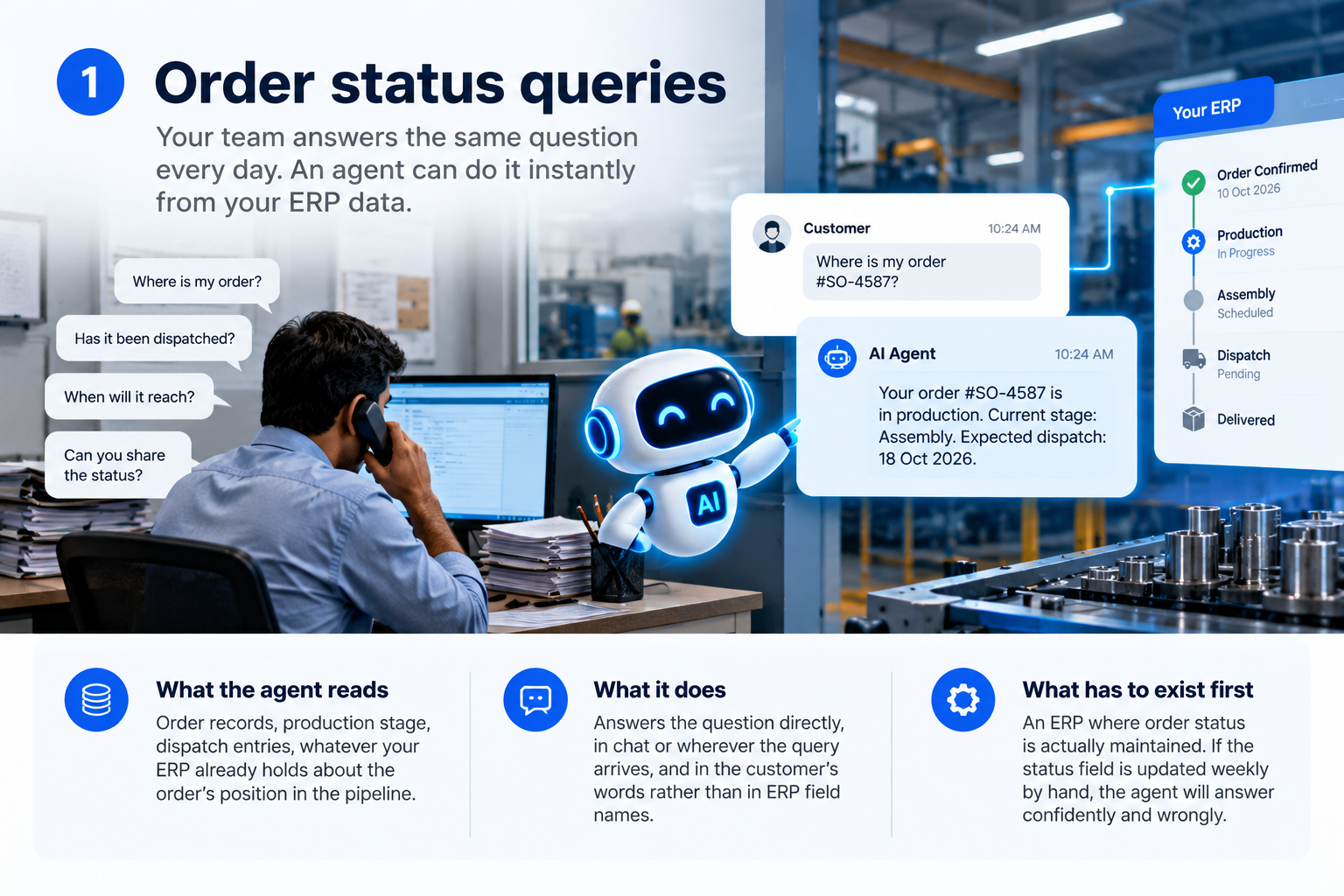
Count how many times a day your office answers some version of where is my order. Someone takes the call or the message, opens the ERP, finds the order, reads the status, and types a reply. Multiply by every customer and every dealer who asks.
What the agent reads: order records, production stage, dispatch entries, whatever your ERP already holds about the order's position in the pipeline.
What it does: answers the question directly, in chat or wherever the query arrives, and in the customer's words rather than in ERP field names. The person who used to do the lookup gets their hours back.
What has to exist first: an ERP where order status is actually maintained. If the status field is updated weekly by hand, the agent will answer confidently and wrongly. The system of record has to be a record before anything should read from it, which is the territory our ERP for manufacturing work covers.
2. Quoting with many variables
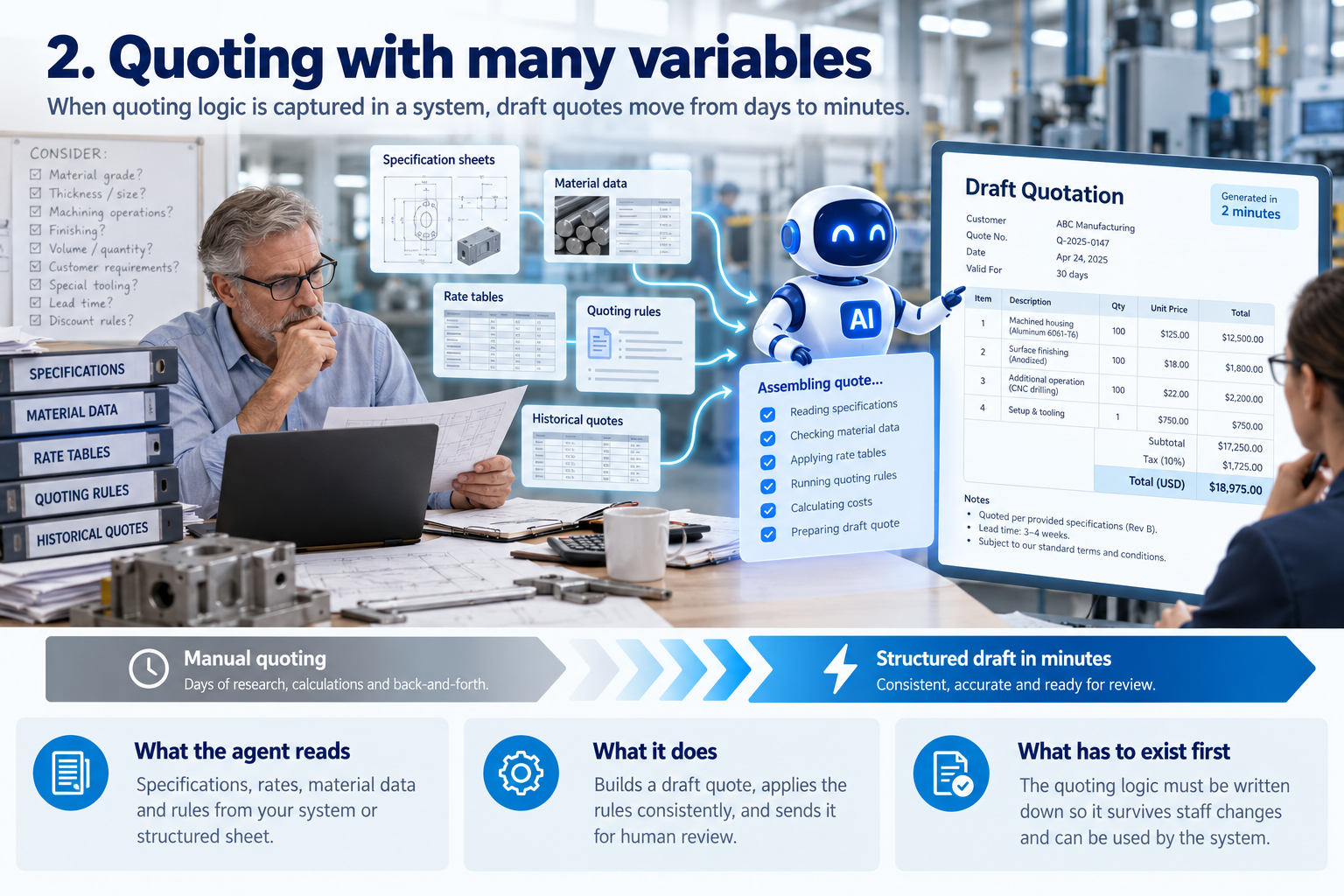
In plenty of manufacturing businesses, quoting is a senior person's private craft. The variables live in their head, the method lives in their experience, and every quote waits for their availability.
At Utech Waterproofing, a quote took days because of the number of variables involved. Once the quoting logic was captured in a system, the same work went from days to minutes. The variables did not get simpler. The assembly stopped depending on one person's calendar.
What the agent reads: the inputs your quotes depend on, such as specifications, rates, material data and rules, held in whatever system or structured sheet currently feeds them.
What it does: assembles a draft quote from those inputs, applies the rules consistently every time, and hands the draft to a human for review. The person still decides. They just stop rebuilding the calculation from scratch.
What has to exist first: the quoting logic has to be written down. Extracting it from the expert's head is usually the hardest part of the project and the most valuable, because once extracted it survives staff changes.
3. Exception alerts from production data
Most production problems are visible in the data before they are visible in the schedule. A line running slower than plan, a count drifting away from target, an order sitting in one stage far longer than its neighbours. Someone could spot these by watching reports all day. Nobody has that job, so the problems surface late.
What the agent reads: the production data your systems already log, counts, timestamps, stage movements, against the plan they are supposed to follow.
What it does: watches continuously and raises a flag the moment something deviates past a threshold, routed to the person who can act. Not a dashboard somebody has to remember to open. A message that arrives.
What has to exist first: production data flowing into a system at a useful frequency, and a plan definition to compare it against. Where data reaches the ERP days late, alerts are history lessons. This is a core pattern in our intelligent automation practice, and it only works at the speed of the data feeding it.
4. Quality documentation assembly
Quality records are a paperwork burden with a deadline attached. Test results in one place, batch details in another, formats dictated by whoever will inspect them. Assembling the pack is manual, repetitive and unforgiving of mistakes.
This is one where we speak in capability terms: the shape of the work is what makes it automatable. Document assembly from structured sources is exactly what agents do well.
What the agent reads: inspection entries, batch records, test values, wherever those are captured today.
What it does: compiles the documentation pack in the required format, flags missing entries while there is still time to fix them, and keeps every pack consistent with the last one.
What has to exist first: quality data captured digitally at the point of inspection. Paper registers have to become digital entries before anything can assemble them. That change is modest, and it is the gate.
5. Dispatch and field coordination
The last stretch between the plant and the customer runs on phone calls. Is the vehicle loaded, did the material leave, when does it reach, who informs the customer. Each question costs somebody minutes, and the answers already exist somewhere in the dispatch records.
What the agent reads: dispatch entries, vehicle and consignment details, delivery confirmations as your process captures them.
What it does: keeps the customer and the field team informed without a coordinator relaying every update by hand, and answers the when does it reach question from the record instead of from memory.
What has to exist first: dispatch events recorded as they happen rather than reconstructed at day's end. The agent can only relay what the system knows.
Why these five go first
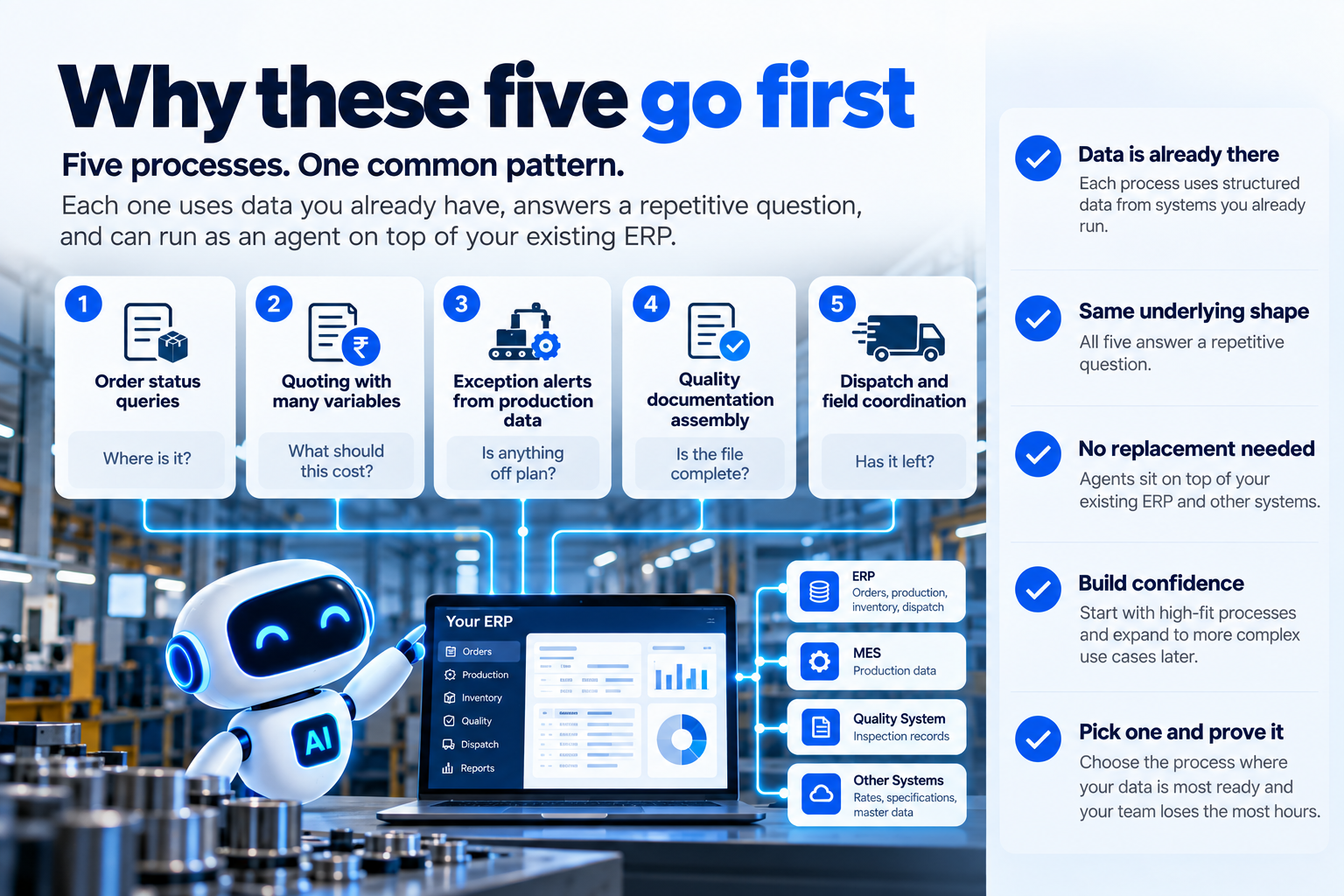
Lay the five side by side and the shared shape appears. Each one sits on data that is already structured inside a system most manufacturers run today. And each one is, underneath the surface variety, a repetitive question: where is it, what should this cost, is anything off plan, is the file complete, has it left.
Repetitive questions with structured data behind them are the natural first territory for agentic AI, which is the ground our AI for manufacturing page maps in more depth. Processes that need judgment calls on unstructured inputs come later, after the business has built confidence and the data foundation has widened.
There is a practical point hiding here too. None of the five requires replacing anything. An agent layer can sit on top of the ERP you already run, reading and answering through the systems your team already trusts. We have written up how that works technically in MCP for ERP: add AI to existing software without replacing it. The short version is that the path into agentic AI runs through your existing systems, not around them.
Pick one of the five. The one where your data is most ready and your people lose the most hours. Prove it, then take the next.
Accucia's view
Agentic AI in manufacturing is won process by process, not plant by plant. Accucia Softwares Pvt. Ltd. has been building from Pune since 2018, and the position we hold after the software projects delivered since 2018 is firm: start where the data already exists, put the agent inside the systems the team already runs, and let one working process make the argument for the next. The five above are where that approach lands first because their data is ready and their work is repetitive. Companies that start there get working systems while others are still scoping moonshots.
Book a free AI Readiness Assessment to find out which of the five your plant should start with. WhatsApp: https://wa.link/1bwdd2
FAQ
What is agentic AI in manufacturing?
Agentic AI means software that reads data from your existing systems and acts on it, answering queries, drafting documents or raising alerts, rather than waiting for a person to run every step. In manufacturing it typically connects to the ERP and production records the plant already maintains.
Does agentic AI replace our ERP or work with it?
It works with it. The agent layer connects to the ERP you already run, reads what it holds and answers through it. Your team keeps the screens and records they know. Replacement is a separate decision, needed only when the current system genuinely cannot support the business.
Which process should we automate first?
The one where your data is already structured and your people lose the most repetitive hours, which differs by plant. Order status queries and quoting are common starting points because the inputs usually exist in the ERP today. An assessment of your systems settles the ranking with evidence.
Book Your Free AI Readiness Assessment.