
Visitor Management System: 2026 Buyer's Guide for India
Quick Answer
A visitor management system replaces the paper gate register with software that pre-registers guests, captures ID and photo at entry, alerts the host, prints a badge, and logs exit. It gives security an accurate live list of everyone inside the building, a searchable record for audits, and a roll call list during an evacuation. By Mr. Sumeet Katariya, CEO, Accucia Softwares Pvt. Ltd.
The four entry types most buildings get wrong
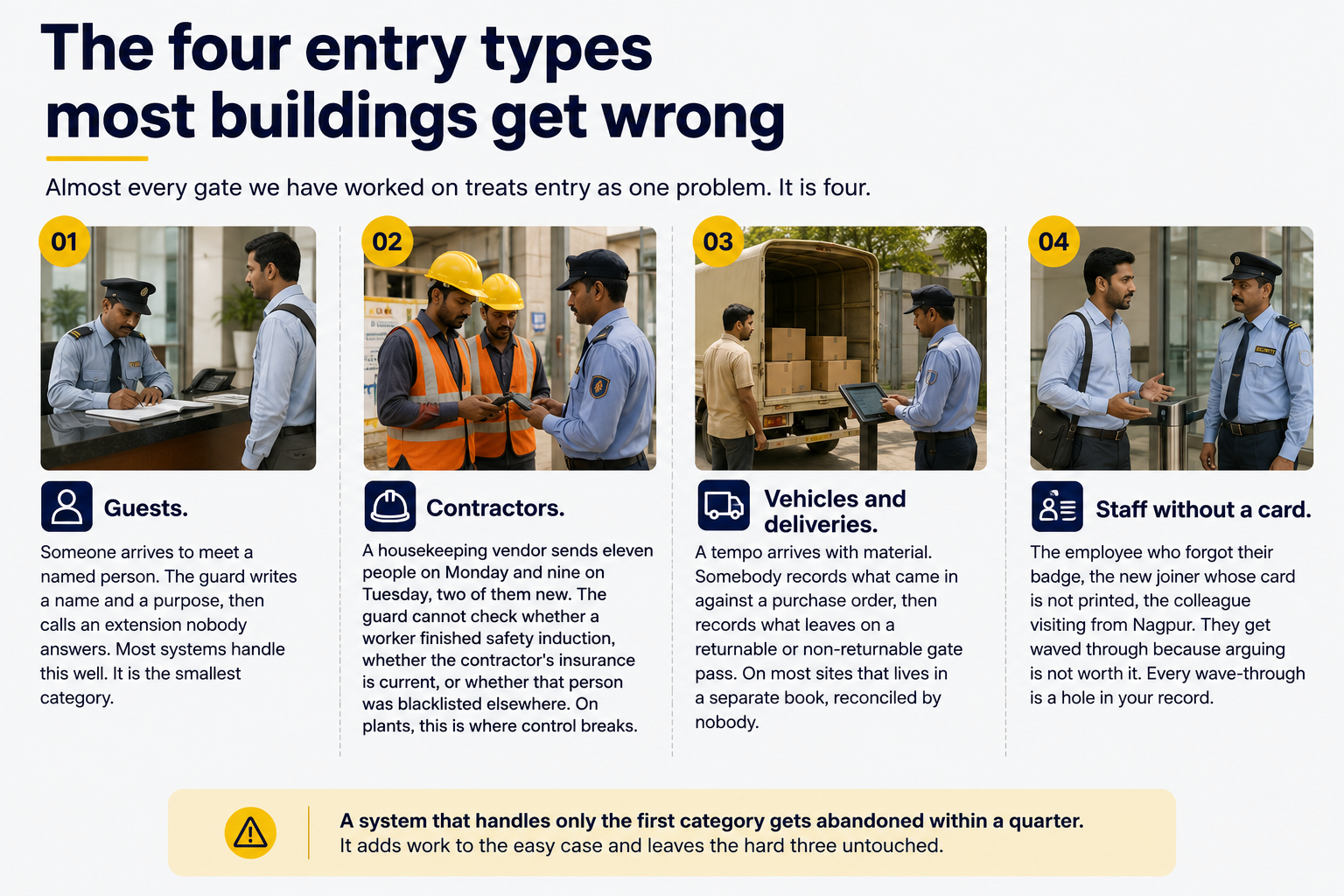
Almost every gate we have worked on treats entry as one problem. It is four.
Guests. Someone arrives to meet a named person. The guard writes a name and a purpose, then calls an extension nobody answers. Most systems handle this well. It is the smallest category.
Contractors. A housekeeping vendor sends eleven people on Monday and nine on Tuesday, two of them new. The guard cannot check whether a worker finished safety induction, whether the contractor's insurance is current, or whether that person was blacklisted elsewhere. On plants, this is where control breaks.
Vehicles and deliveries. A tempo arrives with material. Somebody records what came in against a purchase order, then records what leaves on a returnable or non-returnable gate pass. On most sites that lives in a separate book, reconciled by nobody.
Staff without a card. The employee who forgot their badge, the new joiner whose card is not printed, the colleague visiting from Nagpur. They get waved through because arguing is not worth it. Every wave-through is a hole in your record.
A system that handles only the first category gets abandoned within a quarter. It adds work to the easy case and leaves the hard three untouched.
What a paper register cannot do
Four things, and each matters on a bad day. It cannot pre-approve, so every arrival is a negotiation at the gate. It cannot check a blacklist, because that needs a guard to remember a name, and guards rotate. It cannot produce an evacuation list, because a bound book records arrival times and almost no exits. And it cannot prove who was inside between 14:00 and 16:00 when a laptop goes missing.
Pre-approval — Paper register: Not possible. Digital system: Host approves by QR invite.
Blacklist check — Paper register: Guard memory. Digital system: Automatic, on name, phone and photo.
Live count inside — Paper register: Not available. Digital system: Live, by gate and area.
Exit capture — Paper register: Often skipped. Digital system: Enforced at turnstile or badge scan.
Search a past visit — Paper register: Page by page. Digital system: Seconds, by name, phone or host.
Contractor documents — Paper register: Not tracked. Digital system: Entry blocked when a document expires.
Photo evidence — Paper register: None. Digital system: Captured at every entry.
Retention control — Paper register: Book sits in a cupboard. Digital system: Automatic deletion at the set period.
Legibility — Paper register: Variable. Digital system: Not a factor.
The visitor management system feature set worth paying for
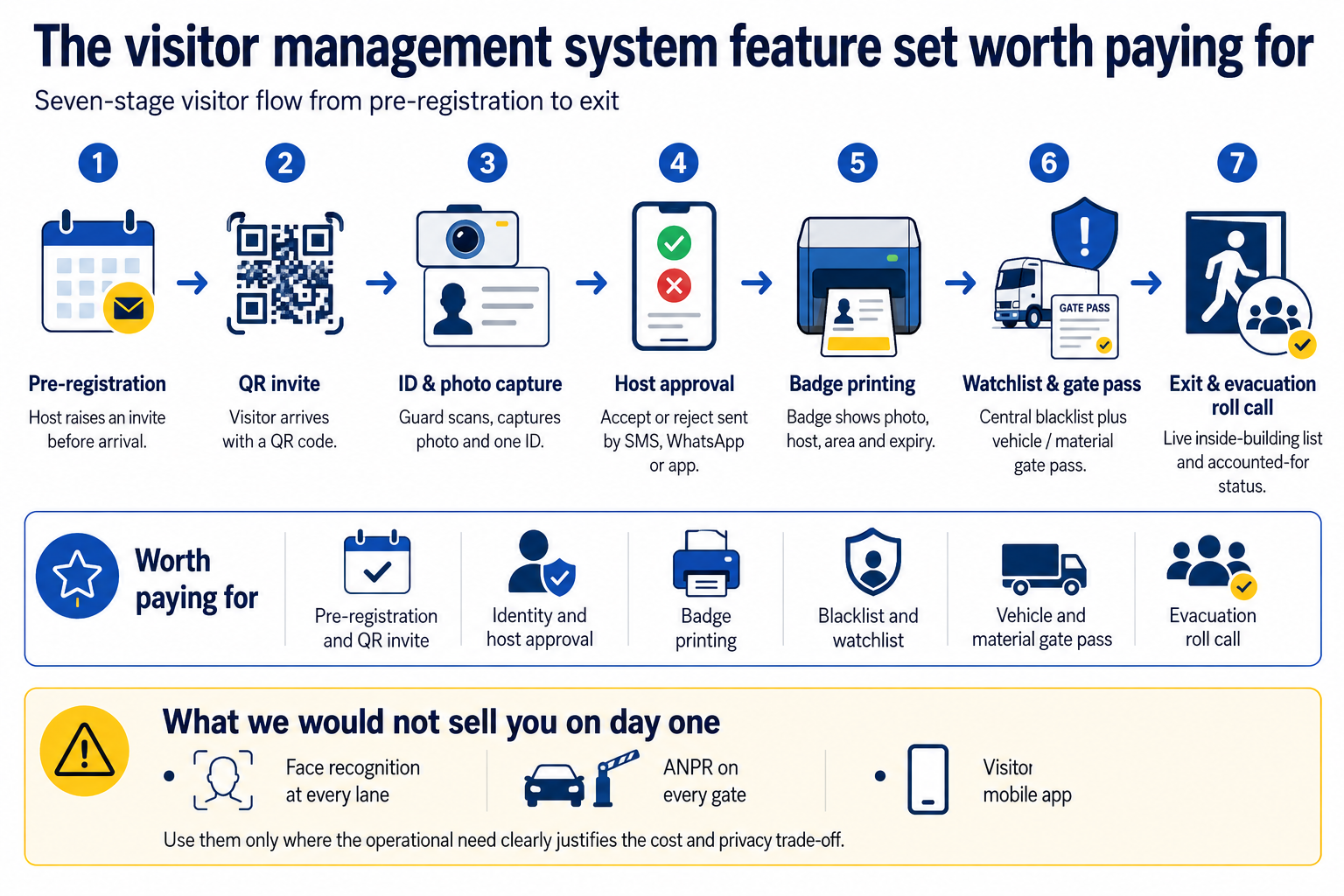
[Diagram: seven-stage visitor flow from Pre Registration to Exit. See Inline Media Notes for the prompt.]
Pre-registration and QR invite. The host raises an invite, the visitor arrives with a QR code, and the guard scans instead of types. This does more for gate queues than any hardware.
Identity and host approval. A photo on the spot, one identity document, and an accept or reject sent to the host by SMS, WhatsApp or app. Keep the identity capture thin, for reasons in the next section.
Badge printing. Photo, host name, valid areas and expiry time, colour-coded so a supervisor can tell a contractor from a guest at fifteen feet.
Blacklist and watchlist. Central, applied at every gate, with a reason field and a named owner. A blacklist nobody owns becomes noise.
Vehicle and material gate pass. Inward material against a purchase order, outward returnable and non-returnable passes, driver and vehicle number captured once.
Evacuation roll call. A live inside-the-building list on the safety officer's phone, with a way to mark people accounted for at the assembly point.
What we would not sell you on day one: face recognition at every lane, ANPR on every gate, or a visitor mobile app. Face recognition earns its place on busy contractor gates where card sharing is the real problem, and our computer vision work sits behind those deployments. Elsewhere it adds cost and a privacy conversation you do not need.
Deployment realities in India
The software is the easy part. The gate is not.
Fixed kiosk — Best for: Corporate lobbies, government reception counters. Watch out for: Needs power and a mount, queues at shift change.
Guard tablet — Best for: Factory gates, multi-gate campuses, contractor entry. Watch out for: Battery discipline, device damage, needs a rugged case.
Turnstile or flap barrier — Best for: Enforcing exit capture, restricted areas. Watch out for: Capital cost, civil work, controller integration.
Three things break rollouts here, and all three are predictable.
The network at the gate is unreliable. Gates sit at the perimeter, furthest from the switch room. The app must hold the employee master, the watchlist and the day's pre-registrations on the device, record entries offline, and sync when the link returns. Ask any vendor to demonstrate a check-in with the network cable pulled out. Many cannot.
Guards rotate weekly. Training resets constantly. The screen must be learnable in five minutes: no settings, no twelve-item dropdowns, no free text where a button will do. Design for icons and photographs, so a guard can run a whole check-in by tapping pictures.
Language. Marathi and Hindi labels on the guard screen and the printed badge are not a nice extra on a Maharashtra site. They decide whether the system gets used or bypassed. Put the toggle on the login screen, not three levels into settings.
Data rules: what you may capture and how long you may keep it
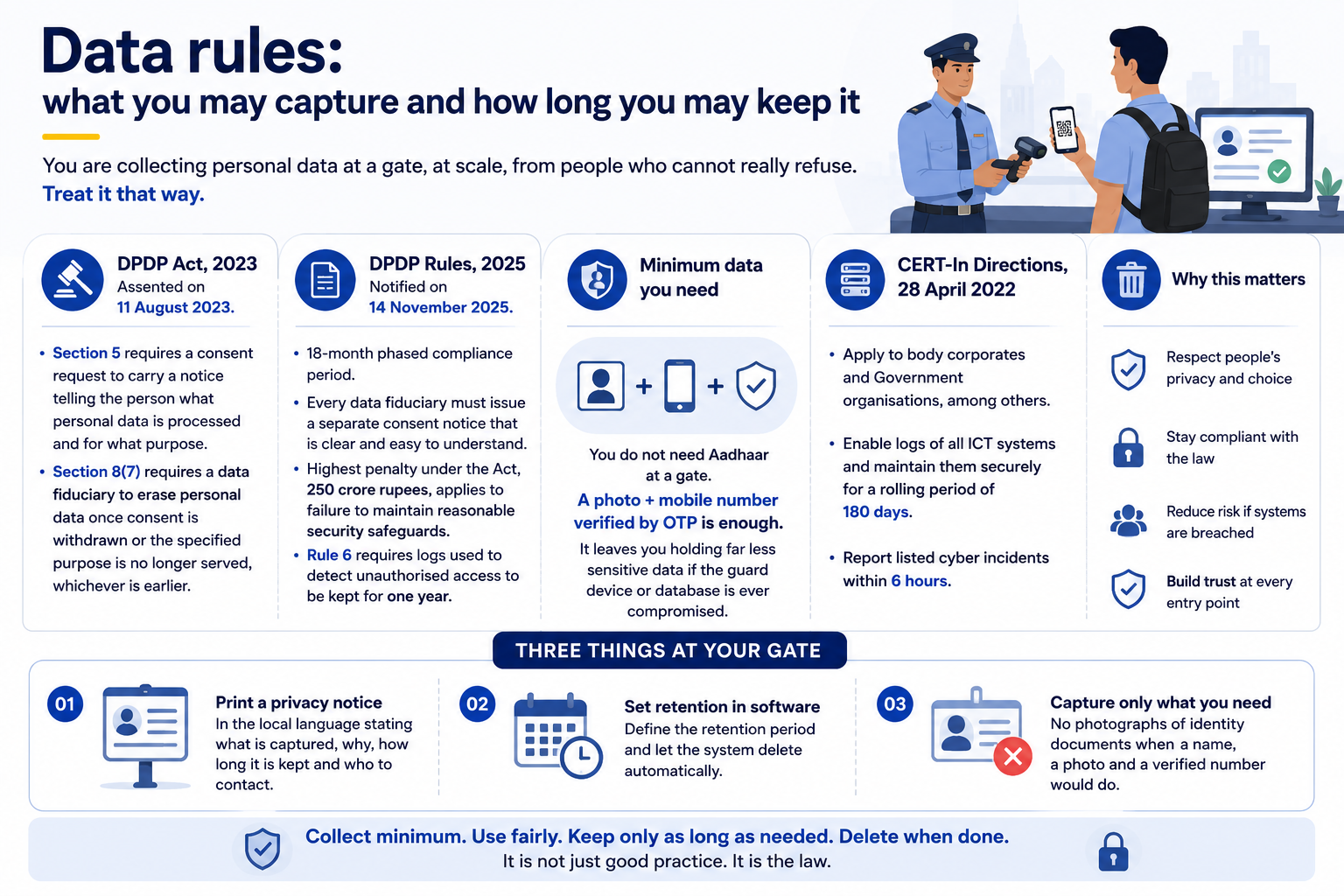
You are collecting personal data at a gate, at scale, from people who cannot really refuse. Treat it that way.
The Digital Personal Data Protection Act 2023 received assent on 11 August 2023. Section 5 requires a consent request to carry a notice telling the person what personal data is processed and for what purpose. Section 8(7) requires a data fiduciary to erase personal data once consent is withdrawn or the specified purpose is no longer served, whichever is earlier.
The DPDP Rules, 2025 were notified on 14 November 2025 with an eighteen-month phased compliance period. The Press Information Bureau note states that every data fiduciary must issue a separate consent notice that is clear and easy to understand, and that the highest penalty under the Act, 250 crore rupees, applies to failure to maintain reasonable security safeguards. Rule 6 requires logs used to detect unauthorised access to be kept for one year.
You do not need Aadhaar at a gate. A photo plus a mobile number verified by OTP is enough, and it leaves you holding far less sensitive data if the guard device or the visitor database is ever compromised.
The CERT-In directions of 28 April 2022 separately require body corporates and Government organisations, among others, to enable logs of all their ICT systems and maintain them securely for a rolling period of 180 days, and to report listed cyber incidents within 6 hours.
So, three things at your gate. A printed privacy notice in the local language stating what is captured, why, how long it is kept and who to contact. A retention period set in software that deletes automatically. And no photographs of identity documents when a name, a photo and a verified number would do.
Integration: turnstiles, HRMS and CCTV
Access control and turnstiles. Controllers are driven over Wiegand, OSDP or a vendor SDK, so a visitor QR code opens the same lane as a staff card, with an expiry time and an area restriction. This is also how you finally get reliable exit capture. Insist on a fire-mode release.
HRMS for the employee master. The host directory must come from HR, not a spreadsheet somebody maintains. When an employee leaves, their ability to invite visitors should end the same day.
CCTV. Full video integration is oversold. What you want is timestamp alignment, so a visit record at 14:12 at Gate 2 points an investigator to the right camera and the right minute. Sync both systems to one time source.
What we deployed, and how it works in practice
Accucia built and deployed a smart visitor management system for a government organisation in Maharashtra. That client stays anonymous, so this describes the mechanism, not named outcomes.
The hard part was not guest reception. A public building takes all four entry types at once, across multiple gates. Citizens arrive without appointments. Contractors arrive in gangs. Each department keeps its own idea of who is expected.
What we built covered pre-registration by QR invite, ID and photo capture at the counter, host notification, badge printing, a central watchlist applied at every gate, and gate pass handling for vehicles and material. The guard interface assumed weekly rotation, with local-language labels and an offline mode.
The full write-up publishes on 20 August as a government visitor management case study. Our government and public sector page covers procurement, audits and on-premise deployment.
Rolling out across a multi gate site
Do not go live everywhere at once. Start at the gate with the worst problem, usually the contractor gate, and run it alone for two weeks.
Then sequence it: employee master from HRMS, contractors with documents, pre-registration for one department, badge printing, then gate by gate. Keep the paper register in parallel for one week only, with a hard stop date.
Three reasons guards stop using it in week three, every time.
The device is dead. Nobody owns charging. Fix it with a mounted dock at each gate and a signed handover checklist at shift change.
One case takes too long. Usually the walk-in with no pre-registration. If that path takes ninety seconds and the paper book takes fifteen, the book wins. Time it, then cut steps.
Nobody reads the output. If no supervisor opens the daily report, guards conclude the data does not matter and start entering rubbish. Assign one person to review yesterday's entries every morning for the first month.
Accucia's view
Most visitor management projects in India fail on the guard interface, not the software. We have watched well-specified systems get abandoned because check-in took four taps too many at a gate where twenty people stood waiting in the sun.
Our position: buy the smallest system that covers all four entry types, and spend what you save on the gate itself. Rugged devices. A charging routine. Local-language labels. Offline capability. A check-in a guard hired last week finishes in under twenty seconds. Skip the visitor mobile app, because visitors will not install it. Skip ANPR unless vehicle throughput is your bottleneck.
That advice costs us revenue on every deal where we could have sold more modules. We give it anyway, because a system guards bypass is worth less than the paper book it replaced.
Cost is driven by gate count, hardware, offline capability, language packs, integrations and where you host. We scope each site before quoting. Ask for a written scope on the Accucia contact page.
Frequently Asked Questions
1. What is a visitor management system?
A visitor management system is software that controls and records entry to a building. It handles pre-registration, identity capture, host approval, badge printing and exit logging. It replaces the paper gate register with a searchable record, and gives security staff a live list of everyone inside the premises.
2. Is a paper visitor register still legal in India?
No general law bans a paper register. The problem is evidential, not legal. A paper book cannot prove who was inside during an incident, cannot be searched quickly, and cannot produce an accurate list during an evacuation. A timestamped digital record answers all three questions. A bound book answers none.
3. What does a visitor management system cost in India?
Cost depends on the number of gates, kiosks or guard tablets, badge printer and scanner hardware, offline capability, language packs, integration with turnstiles or HRMS, and whether you host in-region or on your own servers. Accucia scopes each site before quoting and gives a written scope.
4. Can a visitor management system work when the gate has no internet?
Yes, if it is built for it. The gate app should hold the employee master, the watchlist and the day's pre-registrations locally, record entries offline, and sync when the link returns. Ask the vendor to demonstrate a full check-in with the network cable pulled out.
5. Should we capture Aadhaar at the gate?
Avoid it. A gate does not need a national identity number to know who walked in, and a photocopy of one sitting in a guard drawer or an unencrypted database is a liability you gain nothing from. For visitor entry, a photo plus a mobile number verified by OTP is enough.
6. How long should visitor data be kept?
Set a retention period and enforce it in software. Section 8(7) of the Digital Personal Data Protection Act 2023 requires a data fiduciary to erase personal data once the specified purpose is no longer served or consent is withdrawn, whichever is earlier. Most sites keep visitor photos far longer than any purpose justifies.
7. What is a gate pass system and how is it different?
A gate pass system controls what leaves or enters as material, not who. It covers inward material, returnable and non-returnable outward gate passes, and vehicle movement. A visitor management system covers people. On a factory or a government campus you need both, running on the same guard device.
8. Can it handle contractors and labour gangs?
Yes, and this is where most sites lose control. Contractor workers should be enrolled once against a contractor record, with skill, induction date and insurance validity stored, then checked in daily by face or card. Entry should be blocked automatically when a document expires, without the guard making that call.
9. How does it help during a fire evacuation?
It produces a live list of everyone currently inside, split by gate and by area, on a phone the safety officer already carries. Guards can mark people as accounted for at the assembly point. Without that list, the only way to know who is still inside is to ask around.
10. Can it integrate with our existing turnstiles and HRMS?
Usually yes. Turnstiles and access controllers are driven over Wiegand, OSDP or a vendor SDK, so a temporary visitor credential can open the same lane as a staff card. HRMS supplies the employee master and the host directory. CCTV integration is normally done by matching timestamps rather than video.
11. Where is our visitor data stored?
Accucia deploys in-region on request using AWS, Azure or GCP, with the region chosen to meet your requirement and infrastructure billed to you at cost. We also deploy on your own on-premise servers, which is what many government sites prefer. Sub-processors are limited to those cloud providers.
Ready to modernise visitor management? Book a consultation with Accucia.