Sellon Finserv: From Excel to a Loan Distribution CRM
Quick Answer
Sellon Finserv, an India-based loan distribution company, ran lead management in Excel, document collection on WhatsApp and partner commissions by hand. Accucia Softwares Pvt. Ltd. built them a loan distribution CRM: a web dashboard for management and a mobile app for the field, with lead capture and routing, configurable loan stages, stage-based disbursement tracking, a document collection portal, commission automation, a partner app and field attendance, in one system. This is what was replaced and why a generic CRM could not do it. By Mr. Sumeet Katariya, Accucia Softwares Pvt. Ltd
Who Sellon Finserv is
Sellon Finserv is a loan distribution company in India. It places mortgage products, home loans, mortgage loans, construction finance and commercial premises loans, with a panel of banks, housing finance companies and other financial institutions. Its leads come from developers, from its website and from a network of sales partners, and its customers range from individual home buyers to businesses financing premises.
It is not a lender. It sits between the borrower, the developer, the partner who introduced the lead and the institution that funds the loan. That position is what makes its operations harder than they look from outside.
What the business ran on before
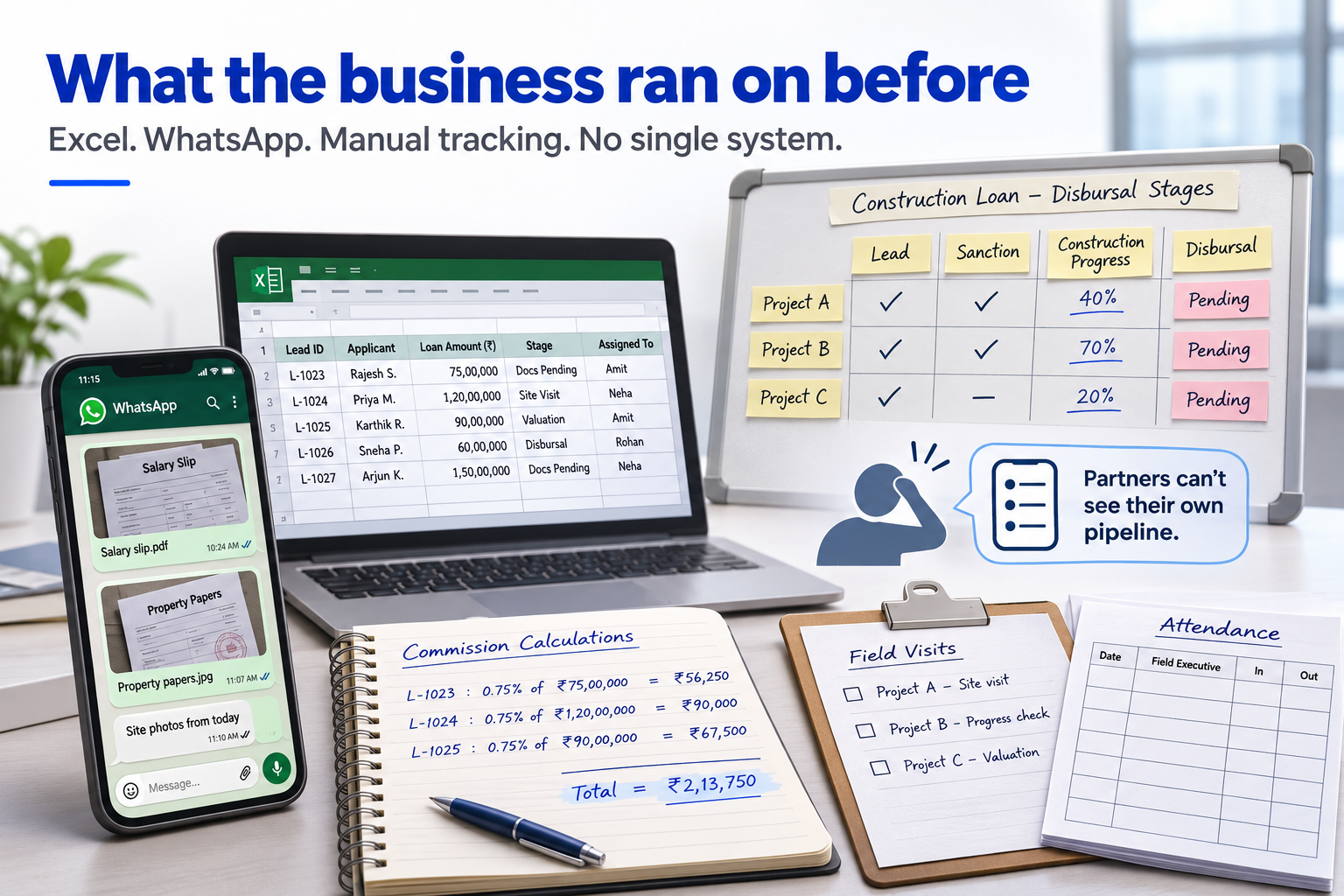
The picture will be familiar to anyone in loan distribution.
Leads arrived from several directions and were tracked across Excel, WhatsApp and memory. Assignment was manual. Response was as fast as whoever saw the message first.
Documents were collected by chasing on WhatsApp. A salary slip here, a property paper there, scattered across chats, with no view of what was still pending for which file.
Construction-finance disbursals are released in stages against project progress. Those stages were tracked by hand and reconciled with difficulty.
Partner commissions, which differ by bank and by product and sometimes split across people, were calculated at month end over several days, and the partners had no view of their own earnings until the calculation was done.
Site visits and field attendance were not recorded in any system. Onboarding a new growth partner took weeks, and once onboarded the partner could not see their own pipeline.
None of this was a lack of effort. It was a business that had outgrown the tools it started with, which is the most common reason anyone calls us.
Why a generic CRM did not fit
Sellon had looked at ready-made CRMs. The problem was not features. It was shape.
A generic sales CRM understands a lead, a deal and a close. It does not understand a loan file that moves through document collection, bank submission, sanction and disbursement, each with its own required fields and sign-offs. It does not understand that a construction loan disburses in tranches tied to site verification. It does not understand commission rules that vary by funding institution, can be percentage or flat, tiered, split or pro-rata, and carry GST and TDS treatment. And it does not give an external partner a controlled window into their own leads and earnings.
Every one of those could be approximated with custom fields and spreadsheets on the side. Which is how the business ended up with Excel in the first place. We have written about where leads get lost in most businesses, and the gaps between tools is the usual answer.
What was built, module by module
The system is a loan distribution CRM with two faces: a web dashboard for management and office staff, and a mobile app for the field team and partners. Role-based access covers admin, manager, loan officer and partner.
The mobile app is built offline-first, so a loan officer at a site with poor signal still records the visit and the app syncs later. Push notifications carry stage changes to the people who need them. The full technical build is on the Sellon Finserv portfolio page.
What changed in the daily work
We are deliberately not publishing numbers in this post. What we can describe is the shape of the work before and after.
A lead now lands in one place regardless of where it came from, is routed to an officer, and cannot be forgotten because an unworked lead is visible. A loan file moves through stages that mean the same thing to everyone, and a file stuck at a stage raises an alert rather than waiting for someone to ask about it. A borrower receives a link and uploads documents against a checklist, so the officer sees what is pending without opening a chat. A construction-finance tranche is released against a verified site visit with photos, and the reconciliation happens in the system. A partner opens their app and sees their leads and their commission, calculated by the rules for that bank, without phoning the office. The owner opens the dashboard and sees the pipeline by stage and by officer.
The spreadsheets did not get better. They got retired.
How the build was run
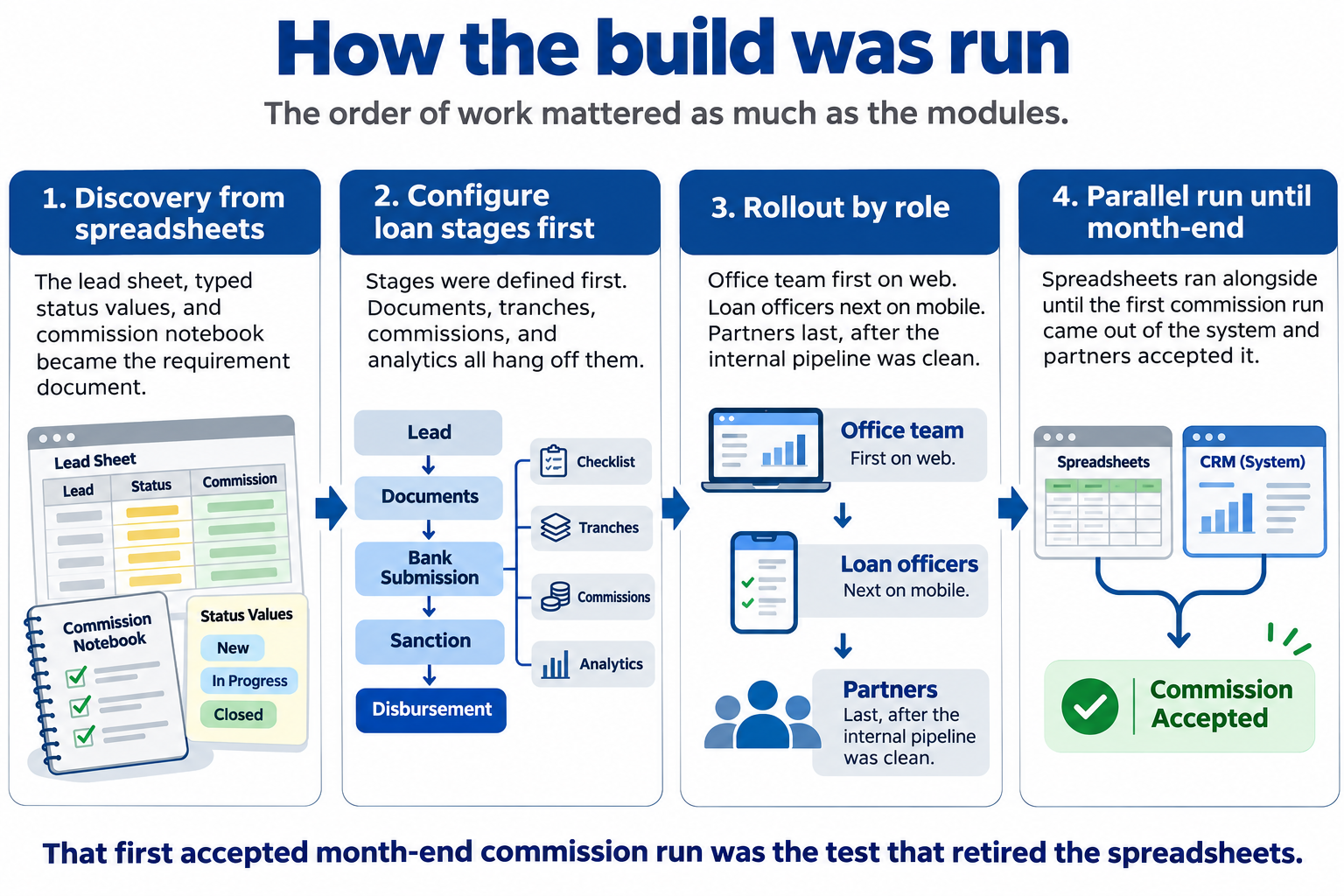
The order of work mattered as much as the modules, so here it is without durations, because every distribution business will take a different time.
Discovery started from the spreadsheets, not from a feature list. The columns in the lead sheet, the status values people actually typed, and the commission workings in the notebook were the requirement document. Where two people used the same status to mean different things, that became a configured stage with a definition.
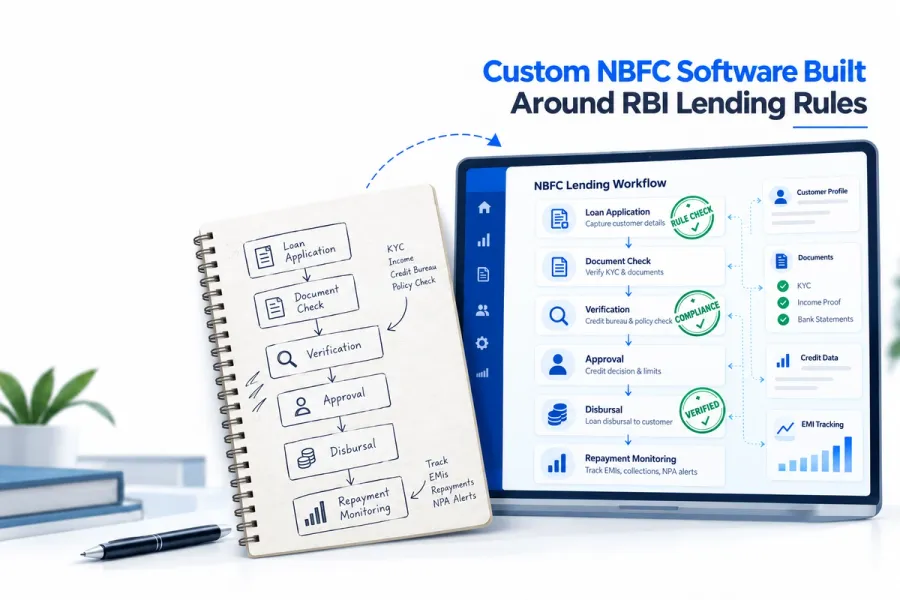
The loan stages were configured before anything else, because every other module hangs off them: documents are checklists per stage, disbursement tracking is a stage with tranches, commissions are triggered by a stage, analytics are counts per stage.
The office team went first on the web dashboard, then the loan officers on the mobile app, and the partners last, once the internal pipeline was clean enough to show them. A partner's first view of their own pipeline should not be a messy one.
And the spreadsheets ran alongside until the first month-end commission run came out of the system and the partners accepted it. That was the test that retired them.
Where the RBI Directions touch a distributor
A distributor is not the lender, but it is not outside the regulation either. In the Reserve Bank of India (Digital Lending) Directions, 2025, issued on 8 May 2025 as circular RBI/2025-26/36, a company that interfaces with the borrower on a lender's behalf falls within the category of lending service provider, and two clauses shape how a distribution system has to behave.
Paragraph 9(i) says that "disbursement of loan by the RE shall always be made into the bank account of the borrower." A distribution CRM therefore tracks disbursal stages and tranches as events; it never sits in the flow of funds, and the system is built so that it cannot.
Paragraph 11(i) says that "the RE, and the LSP which has an interface with the borrower, shall designate nodal grievance redressal officers." That is why borrower-facing records, document requests, stage communications and complaints, live in the system with an owner and a timestamp rather than in a chat thread.
We are not lawyers and this is not legal advice. It is the reason the document portal and the audit trail were built the way they were.
What a loan distribution company should check before building
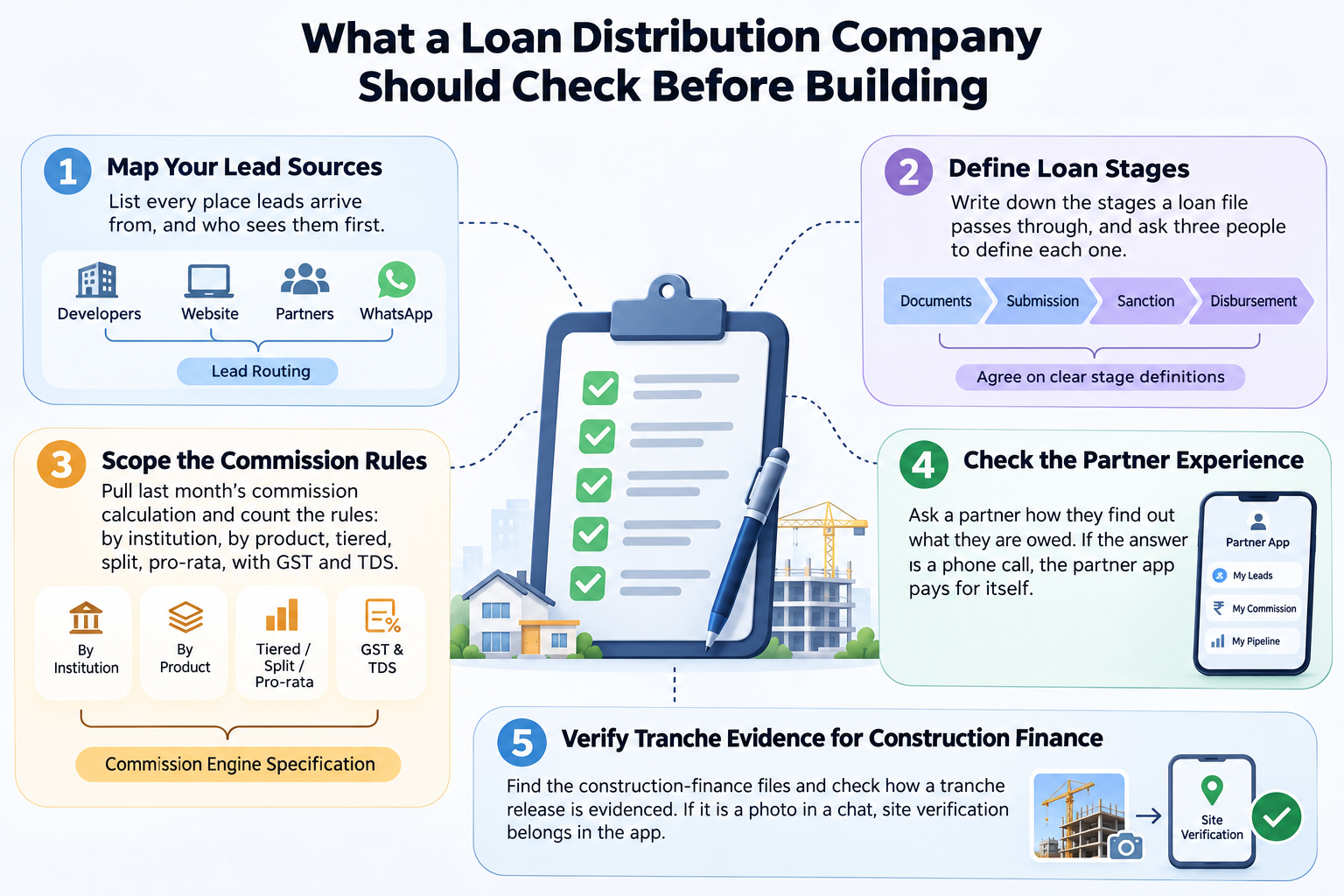
List every place a lead can arrive from today, and who sees it first. If the answer includes "whoever opens WhatsApp", lead routing is the first module.
Write down the stages a loan file passes through, then ask three people to define each one. Disagreements are configuration decisions waiting to be made.
Pull last month's commission calculation and count the rules in it: by institution, by product, tiered, split, pro-rata, with GST and TDS. That count is the commission engine's specification.
Ask a partner how they find out what they are owed. If the answer is a phone call, the partner app pays for itself in office time alone.
Find the construction-finance files and check how a tranche release is evidenced. If it is a photo in a chat, site verification belongs in the app.
Common mistakes in loan distribution CRM projects
Buying the generic CRM and promising to "customise later". Later is when the spreadsheets come back.
Launching the partner app first. Partners see the mess before the internal team has cleaned it, and the first impression sticks.
Treating commission rules as a report. They are a calculation engine with legal consequences for GST and TDS. Build them as rules, test them against last month's actuals, and only then switch.
Leaving the field out. Site visits and attendance are the evidence behind tranche releases. If they are not in the system, the disbursal tracking is only half built.
What this says about custom CRM
Sellon's case is a clean example of when to build rather than configure. The business was not unusual in needing a CRM. It was unusual in the specific shape of its workflow: multi-source leads, stage-gated loan files, tranche disbursal, rule-based commissions, external partners. Each of those is a place where a generic product asks you to keep a spreadsheet on the side, and the spreadsheets are where the business was already drowning.
That is the test we apply in CRM development conversations. If your workflow fits the product's shape, buy it. If the product's shape forces three spreadsheets alongside it, the spreadsheets are the requirement document for the build. For lenders themselves, the same logic runs through loan origination versus lending automation, and our lending automation work sits on the funding side of the same chain Sellon operates in.
Accucia's view
A loan distribution business lives in the gaps between the borrower, the partner and the bank, and a generic CRM has no room for those gaps, so they fill with spreadsheets and WhatsApp. Sellon Finserv's system is what it looks like when the gaps are built into the software instead: one record per loan file, from the lead to the last commission payment, with the field and the partners inside it.
Watch: How Accucia Softwares Helped Sellon Finserv Streamline Lead Management with a Custom Solution.
Read the edition: The Enterprise AI Edge, Ed.22, A requirement met by a person fails on leave days.
If your sales team runs on Excel and your partners phone the office for their commission figure, start with the free AI Readiness Assessment. It maps where each part of your workflow lives today and what to build first.
FAQ
What did Accucia build for Sellon Finserv?
A loan distribution CRM with a web dashboard for management and a mobile app for the field: lead capture and routing, configurable loan stages with approvals and alerts, stage-based disbursement tracking for construction finance, a borrower document collection portal, commission automation by bank and product, a growth partner app, GPS-verified field attendance, and pipeline analytics.
Why did a generic CRM not work for a loan distribution company?
A generic CRM understands leads, deals and closes. It has no structure for stage-gated loan files, tranche disbursals tied to site verification, commission rules that vary by funding institution, or a controlled partner view of leads and earnings. Approximating those with custom fields pushes the real work back into spreadsheets.
Is Sellon Finserv a lender?
No. Sellon Finserv is an India-based loan distribution company that places mortgage and related products with banks, housing finance companies and other institutions. It works between borrowers, developers, sales partners and funding institutions, which is why its workflow needed a purpose-built system.
Does a loan distribution CRM handle the loan funds?
No. Under paragraph 9(i) of the Reserve Bank of India (Digital Lending) Directions, 2025, disbursement is made by the lender directly into the borrower's bank account. A distribution CRM tracks disbursal stages and tranche evidence as events in the loan file; it does not sit in the flow of funds and is built so that it cannot.
Does the Sellon system work in the field without internet?
Yes. The mobile app is built offline-first, so site visits, photos and signatures are recorded without a connection and synced when the phone reconnects, and push notifications carry stage changes to officers and partners.
See how Accucia transformed Sellon Finserv’s loan operations. Watch the success story now!