Custom CRM Development: Build or Buy for Mid-Market
Quick Answer
Buy an off-the-shelf CRM when your pipeline is standard, your team is small and you have little to integrate. Build a custom CRM when your sales process is itself the advantage, when your vertical's workflow fights generic tools, or when the CRM must connect deeply to systems you already run. By Mr. Sumeet Katariya, Accucia Softwares Pvt. Ltd.
Most businesses use under 30% of the software they pay for. The CRM is usually exhibit one.
Walk any mid-market sales floor and you will find the evidence: a powerful platform configured in year one, half-adopted by year two, and quietly bypassed through spreadsheets by year three. The build-or-buy question is really a fit question, and fit is something you can reason about before spending anything.
When buying wins
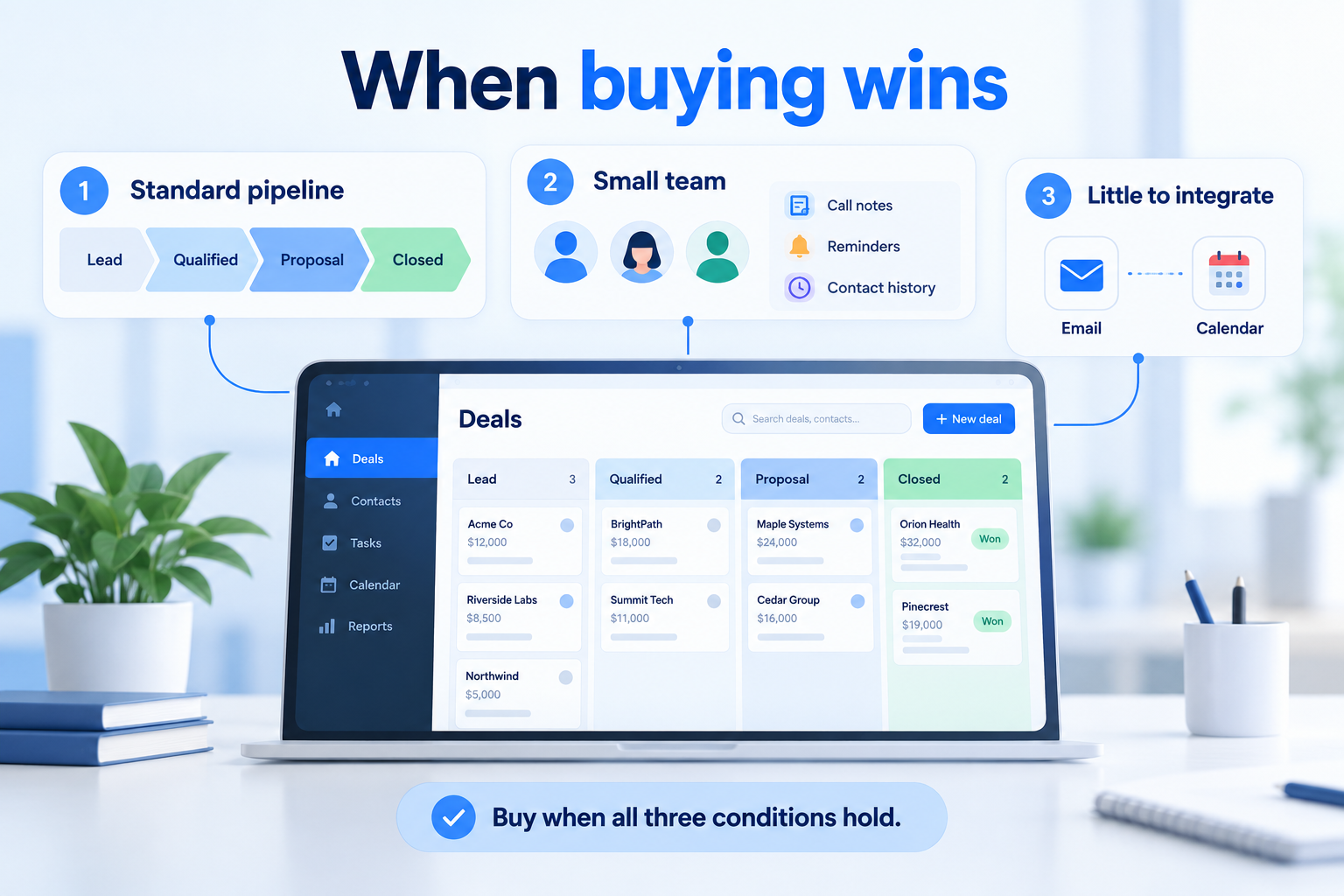
Off-the-shelf CRMs are genuinely good at what they were designed for, and pretending otherwise is how bad build decisions get made. Buy when three conditions hold.
Your pipeline is standard. Lead comes in, gets qualified, gets a proposal, closes or does not. If your process maps cleanly onto stages a generic tool already ships with, you are the customer those products were built for, and a custom build would reproduce at expense what you can rent immediately.
Your team is small and the tool is mostly a memory aid. For a handful of salespeople who need contact history, reminders and a pipeline view, an off-the-shelf product delivers value in week one. The discipline of using it matters far more than what it is.
You have little to integrate. A CRM that stands alone, or touches only email and a calendar, carries none of the integration burden that makes generic tools creak. The pain starts when the CRM must talk to inventory, billing, site operations or loan systems, because that is where configuration ends and contortion begins.
Honest advice from a company that builds software: if all three hold, buy, and spend the money you saved on actually enforcing usage. No custom build fixes a team that will not log calls.
When building wins
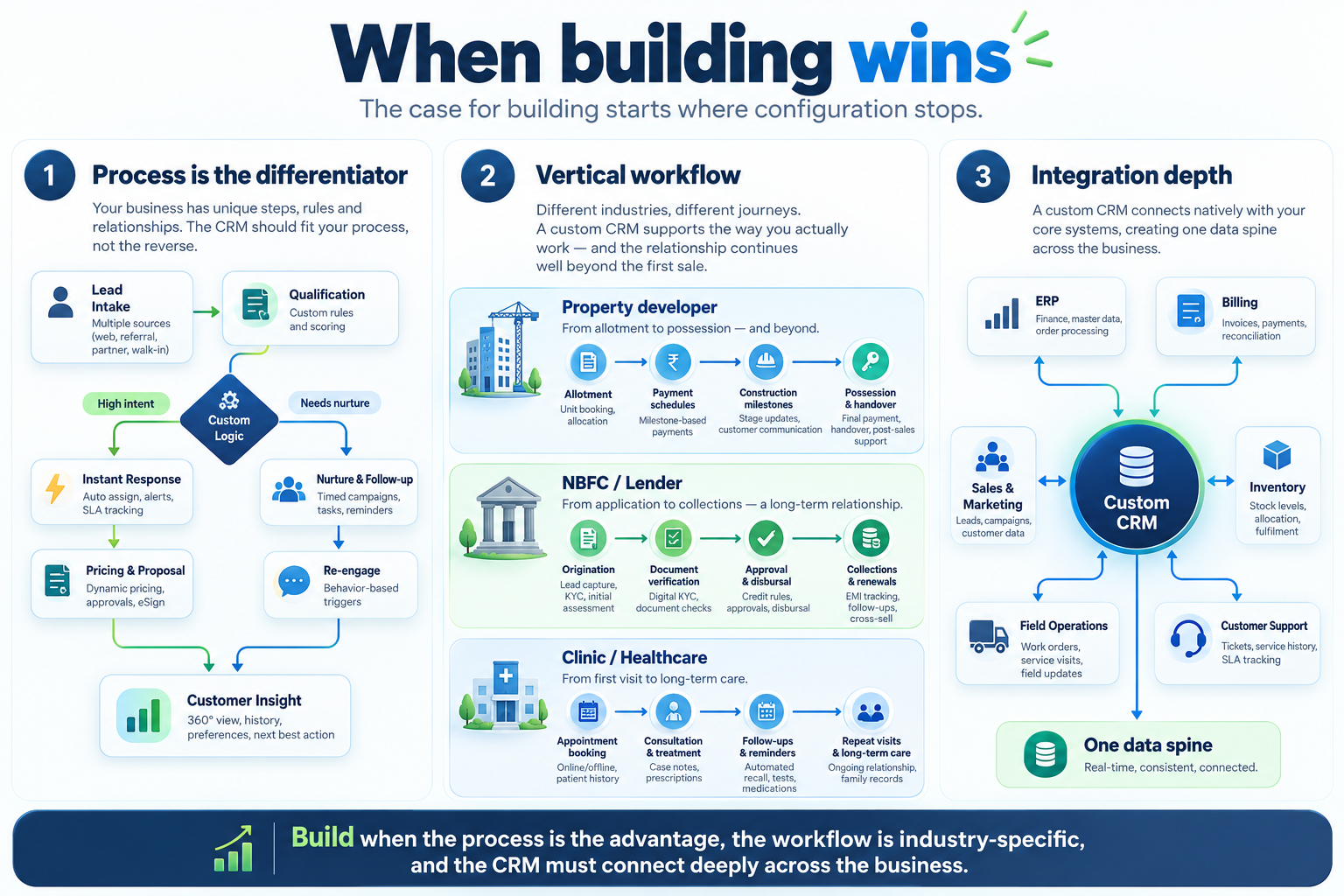
The case for building starts where configuration stops.
The first signal is that your process is the differentiator. Some businesses win because of how they sell: how fast they respond, how they sequence follow-ups, how they price, what they know at the moment of conversation. Forcing that process into someone else's stage model sands off the edge that made it work. When the process is the advantage, the system should fit the process, never the reverse.
The second signal is vertical workflow that generic tools fight. A property developer's sale does not end at closing; it runs through allotment, payment schedules, construction milestones and possession. A lender's "pipeline" is an origination flow with credit checks, document verification and a collections tail. A clinic's revenue walks in on repeat visits, not one-time deals. Generic CRMs can be bent toward each of these, and the bending is exactly the under-30% problem: fields nobody fills, stages nobody believes, reports nobody trusts.
The third signal is integration depth. When the CRM must read and write against ERP, billing, inventory or field operations, a custom build connects natively to how we approach ERP and CRM solutions: one data spine instead of a federation of half-synced tools.
What custom CRM looks like by vertical
Abstract arguments only go so far. Here is what the build choice looks like in three verticals we work in.
Real estate: enquiry to possession. For a renowned real estate developer in Mumbai, the sales object is not a deal, it is a unit, and the relationship runs from first enquiry through booking, payment milestones and possession. A custom CRM models that whole arc: inventory-aware enquiry handling, booking against specific units, milestone-linked follow-ups. An AI layer on top of a system like this can answer questions against live inventory and customer records, the kind of capability no generic pipeline tool offers out of the box.
NBFC lending: origination to collection. In lending, the CRM and the loan lifecycle are the same system wearing two hats. An enquiry becomes an application, an application becomes a file moving through verification and approval, a disbursed loan becomes a repayment relationship with its own follow-up cadence. Our lending automation work exists because that flow, origination through collection, is a workflow problem first and a sales problem second. Generic CRMs model the first two weeks of that relationship and go silent for the following five years.
Clinics: lead to revisit. The clinic operating system built at Dr. Tathed's treats the patient relationship as the asset: enquiry handling, appointment flow, and the revisit cycle that clinic revenue actually depends on. The CRM logic is inseparable from the operational system around it, which is precisely why it was built rather than bought.
Three verticals, one pattern: the custom system earns its keep where the relationship outlives the transaction.
The decision table
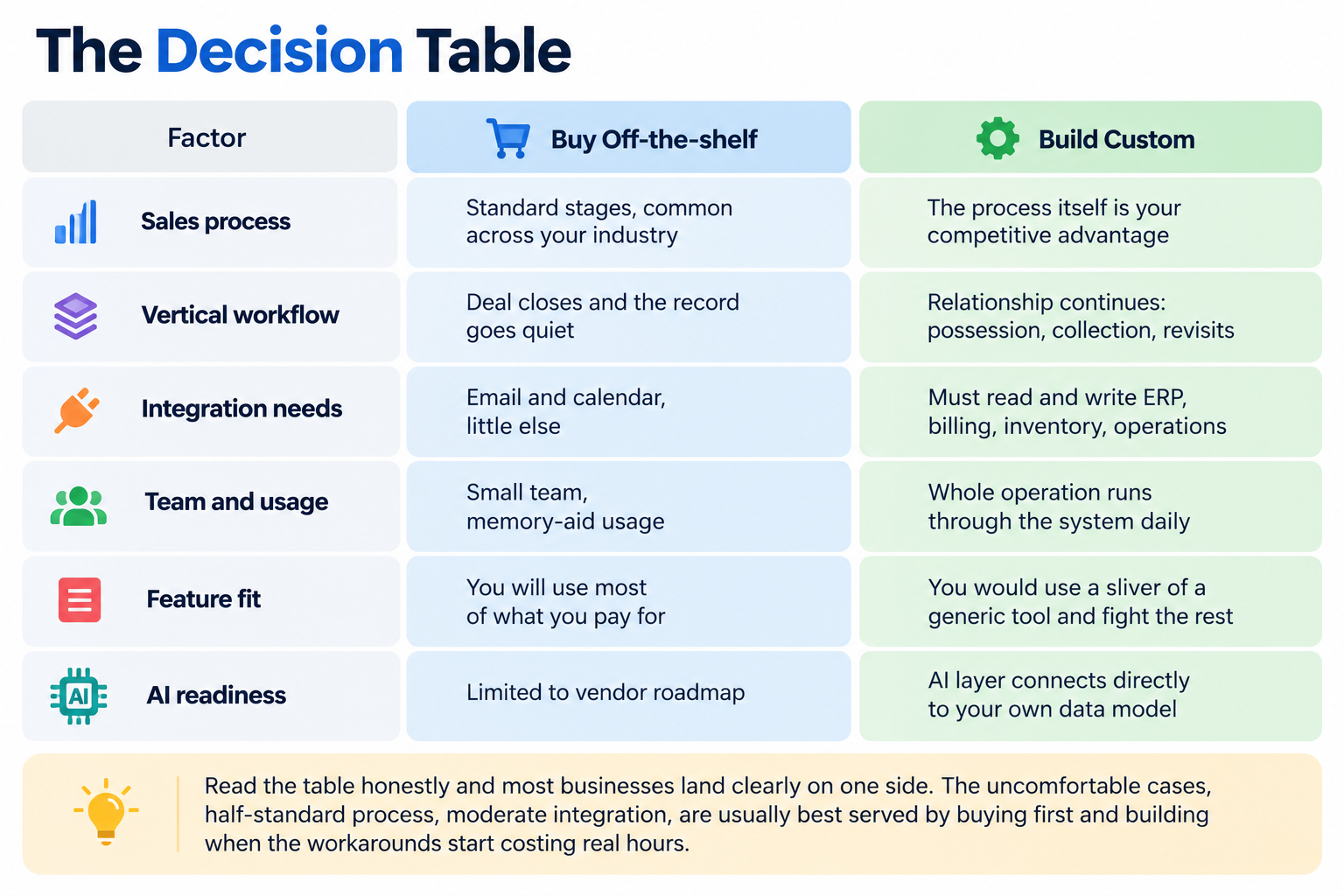
Factor: Sales process
Buy off-the-shelf: Standard stages, common across your industry
Build custom: The process itself is your competitive advantage
Factor: Vertical workflow
Buy off-the-shelf: Deal closes and the record goes quiet
Build custom: Relationship continues: possession, collection, revisits
Factor: Integration needs
Buy off-the-shelf: Email and calendar, little else
Build custom: Must read and write ERP, billing, inventory, operations
Factor: Team and usage
Buy off-the-shelf: Small team, memory-aid usage
Build custom: Whole operation runs through the system daily
Factor: Feature fit
Buy off-the-shelf: You will use most of what you pay for
Build custom: You would use a sliver of a generic tool and fight the rest
Factor: AI readiness
Buy off-the-shelf: Limited to vendor roadmap
Build custom: AI layer connects directly to your own data model
Read the table honestly and most businesses land clearly on one side. The uncomfortable cases, half-standard process, moderate integration, are usually best served by buying first and building when the workarounds start costing real hours.
Integration and the AI layer
One factor has changed the build-or-buy calculus in the last two years: what sits on top of the CRM.
A CRM your assistant can read is a different asset from a CRM your team queries by hand. When the data model is yours, an AI layer can be wired directly into it: ask which enquiries have gone quiet, which files are stuck in verification, which patients are due a revisit, and get answers from live records. This is capability framing, not magic; the assistant is only as good as the structure beneath it. Our MCP integration service does exactly this wiring, giving an AI layer governed access to the systems a business already runs.
Here the custom route has a structural edge. On a bought platform, AI arrives on the vendor's roadmap, shaped by the vendor's generic data model. On a built system, the data model already matches how your business thinks, so the AI layer inherits that fit. The real estate deployment above is the live example: the AI capability was possible because the underlying system modelled units, bookings and milestones in the first place.
This cuts the other way too, worth saying plainly. If you buy, pick the platform with the cleanest data and API story you can find, because whatever you choose will be asked to feed an assistant sooner than you think.
Accucia's view
Build or buy is not a philosophy question, it is a fit question, and the under-30% utilisation problem is what bad fit costs year after year. Buy when a standard tool covers a standard process. Build when the process is the advantage, the vertical workflow is the business, or the CRM must sit on one data spine with everything else you run. Accucia has been building these systems since 2018 from Pune, across real estate, lending and healthcare operations, and the pattern holds: the systems that get used are the ones shaped like the business.
Want to know whether your operation is on the build side of the table, and what an AI layer could read if it were? Start with our free AI Readiness Assessment.
FAQ
When should a business build a custom CRM instead of buying one?
Build when your sales process is itself a competitive advantage, when your vertical's workflow continues long after the deal closes, or when the CRM must integrate deeply with ERP, billing, inventory or operations. Buy when your pipeline is standard, your team is small and integration needs are light.
Why do so many CRM implementations fail to get used?
Fit. Most businesses use under 30% of the software they pay for, and the CRM suffers worst because generic stage models rarely match real processes. Fields nobody fills and stages nobody believes push teams back to spreadsheets, which is a fit failure rather than a discipline failure.
What does a custom CRM look like in specific industries?
In real estate, it runs enquiry to possession with inventory-aware bookings and milestone follow-ups. In NBFC lending, it carries origination through verification, disbursement and collections in one flow. In clinics, it manages the lead-to-revisit cycle that repeat-visit revenue depends on. Each models a relationship that outlives the transaction.
How does AI change the CRM build-or-buy decision?
A custom CRM owns its data model, so an AI layer can connect directly and answer questions from live records: quiet enquiries, stuck files, due revisits. On bought platforms, AI capability arrives on the vendor's roadmap and fits the vendor's generic model, which weakens the assistant's usefulness.
Build or Buy? Find the Right CRM for Your Business