
Custom NBFC Software Built Around RBI Lending Rules
Quick Answer
Generic loan management software forces your credit process into the vendor's shape, and compliance gets bolted on through workarounds. A custom NBFC build starts from your actual lending flow, from origination to collections, and writes the RBI Digital Lending Directions into every step: key fact statements, disbursal paths and consent capture enforced by the system itself. By Mr. Sumeet Katariya, Accucia Softwares Pvt. Ltd.
Where generic loan software pinches an NBFC
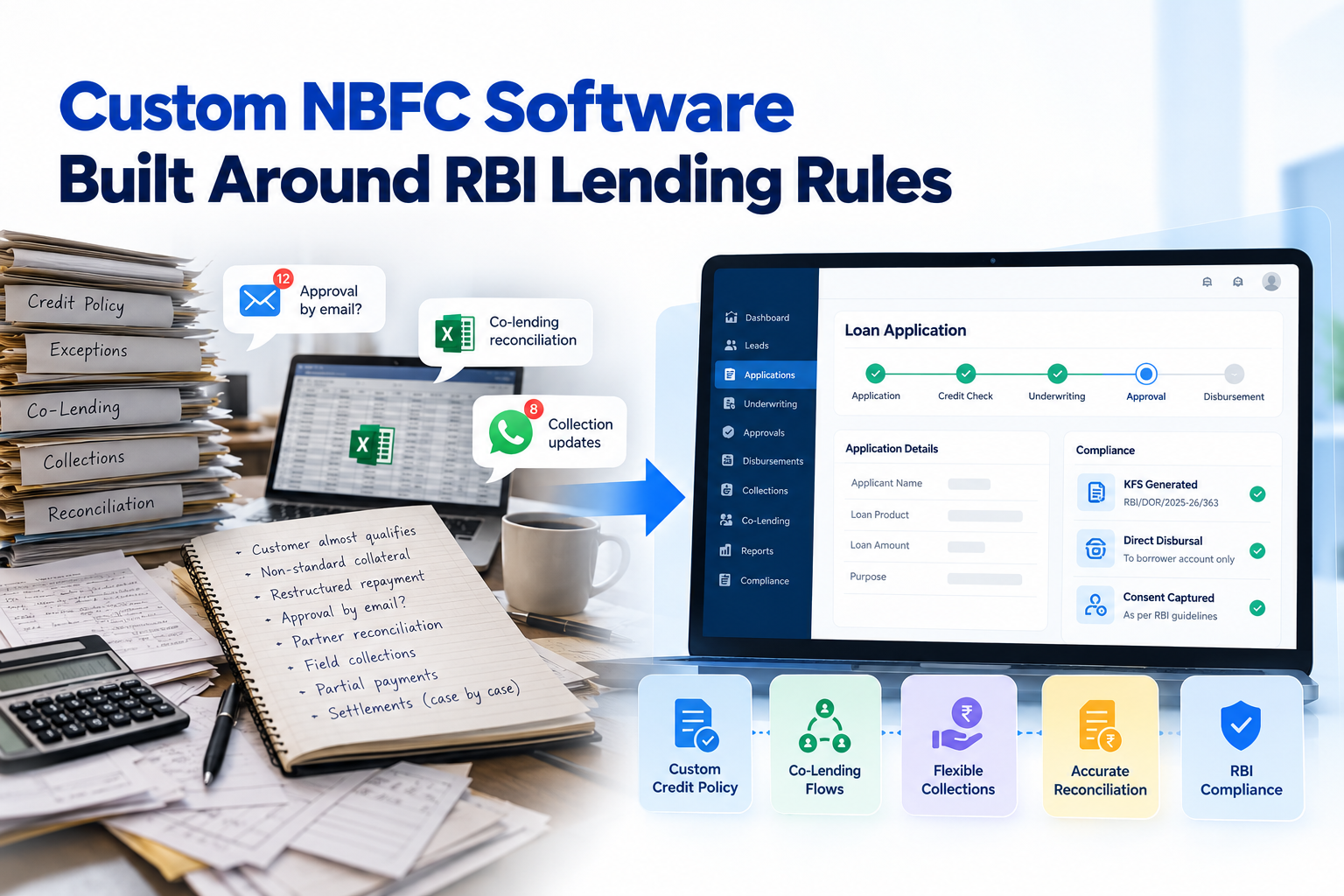
Every NBFC we have spoken to runs on exceptions. The credit policy says one thing, and then there is the customer who almost qualifies, the collateral that does not fit the standard categories, the repayment schedule that was restructured after a bad season. Generic loan management software handles the policy. It is the exceptions that pinch.
Start with credit policy exceptions. Most off-the-shelf products model approval as a linear flow with a deviation flag. Real NBFCs run layered exception matrices: who can approve what deviation, at what exposure, with what additional documentation. When the product cannot model that, the exception moves to email. Now your most sensitive credit decisions live outside the system of record, invisible to audit.
Co-lending flows pinch harder. Two balance sheets, two sets of credit decisions, split disbursals, split collections, reconciliation between partners. A product built around single-lender assumptions treats all of that as an integration problem. Teams end up reconciling co-lending books in spreadsheets, which is exactly where fund flow rules are most likely to be quietly broken.
Then there is collections reality. Software designed in a conference room assumes borrowers answer phones and pay online. Field collections, partial payments collected in cash and deposited later, settlements negotiated case by case, none of this fits the tidy bucket logic most products ship with. So collections teams build their own trackers, and the gap between what the system says and what is actually happening in the field widens every month.
None of these are software bugs. They are the predictable cost of running your process on someone else's abstraction. Your credit process is the business. Software that makes you change it to fit the vendor's screens is selling you their process, not yours.
What custom means in lending
Custom gets misunderstood as building everything from scratch, which scares people off. What it actually means is simpler: the system is mapped to your flow, stage by stage, rather than your flow being mapped to the system.
In origination, that means your sourcing channels, your document set, your exception matrix. If your field officers capture leads on a phone in a language other than English, the system should too. If your credit committee works a certain way on certain exposures, the approval routing should mirror it exactly, including the people who must sign off and the order they sign in.
In underwriting, custom means your scorecard, not a generic one with your logo. The data points your credit team actually weighs, the thresholds they actually apply, and room for the manual judgment layer most NBFC lending still depends on. The system should record that judgment, not pretend it does not exist.
In servicing, it means your repayment structures. Restructures, moratoria, part-prepayments with your specific recalculation rules. And in collections, it means the reality described above: field visits, cash receipts, settlement workflows, each one captured where it happens so the loan file stays complete.
The connective tissue matters as much as the stages. A custom build gives you one data spine from first lead to final closure, which is what makes audit trails, regulatory reports and management questions answerable from one place. We build lending systems this way as a practice, and the approach is documented at https://www.accucia.com/services/lending-automation for anyone who wants the longer version.
A caution from experience: custom is only worth it when your process genuinely diverges from the standard. An NBFC doing plain salaried personal loans against bureau scores will get most of what it needs off the shelf. The case for custom grows with every exception matrix, co-lending partner and field process you run.
Compliance built in, not bolted on
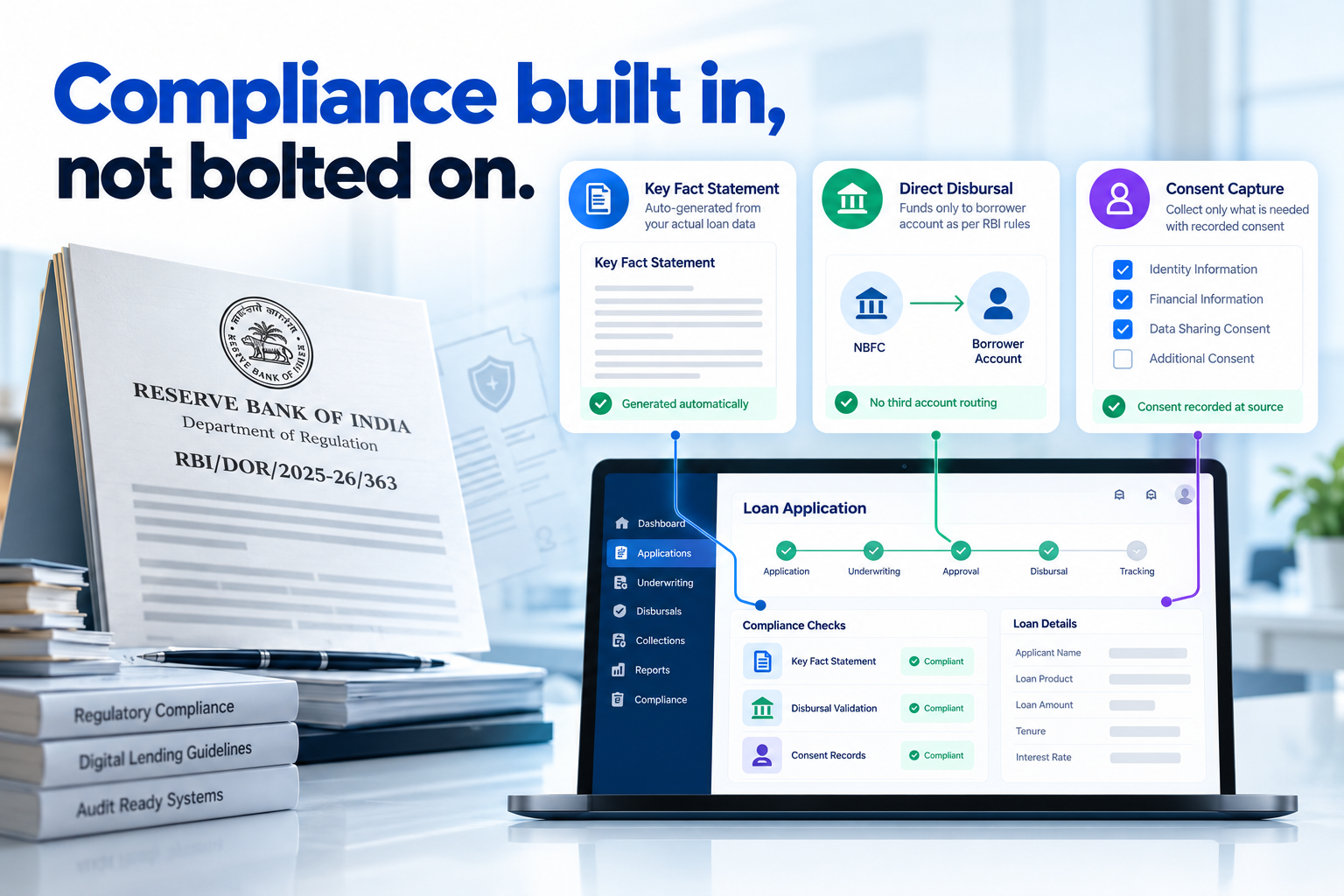
The strongest argument for custom in 2026 is regulatory. RBI/DOR/2025-26/363, issued 28 November 2025, put obligations on digital lending that are properties of the software's behaviour, not of any policy document. Three of them shape system design directly.
The key fact statement first. It is a generated document, and generation is a software feature. In a custom build, the statement is produced from the same tables that drive the loan: the charges configured on the product, the schedule the system will actually enforce. Change the loan and the statement changes with it. In a bolted-on arrangement, someone maintains a template beside the system and fills it from memory. That works until volume grows or the one person who knows the template goes on leave.
Disbursal next. The RBI Digital Lending Directions require funds to move directly between the regulated entity and the borrower. In a custom system you can make non-compliant routing structurally impossible: the disbursal module simply has no path that touches a third account. That is a stronger position than a configuration setting someone could change, and it is the kind of thing an inspector can be shown in minutes.
Consent capture third. The borrower journey collects only what the lending decision needs, consent is recorded against each data point at the moment of collection, and refusal is handled gracefully instead of silently blocking the application. When you own the build, the consent boundary is drawn where the regulation draws it, not where a foreign product's defaults happen to sit.
The pattern across all three: compliance stops being a review activity and becomes an architectural property. Your compliance team reviews what the system enforces rather than policing what people remember to do. For how we handle the surrounding questions, hosting, data handling and our standing positions on security, see https://www.accucia.com/trust.
The AMC Bank relationship as BFSI trust proof
Claims about understanding banking are cheap, so here is ours in verifiable form. AMC Bank has worked with Accucia since 2018. In banking and finance, the length of a technology relationship says more than any feature list, because a partner that mishandles a regulated institution's work does not get year after year of it.
Eight years covers a lot of regulatory weather. Circulars arrive, audit findings need responses, systems get inspected. A vendor relationship that survives all of that has been tested in the exact dimension an NBFC should care about: does this partner keep showing up, keep adapting the system, and keep the institution comfortable in front of its regulator?
Mr. Tejas Tiwari, IT Head at AMC Bank, has spoken about the working relationship from the bank's side, and the engagement is documented in our portfolio at https://www.accucia.com/portfolio/banking-website-development-amc-bank. We will not dress the relationship up with performance numbers. The fact that matters is the duration, and that it continues.
For an NBFC evaluating a custom build, the transferable point is this: ask any prospective partner for their longest BFSI relationship and what it survived. The answer tells you more than a capabilities deck.
Where an AI layer fits a lending stack
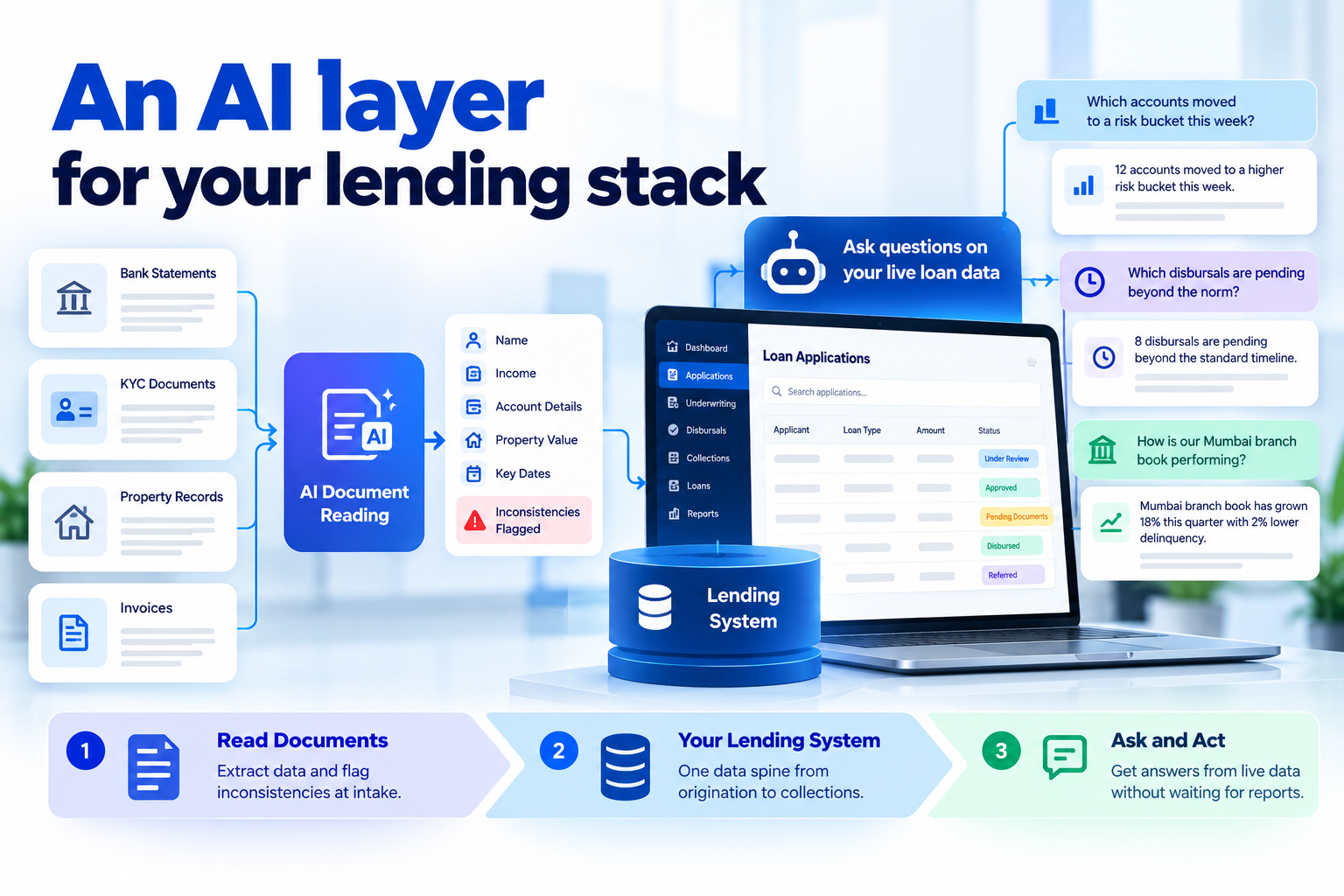
Once the lending system is yours, a second opportunity opens that off-the-shelf buyers find harder to reach: an AI layer that works on top of live loan data.
Two capabilities are practical today. The first is document reading. Lending runs on documents, bank statements, KYC papers, property records, invoices. An AI layer can read them at intake, extract the fields your process needs and flag inconsistencies for a human to examine, which compresses the slowest part of origination without removing judgment from it.
The second is query answering on live loan data. The questions a lending business asks all day, which accounts moved into a risk bucket this week, which disbursals are pending beyond the norm, how a particular branch's book is behaving, normally wait for someone to build a report. An AI layer that lets assistants read and act on live system data turns those into questions you simply ask, with the answer drawn from the same data spine the loan book runs on.
The reason this favours custom owners is access. When you control the system's data model and interfaces, connecting an AI layer is an engineering task you can schedule. When a vendor controls them, it is a roadmap item you can request. We are deliberately framing this as capability rather than magic: the AI layer is only as good as the system of record underneath it, which is one more reason to get that system right first. Our broader BFSI engineering practice, including this kind of work, lives at https://www.accucia.com/industries/finance-banking.
Accucia's view
An NBFC's lending process is its competitive asset, and renting a generic abstraction of it is a slow tax paid in workarounds, spreadsheet risk and compliance gaps. Build the system around the real flow, write the RBI Digital Lending Directions into the architecture where they cannot be switched off, and insist on ownership terms agreed in writing before work starts, never a blanket claim. Then add intelligence on top. That order of operations is the whole strategy.
Book a free AI Readiness Assessment for your lending stack, or message us on WhatsApp at https://wa.link/1bwdd2.
FAQ
When does custom NBFC software make more sense than off-the-shelf loan management software?
When your process diverges from the standard the product was designed around. Layered credit exception matrices, co-lending partnerships, field-heavy collections and unusual collateral all push the case toward custom. If your lending is plain salaried loans decided on bureau scores, an off-the-shelf product will likely serve you well.
How does a custom build handle the RBI Digital Lending Directions?
By making the obligations architectural. Key fact statements generate from the same data that drives the loan, the disbursal module has no path through third-party accounts, and consent is captured per data point in the borrower journey. Compliance becomes something the system enforces rather than something staff remember to do.
Who owns the source code in a custom lending software engagement?
That should never rest on a blanket claim from either side. Our position is that ownership terms are agreed in writing before work starts, covering code, data and what happens if the engagement ends. Any partner unwilling to put ownership on paper before the build begins is telling you something important.
What does an AI layer actually do in an NBFC lending stack?
Two practical things today. It reads lending documents at intake, extracting fields and flagging inconsistencies for human review. And it answers questions against live loan data, so risk, disbursal and portfolio queries stop waiting for someone to build a report. It works best on top of a clean, owned system of record.
Why does the AMC Bank relationship matter to an NBFC evaluating Accucia?
Because duration is the hardest proof to fake in BFSI. AMC Bank has worked with Accucia since 2018, through the regulatory and audit cycles any regulated institution faces. A technology relationship that long, still running, demonstrates the thing an NBFC actually needs: a partner that keeps adapting the system as requirements change.
Transform Your Lending Operations with AI