Real Estate ERP: Why Builders Outgrow a Sales CRM
Quick Answer
A sales CRM manages enquiries, site visits and bookings, and it does that well. A real estate ERP runs the rest of the builder's business: projects, procurement, contractor billing, approvals and possession, on the same data spine as sales. Builders outgrow the CRM when payment schedules start depending on construction progress the CRM cannot see. By Mr. Sumeet Katariya, Accucia Softwares Pvt. Ltd.
What a sales CRM covers for a builder, and where it stops
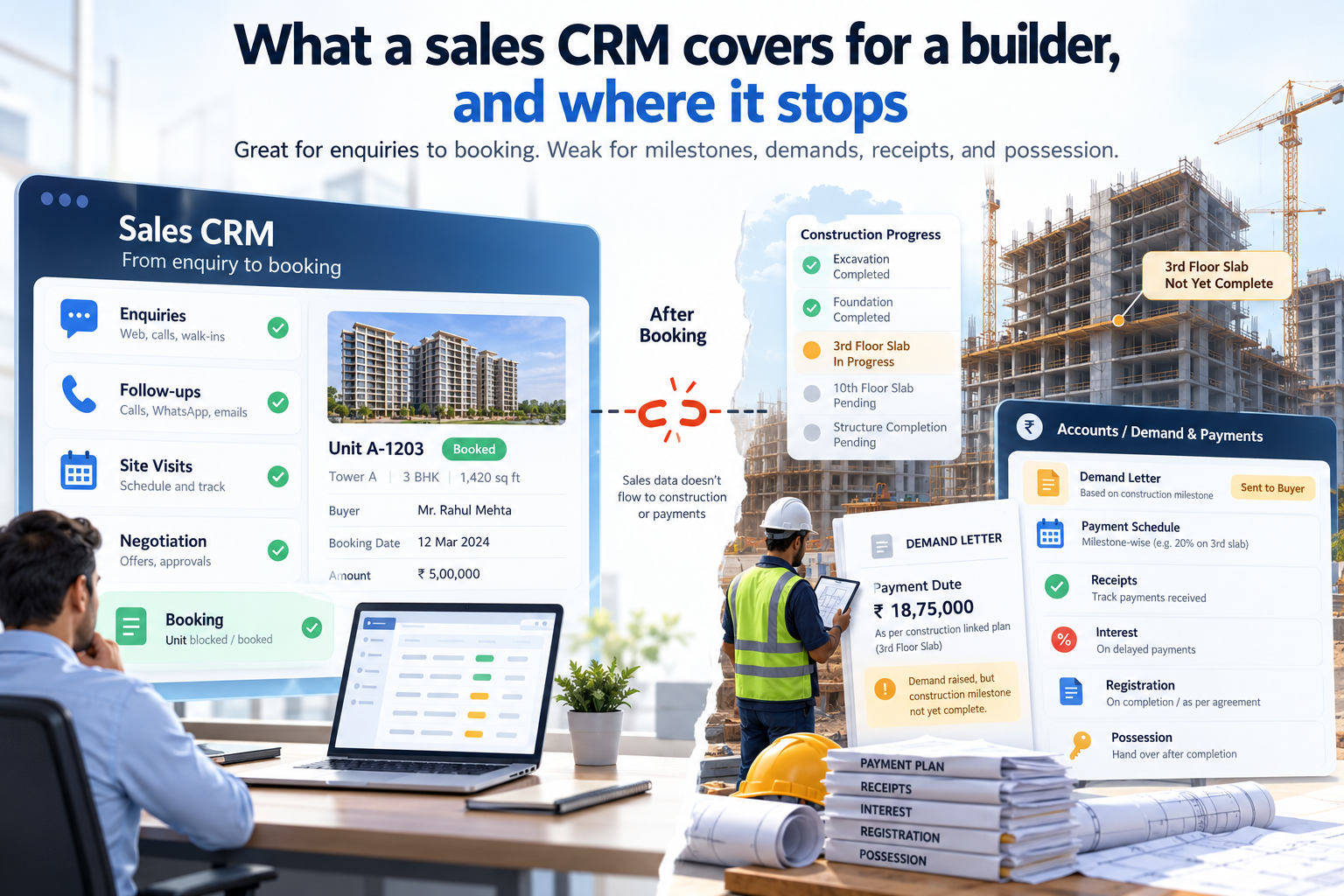
Give the CRM its due first. For a builder running sales, a decent CRM captures every enquiry from the portals and the walk-ins, stops leads leaking between telecallers, schedules site visits, and tracks each prospect through negotiation to booking. Follow-ups happen because the system nags. The sales head finally has a pipeline that is more than a diary.
Then the booking is signed, and the CRM's world ends.
The CRM knows who enquired. It has no idea the slab got delayed, and the buyer's payment schedule depends on the slab. That single sentence is the whole problem. In construction-linked plans, the demand letter to the buyer is triggered by a physical event on site. The CRM holds the buyer. The site engineer holds the event. Nothing connects them, so accounts raises demands from a spreadsheet someone updates after walking the project, and the buyer sometimes receives a letter for a milestone the tower has not reached. Every builder who has had that awkward phone call knows it.
Post-booking, the real customer relationship is about money and milestones: demands raised, receipts collected, interest on delays, modifications requested, registration, possession. A sales CRM was never designed to hold any of that, which is why it fills up with notes fields and attachments until nobody trusts it.
What runs the rest of the business
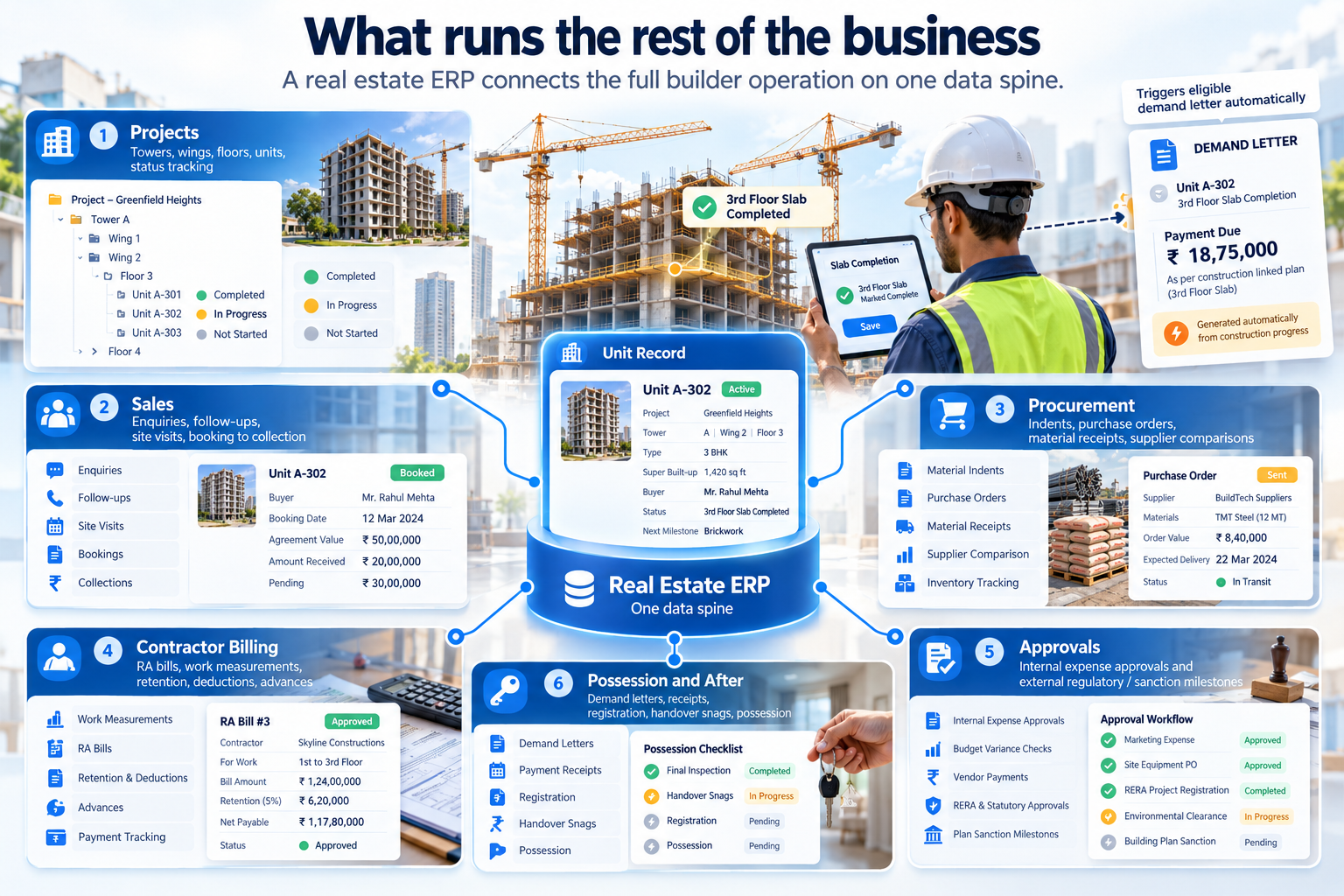
Walk through what a builder actually operates and the shape of the needed system becomes obvious.
Projects: towers, wings, floors, units, each with a status that changes as construction proceeds. The unit is the atom of the business. Its construction state, its sale state and its payment state are three views of one thing, and they belong in one record.
Procurement: indents from site, purchase orders, material receipts, rate comparisons across suppliers. Cement and steel do not wait for month end, and procurement leakage is quiet because it hides across hundreds of small transactions nobody can see together.
Contractor billing: running account bills, work measurements, retention, deductions, advances recovered. This is where paper rules on most sites today, and where disputes are born months before they surface.
Approvals: internally, who may sanction which expense at which amount; externally, the regulatory and sanction milestones a project moves through. An approval that lives in someone's inbox is an approval nobody can audit.
Possession and after: demand letters tied to actual construction stages, receipts, registration status, handover snags, the last mile where a buyer becomes either a reference or a grievance.
A real estate ERP is simply all of the above on one data spine, with sales as one module among several rather than the only system in the building. When the site engineer marks the slab complete, the eligible demand letters are already drafted, because the unit record connects the physical event to the buyer's plan. We build these systems as custom work, mapped to how a specific builder actually operates, and our ERP and CRM practice is described at https://www.accucia.com/services/erp-crm-solutions.
The line where builders outgrow CRM
Not every builder needs an ERP on day one, so it is worth being precise about where the line sits. Two conditions, and crossing either one is the signal.
The first is multiple projects. One project, one site team, one bank account to reconcile: an owner with a CRM and disciplined spreadsheets can hold that in their head, and many do. At two or three concurrent projects the spreadsheets start multiplying, each project develops its own formats, and consolidating a cash position across projects becomes a monthly archaeology exercise. The owner's attention becomes the integration layer, which is exactly the resource the business can least afford to spend on reconciliation.
The second is construction-linked payment plans. The moment buyer collections are triggered by site progress, sales data and construction data must live together. A CRM-plus-spreadsheet arrangement means every demand cycle requires a human to carry information from the site to accounts, and humans carry it late, or carry it wrong. Builders selling on time-linked or down-payment plans can defer this longer. Builders on construction-linked plans cannot, because the gap between slab and demand letter shows up directly as delayed collections, demand cycle after demand cycle.
An aside from experience: the builders who feel this most sharply are often the ones whose sales are going well. More bookings means more payment plans in flight, which means more milestone-to-demand connections being managed by hand. Growth converts a tolerable manual process into an untenable one, usually in the space of a single good launch.
Proof without naming
Positioning claims deserve proof, and ours is live. A renowned real estate developer in Mumbai runs a custom ERP we built, covering the operational span described above on one system: projects, procurement, contractor billing, approvals, payments and the sales pipeline together.
The part of that engagement most relevant to where the industry is heading: we delivered an AI layer on top of the ERP that exposes in-system services to assistants, so the ERP's live data and actions can be read and used conversationally rather than only through screens. That is stated as capability delivered, not a roadmap slide. It runs.
We keep the client unnamed deliberately, and we would extend the same discretion to any builder we work with. What the engagement demonstrates is transferable: a developer's full operation can run on one custom system, and that system can be made conversational. Those are the two facts a builder evaluating this path needs.
What an AI layer adds to a real estate ERP
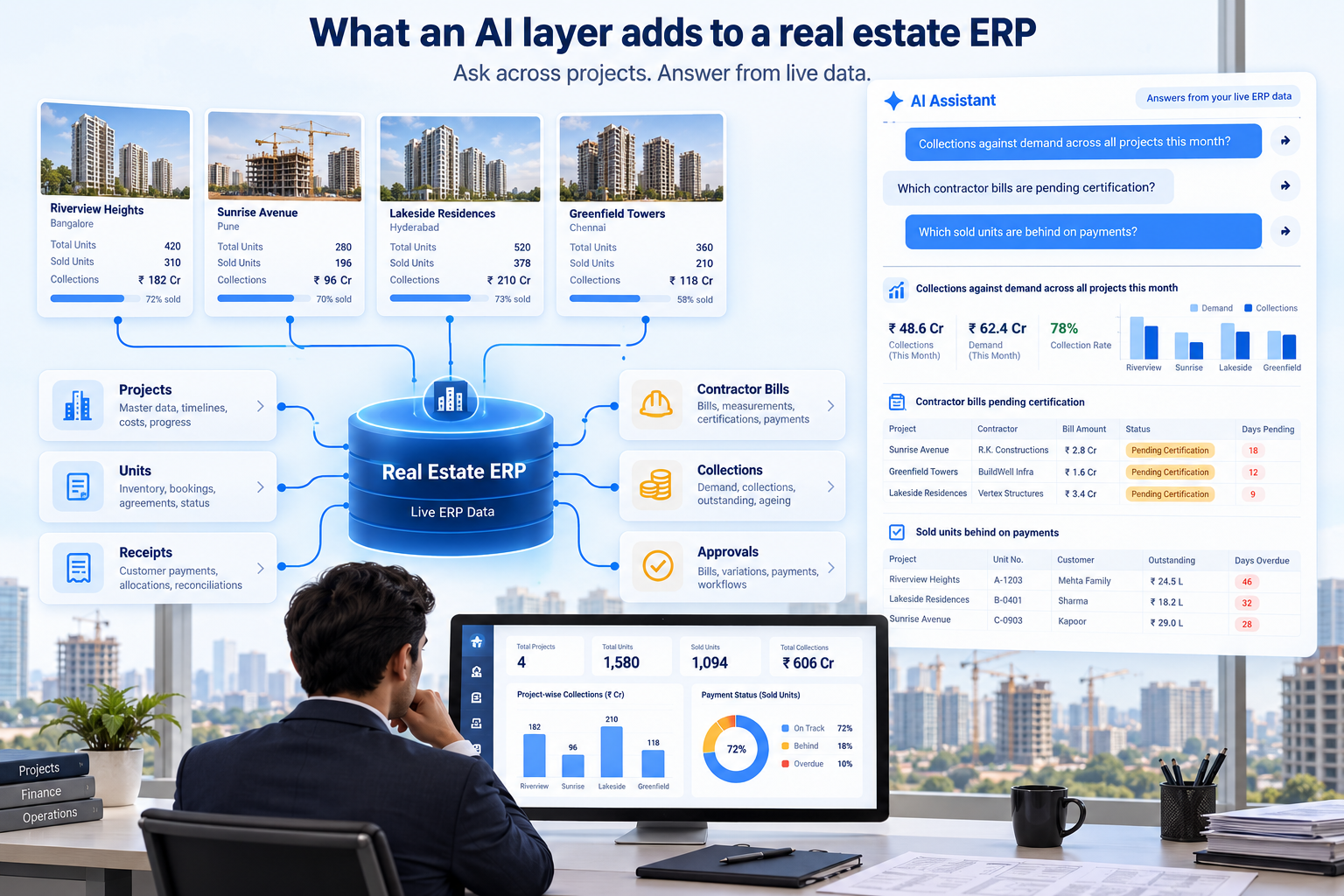
Once the business runs on one data spine, the owner's questions become answerable in plain language.
Think about the questions a developer asks in a review meeting. Collections against demand across all projects this month. Which contractors' bills are pending certification and for how long. Which units are sold but behind on payments, project by project. Today, each answer is an MIS report someone assembles, and the meeting discusses data that was true last week.
An AI layer changes the interface. The owner asks in plain language, across projects, and the answer is drawn from the live ERP: the same unit records, the same bills, the same receipts. Follow-up questions cost nothing, so the conversation goes where the numbers lead instead of stopping where the report ends. The capability depends on the ERP exposing its data and services to assistants in a structured, governed way, which is engineering work in its own right; we describe our approach to that integration layer at https://www.accucia.com/services/mcp-integration.
Two cautions, so this stays honest. The AI layer answers from the system of record, so a builder still running on spreadsheets has nothing trustworthy for it to read; the ERP comes first. And access needs the same discipline as any MIS: who may ask what, and what the assistant may touch, is a design decision, not a default. This holds wherever the builder operates; our Gulf real estate work, covered at https://www.accucia.com/gulf/real-estate-crm-dubai, runs into the same sequencing conversation with developers there.
Accucia's view
A sales CRM is the right first system for a builder, and the wrong last one. The business is the unit record: its construction state, sale state and payment state in one place, feeding procurement, contractor billing, approvals and possession. Builders on construction-linked plans with more than one project have already crossed the line, whether or not the software has caught up. Build the ERP around your actual operation, then make it conversational with an AI layer. One renowned developer in Mumbai already runs exactly that, and the pattern will spread faster than most of the industry expects.
Book a free AI Readiness Assessment for your projects, or message us on WhatsApp at https://wa.link/1bwdd2.
FAQ
What is the difference between a real estate CRM and a real estate ERP?
A CRM manages the revenue conversation: enquiries, site visits, follow-ups and bookings. An ERP runs the operation: projects, procurement, contractor billing, approvals, buyer payments and possession, with sales as one module on a shared data spine. The practical difference shows in construction-linked demands, which need site and sales data connected.
When should a builder move from CRM to ERP?
Two signals. Running multiple concurrent projects, where consolidating cash and progress across spreadsheets starts consuming the owner's attention. And selling on construction-linked payment plans, where demand letters depend on site milestones the CRM cannot see. Crossing either signal means the move is already overdue; crossing both means it is urgent.
Can a real estate ERP handle construction-linked payment plans automatically?
Yes, and this is its clearest advantage. The unit record connects construction state to the buyer's payment schedule, so when the site team marks a milestone complete, eligible demand letters are drafted from live data. Collections stop depending on someone manually carrying progress updates from the site to the accounts team.
What does an AI layer do on top of a real estate ERP?
It lets the owner and senior team ask questions in plain language across projects, collections against demand, pending contractor bills, units behind on payments, and get answers from live ERP data instead of waiting for MIS reports. It requires the ERP to expose data and services to assistants in a structured, governed way.
Transform your real estate operations with AI-powered ERP