
Real Estate CRM for Developers: Enquiry to Registration
Quick Answer
A real estate CRM is sales and post sales software built around a property transaction rather than a generic deal record. An Indian developer needs it to hold unit level inventory, site visits, channel partner attribution, bookings, the registered agreement for sale, construction linked demand letters, collections and possession, plus the documents a RERA authority can demand. By Mr. Sumeet Katariya, CEO, Accucia Softwares Pvt. Ltd.
Most developers we meet have a CRM. What they usually do not have is a system that survives the booking. The lead arrives from a portal, gets called, gets a site visit, gets negotiated, and then the moment money changes hands the record stops being a CRM record and becomes a folder, a WhatsApp group and a spreadsheet only one person in accounts fully understands.
The gap matters more when the market is slow. ANAROCK put unsold inventory across the top seven cities at 601,210 units at the end of Q1 2026, against 101,675 units sold in the quarter. When stock runs that deep, what separates two developers on the same road is rarely the product. It is whether the follow up happened on day four or day forty.
The lifecycle a generic sales CRM cannot model
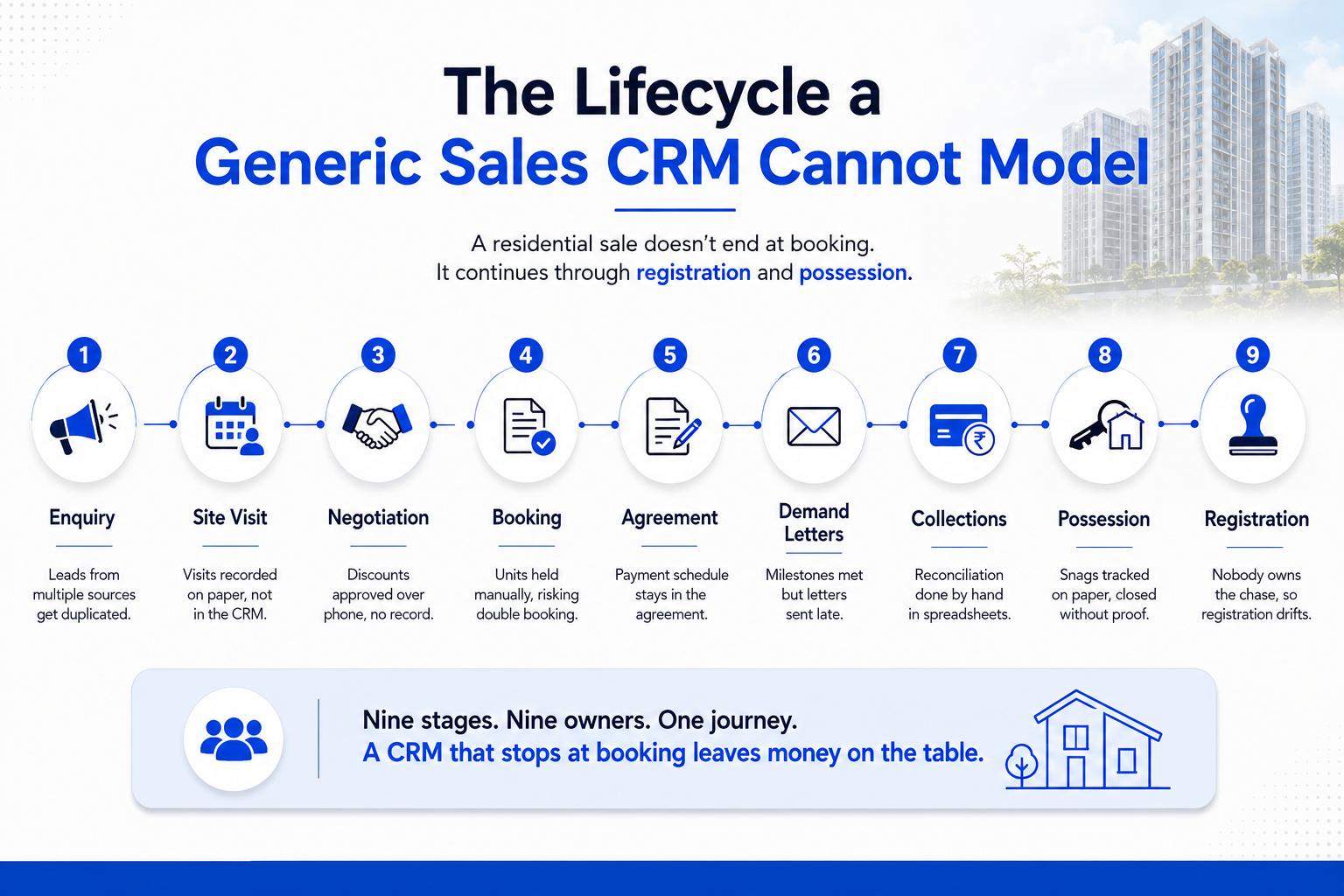
A generic CRM models a pipeline: a deal, a value, a probability, a close date. A residential project does not close at booking. It closes at registration, and often at possession, and the obligations in between are statutory rather than commercial.
Enquiry
Source, campaign, portal, partner code, consent record
The same person arrives three times from three sources and becomes three leads
Site visit
Scheduled slot, executive assigned, actual visit marked, units shown
Visit marked in a register at the site office, never back in the CRM
Negotiation
Quoted rate, discount sought, approval level, expiry of the quote
Discounts approved over phone with no record of who approved what
Booking
Unit held, booking amount, allotment letter issued
Two executives hold the same unit on the same afternoon
Agreement
Registered agreement for sale, payment schedule, possession date
Payment schedule lives in the agreement, not in any system that can act on it
Demand letters
Milestone certified, letter generated, dispatch proof
Milestone reached weeks before anyone raises the demand
Collections
Receipt, part payments, interest on delay, bank reconciliation
Reconciliation done by hand against a bank statement
Possession
Snag list, occupancy certificate, handover checklist
Snags tracked on paper and closed without evidence
Registration
Stamp duty paid, document registered, index copy filed
Nobody owns the chase, so registration drifts
Every one of those nine rows has a different owner in a real developer: pre sales, sales, CRM desk, accounts, projects, legal. A CRM that serves only the first four rows is a call centre tool wearing a property skin, and the rows below it are where developers actually lose money.
Channel partners are a second sales force with different rules
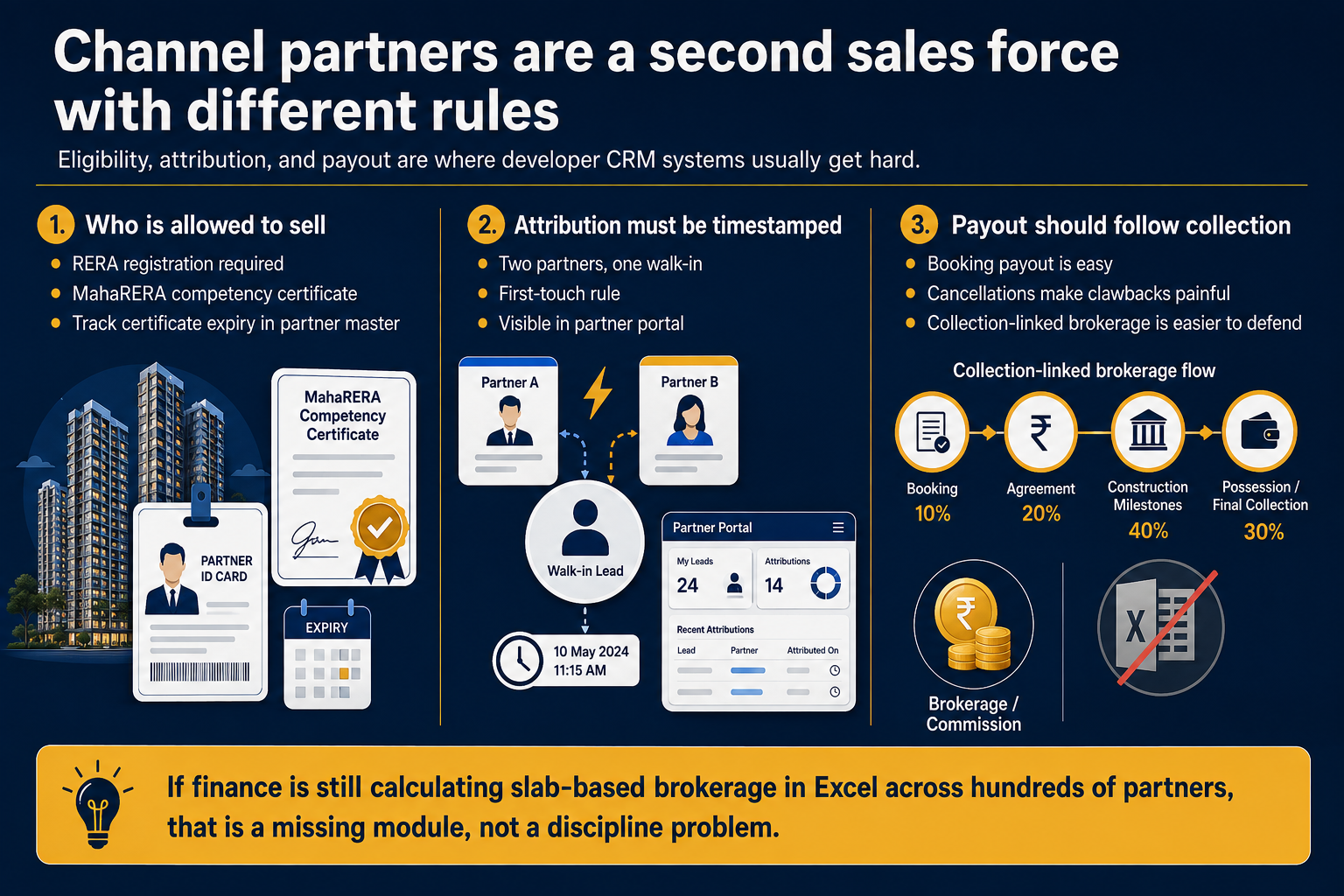
For most residential projects a large share of bookings arrive through channel partners, and this is where developer software gets genuinely hard.
Start with who is allowed to sell. Section 9 of the Real Estate (Regulation and Development) Act, 2016 says plainly that no real estate agent shall facilitate the sale or purchase of any plot, apartment or building in a registered project without obtaining registration under that section. In Maharashtra it goes further: MahaRERA requires agents to complete training and pass an examination for a Certificate of Competency, and from 1 January 2024 promoters have to ensure the agents enlisted for their projects hold a valid certificate. That is a field in your partner master, with an expiry date on it, not a PDF in somebody's inbox.
Then attribution. Two partners register the same walk in on the same day and both claim the booking. Without a timestamped first touch rule both sides accepted at onboarding, that dispute is settled by whoever escalates louder. The rule belongs in the system, visible to the partner in their own portal.
Then payout. Brokerage on booking is easy to compute and expensive to unwind, because a cancellation means clawing back money already paid. Brokerage released against collection milestones is harder to build and much easier to defend. If finance is still calculating slab based brokerage in Excel across hundreds of partners, that is a missing module rather than a discipline problem. We cover the wider commercial picture on our ERP and CRM solutions page.
Inventory has to be a first class object, not a dropdown
In a generic CRM the property is a text field on the opportunity. In a developer's CRM the unit is the object, and the lead hangs off it.
A unit carries a tower, a floor, a number, a carpet area, a facing, a view premium, a floor rise, a plan variant, a status, and a hold with an owner and a clock on it. Two executives should not be able to hold the same unit, and a hold that nobody converts should release itself and go back into available stock without anyone remembering to do it.
Spreadsheet inventory fails on concurrency. The sheet is rarely wrong, but two people opened it at 4pm. We have watched a sales head keep a private copy of the availability sheet because he did not trust the shared one, a reasonable response to a system that has burned him and also the exact behaviour that produces a double booking at quarter end.
Pricing behaves the same way. If a unit price is computed from a base rate plus premiums and applicable charges, a rate revision is one change. If it is a number typed into a cost sheet, a rate revision is hundreds of changes and some of them will be wrong.
Collections and demand letters, where the money actually lives
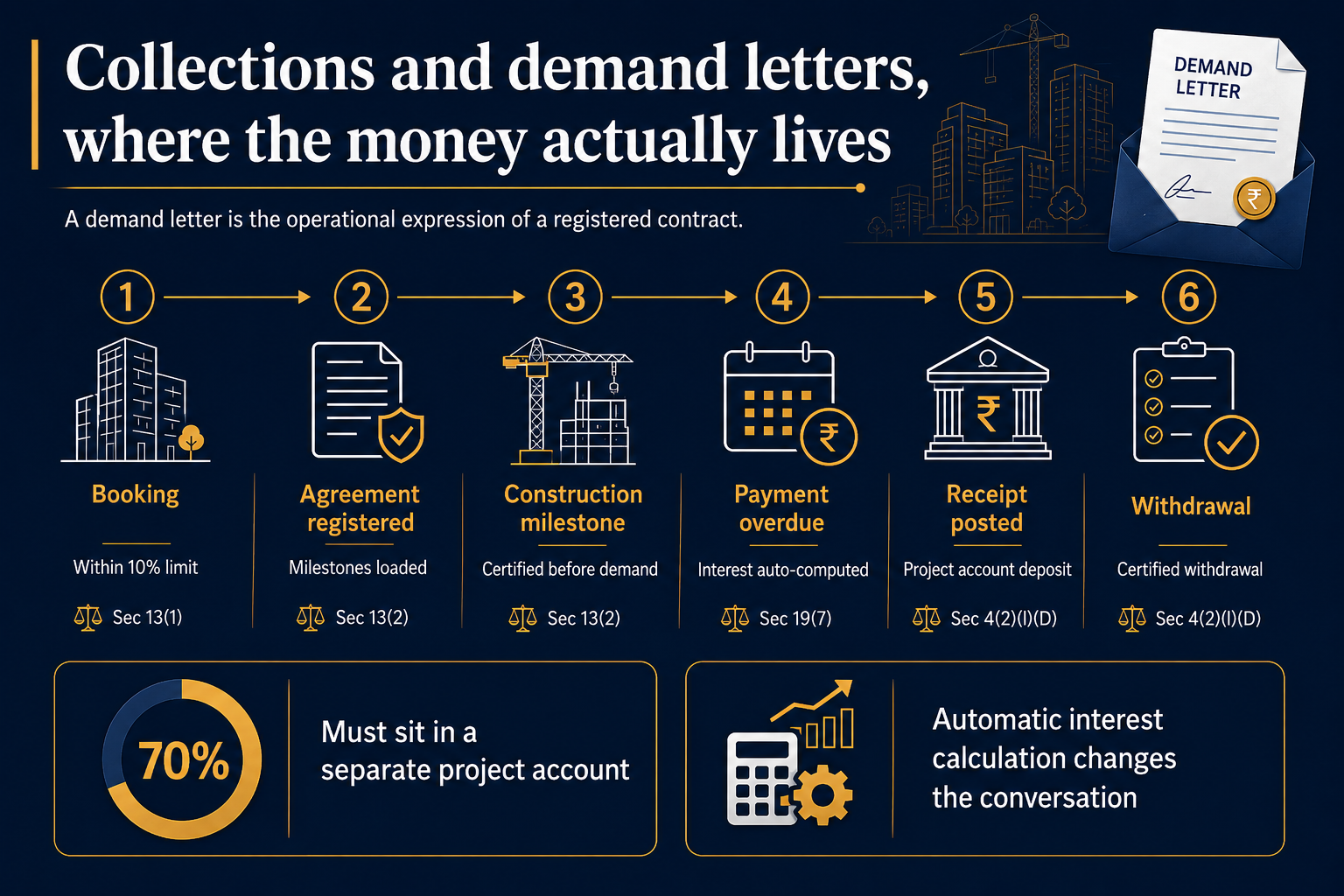
This is the stretch the Hook points at, and it is worth being precise about the law.
Section 13(1) of RERA prevents a promoter from accepting more than ten per cent of the cost of the apartment, plot or building as an advance payment or application fee without a written, registered agreement for sale. Section 13(2) requires that agreement to specify the dates and the manner by which payments are to be made. Section 19(6) makes the allottee responsible for paying in the manner and within the time specified in that agreement, and Section 19(7) makes them liable for interest at the prescribed rate on any delay.
Read those together and a demand letter stops being correspondence. It is the operational expression of a registered contract, and the system has to be able to prove it went out, when, and against which certified milestone.
Booking
Advance collected stays within the ten per cent ceiling until the agreement is registered
RERA Section 13(1)
Agreement registered
Payment milestones from the registered agreement loaded against the unit
RERA Section 13(2)
Construction milestone reached
Site certification recorded, then the demand raised against the correct slab
RERA Section 13(2)
Payment overdue
Interest computed at the prescribed rate from the due date, with a reminder trail
RERA Section 19(7)
Receipt posted
Deposit of the mandated share into the designated project account
RERA Section 4(2)(l)(D)
Withdrawal from project account
Certification by the engineer, the architect and the chartered accountant in practice
RERA Section 4(2)(l)(D)
That last pair is the one finance teams underestimate. Section 4(2)(l)(D) requires seventy per cent of the amounts realised from allottees to sit in a separate scheduled bank account for construction and land cost, withdrawable only in proportion to the percentage of completion and only on certification by an engineer, an architect and a chartered accountant in practice. If your CRM cannot tell your accounting system which receipt belongs to which project, that split is being done manually every month by somebody who is one resignation away from taking the method with them.
Interest on delay is the other quiet one. Most developers hold a right they never exercise, because computing it across hundreds of units by hand is not worth the effort. A system that computes it automatically changes the conversation, whether or not you enforce it.
RERA and the paper trail the authority can ask for
Treat RERA compliance as a set of artefacts the system produces as a by product of normal work, rather than as a report someone assembles at the end.
Section 11(1) requires the promoter to keep the project webpage updated quarterly with the list of number and types of apartments or plots booked, the number of garages booked, and the status of the project. If booking status is authoritative in your CRM, that quarterly filing is an export. If bookings live partly in the CRM and partly in a sheet, someone spends a week reconciling before every filing, every quarter, forever.
Section 11(3) requires the promoter, at the time of booking and allotment, to give the allottee the sanctioned plans and layout plans with specifications, and the stage wise time schedule of completion including provisions for water, sanitation and electricity. That is a document pack tied to a booking event, versioned, with proof of what was issued to whom.
Maharashtra adds another layer. Under MahaRERA Order No. 31/2022, promoters must upload the proforma of the allotment letter and the agreement for sale in the format prescribed under Annexure A of Rule 10 of the Maharashtra Real Estate Rules, with any deviations highlighted in a different colour. So your document templates carry regulatory weight, and the version your sales team is issuing has to match the version on file.
Registration itself sits under the Registration Act, 1908. Instruments creating or extinguishing a right in immovable property above the statutory threshold require registration, and a document other than a will must be presented for registration within four months of execution, with delayed registration only possible on payment of a fine. On the cost side, stamp duty in Mumbai is currently levied at six per cent for men and five per cent for women, with most other Maharashtra areas at seven and six per cent respectively, and registration charges at one per cent of value subject to a cap of thirty thousand rupees. Buyers ask about these constantly, and a cost sheet generated with these heads built in removes a whole category of later dispute. More on how we approach real estate systems.
Marketing integration: three channels, one person, one record
Portal leads, missed call numbers and WhatsApp enquiries are three pipes carrying the same people. De-duplication across all three is the single highest value integration in a developer's stack, because a duplicate is not just clutter. It is two executives calling the same buyer within an hour and telling him two different things about the same unit.
De-duplicate on mobile number first, then on a fuzzy match of name plus project interest, and keep every source that touched the record rather than overwriting it. First touch drives partner attribution while last touch drives spend decisions, so collapsing them into one field means losing an argument with finance or marketing later.
Compliance now shapes this too. Under the TCCCPR amendments notified in 2025, commercial messaging in India runs on registered headers and content templates with defined suffixes, penalties are specified for improper header or content template registration, and after a customer opts out no consent request may be sent for ninety days unless they opt back in sooner. Separately, the Digital Personal Data Protection Rules were notified on 14 November 2025 with a phased compliance window, requiring clear standalone consent notices and a response to a data principal's access, correction or erasure request within ninety days.
Practically, consent becomes a stored object with a timestamp and a source, an opt out has to propagate to every outbound channel quickly, and an erasure request has to be executable without a developer writing a SQL query. If your enquiry capture and your WhatsApp automation do not share a consent record, you have two compliance postures and only one is documented.
Off the shelf, custom, or extend the ERP you already run
One or two projects, no channel partner network, standard payment plans
Off the shelf real estate CRM
Configuration is faster and cheaper than construction, and the edge cases have not appeared yet
Multiple projects, active partner network, brokerage tied to collection
Off the shelf core plus a custom partner and payout layer
Partner economics are where products differ most and configuration runs out
You already run an ERP that holds finance and projects
Extend the ERP
Collections, escrow splits and demand letters already have a home; a separate CRM adds a reconciliation problem
Land, joint development, leasing and residential under one roof
Custom, built on your own object model
No product models all four cleanly, and forcing them into one produces workarounds nobody documents
Sales is fine, everything after booking is manual
Do not replace the CRM, build the post booking layer
The failure is downstream, and rip and replace projects fail on change management, not technology
The last row is the one we recommend most often and sell least often. If the problem starts at booking, replacing a working sales CRM buys nothing and costs a quarter of disruption. Our ERP versus CRM comparison covers where the boundary usually sits.
What this looks like when it is actually built
For a residential developer we have built for, the useful part of the work was never the sales screens. It was making the unit the centre of the model, wiring holds so concurrency could not produce a double booking, generating demand letters from certified milestones rather than from a calendar reminder, and giving accounts a receipt trail that mapped to the project account without a monthly manual split.
The change people noticed first was smaller than any of that. The site office stopped keeping its own availability sheet, which only happens when the shared system is fast enough and trusted enough that a private copy feels like extra work rather than insurance.
Accucia's view
Here is the assertion, and it costs us business: most developers asking for a new real estate CRM do not need one. Their sales CRM is fine. What is missing is the post booking layer, and that is a smaller, cheaper, less glamorous project than the one they came in asking to buy. We say this in first meetings and it regularly ends with a shorter scope and a smaller invoice.
The honest counter position is that this is not always right. When the CRM in place cannot hold unit level inventory at all, bolting a post booking layer onto it produces two sources of truth about availability, which is worse than either system alone. And where the sales team has already lost faith in the tool, keeping it for political reasons means the new layer inherits data nobody believes. Replacement is then the cheaper path even though the quote looks larger. The real test is whether the people entering data trust the screen in front of them.
On security posture we would rather be exact than impressive. Our ISO 27001 implementation is underway, an auditor has been appointed, and certification is targeted for Q1 2027, January to March. Until then we say implementation, not certified. Our current position is set out on our trust page.
If you want a defensible read on where your enquiry to registration flow actually leaks before you commit to any build, our AI Readiness Audit is a fixed scope engagement at ₹2 to 5 lakh over two weeks. Indicative commercials for other work sit on our cost page, and you can reach the team through contact.
Frequently Asked Questions
What is a real estate CRM?
A real estate CRM is software that manages a property transaction from first enquiry through booking, agreement, collections and registration. Unlike a generic sales CRM it treats the unit as the central object, tracks channel partner attribution, generates demand letters against construction milestones, and stores the documents a regulator can demand.
How is a real estate CRM different from a generic sales CRM?
A generic CRM ends at the closed deal. A developer's obligations begin there: registered agreement for sale, milestone linked demand letters, interest on delayed payments, deposits into the designated project account, possession and registration. A real estate CRM models unit level inventory with holds, and partner payouts released against collections.
Does RERA require a developer to use a CRM?
No statute names CRM software. RERA does require outcomes that manual methods struggle to produce reliably, including quarterly updates on apartments and garages booked and project status under Section 11(1), and a registered agreement before accepting more than ten per cent under Section 13(1). Software makes those artefacts a by product.
Should brokerage be paid on booking or on collection?
Paying on collection is the safer commercial structure, because a cancelled booking after payout means clawing money back from a partner. Paying on collection needs the CRM and the finance system to share receipt data at unit level, which is precisely the integration most developers skip and later rebuild.
How do we stop double bookings without replacing everything?
Make the unit the object of record and give it a hold with an owner and an expiry, enforced by the system rather than by etiquette. A hold nobody converts should release automatically. That single change removes most double bookings, and it does not require replacing a functioning sales CRM.
What does a developer have to file with RERA every quarter?
Section 11(1) of RERA requires the promoter to keep the project page updated quarterly with the list of number and types of apartments or plots booked, the number of garages booked, and the status of the project. If booking data is authoritative in one system, that filing becomes an export rather than a reconciliation exercise.
What are the stamp duty and registration charges on a flat in Maharashtra?
Stamp duty in Mumbai is currently six per cent for men and five per cent for women, while most other Maharashtra areas apply seven and six per cent respectively. Registration charges are one per cent of value subject to a cap of thirty thousand rupees. Rates change, so confirm against the current government notification.
Can we extend our existing ERP instead of buying a real estate CRM?
Often yes, and it is usually the better answer when the ERP already holds finance and project data. Collections, project account splits and demand letters then live beside the ledgers that must agree with them. A separate CRM adds a reconciliation surface between two systems that both claim to know what was collected.
See how Accucia can simplify your real estate operations.