
Real Estate Collections: Demand Letters by Milestone
Quick Answer
A real estate ERP tracks collections by holding, for every sold unit, the agreed payment schedule, the construction milestones it is linked to, the demand letters raised against each milestone, the receipts against each demand, and the outstanding balance that results. When the engineer marks the slab cast, the demands for that milestone are raised across every unit on that plan, and the owner can see what is outstanding across the project as of right now, without calling anyone. By Mr. Sumeet Katariya, Accucia Softwares Pvt. Ltd.
The question that exposes the spreadsheet
Every developer we have worked with asks the same question in the Monday review. How much is outstanding across the project, as of today?
In most offices the answer takes a while. The sales CRM knows who booked which unit. The accounts team's spreadsheet knows what was collected. The site engineer knows which milestones were reached, usually in a WhatsApp message. Someone merges the three, the figure arrives by Wednesday, and by Wednesday it is already wrong.
If answering that question requires calling two people and merging three files, the business has outgrown its software category. We made that argument in why builders outgrow a sales CRM. This post is about the specific module that most often triggers the realisation: collections.
Why collections are harder than sales for a developer
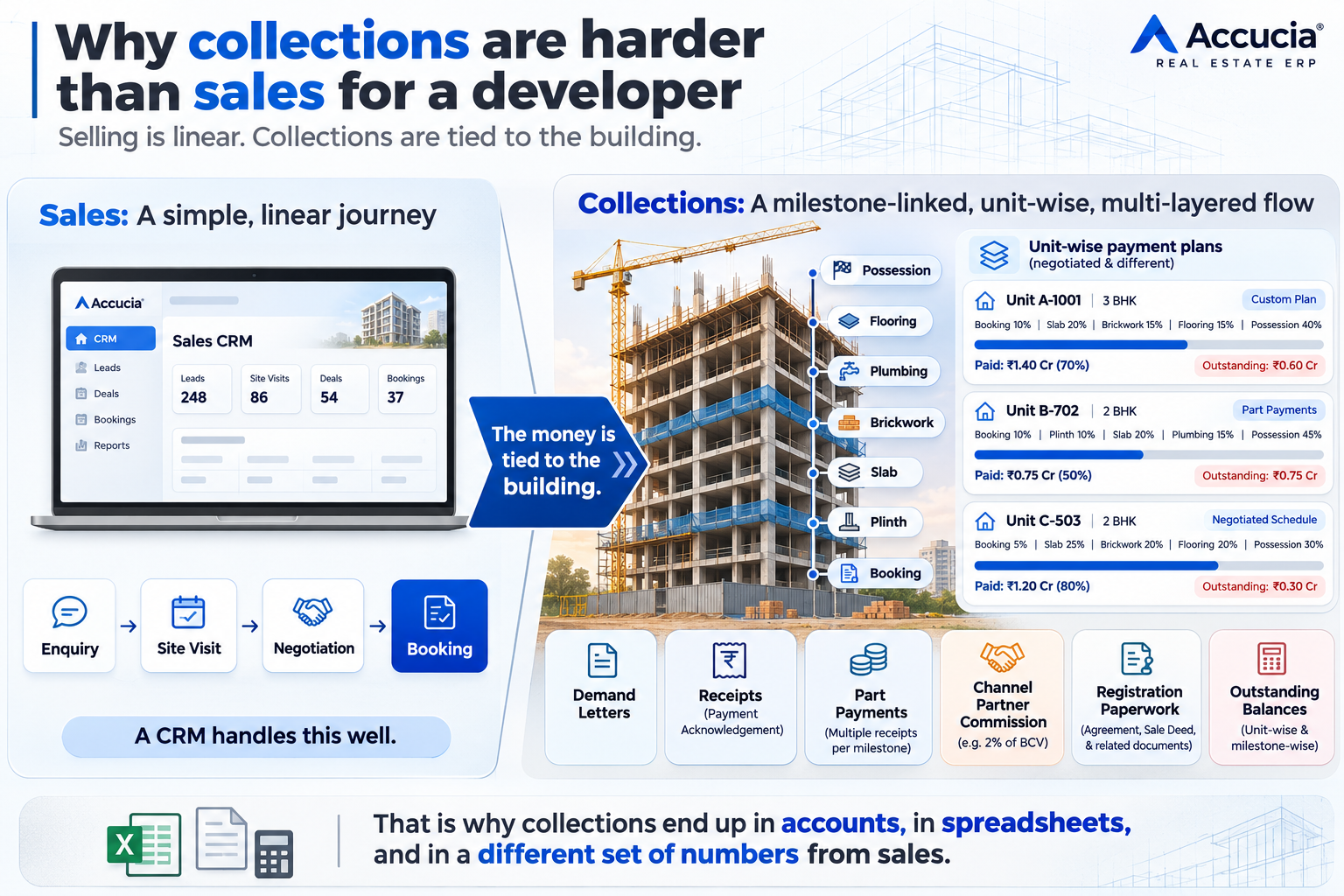
Selling a flat is a linear process. Enquiry, site visit, negotiation, booking. A CRM handles it, and the enquiry-to-registration flow we described earlier is well understood.
Collecting the money is not linear, because the money is tied to the building.
Most residential sales in India run on construction-linked payment plans. A percentage at booking, a percentage at plinth, a percentage at each slab, a percentage at brickwork, plumbing, flooring, possession. The schedule differs by project, and the percentages and dates frequently differ by unit, because the buyer negotiated. The milestone dates are not known in advance; they happen when the site reaches them. Add channel partner commissions settled against collections, registration formalities, and buyers who pay late or in parts, and you have a ledger that no sales system was built to hold.
So it lives in accounts, in spreadsheets, and the sales team and the accounts team describe the same project in two different sets of numbers.
What the ERP holds
A real estate ERP built for the full lifecycle treats the booking as the start of the record, not the end. Per unit, it holds:
None of this is exotic. What makes it work is that it is one record, written by the sales team at booking, by the site team at each milestone, by accounts at each receipt, and read by the owner whenever they like.
The demand letter that raises itself
The moment that persuades most developers is the demand run.
In the spreadsheet world, the engineer reports the fourth slab cast. Accounts opens the project sheet, filters the units on plans where the fourth slab is a milestone, calculates each unit's percentage, drafts the letters, and sends them over the following week. Some units are missed because the negotiated plan was recorded in an email. Some letters go out with last quarter's percentage.
In the ERP, the site engineer marks the milestone reached. The system identifies every unit whose schedule includes that milestone, calculates each unit's demand from its own negotiated terms, generates the letters, and logs them against the unit. Accounts reviews and releases. The owner sees the total demanded and the total outstanding change the same day.
The second-order effect is the one that matters for cash flow: demands go out on the day the milestone is reached rather than the week after, across every unit rather than most of them.
Where the regulator meets the ledger
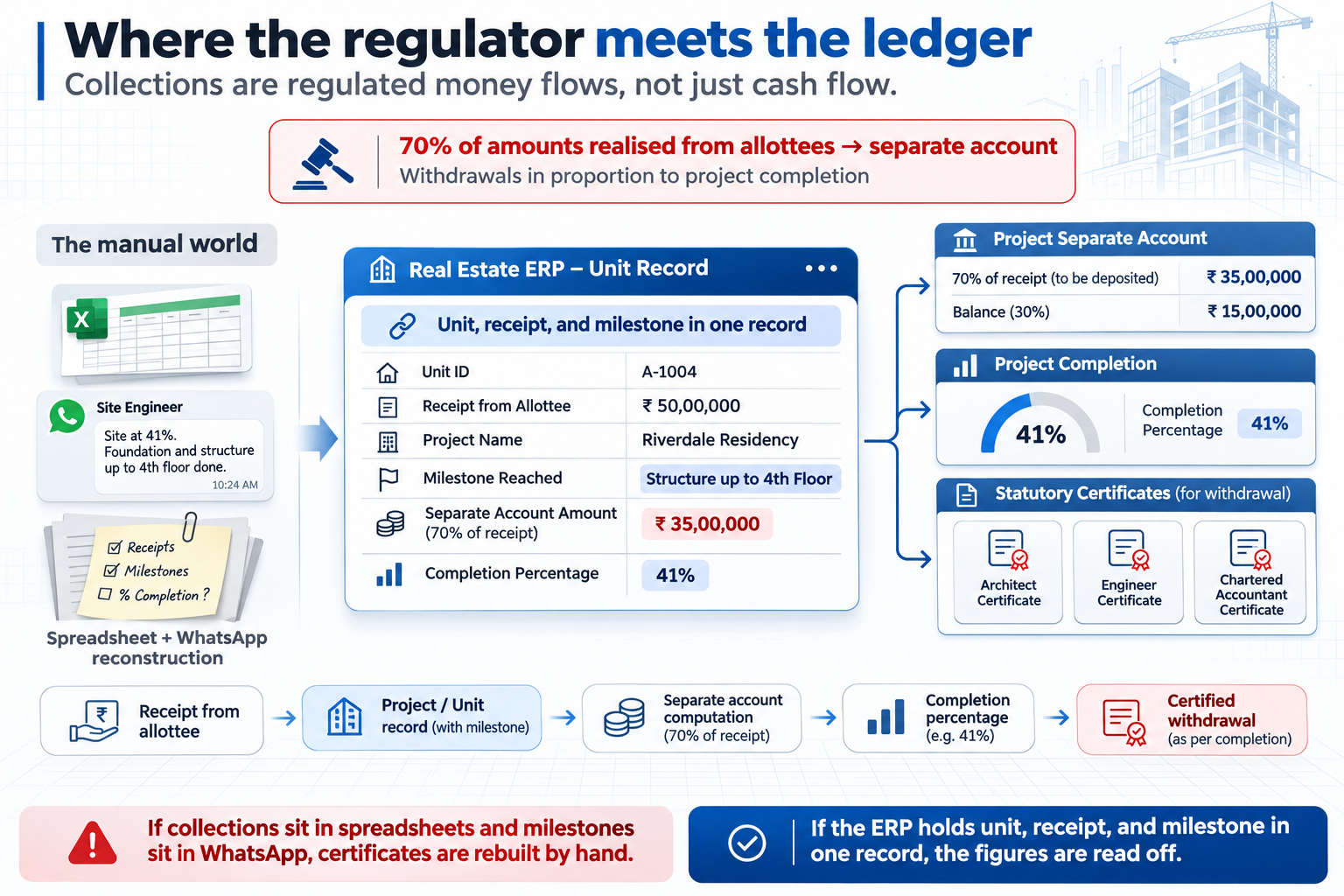
Collections are not only a cash-flow matter in India. They are a regulated flow of money, and the ledger has to be able to show it.
Section 4(2)(l)(D) of the Real Estate (Regulation and Development) Act, 2016 mandates, in the words MahaRERA uses in its March 2024 discussion paper on project bank accounts, that "seventy percent of the amount realized for the real estate project from the allottees, from time to time shall be deposited in a separate account." Withdrawals from that account are made "in proportion to the percentage of completion of the project," certified through the architect, engineer and chartered accountant forms MahaRERA prescribes.
Read that against the collections module. Every receipt has to be identifiable as a receipt from an allottee for a specific project, so that the seventy percent can be computed and evidenced. Every withdrawal has to be traceable to a completion percentage, which is the same construction progress the demand run depends on. A developer whose collections sit in a spreadsheet and whose milestones sit in WhatsApp is reconstructing both numbers by hand for every certificate. A developer whose ERP holds the unit, the receipt and the milestone in one record is reading them off. We are not lawyers and this is not legal advice; it is an observation about where the data has to live for the certificates to be easy.
What to check in your own collections process this week
- Ask for the outstanding figure across one project, and time how long the answer takes. Then ask how it was assembled. The number of files is the number of places it can be wrong.
- Pick five sold units at random and compare the payment plan in the sales file with the plan accounts is collecting against. Differences are the negotiated terms that never made it across.
- Find the date the last slab was certified and the date the demand letters for it went out. The gap is working capital sitting with the buyer.
- Count the demands for that milestone against the units on that plan. Missing letters are missing receipts.
- Ask how the next channel partner settlement will be calculated. If the answer begins with the partner's own statement, the ledger is not doing its job.
Common mistakes developers make with collections software
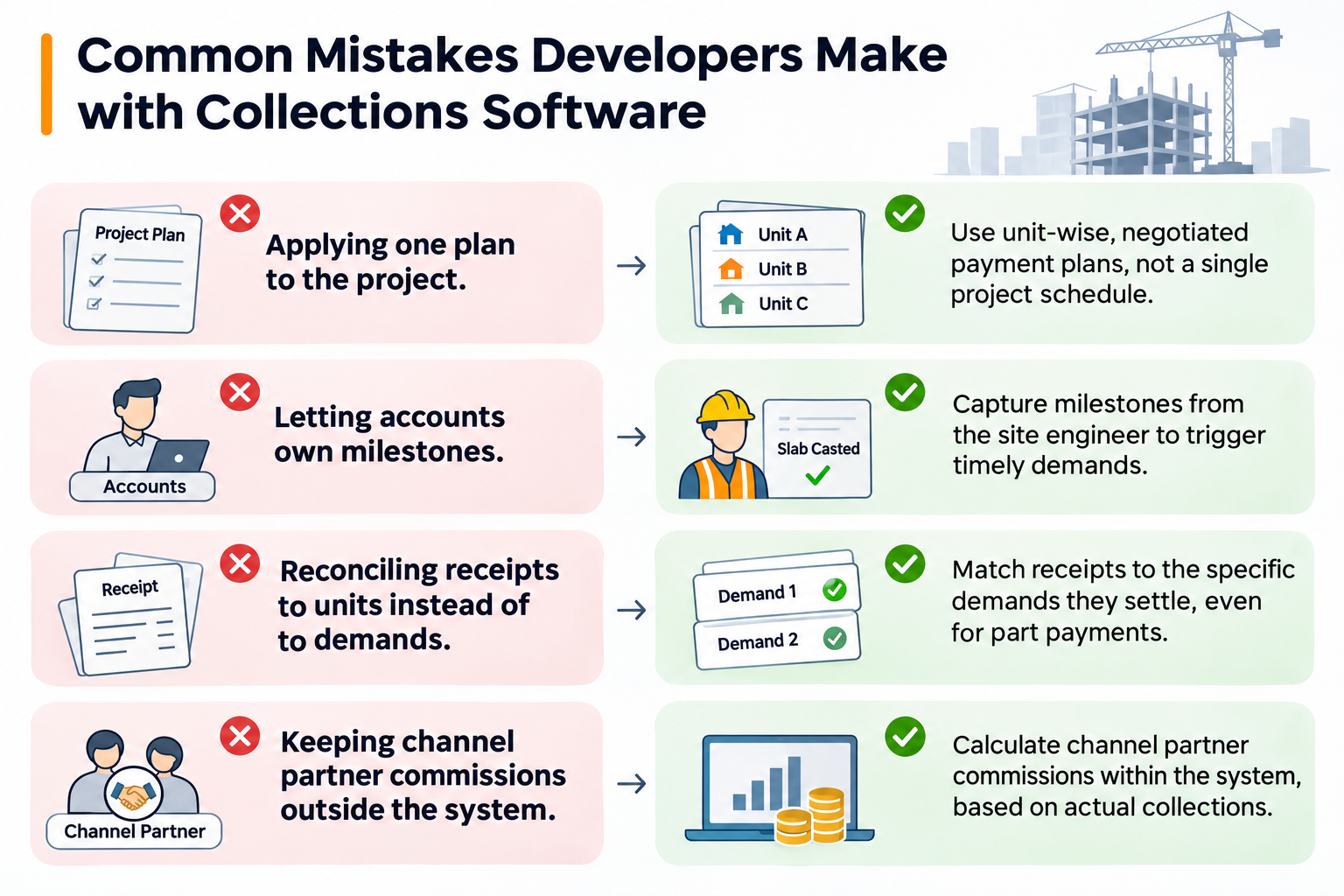
Applying one plan to the project. Negotiated terms are the norm, not the exception. A project-level schedule will be wrong for a meaningful share of units on day one, and the corrections will go back into a spreadsheet.
Letting accounts own milestones. The site engineer knows when the slab was cast. If the milestone is entered by accounts on hearsay, the demand run is late by exactly the length of the hearsay.
Reconciling receipts to units instead of to demands. A buyer who pays half of two demands looks fully paid on one and unpaid on the other if receipts are not matched to the demand they settle.
Keeping channel partner commissions outside the system. The commission is a function of collections received. Calculated anywhere else, it becomes a quarterly argument.
What this looks like in month three
A quarter after go-live, the Monday question is answered from a screen before the meeting starts. The last milestone certified on site triggered demands across every affected unit on the same day, each on its own negotiated terms, and accounts released them after review rather than drafting them. Receipts, including part payments, sit against the demand they settle, so outstanding per unit is current. The certificates for the separate account draw on receipts and completion percentages the system already holds. And the first channel partner settlement of the quarter was produced from the ledger, with the partner checking it rather than the other way round.
Built for a developer in Mumbai, enquiry to possession
We built exactly this for a renowned real estate developer in Mumbai, covering the journey from enquiry to possession: bookings, milestones, demand letters, collections against per-unit schedules, registration paperwork, possession handover and channel partner settlements, in one system, so the booking is the start of the record rather than the end of it.
We do not name the client. We can describe the work in full, and the shape of it transfers to any developer running construction-linked plans across more than one project.
What to look for in a real estate ERP for collections
Our ERP and CRM work is built to these checks, and the real estate industry page sets out how the sales and operations sides fit together.
Accucia's view
A developer's money lives in the link between a construction milestone and a per-unit payment schedule, and a sales CRM has no place to put that link. Collections tracking is where the ERP earns its keep: demands raised the day the slab is cast, receipts reconciled to the demand they settle, and one outstanding figure the owner can trust on a Monday morning.
Read the edition: The Enterprise AI Edge, Ed.22, A requirement met by a person fails on leave days.
If your bookings are managed in one tool and your money in another, the free AI Readiness Assessment maps the split and ranks what to fix first.
FAQ
How does a real estate ERP track collections?
It holds, for every sold unit, the negotiated payment schedule, the construction milestones it is linked to, each demand letter raised, each receipt against each demand, and the resulting outstanding balance. Sales, site and accounts write to the same record, so the outstanding figure per unit and per project is live.
What is a construction-linked payment plan?
A payment schedule in which instalments fall due when the building reaches physical milestones, such as plinth, each slab, brickwork, flooring and possession, rather than on fixed calendar dates. Percentages and milestones are often negotiated per unit, which is why collections tracking has to work at unit level.
Why can a sales CRM not handle developer collections?
A sales CRM is built around the enquiry and the booking. It has no structure for milestone-linked schedules, demand letters, receipts reconciled to demands, or outstanding balances per unit. Those end up in accounts spreadsheets, and the owner reconciles the two worlds in review meetings.
How does the seventy percent separate account rule relate to collections software?
Section 4(2)(l)(D) of the Real Estate (Regulation and Development) Act, 2016 requires seventy percent of amounts realised from allottees for a project to be deposited in a separate account, with withdrawals in proportion to certified completion. Software that holds each receipt against its unit and project, alongside construction progress, provides the figures those certificates rely on without reconstruction.
Can demand letters be generated automatically?
Yes. When the site team marks a milestone as reached, the ERP identifies every unit whose schedule includes that milestone, calculates each unit's demand from its own terms, generates the letters and logs them against the unit, so demands go out the day the milestone is reached rather than the week after.
Streamline Your Real Estate Collections with Accucia ERP.