
ERP Software in the UAE: VAT, PDPL and Offshore Builds
Quick Answer
ERP software UAE buyers purchase from an offshore developer is usually cash neutral for VAT. Under Article 48 of Federal Decree-Law No. 8 of 2017 you self account for 5% on the imported service and recover it in the same return, so the net cash cost is nil with full recovery. UAE withholding tax is zero. By Mr. Sanjay Katariya, Vice President, AI & Digital Solutions, Accucia Softwares Pvt. Ltd.
A UAE finance director's first question about an Indian ERP vendor is rarely about the software. It is what the tax and data position looks like when the invoice arrives from Pune. Most vendors either dodge that question or get it wrong.
The real answer is friendlier to the buyer than people assume.
Here is the commercial and legal position for buying ERP software in the UAE from a supplier outside the country, with the sources.
The four things a UAE buyer is actually checking
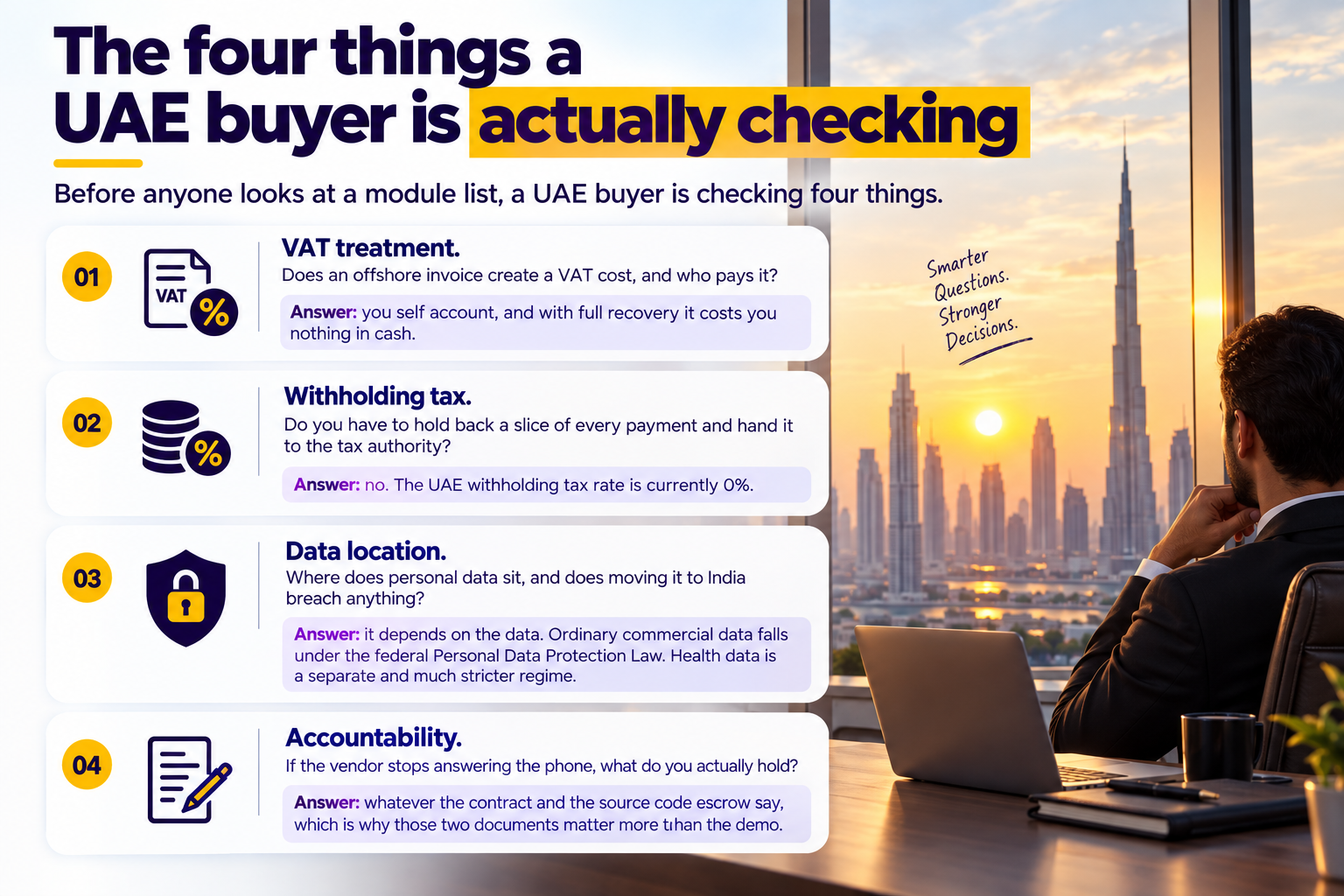
Before anyone looks at a module list, a UAE buyer is checking four things.
One, VAT treatment. Does an offshore invoice create a VAT cost, and who pays it?
Answer: you self account, and with full recovery it costs you nothing in cash.
Two, withholding tax. Do you have to hold back a slice of every payment and hand it to the tax authority?
Answer: no. The UAE withholding tax rate is currently 0%.
Three, data location. Where does personal data sit, and does moving it to India breach anything?
Answer: it depends on the data. Ordinary commercial data falls under the federal Personal Data Protection Law. Health data is a separate and much stricter regime.
Four, accountability. If the vendor stops answering the phone, what do you actually hold?
Answer: whatever the contract and the source code escrow say, which is why those two documents matter more than the demo.
Reverse charge VAT under Article 48, explained properly
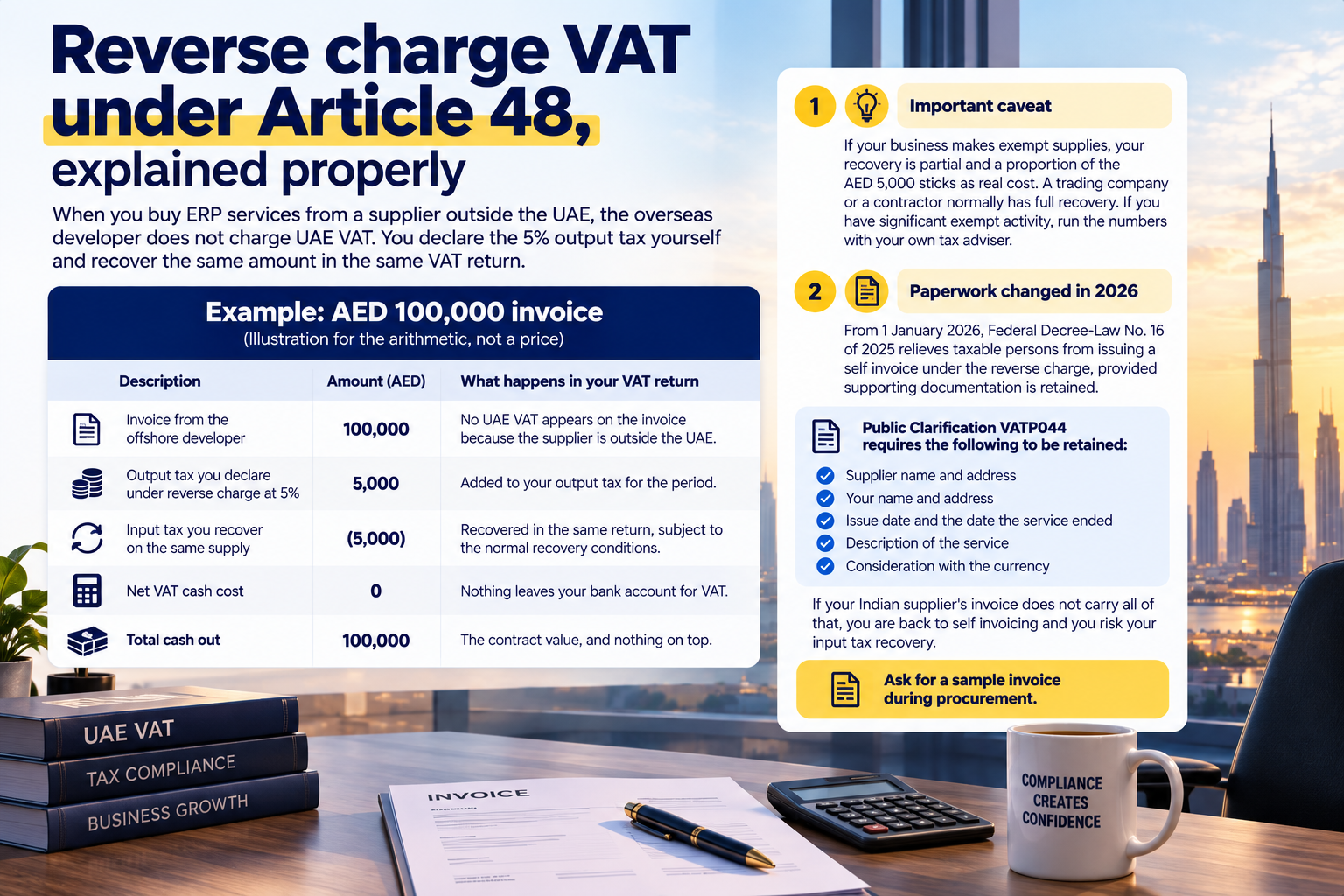
Under Article 48 of Federal Decree-Law No. 8 of 2017 on Value Added Tax, a taxable person who imports concerned services for the purposes of their business is treated as making a taxable supply to themselves.
In plain terms, the overseas developer does not charge UAE VAT. You declare the output tax yourself at the standard 5% rate and, subject to the normal input tax conditions, you recover the same amount in the same VAT return.
Here is what that looks like on a hypothetical AED 100,000 invoice. The figure is an illustration for the arithmetic, not a price.
Invoice from the offshore developer: AED 100,000. No UAE VAT appears on the invoice because the supplier is outside the UAE.
Output tax you declare under reverse charge at 5%: AED 5,000. This is added to your output tax for the period.
Input tax you recover on the same supply: AED 5,000. This is recovered in the same return, subject to the normal recovery conditions.
Net VAT cash cost: AED 0. Nothing leaves your bank account for VAT.
Total cash out: AED 100,000. The contract value, and nothing on top.
Two caveats that honest vendors mention and dishonest ones do not.
If your business makes exempt supplies, your recovery is partial and a proportion of that AED 5,000 sticks as real cost. A trading company or a contractor normally has full recovery. A business with a significant exempt activity should run the numbers with its own tax adviser rather than trusting a table on a website.
The paperwork changed recently.
From 1 January 2026, Federal Decree-Law No. 16 of 2025 relieves taxable persons from issuing a self invoice under the reverse charge, provided supporting documentation is retained.
Public Clarification VATP044 sets out what that documentation must contain: supplier name and address, your name and address, the issue date and the date the service ended, a description of the service, and the consideration with the currency.
If your Indian supplier's invoice does not carry all of that, you are back to self invoicing and you risk your input tax recovery.
Ask for a sample invoice during procurement.
Withholding tax: the UAE charges none
The UAE currently applies a 0% withholding tax to UAE sourced income derived by non-residents.
You pay the offshore supplier the full invoice value. There is no deduction, no certificate to issue, no filing.
This is a genuine commercial difference from other Gulf markets, not a talking point.
In Saudi Arabia, payments to a non-resident for services attract withholding tax at rates between 5% and 20% depending on the type of service, with royalties at 15%.
On a multi-year ERP programme that difference is real money, and it is one of the reasons a UAE buyer can work with an offshore team on simpler terms than a Saudi buyer can.
Data: PDPL Article 23, and why hospitals are a different conversation
Cross border transfers of personal data out of the UAE are governed by Article 23 of the federal Personal Data Protection Law, Federal Decree-Law No. 45 of 2021.
Transfers are permitted to countries the UAE Data Office has determined offer an adequate level of protection.
Where no adequacy determination exists, the transfer can still proceed on the basis of a contract that applies the requirements of the PDPL, the data subject's express consent, necessity for performance of a contract, international judicial cooperation, or public interest.
One point vendors gloss over: much of the PDPL's operational detail sits in executive regulations.
As at the most recent published legal commentary, in early 2025, those regulations had not been issued and the Data Office was not yet operational, so confirm the current position before you contract.
That does not make the law optional.
It means the operational detail may still be unsettled, so write the protections into the contract rather than wait for a regulator to define them.
What we would ask a vendor to sign up to, in writing:
- A named list of every sub-processor and the country each one sits in. Ours are AWS, Azure, Google Cloud Platform, client on-premise, plus error and performance monitoring, analytics and product telemetry, and helpdesk tooling.
- A deployment region you choose. We deploy in-region on request across AWS, Azure or Google Cloud Platform, with infrastructure billed to you at cost, or to your own on-premise servers.
- Breach notification timelines, deletion on termination, and named individuals accountable for both.
- A mutual non-solicit, 12 or 24 months, agreed per engagement and always in writing.
Health data is a separate regime
If you are buying a hospital or clinic ERP, ignore everything above and start again.
Federal Law No. 2 of 2019 on the use of information and communication technology in health fields prohibits processing or storing health data related to UAE health services outside the country.
Ministerial Decision No. 51 of 2021 later set out a defined list of exemptions, covering treatment abroad, approved research on anonymised data, insurance claims on de-identified information and telemedicine, each with conditions on consent, encryption and retention.
Those are narrow carve-outs, not a general licence.
The consequence is simple.
A trading company ERP can be built offshore and hosted wherever you choose.
A hospital ERP holding patient records is a UAE-hosted build unless you can point to a specific exemption.
The working week and the 90 minute question
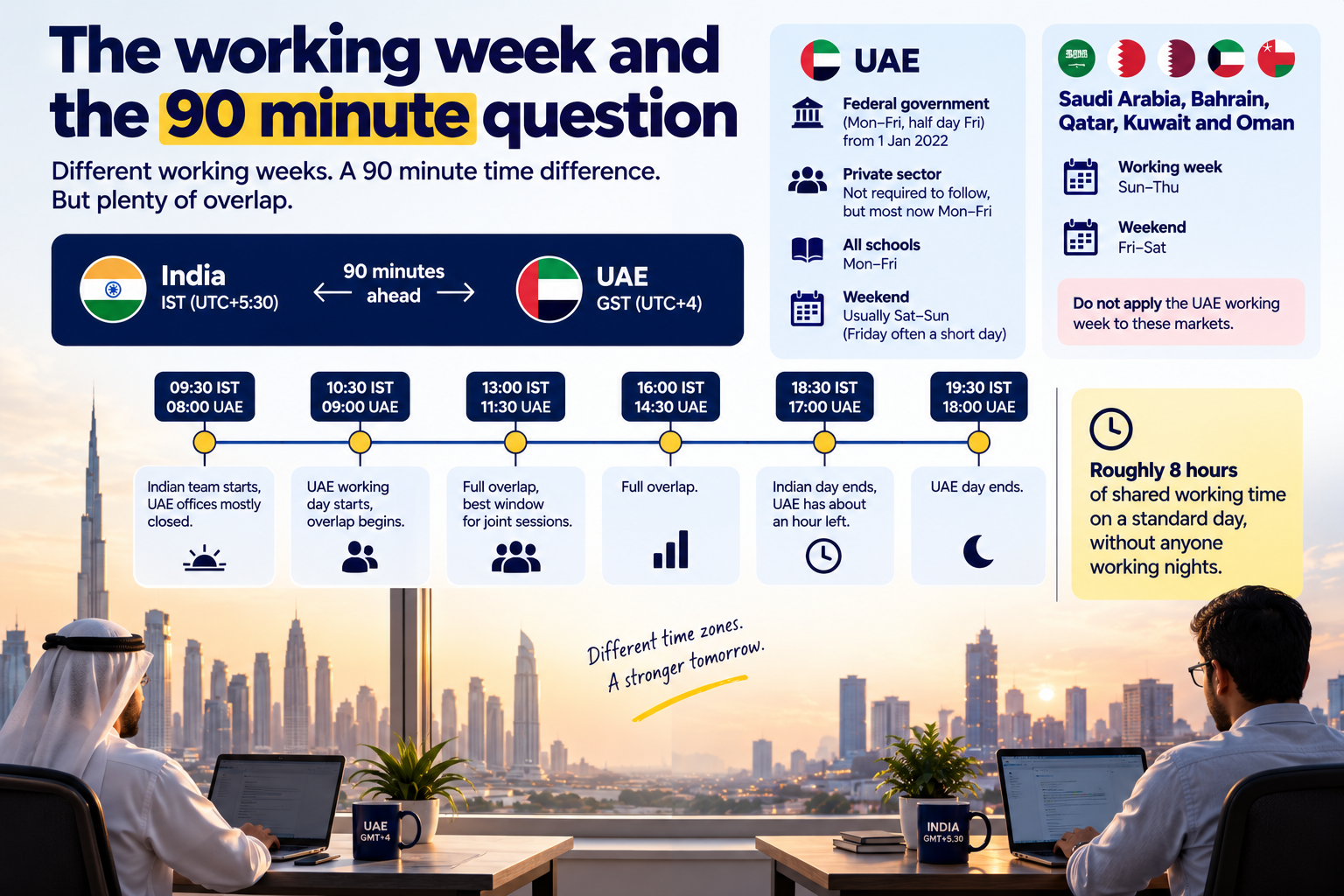
From 1 January 2022, UAE federal government entities moved to a four and a half day week running Monday to Friday lunchtime, and all schools moved to Monday to Friday.
The private sector was not required to follow.
Under the UAE Labour Law an employer chooses when the weekly rest day falls.
Most UAE private sector businesses have since aligned with a Monday to Friday week and a Saturday and Sunday weekend, but some have not, and Friday is often a short day.
Confirm the actual working week of your counterpart rather than assuming it.
Do not apply any of this to Saudi Arabia, Bahrain, Qatar, Kuwait or Oman. Those markets run Sunday to Thursday with a Friday and Saturday weekend.
The UAE is on Gulf Standard Time, UTC+4.
India is on Indian Standard Time, UTC+5:30.
The offset is 90 minutes, with India ahead.
09:30 IST = 08:00 UAE: Indian team starts, UAE offices mostly closed.
10:30 IST = 09:00 UAE: UAE working day starts, overlap begins.
13:00 IST = 11:30 UAE: Full overlap, best window for joint sessions.
16:00 IST = 14:30 UAE: Full overlap.
18:30 IST = 17:00 UAE: Indian day ends, UAE has about an hour left.
19:30 IST = 18:00 UAE: UAE day ends.
On a standard day that gives you roughly eight hours of shared working time, without anyone working nights.
It is why we run daily stand-ups at 09:00 GST rather than asynchronous updates.
UAE against Saudi Arabia: the commercial differences that matter
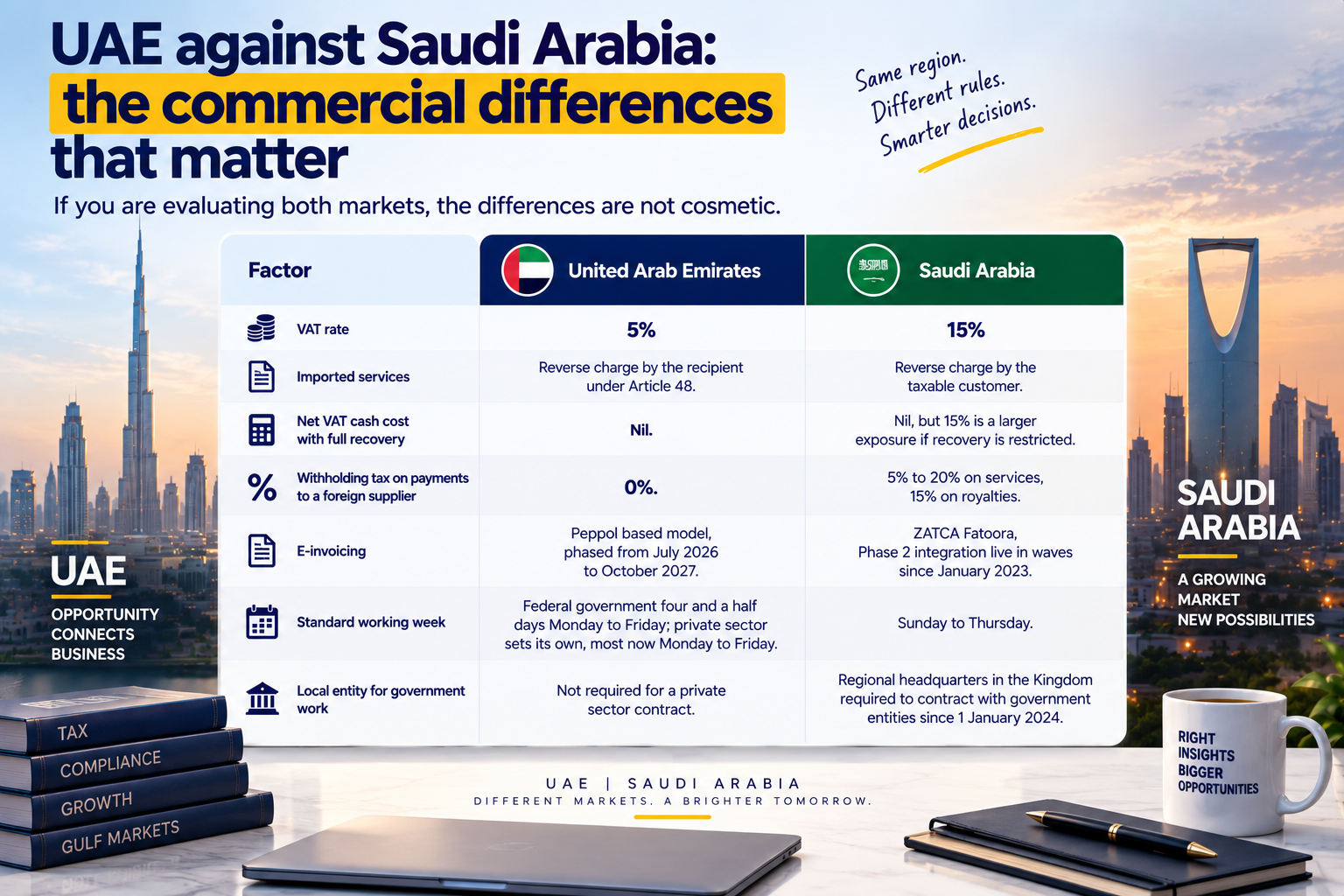
If you are evaluating both markets, the differences are not cosmetic.
This is the comparison we walk clients through across our Gulf practice.
VAT rate
United Arab Emirates: 5%
Saudi Arabia: 15%
Imported services
United Arab Emirates: Reverse charge by the recipient under Article 48.
Saudi Arabia: Reverse charge by the taxable customer.
Net VAT cash cost with full recovery
United Arab Emirates: Nil.
Saudi Arabia: Nil, but 15% is a larger exposure if recovery is restricted.
Withholding tax on payments to a foreign supplier
United Arab Emirates: 0%.
Saudi Arabia: 5% to 20% on services, 15% on royalties.
E-invoicing
United Arab Emirates: Peppol based model, phased from July 2026 to October 2027.
Saudi Arabia: ZATCA Fatoora, Phase 2 integration live in waves since January 2023.
Standard working week
United Arab Emirates: Federal government four and a half days Monday to Friday; private sector sets its own, most now Monday to Friday.
Saudi Arabia: Sunday to Thursday.
Local entity for government work
United Arab Emirates: Not required for a private sector contract.
Saudi Arabia: Regional headquarters in the Kingdom required to contract with government entities since 1 January 2024.
Registration and procurement: when a local entity actually becomes necessary
A foreign supplier can invoice a UAE business today.
The reverse charge exists precisely so that cross border services work without the supplier registering locally.
For a private sector contract you do not need a UAE trade licence on the other side of the table.
Three situations change that.
Government and semi-government tenders.
Public procurement in the UAE generally expects a locally registered bidder or a local partner of record.
If your ERP is going into a federal or emirate-level entity, plan for a local prime contractor with the offshore team subcontracted underneath.
People on the ground for long periods.
Under the federal corporate tax regime, a non-resident creates a permanent establishment through a fixed place in the UAE through which its business is conducted, or through a person who habitually concludes contracts on its behalf.
A discovery visit is one thing.
A team sitting in your office for months is another.
Contractual preference.
Some buyers simply require a UAE entity for comfort.
We do not have a Dubai office, a UAE address, a trade licence, a TRN or a local team, and we will tell you that in the first call rather than the fifth.
What ERP software UAE buyers need in the box
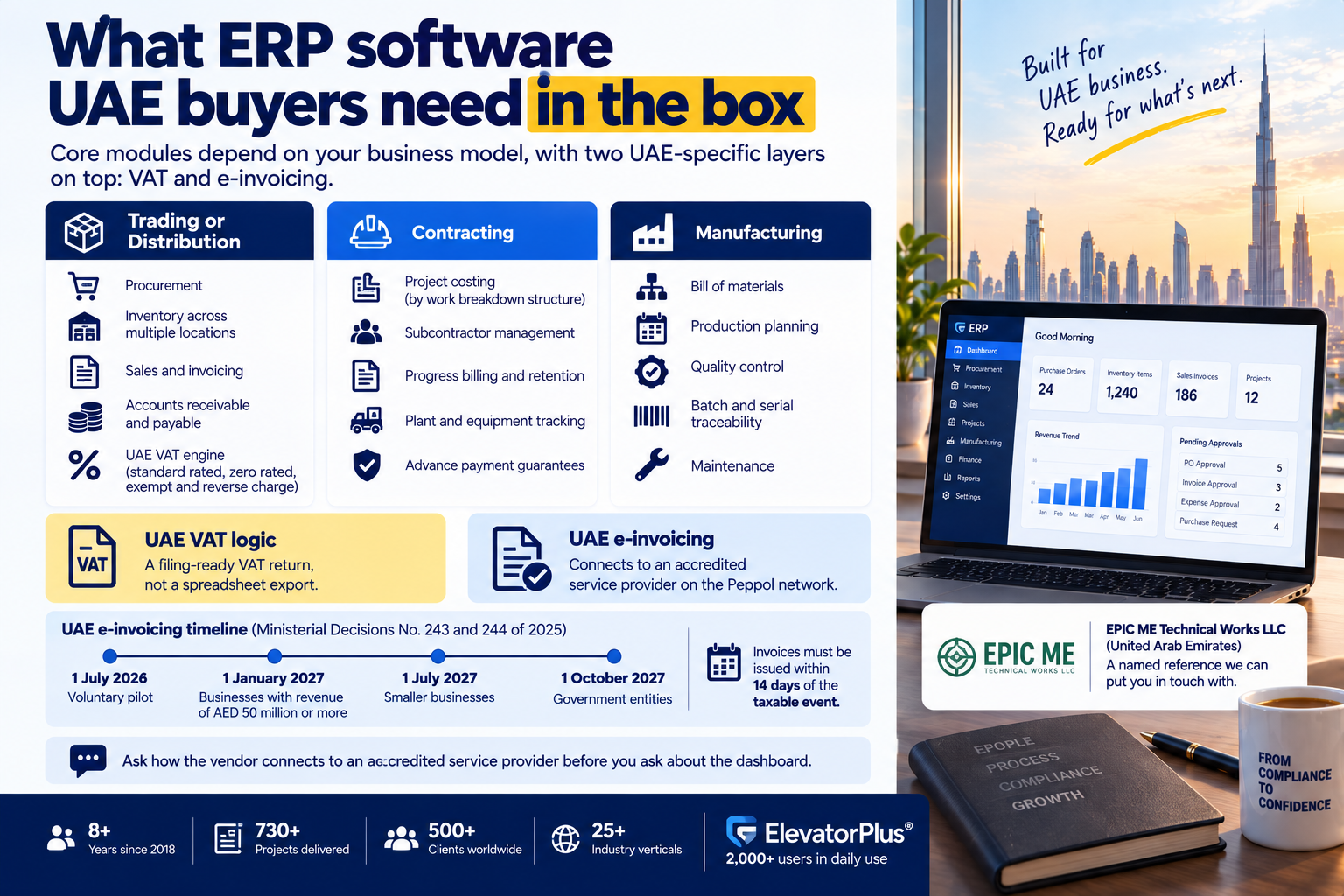
Module requirements in the UAE follow the business model, not the country, with two local layers bolted on top.
For a trading or distribution business: procurement, inventory across multiple locations, sales and invoicing, accounts receivable and payable, and a VAT engine that handles standard rated, zero rated, exempt and reverse charge transactions correctly.
For a contracting business: project costing by work breakdown structure, subcontractor management, progress billing and retention, plant and equipment tracking, and advance payment guarantees.
For a manufacturing business: bill of materials, production planning, quality control, batch and serial traceability, and maintenance.
Then the two local layers.
First, VAT logic that produces a filing-ready return rather than a spreadsheet export.
Second, e-invoicing.
Ministerial Decisions No. 243 and 244 of 2025 put the UAE model on the Peppol network: a voluntary pilot from 1 July 2026, businesses with revenue of AED 50 million or more complying from 1 January 2027, smaller businesses from 1 July 2027 and government entities from 1 October 2027.
Invoices must be issued within 14 days of the taxable event.
Ask how the vendor connects to an accredited service provider before you ask about the dashboard.
Our ERP and CRM practice covers those builds.
In the UAE, EPIC ME Technical Works LLC (United Arab Emirates) is a named reference we can put you in touch with.
Across 8 years since 2018 we have delivered 730+ projects for 500+ clients worldwide across 25+ industry verticals, and our elevator maintenance product ElevatorPlus is in daily use by 2,000+ users.
Cost and timeline: what drives the number
We do not publish a price for an ERP build, because the range is wide and the drivers are specific to you.
What we do publish is the list of drivers:
Number of modules.
Number of concurrent users.
How much of your process is genuinely non-standard.
How many external systems you integrate with.
Whether you need in-region hosting.
Data migration complexity.
How much change management you want us to carry.
Timeline follows the same logic.
A single-country trading ERP with clean master data is a different programme to a multi-entity contracting ERP with 12 years of legacy transactions to migrate.
The full breakdown sits on our how-we-work page.
Accucia's view
Three positions, including the ones that cost us work.
If you are a UAE hospital or clinic group, we will not offer you the cheaper offshore-hosted option.
Federal Law No. 2 of 2019 makes UAE hosting the default for health data, and the exemptions are narrow.
That costs us margin on every healthcare deal.
We would rather lose the margin than hand you a licensing problem.
If your procurement requires a supplier with a UAE trade licence, TRN and local team, we are not that supplier.
We are an Indian company delivering to the UAE.
We have no Gulf office and we do not pretend otherwise.
On certifications, we will not overstate.
ISO 27001 is not held and implementation is underway.
ISO 9001 is not held and is in progress.
We do not hold CERT-In empanelment.
Where a security audit is required, you commission the empanelled auditor, we build to the auditor's requirements and we implement every finding.
Our full position on security and sub-processors is on our trust page.
What we will say without hedging: the commercial mechanics of buying ERP from India into the UAE are better than most buyers expect.
VAT is cash neutral with full recovery.
Withholding tax is zero.
The working day overlaps by about eight hours.
The remaining risk is contractual, and contractual risk is the kind you can write down and manage.
If you want the tax and data position checked against your specific business before you shortlist vendors, talk to us.
Frequently Asked Questions
Does an Indian ERP vendor charge UAE VAT on the invoice?
No.
A supplier outside the UAE does not charge UAE VAT.
Under Article 48 of Federal Decree-Law No. 8 of 2017 you account for the 5% yourself under the reverse charge and recover the same amount in the same return where you have full input tax recovery.
What is the net VAT cost of an offshore ERP build in the UAE?
Nil in cash terms for a business with full input tax recovery.
You declare output tax at 5% and recover an equal amount of input tax in the same VAT return.
If your business makes exempt supplies, your recovery is partial and a proportion of that 5% becomes a real cost.
Do I have to withhold tax on payments to a foreign software supplier?
No.
The UAE withholding tax rate on UAE sourced income derived by non-residents is currently 0%.
You pay the full invoice value with no deduction and no filing obligation.
This differs from Saudi Arabia, where services paid to non-residents attract withholding tax between 5% and 20%.
Do I still need a self invoice under the reverse charge?
Not from 1 January 2026.
Federal Decree-Law No. 16 of 2025 relieves taxable persons from issuing self invoices under the reverse charge, provided supporting documentation is retained.
Public Clarification VATP044 lists what that documentation must contain, so check your supplier's invoice format during procurement.
Can personal data be transferred from the UAE to India for an ERP build?
Yes, subject to Article 23 of Federal Decree-Law No. 45 of 2021.
Transfers are permitted to adequate jurisdictions, or on the basis of a contract applying PDPL requirements, express consent, contractual necessity, judicial cooperation or public interest.
Write the safeguards into your vendor contract.
Are the PDPL executive regulations in force yet?
Check the current position before you rely on it.
As at the most recent published legal commentary, in early 2025, the executive regulations supplying the PDPL's operational detail had not been issued and the UAE Data Office was not operational.
The law itself still applies, so put transfer safeguards, breach notification and deletion terms into the contract now.
Can a UAE hospital ERP be hosted in India?
Generally no.
Federal Law No. 2 of 2019 prohibits processing or storing health data related to UAE health services outside the country.
Ministerial Decision No. 51 of 2021 sets out a defined list of exemptions such as treatment abroad and approved research, each with conditions.
Assume UAE hosting for patient data.
Is the UAE private sector working week Monday to Friday?
Most UAE private sector businesses now work Monday to Friday, but this is not a legal requirement.
The January 2022 change applied to federal government entities and schools.
Under the UAE Labour Law a private employer sets its own rest day, so confirm your counterpart's actual working week rather than assuming.
How many hours does a UAE team overlap with an Indian team?
About eight hours on a standard working day.
The UAE is UTC+4 and India is UTC+5:30, a 90 minute offset with India ahead.
An Indian day of 09:30 to 18:30 IST maps to 08:00 to 17:00 in the UAE, covering almost the whole UAE working day.
Does a foreign ERP vendor need to register in the UAE?
Not for a normal private sector contract.
The reverse charge exists so cross border services work without local supplier registration.
Registration or a local partner becomes necessary for government tenders, and permanent establishment questions arise if the vendor keeps staff or a contract-signing agent in the UAE long term.
When does UAE e-invoicing become mandatory?
Ministerial Decisions No. 243 and 244 of 2025 set a voluntary pilot from 1 July 2026.
Businesses with revenue of AED 50 million or more comply from 1 January 2027, smaller businesses from 1 July 2027 and government entities from 1 October 2027.
Invoices must be issued within 14 days.
What does an ERP implementation in the UAE cost?
There is no single figure.
Cost is driven by module count, concurrent users, how non-standard your processes are, integration count, in-region hosting, data migration complexity and change management scope.
We publish the drivers rather than a band, because a band would be misleading for most buyers.
Talk to us before you shortlist your ERP vendor.