AI Implementation Services: After the Readiness Assessment
Quick Answer
AI implementation services turn a readiness assessment into a working system. The sequence: pick the first integration where data is ready, the question is repetitive and an owner cares; wire the AI layer into live systems with proper access control; define the measurement before building; prove value in production; then scale what worked. By Mr. Sumeet Katariya, Accucia Softwares Pvt. Ltd.
The assessment report is not the finish line. It is a ranked list waiting for someone to build item one.
That gap, between the report and the running system, is where most enterprise AI effort quietly dies. Companies commission the assessment, nod at the findings, circulate the deck, and six months later nothing reads their data except the people who always did. Implementation is a different discipline from assessment, and it is the one that earns.
From gap map to first build
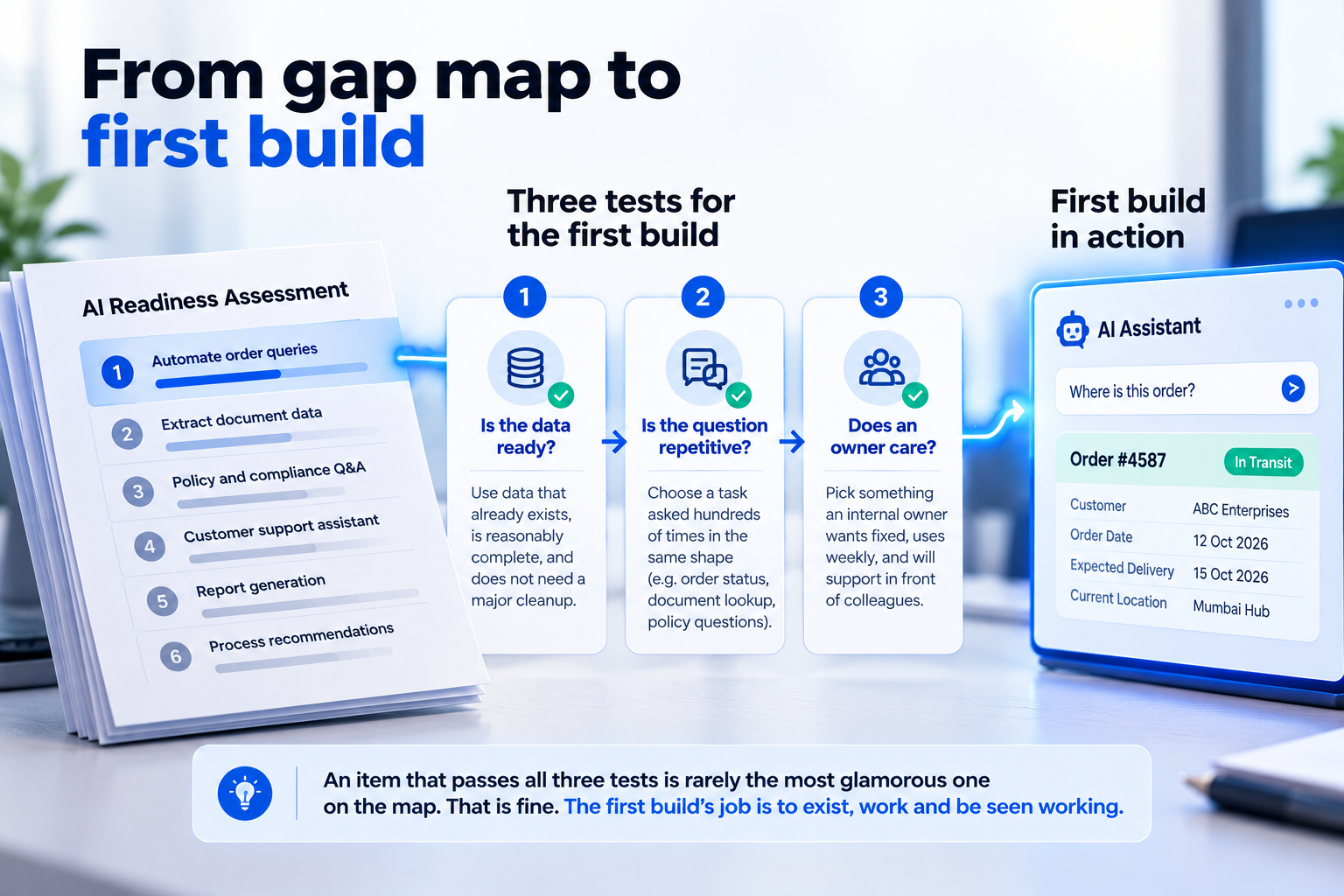
A good readiness assessment hands you a gap map: where AI could remove work, ranked by feasibility and value. The implementation question is narrower. Which item becomes the first build?
Three tests, applied in order, settle it.
Is the data ready? Not perfect, ready. The first build should sit on data that already exists in a system of record, is reasonably complete, and does not need a six-month cleanup project as a prerequisite. If the top-ranked item needs data you do not yet collect, it is not item one, whatever the deck says.
Is the question repetitive? AI earns fastest on questions asked hundreds of times in nearly the same shape: where is this order, what does this document say, which policy applies here. A task performed occasionally by one expert is a poor first target no matter how painful it is, because the system gets too few repetitions to prove itself.
Does an owner care? Somebody inside the business must want this specific thing fixed, use it weekly, and be willing to say so in front of colleagues. Systems without an internal owner get politely ignored, and politely ignored is how AI initiatives end. We have watched owner enthusiasm rescue mediocre pilots and owner absence sink technically excellent ones. Pick the owner first if you have to pick.
An item that passes all three tests is rarely the most glamorous one on the map. That is fine. The first build's job is to exist, work and be seen working.
What implementation actually involves
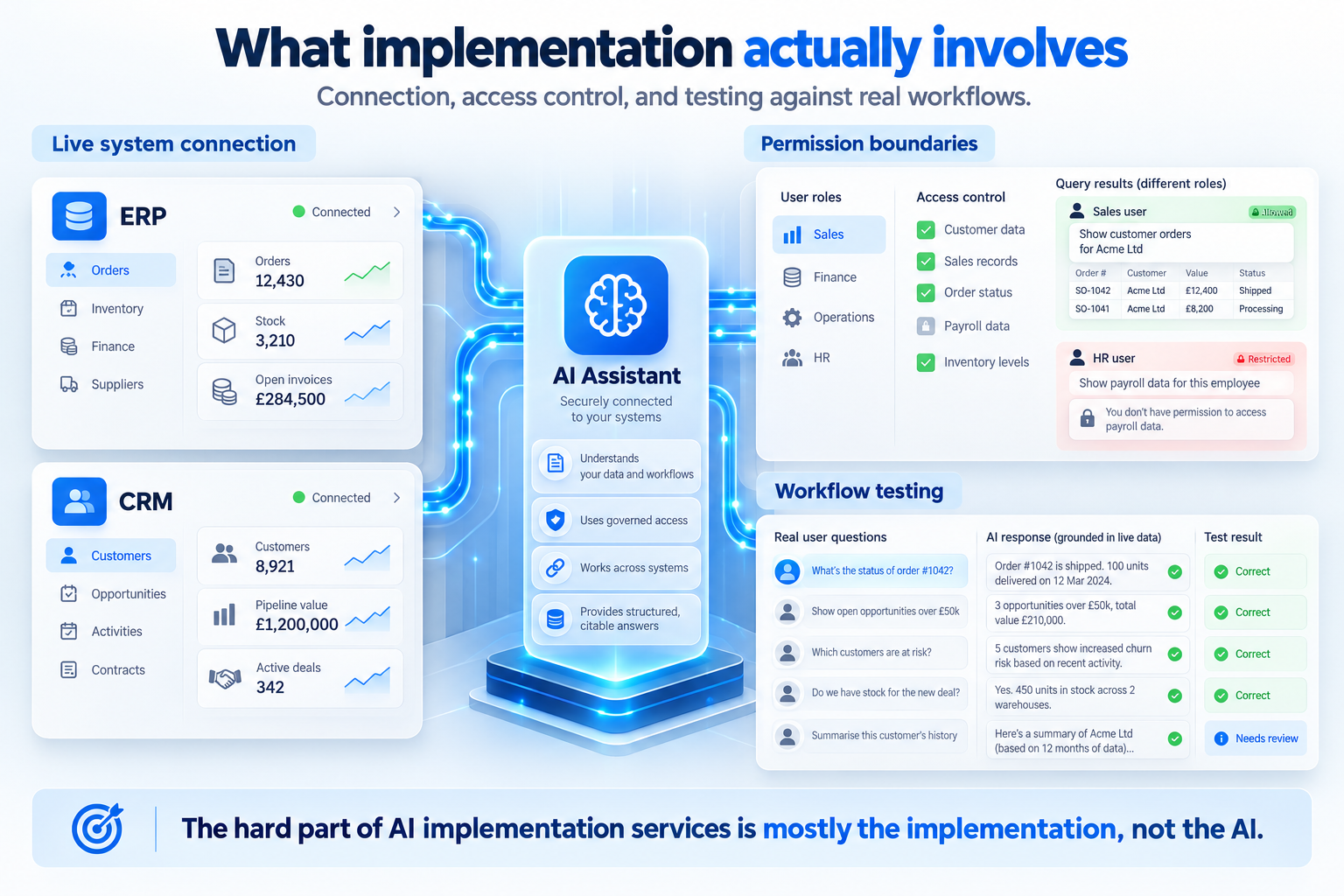
The word "implementation" hides a lot of unglamorous engineering. Here is what the work actually is.
The centre of it is connection. An AI layer is only as useful as the systems it can read, which for most mid-size and enterprise operations means the ERP and the CRM, the places where orders, customers, stock and money already live. Wiring an assistant into those systems, so it answers from live records instead of from general knowledge, is the core of our AI development and automation work. For connecting AI to existing enterprise systems specifically, MCP integration is how we give an AI layer structured, governed access to the software you already run, rather than replacing that software.
Access control comes next, and earlier than most teams expect. The moment an assistant can read live business data, the question "who is allowed to ask it what" becomes a design input, not an afterthought. A sales assistant should not surface payroll. A junior analyst's queries should not return what their login could never see. Implementation means building the AI layer inside the same permission boundaries the business already enforces, and testing those boundaries deliberately.
Then comes testing against real workflows, which is different from testing against a demo script. Real users phrase questions badly, ask things the system was not designed for, and paste in half the context. The test set has to come from the floor: actual questions, pulled from actual tickets and chats, answered by the system and graded by the people who know the right answers. This stage is slower than anyone wants and skipping it is how confident, wrong systems reach production.
None of this is exotic. It is systems integration with a new kind of component, done by people who have integrated systems before. That is worth knowing when you evaluate providers: the hard part of AI implementation services is mostly the implementation, not the AI.
Proving value before scaling
Define the measurement before the build. Not after the build, not during the rollout. Before. The team should be able to finish this sentence on day one: this system works if changes, measured by , compared against the current baseline of ___.
A worked example, from a project we can describe but not name. A large Indian pharmaceutical company came through exactly this path: assessment first, then one scoped build, an AI assistant answering document and data queries that previously meant manual digging. Because the measures were defined up front, the results were checkable rather than anecdotal: 75% less time per query, 95% accuracy against the graded test set, 40% faster onboarding for new staff who no longer needed months of tribal knowledge to find answers, and payback inside 8 months. The full story is in the pharma case study.
Notice what made those numbers possible. Not the model. The baseline. Someone measured how long queries took before, so "less time per query" meant something afterward. Teams that skip the baseline end up arguing about whether the system helps, which is an argument nobody wins.
Scaling, when it comes, should follow the proof, one integration at a time, each with its own measure. The second build goes faster than the first because the plumbing, permissions and evaluation habits already exist.
Why implementation beats experimentation
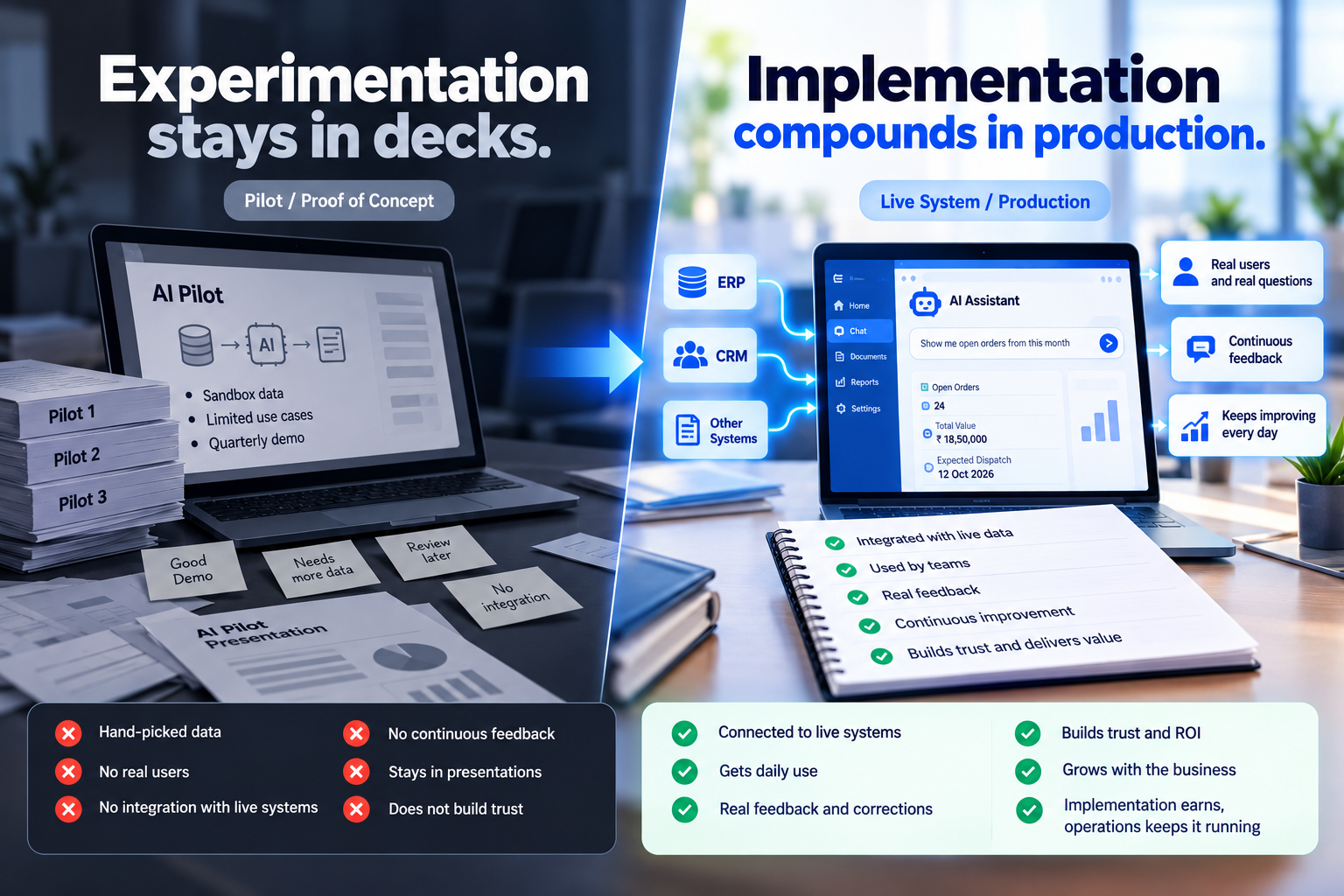
Pilots die in decks. A proof of concept that lives in a sandbox, fed hand-picked data, demonstrated quarterly, is a presentation with extra steps. It cannot earn trust because nobody depends on it, and it cannot compound because nothing connects to it.
Production systems compound. A working assistant wired into live data gets used, and use generates the two things experiments never produce: real feedback and real expectations. Users report the answers that were wrong. They ask for the adjacent capability. The question list grows, the test set grows, and each improvement lands in a tool people already open every day. Within a year the production system has absorbed hundreds of corrections the sandbox pilot never saw.
There is an organisational effect too. A business that has one AI system in production argues about the roadmap. A business with three pilots in decks argues about whether AI works. Those are very different meetings to sit in.
This is also why the question of who runs the system matters as much as who builds it. Models update, APIs change, usage grows, and the question list drifts with the business. Our managed AI operations service exists because an AI layer is a living system: it needs monitoring, evaluation and tuning after launch the same way any production system does. Implementation gets you to earning; operations keeps you there.
Accucia's view
An AI readiness assessment is worth exactly as much as the first system built from it. We hold that view as implementers: Accucia has been delivering software since 2018 from Pune, and the AI work we ship follows the same discipline as everything else, scoped builds, live integrations, measures defined before code. Choose the first build by data readiness, repetition and ownership, wire it into the systems you already run, and measure it against a baseline you recorded before you started. Everything else in enterprise AI is commentary.
If you have an assessment gathering dust, or have not run one yet, start with our free AI Readiness Assessment and we will show you what item one looks like for your business.
FAQ
What are AI implementation services?
AI implementation services take a business from an assessment or plan to a working AI system in production. The work covers scoping the first integration, connecting the AI layer to live systems such as ERP and CRM, enforcing access control, testing against real workflows, and measuring results against a pre-build baseline.
What should come first after an AI readiness assessment?
One scoped build, chosen by three tests: the data already exists and is reasonably complete, the question is asked repetitively in a similar shape, and a specific internal owner wants it fixed and will use it. An item passing all three beats a more glamorous item that fails one.
How do you measure whether an AI implementation worked?
Define the measure before building: what should change, how it is measured, and the current baseline. In one pharmaceutical deployment this discipline made results checkable, with 75% less time per query, 95% accuracy on a graded test set, 40% faster onboarding and payback inside 8 months.
Why do AI pilots fail to reach production?
Pilots run in sandboxes on hand-picked data, so nobody depends on them, no real feedback arrives, and trust never accumulates. Production systems wired into live data get daily use, collect corrections, and compound. The gap is usually integration and ownership, not model capability.
Turn Your AI Pilot Into Real Business Results