
Loan Origination System vs Lending Automation for NBFCs
Quick Answer
A loan origination system covers the loan from application to sanction: capture, KYC, credit assessment, approval. Lending automation covers the whole life of the loan after that as well: Key Fact Statement, cooling-off, direct disbursal, EMI schedule, collections, portfolio reporting and grievance handling, with the RBI Digital Lending Directions 2025 built into the workflow rather than remembered by a person. Most NBFCs need the second, and discover it around the first audit. By Mr. Sumeet Katariya, Accucia Softwares Pvt. Ltd.
What a loan origination system covers, and where it stops
A loan origination system, LOS in the trade, does one thing well. It takes an application and turns it into a sanction. Application capture, document upload, bureau pull, internal scoring, the credit committee workflow, the sanction letter. For an NBFC growing its book, the LOS is usually the first piece of software bought, because origination is where the growth is felt and where the manual effort is most visible.
Then the loan is sanctioned and the LOS has, by its own definition, finished.
What follows is longer, messier and more regulated than what came before. The money has to move the right way. The borrower has to receive the right document before signing. A cooling-off window has to be respected. Instalments have to be scheduled, collected, chased and reported. Complaints have to be logged and escalated. The regulator has to receive data in a prescribed shape. None of this is origination, so none of it lives in the LOS, and it ends up in the accounts team's spreadsheets.
What happens after sanction
List it out and the imbalance is obvious.
The top three rows are the LOS. The seven below are the loan. An NBFC that buys only the top three has digitised the part of the business that produces loans and left the part that produces revenue, risk and regulatory exposure on paper.
Lending automation: the whole life of the loan in one workflow
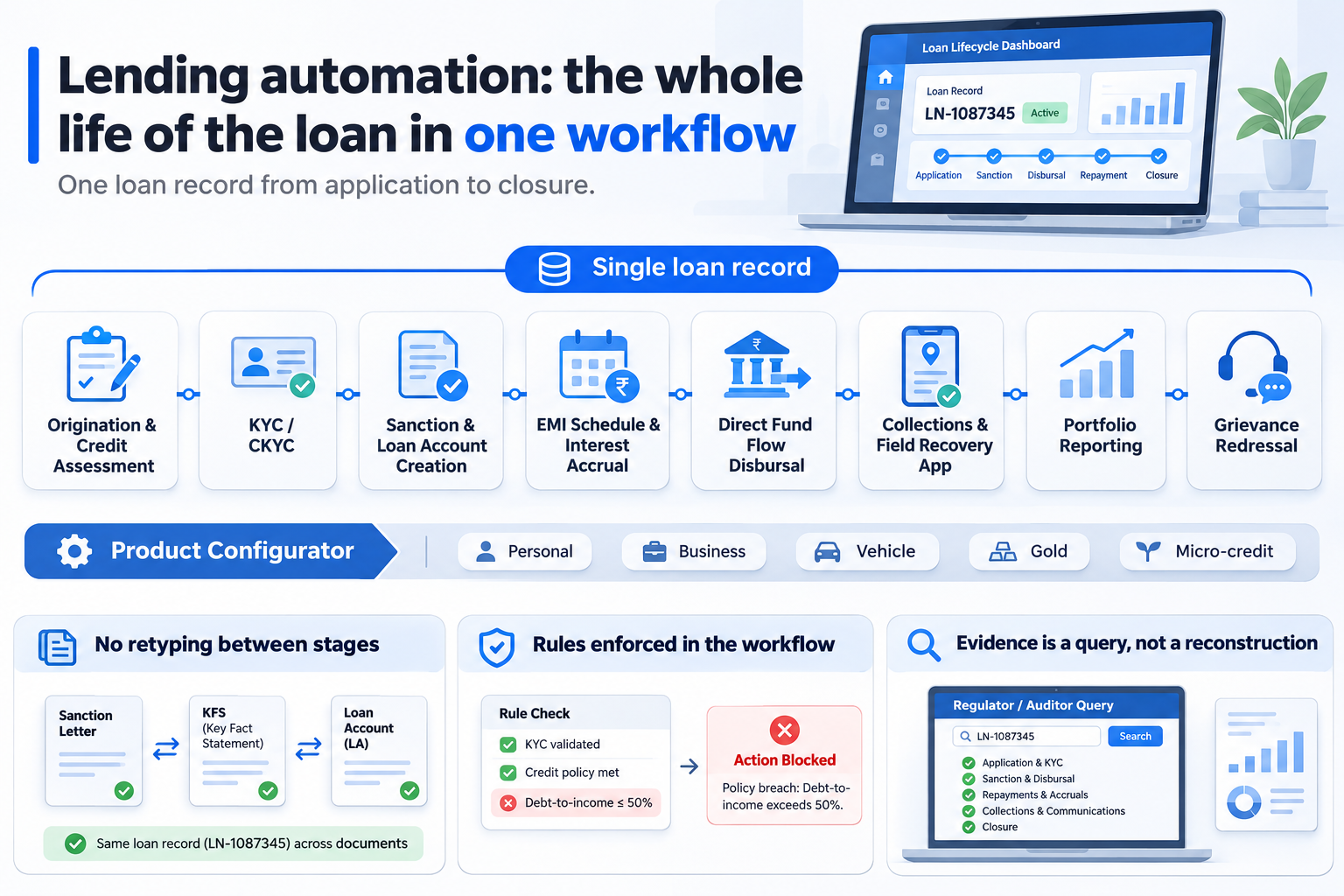
Lending automation is the unglamorous name for the alternative: one system in which the loan is a single record from application to closure, and every stage reads and writes that record.
In the lending systems we build for NBFCs, that means origination and credit assessment at the front, then KYC and CKYC, then the loan account created on sanction with its EMI schedule and interest accrual, then disbursal through direct fund flow, then collections with a field recovery app for the agents, then portfolio reporting, then grievance redressal. A product configurator sits across it so personal, business, vehicle, gold and micro-credit loans run on the same spine with different rules.
The practical difference shows up in three places. Nothing is retyped between stages, so the sanction letter, the KFS and the loan account all carry the same numbers. Nothing depends on a person remembering, so a disbursal that would breach a rule is blocked rather than flagged in a report two weeks later. And when the regulator or auditor asks, the evidence is a query rather than a reconstruction.
We set out the compliance checklist NBFC buyers should run against any system, and the case for building around the rules rather than bolting them on. This post is the shorter argument: the rules live after sanction, so the system has to as well.
Where the RBI Digital Lending Directions 2025 bite
The Reserve Bank of India (Digital Lending) Directions, 2025, issued on 8 May 2025 as circular RBI/2025-26/36 (DOR.STR.REC.19/21.07.001/2025-26), consolidated the digital lending framework NBFCs now operate under. Read it against the two system types and a pattern appears. Almost every operational requirement sits after sanction.
A requirement met by a person fails on leave days, during growth spurts and under audit pressure. A requirement met in code is met every time, with a record to show for it. That sentence is the whole argument for lending automation over a standalone LOS.
What the Directions actually say, paragraph by paragraph
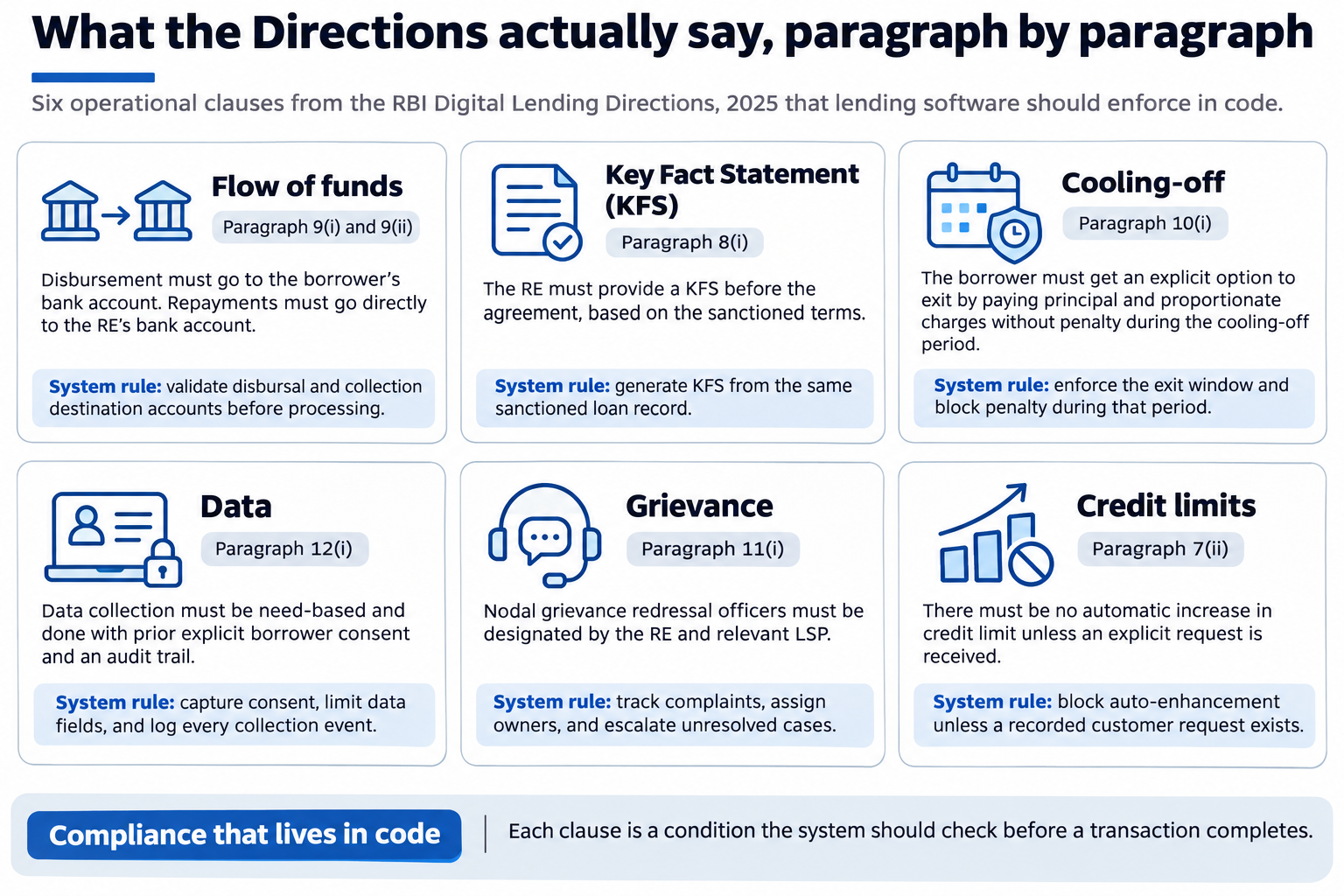
It helps to read the operative clauses rather than summaries of them, because the wording tells you what the system has to enforce. The Reserve Bank of India (Digital Lending) Directions, 2025 were notified on 8 May 2025 (RBI/2025-26/36, DOR.STR.REC.19/21.07.001/2025-26). The clauses below are quoted from that notification.
- Flow of funds, paragraph 9(i) and 9(ii). "Disbursement of loan by the RE shall always be made into the bank account of the borrower" and "RE shall ensure that all loan servicing, repayment, etc. is executed by the borrower directly in the RE's bank account." In a system, this is a rule on the disbursal and collection transactions, not a note in a procedure.
- Key Fact Statement, paragraph 8(i). "RE shall provide a Key Fact Statement (KFS), as per instructions contained in" the applicable circular. The KFS is a document the system generates from the sanctioned terms and sequences before the agreement, so the numbers on it and on the loan account cannot differ.
- Cooling-off, paragraph 10(i). "The borrower shall be given an explicit option to exit a digital loan by paying the principal" and the proportionate charges "without any penalty during an initial cooling-off period." The system holds the window and blocks what the window forbids.
- Data, paragraph 12(i). "RE shall ensure that any collection of data by their DLA and DLA of their LSP is need-based" and done "with prior and explicit consent of the borrower having audit trail." Need-based collection and an audit trail are schema and logging decisions.
- Grievance, paragraph 11(i). "The RE, and the LSP which has an interface with the borrower, shall designate nodal grievance redressal officers." The designation is a people decision; the tracking and escalation that make it work are a workflow.
- Credit limits, paragraph 7(ii). "RE shall ensure that there is no automatic increase in credit limit unless an explicit request is received." A LOS that re-scores and auto-enhances limits is in direct conflict with this clause unless the request is captured first.
Every one of those six clauses is a condition a system can check before a transaction completes. That is what we mean by compliance that lives in code.
What to check in your own setup this week
- Take one live loan and trace it from application to the last EMI. Count the systems and spreadsheets it passed through. Each hand-off is a place a number was retyped.
- Find the KFS for that loan and compare its figures with the loan account. If they match, ask how. If the answer is "the same person typed both", the match is luck.
- Ask who would stop a disbursal that routed through a service provider's account. If the answer is a person, ask what happens when that person is on leave.
- Pull last quarter's regulatory submission and ask how long it took to assemble. The hours are the cost of the gap behind the LOS.
- Open the grievance register, whatever it is. If it is an inbox, the escalation to the nodal officer is happening in someone's memory.
Common mistakes NBFCs make with lending software
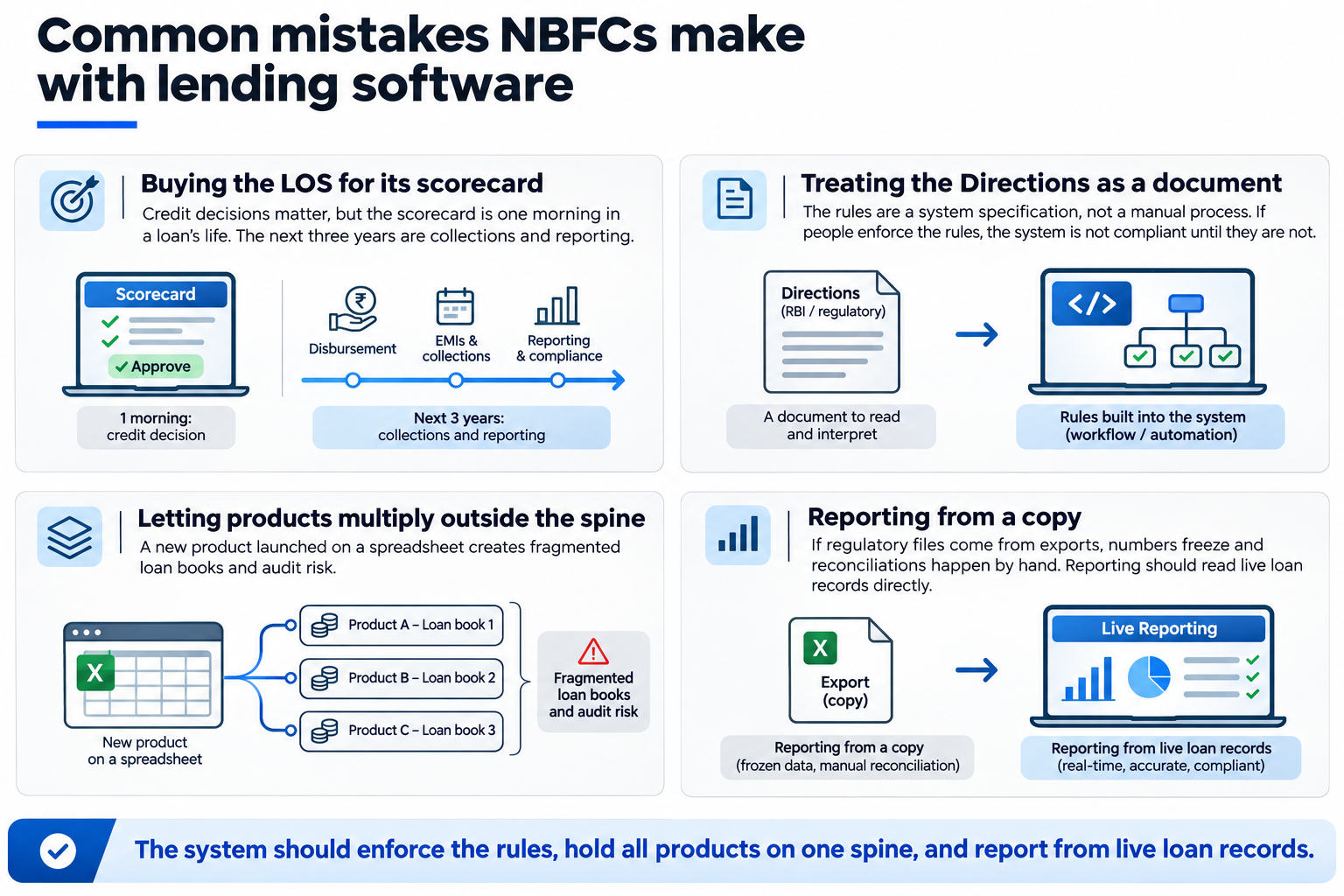
Buying the LOS for its scorecard and judging the whole stack by it. Credit decisions matter, but the scorecard is one morning in a loan's life. The next three years are collections and reporting.
Treating the Directions as a document the compliance team owns. They are a specification the system has to meet. If the compliance team is the enforcement mechanism, the system is not compliant, the people are, until they are not.
Letting products multiply outside the spine. A new product launched on a spreadsheet because the system could not hold it is how an NBFC ends up with three loan books and one audit.
Reporting from a copy. If the regulatory file is assembled from exports, the numbers are frozen at export time and reconciled by hand. Reporting should read the loan records directly.
What this looks like in month three
A quarter after a lending automation go-live, the sanction letter, the KFS and the loan account carry the same figures because they are the same record. Disbursal to anything other than the borrower's account is blocked, not flagged. The cooling-off window is enforced by the system's calendar. Collections agents close visits on the field app and the portfolio-at-risk view updates without a month-end exercise. The first regulatory submission has been produced from the system, and the time it took is measured in hours rather than days. Grievances have a register, an owner and an escalation clock.
None of those are claims a vendor should make with percentages. They are conditions an NBFC can verify.
Build, buy or configure: the honest answer
There are good LOS products, and an NBFC with a working one does not need to throw it away. The question is what sits behind it.
If the post-sanction stages are already in a loan management system that talks to the LOS without retyping, and the Directions' rules are enforced inside that system rather than in a procedure document, you have lending automation by another route. Keep it.
If the post-sanction stages are in spreadsheets, a billing tool and an email inbox, you have a LOS and a liability. The build decision then depends on how specific your products and processes are. NBFCs with standard retail products can often configure; NBFCs with construction finance, stage-wise disbursal, channel partner commissions or co-lending arrangements usually find the configuration runs out and build the lending spine to fit.
Sellon Finserv, an India-based loan distribution company, is one example of the second kind: lead to disbursal with configurable loan stages, stage-based disbursement tied to site verification, and commission rules per bank, which no generic product held. We will write up what that system replaced later this month.
Accucia's view
An NBFC should buy software for the life of the loan, not for the moment of sanction, because every rule that can cost it a licence sits after the LOS has finished its job. Lending automation is the discipline of putting those rules in code, and the first audit after go-live is where the decision pays back.
Watch: Direct disbursal is a rule software should enforce, not remind you.
Read the edition: The Enterprise AI Edge, Ed.22, A requirement met by a person fails on leave days.
If your loan book runs on a LOS plus spreadsheets, the free AI Readiness Assessment maps where each post-sanction stage lives today and which gap to close first. Our broader finance and banking work sits behind it.
FAQ
What is the difference between a loan origination system and lending automation?
A loan origination system covers application to sanction: capture, KYC, credit assessment and approval. Lending automation covers the whole life of the loan, including Key Fact Statement, cooling-off, direct disbursal, EMI schedules, collections, portfolio reporting and grievance handling, with the regulatory rules enforced inside the workflow rather than by a person following a checklist.
Does an NBFC need more than a loan origination system?
Usually, yes. Origination produces the loan, but revenue, risk and most regulatory requirements sit after sanction. If disbursal, collections, reporting and grievances live in spreadsheets and email, the NBFC has digitised the easy half and left the regulated half manual.
Which RBI requirements apply after sanction?
Under the Reserve Bank of India (Digital Lending) Directions, 2025, issued 8 May 2025 as circular RBI/2025-26/36, the Key Fact Statement must be issued before the agreement, disbursal must go directly to the borrower's account, a cooling-off period applies before disbursal, lending data must be stored in India, grievances need tracked escalation, and reporting must follow the prescribed shape. All of these sit after the origination system has finished.
Which clause of the Directions prevents automatic credit limit increases?
Paragraph 7(ii) of the Reserve Bank of India (Digital Lending) Directions, 2025, notified 8 May 2025, states that the regulated entity "shall ensure that there is no automatic increase in credit limit unless an explicit request is received." A system that auto-enhances limits on re-scoring must capture that request first.
Should an NBFC replace its existing loan origination system?
Not necessarily. If the post-sanction stages run in a loan management system that connects to the LOS without retyping and enforces the rules in code, keep it. If they run in spreadsheets and inboxes, the gap is behind the LOS, and that is where to build.
Simplify NBFC Lending. Automate Compliance