
Elevator Service ERP Across the UAE, Saudi and Bahrain
Quick Answer
Accucia built and rolled out elevator service management software for three Gulf operators: EPIC ME Technical Works LLC in the United Arab Emirates, Triolift in Saudi Arabia and Gulf Integrated Vertical Solutions in Bahrain. One platform, three countries, working weeks that do not line up, and an Indian delivery team covering all of it. By Mr. Sanjay Katariya, Vice President, AI & Digital Solutions, Accucia Softwares Pvt. Ltd.
Three operators, three countries, one platform
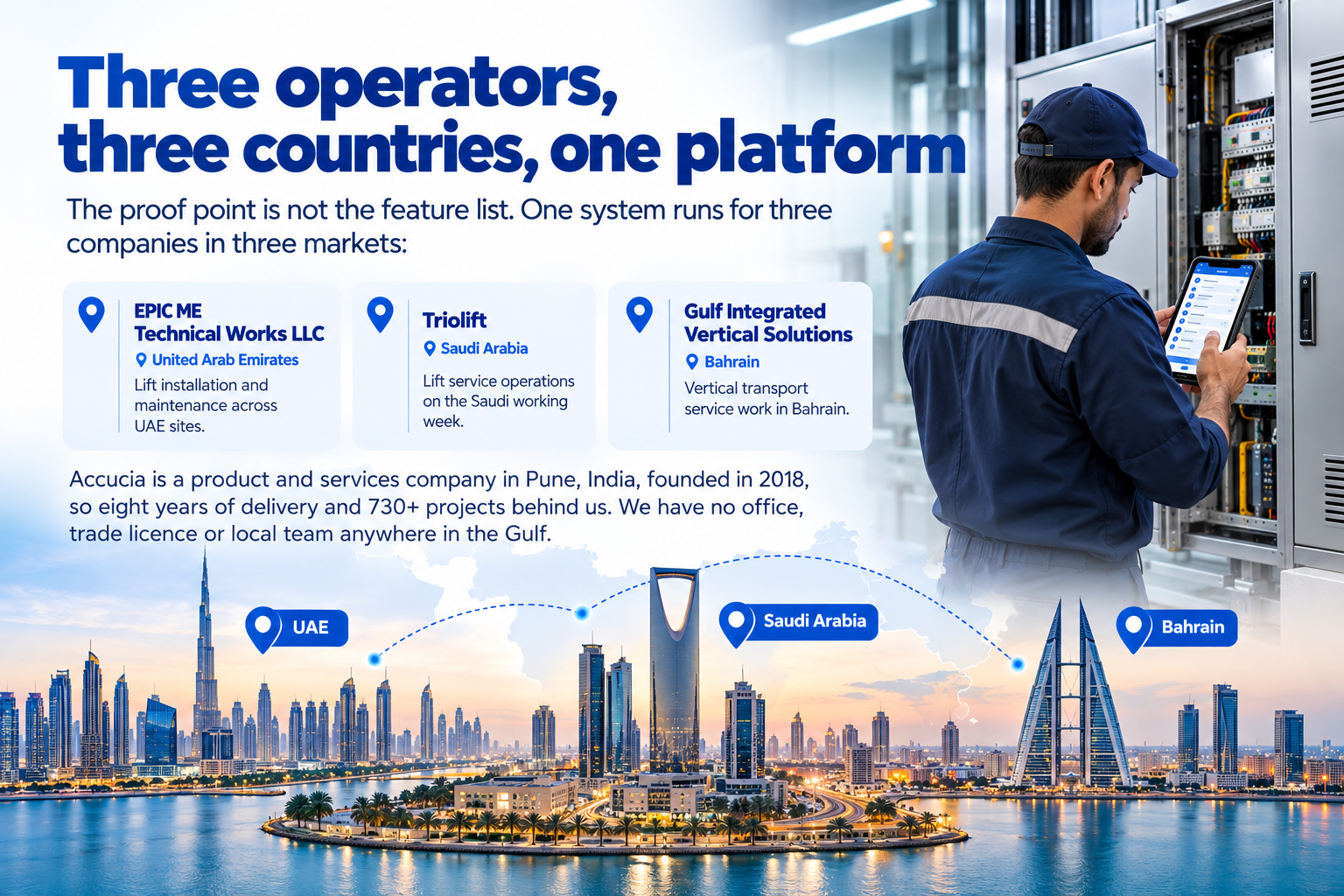
The proof point is not the feature list. One system runs for three companies in three markets:
EPIC ME Technical Works LLC, United Arab Emirates. Lift installation and maintenance across UAE sites.
Triolift, Saudi Arabia. Lift service operations on the Saudi working week.
Gulf Integrated Vertical Solutions, Bahrain. Vertical transport service work in Bahrain.
Accucia is a product and services company in Pune, India, founded in 2018, so eight years of delivery and 730+ projects behind us. We have no office, trade licence or local team anywhere in the Gulf.
The three numbers elevator margin depends on
An elevator service business is an annuity business. Revenue comes from annual maintenance contracts. Profit comes from three things: breakdown frequency, jobs closed per technician per day, and renewal rate.
Most operators track all three in spreadsheets. Renewal dates sit in one file, breakdown history in another, spares in a third, and the technician's movements in a WhatsApp group. When a building manager asks why the same lift failed twice in a month, nobody answers inside a day. At renewal there is no service history to show, so the talk turns to price.
What the elevator service management software does
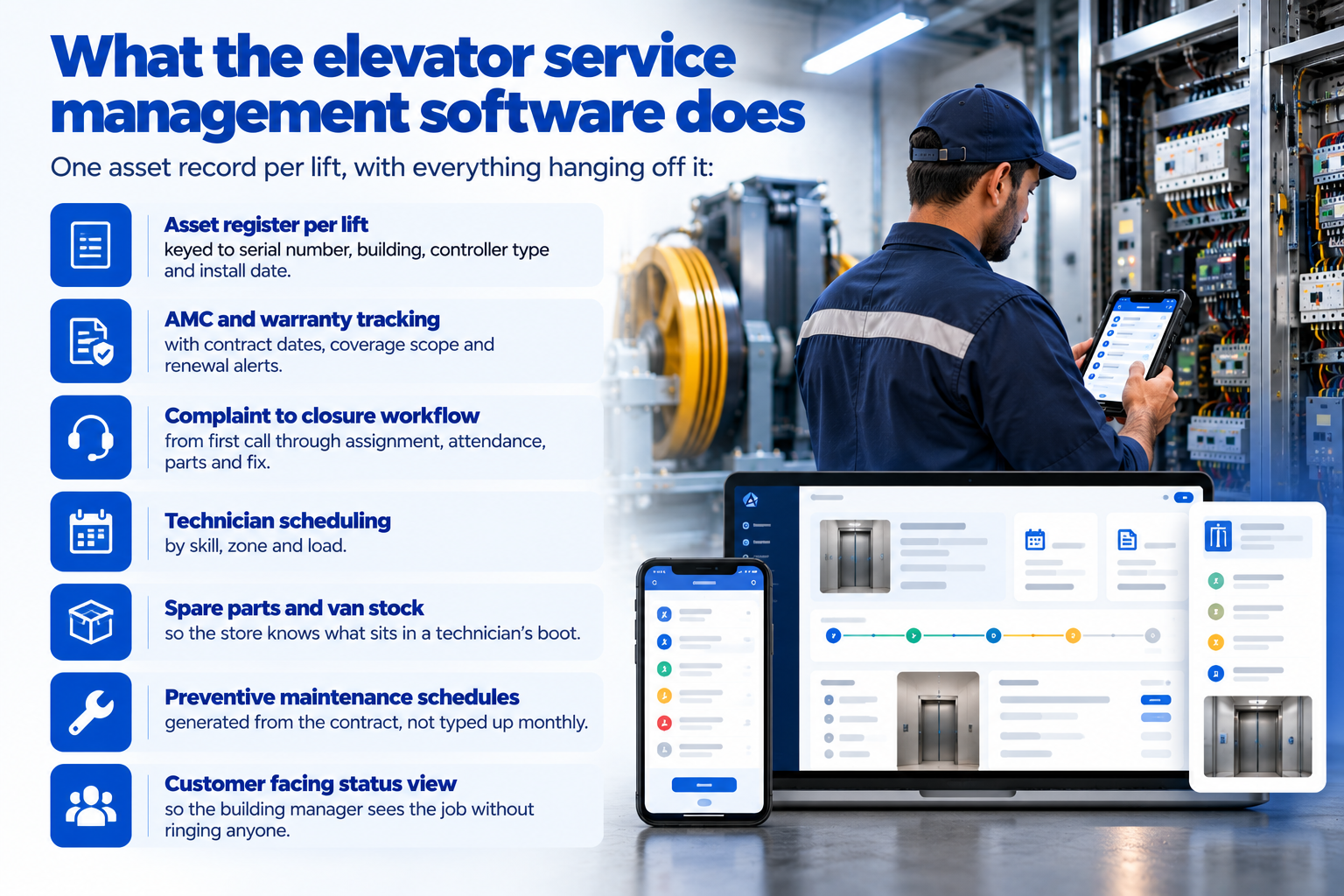
One asset record per lift, with everything hanging off it:
Asset register per lift — keyed to serial number, building, controller type and install date.
AMC and warranty tracking — with contract dates, coverage scope and renewal alerts.
Complaint to closure workflow — from first call through assignment, attendance, parts and fix.
Technician scheduling — by skill, zone and load.
Spare parts and van stock — so the store knows what sits in a technician's boot.
Preventive maintenance schedules — generated from the contract, not typed up monthly.
Customer facing status view — so the building manager sees the job without ringing anyone.
[Diagram: complaint to closure workflow, seven stages from Complaint Logged to Closure Confirmed with a Spare Part Required branch, see Inline Media Notes.]
Feature detail sits on the ElevatorPlus product page and the portfolio entry.
Implementation, which is where the work actually was
Building the software took a fraction of the effort. Getting technicians in three countries to use it daily took the rest.
Data migration from spreadsheets
Spreadsheets lie. The same lift appeared three times under three spellings of the building name, serial numbers carried different separators, and contract end dates were stored as text.
We did not clean it all up front. We migrated the asset register and live contracts first, because those carry the revenue, and left historic job records to a second pass.
Deduplication ran against serial number plus building, with the client's supervisor confirming every merge by hand. A fuzzy name match quietly joins two lifts in different towers, and you find out six months later when a visit reaches the wrong address.
Field training, delivered by the client's own people
We trained supervisors first, in a room, on real jobs from their own data. They then trained technicians in the field.
That beat sending trainers, for one reason: a technician tells his own supervisor the app is annoying, and tells a visiting consultant nothing.
[Video: 20 second screen capture of the technician app closing a job card, see Inline Media Notes.]
One month of parallel running
For the first month both systems ran, paper job cards and spreadsheet alongside the app.
It is expensive, everybody hates it, and we insist on it.
Parallel running is how you find out the app is missing a job type, or that a whole class of AMC customer was never in the spreadsheet.
Week 1
Asset register and live AMC contracts migrated, supervisors trained.
Old system status: Fully live.
Week 2
Technician app issued, job cards raised in both systems.
Old system status: Parallel run begins.
Week 3
Reason code and connectivity fixes shipped.
Old system status: Parallel run continues.
Week 4
Scheduling and preventive maintenance moved across.
Old system status: Parallel run continues.
Week 5
The two records reconciled, gaps closed.
Old system status: Read only.
Week 6
Spreadsheets retired for daily work.
Old system status: Archived. Pasted text
What changed after week three, because the field said so
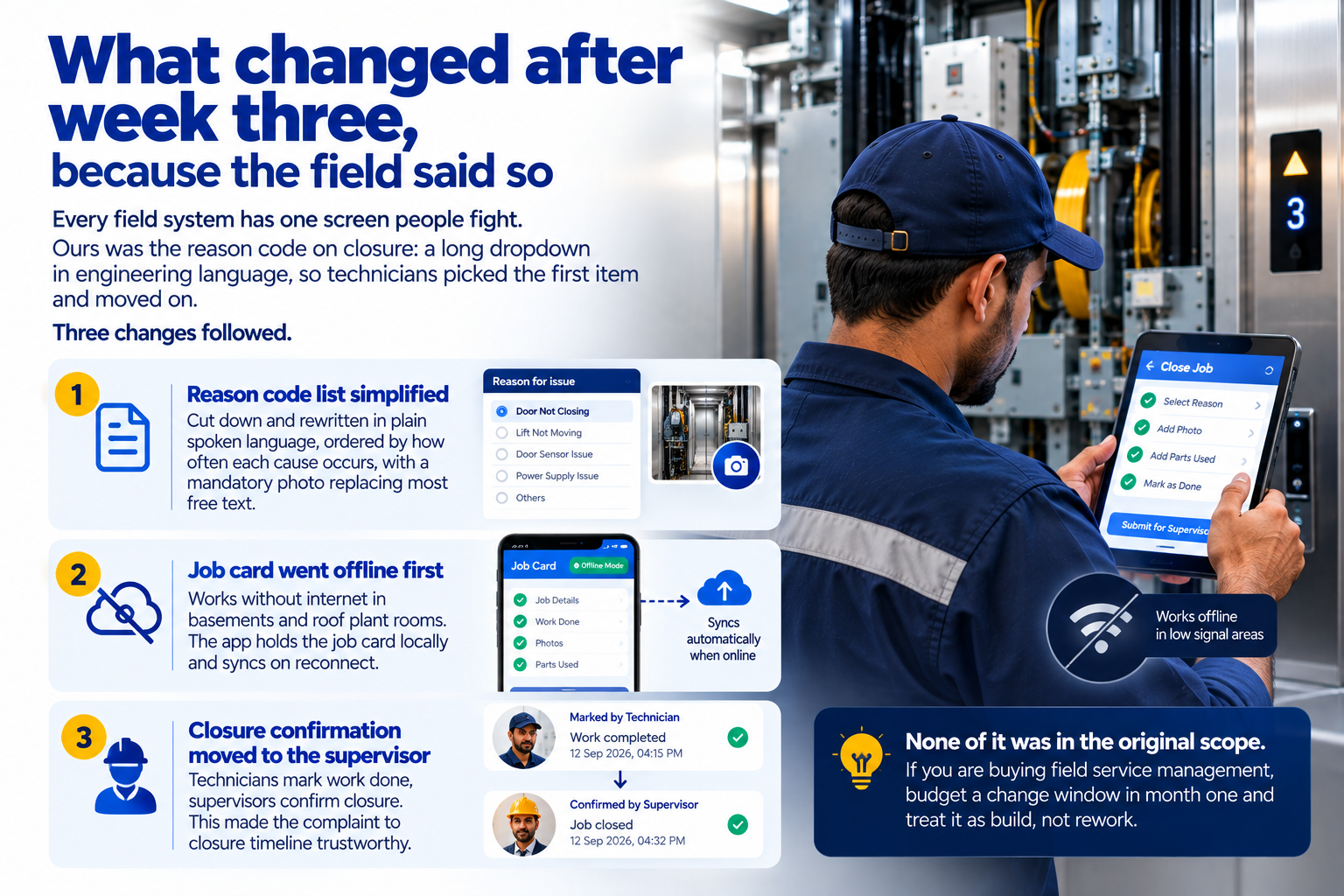
Every field system has one screen people fight.
Ours was the reason code on closure: a long dropdown in engineering language, so technicians picked the first item and moved on.
Three changes followed.
1. The reason code list was cut down and rewritten in plain spoken language. It was ordered by how often each cause occurs, with a mandatory photo replacing most free text. Photographs get taken. Paragraphs do not.
2. The job card went offline first. Machine rooms sit in basements and roof plant rooms where signal is poor. The app holds the job card locally and syncs on reconnect. Before that, technicians closed jobs from memory in the car park.
3. Closure confirmation moved to the supervisor. Technicians mark work done, supervisors confirm closure. That made the complaint to closure timeline trustworthy.
None of it was in the original scope.
If you are buying field service management, budget a change window in month one and treat it as build, not rework.
Working weeks that do not line up, one support rota
Saudi Arabia is the settled one. It runs Sunday to Thursday with an official Friday and Saturday weekend, set by Royal Order in June 2013, and Article 104 of the Saudi Labor Law gives a worker two rest days a week, one of them a Friday.
Bahrain is where the tidy version falls apart. Bahraini law makes Friday the weekly rest day and leaves the second rest day to the employer. Many Bahraini businesses do run Sunday to Thursday and take Friday and Saturday off, but others take Thursday and Friday, so there is no single private sector weekend to build a rota against.
With a Bahraini counterpart you ask what their week is. You do not assume it.
The UAE is less tidy than most write-ups suggest. From 1 January 2022 the federal government moved to a four and a half day week: Monday to Thursday 7.30am to 3.30pm, Friday 7.30am to 12.00pm, Saturday and Sunday off.
That applied to federal government entities and schools. The private sector was never required to follow. Dr Abdulrahman Al Awar, Minister of Human Resources and Emiratisation, said private companies choose their own hours and days within the legal maximum.
Most have since aligned to Monday to Friday with a Saturday and Sunday weekend. Some have not.
For a UAE private company, ask what its week actually is.
So one platform had to carry a Thursday that is a full working day in Riyadh, a working day for some Manama employers and a weekend day for others, and a half day or a weekend day for parts of the UAE.
The working week is not uniform across the Gulf and it cannot be assumed, which is why the working calendar is configured per client rather than per country.
Overlap is what makes support workable.
India runs UTC+5:30, the UAE UTC+4, Saudi Arabia and Bahrain UTC+3, with no daylight saving in the chain.
An Indian team working 9.30am to 6.30pm covers 8.00am to 5.00pm in Dubai and 7.00am to 4.00pm in Riyadh and Manama, which puts the desk live across the Gulf morning and early afternoon when breakdown calls peak.
Sunday is the pressure point, a working day in Saudi Arabia and Bahrain and a weekend day in India, so Sunday cover is a named on call engineer with an agreed response window, not a full desk.
English is the working language for supervisors and office staff.
Technician screens were kept short and icon led, because the field workforce is multilingual and reading long English instructions on a phone in a lift shaft is not realistic. Pasted text
Hosting and data
We deploy in-region on request, on AWS, Azure or Google Cloud Platform, with the region chosen to meet the client's requirement and infrastructure billed to the client at cost.
We also deploy to a client's own on-premise servers.
Managed cloud in an accepted region was the right call here. Elevator service companies do not want to run server rooms, and it gave the technician app the uptime it needs on a Friday night breakdown.
On-premise suits a contract or tender that demands it.
To be plain: Accucia does not hold ISO 27001 and does not hold CERT-In empanelment. Where an empanelled audit is required, the client commissions it and we implement every finding.
What changed, stated honestly
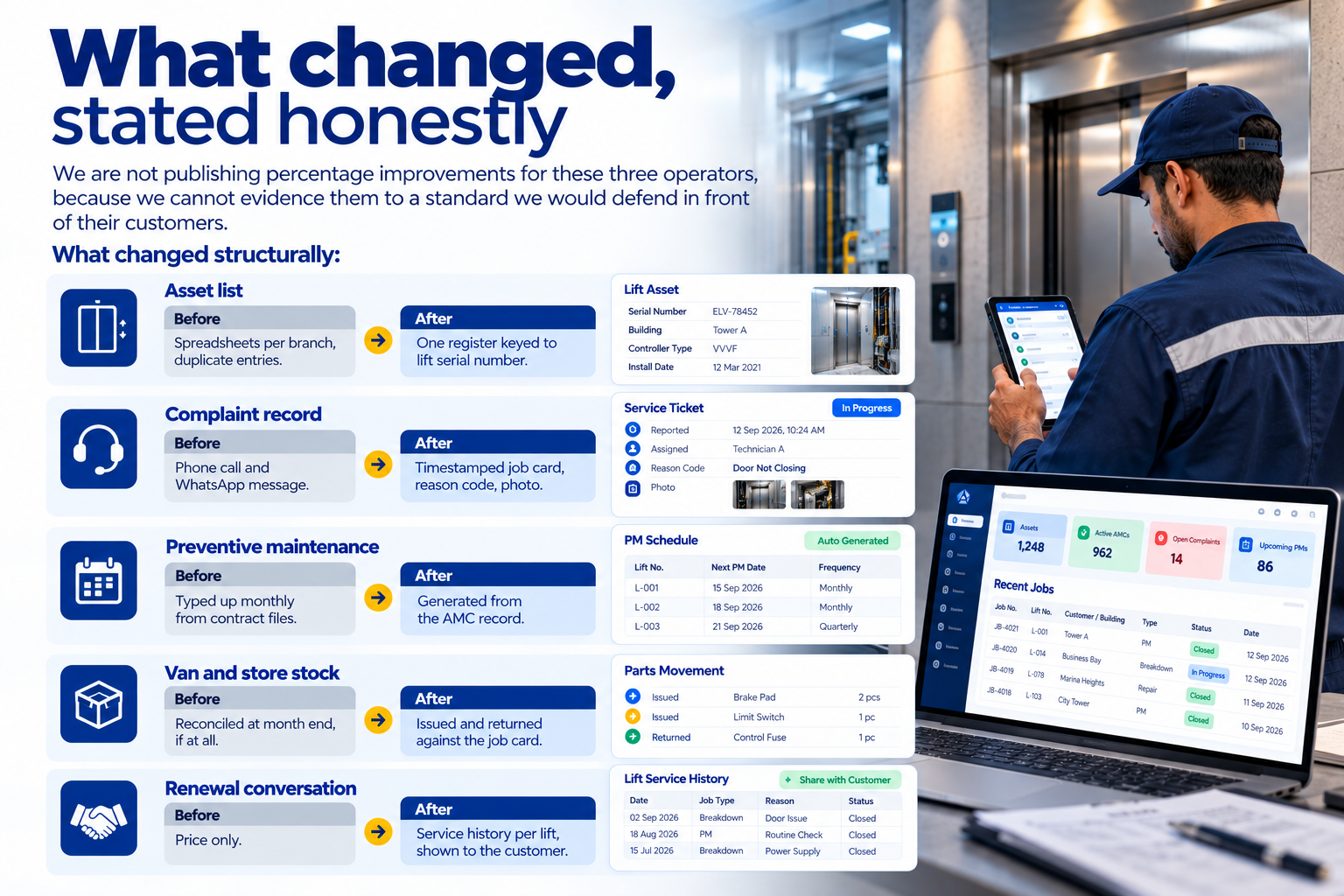
We are not publishing percentage improvements for these three operators, because we cannot evidence them to a standard we would defend in front of their customers.
What changed structurally:
Asset list
Before: Spreadsheets per branch, duplicate entries.
After: One register keyed to lift serial number.
Complaint record
Before: Phone call and WhatsApp message.
After: Timestamped job card, reason code, photo.
Preventive maintenance
Before: Typed up monthly from contract files.
After: Generated from the AMC record.
Van and store stock
Before: Reconciled at month end, if at all.
After: Issued and returned against the job card.
Renewal conversation
Before: Price only.
After: Service history per lift, shown to the customer. Pasted text
The same pattern works outside elevators
Nothing here is specific to lifts.
The pattern is asset centric field service: a serialised asset, a contract attached to it, a schedule generated from that contract, a job card that closes against the asset, parts issued against the job.
Swap the asset and it holds for HVAC, diesel generator sets, medical equipment, fire systems and industrial machinery.
We build and implement these for any service industry.
What we would do differently
We would put the offline first job card in version one instead of week three.
We knew machine rooms have no signal and still built version one assuming connectivity, because it was faster.
Technicians spent two weeks entering jobs from memory, which damaged trust in the data at the moment we most needed people to believe in it.
We would also have migrated one branch fully before touching the others.
Accucia's view
Most case studies here open with a number: forty per cent faster, thirty per cent more jobs per technician.
We will not print one unless the client's own system produced it and the client will stand behind it. That costs us deals. We accept it.
There is a legal edge too. Article 48 of UAE Federal Decree-Law No. 34 of 2021 on Countering Rumours and Cybercrimes provides for imprisonment and/or a fine of not less than AED 20,000 and not more than AED 500,000 for promoting a good or service through a misleading advertisement or technique which includes inaccurate data.
If you market to a Gulf audience with named clients attached, an invented statistic is no longer only a marketing decision.
Ask any vendor to show you the query behind their figure.
We will show you ours. Pasted text
Frequently Asked Questions
What is elevator service management software?
Elevator service management software runs the maintenance side of a lift business. It holds an asset record per lift, tracks AMC contracts and warranty, manages complaint to closure workflow, schedules technicians, controls spare parts and van stock, and generates preventive maintenance visits from the contract rather than a spreadsheet.
Which operators use this platform in the Gulf?
Three named clients: EPIC ME Technical Works LLC in the United Arab Emirates, Triolift in Saudi Arabia and Gulf Integrated Vertical Solutions in Bahrain.
All three are cleared to be named. They operate in three countries with three regulatory contexts on one platform, ElevatorPlus.
How does one platform handle different Gulf working weeks?
Saudi Arabia runs Sunday to Thursday.
In Bahrain Friday is the rest day and the employer sets the second one, so weekends vary.
UAE federal government moved to Monday to Friday lunchtime in January 2022, but private companies set their own week.
Working calendars are configured per client, not per country.
Where is the data hosted?
We deploy in-region on request, on AWS, Azure or Google Cloud Platform, with the region chosen to meet the client's requirement and infrastructure billed to the client at cost.
We also deploy to a client's own on-premise servers.
Sub-processors include monitoring, analytics and helpdesk tooling.
How long does a rollout take?
Plan roughly six weeks from data migration to retiring the spreadsheets, with a month of parallel running in the middle.
Timelines vary with data quality, branch count and technician headcount.
The parallel run is not optional in our method, because that is where missing job types surface.
Do technicians need a data connection in the field?
No.
The job card works offline. Machine rooms are usually in basements or roof plant rooms where mobile signal is poor, so the app holds the job card on the device and syncs when the phone reconnects.
We added this in week three of the first rollout.
Can it track AMC contracts and warranty together?
Yes.
Each lift carries both, and coverage is resolved at the point of the job.
That matters because a part failing under warranty and the same part failing under an AMC produce different invoices, and getting it wrong causes billing disputes with building managers.
What happens to our existing spreadsheets?
We migrate the asset register and live contracts first, because they carry the revenue, then handle historic job records in a second pass.
Duplicates are merged against serial number plus building, confirmed by your own supervisor.
The spreadsheets stay live through the parallel run, then get archived.
Does Accucia have an office in the UAE or Saudi Arabia?
No.
Accucia has no Gulf office, trade licence or local team. We are based in Pune, India, and deliver to Gulf clients from there, training your supervisors first so they can train technicians on site.
If you need a local legal entity for procurement, tell us early.
Does this only work for elevators?
No.
The pattern is asset centric field service and it applies to HVAC, diesel generator sets, medical equipment, fire systems and industrial machinery.
Any business with serialised assets, maintenance contracts and technicians in vans runs the same model.
We build and implement for any service industry.
See What One System Can Change.