Software Development Partner vs Vendor After Go-Live
Quick Answer
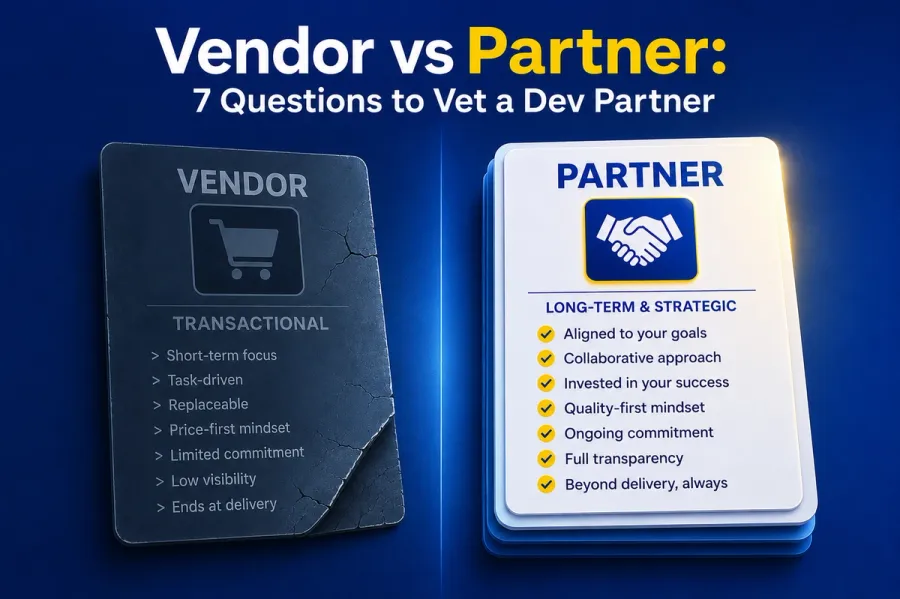
After go-live, a software development partner keeps named people on your system, makes changes as your business changes, answers incidents with an escalation path in writing, carries the knowledge through your staff turnover, and plans the next phase with you. A vendor hands over the code, closes the project, and routes everything that follows through a support ticket queue. The difference is invisible at launch and decisive by month nine. By Mr. Sumeet Katariya, Accucia Softwares Pvt. Ltd.
Launch day looks the same for both
On the day a system goes live, you cannot tell a vendor from a partner. Both have delivered. Both have a team in the room. Both have a slide with a tick on it. The sales lead who ran the engagement is still returning calls within the hour.
The difference starts about a week later, when the sales lead moves to the next prospect and you find out who is actually left.
We have written before about what a development partner does beyond writing code and the seven questions to vet one. This piece is narrower. It is about the months after launch, because that is where the two models separate.
Five things that happen after go-live
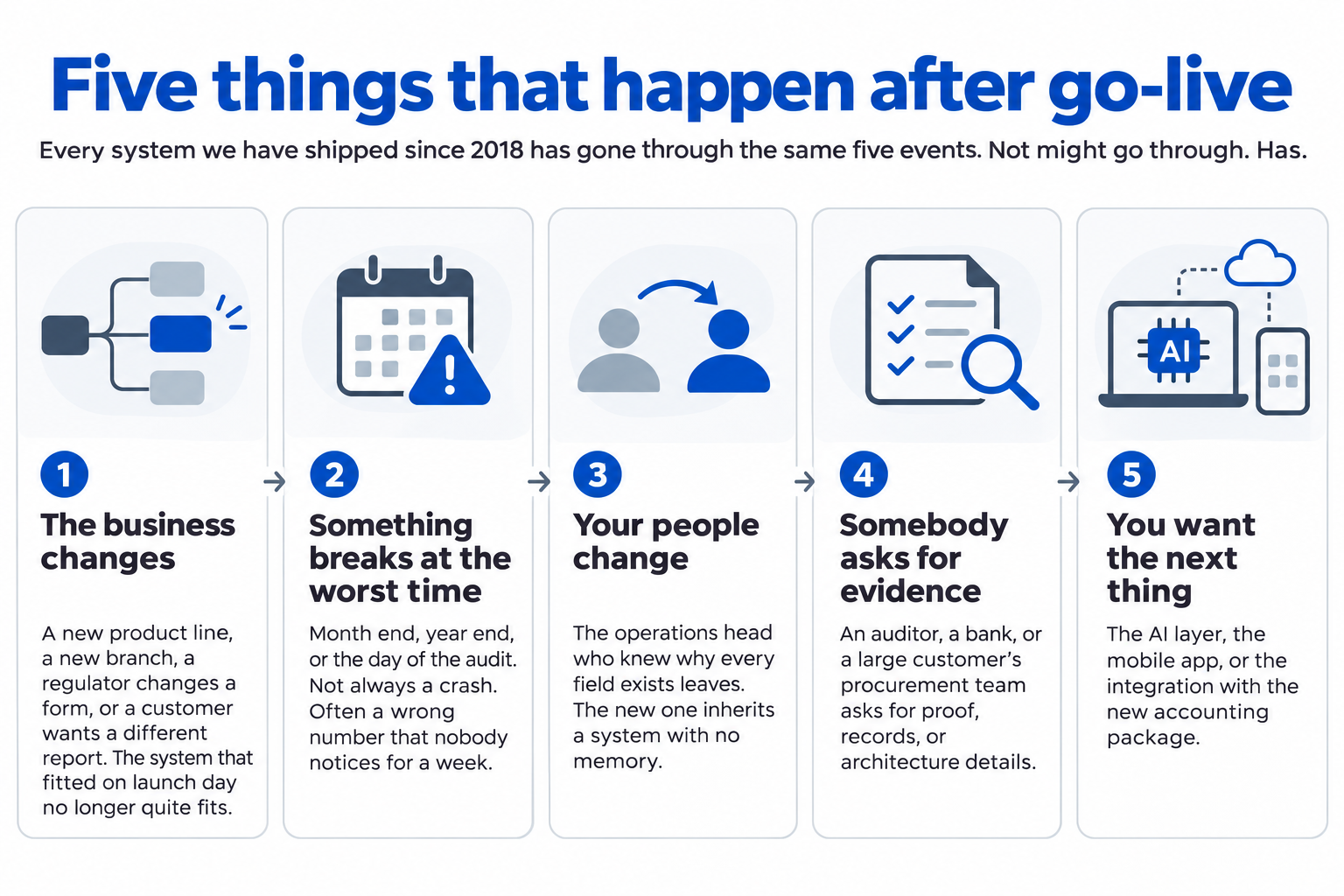
Every system we have shipped since 2018 has gone through the same five events. Not might go through. Has.
The business changes. A new product line, a new branch, a regulator changes a form, a customer wants a different report. The system that fitted on launch day no longer quite fits.
Something breaks at the worst time. Month end, year end, the day of the audit. Not a crash necessarily, often a wrong number that nobody notices for a week.
Your people change. The operations head who knew why every field exists leaves. The new one inherits a system with no memory.
Somebody asks for evidence. An auditor, a bank, a large customer's procurement team with a questionnaire.
You want the next thing. The AI layer, the mobile app, the integration with the new accounting package.
What a partner does at each one
The table is the summary. The texture matters more.
When the business changes, a partner does not start from a blank requirements document. The engineer who built your quotation module is the one who extends it, so the change is small, fast and does not break the thing next to it. This is why we keep named leads on client systems rather than rotating whoever is free. How we work sets out the engagement shapes that make this possible.
When something breaks, the question is not whether there is a support process. Everyone has one. The question is whether the person who answers can read your system, or has to open a ticket to someone who can. For AI systems in particular, where the failure is usually a quietly wrong answer rather than an outage, we run managed AI operations with drift monitoring and a named backup, because a helpdesk cannot see drift.
When your people change, the partner becomes the memory. A new operations head inherits a system and a team that can explain why every field exists, because the people who built it are still on it. That is not in any statement of work. It is what staying means.
When someone asks for evidence, a partner has it. Where the data sits, who can reach it, how the system connects to what you already run. Vague answers here become expensive answers later, usually in front of a procurement team.
And when you want the next thing, you are talking to people who know what the first thing does, which is the cheapest discovery phase there is.
Why this matters more for AI builds than for anything before
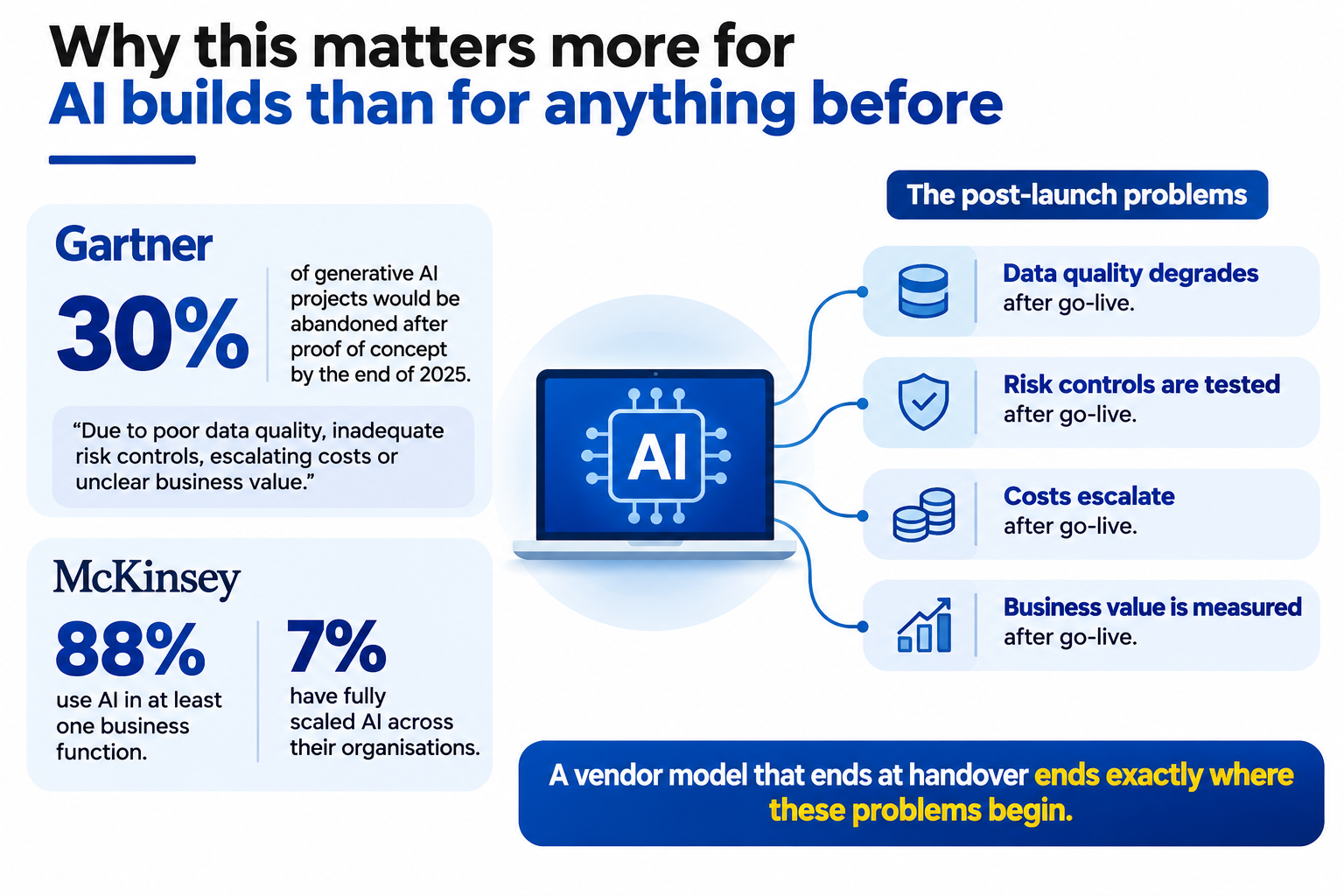
The after-go-live phase has always decided whether software pays for itself. With AI systems it decides whether the system keeps working at all.
Gartner predicted in July 2024 that at least 30 percent of generative AI projects would be abandoned after proof of concept by the end of 2025, "due to poor data quality, inadequate risk controls, escalating costs or unclear business value." Every one of those four causes is a post-launch problem. Data quality degrades after go-live. Risk controls are tested after go-live. Costs escalate after go-live. Business value is measured after go-live. A vendor model that ends at handover ends exactly where those problems begin.
McKinsey's State of AI survey, published 5 November 2025, found that 88 percent of respondents reported their organisations use AI in at least one business function, while only 7 percent said AI had been fully scaled across their organisations. The gap between those two numbers is the gap between a launch and a system that someone kept working on. That is the partner's job.
What to put in the contract so staying is enforceable
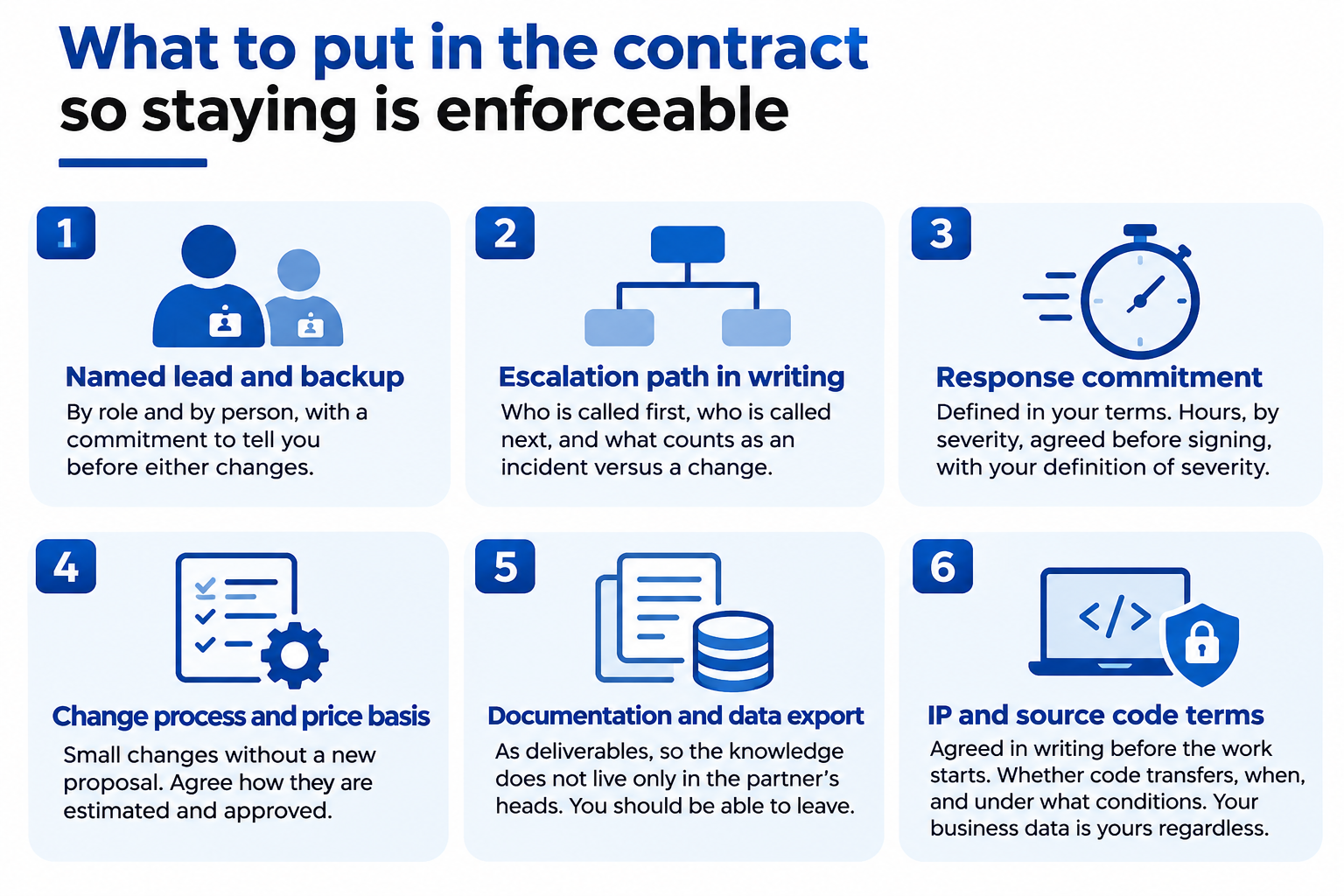
A partner relationship should survive the departure of everyone who negotiated it, which means the staying has to be written down. These are the clauses we would expect any buyer to ask us for.
A named lead and a named backup, by role and by person, with a commitment to tell you before either changes.
An escalation path in writing: who is called first, who is called when the first person does not answer, and what counts as an incident versus a change.
A response commitment defined in your terms. Not "best efforts". Hours, by severity, agreed before signing, with your definition of severity.
A change process with a price basis. Small changes should not need a new proposal. Agree how they are estimated and approved so the queue never forms.
Documentation and data export as deliverables, so the knowledge does not live only in the partner's heads either. You should be able to leave, which is the best reason to stay.
Intellectual property and source code terms agreed in writing before the work starts. Whether code transfers, when, and under what conditions is a contractual matter settled up front, never assumed from a brochure. Your business data is yours regardless.
Common mistakes buyers make after go-live
Letting the statement of work become the relationship. The SOW described the launch. Month nine is not in it. If nothing replaced it, nothing is governing the part that matters.
Not budgeting for change. The business will change; the system will need to follow. A build with no change budget is a build that will be worked around in spreadsheets within a year, which is how most companies end up using under 30 percent of the software they pay for.
Losing the one person who knew. If a single employee holds the reason every field exists, the system's memory leaves with them. Insist that the partner holds that memory too, and check that they can explain your own system back to you.
Measuring the vendor by launch date. On time and on budget describes one day. Judge the first year.
What month three after go-live should look like
Not a percentage, a set of conditions. The named lead has made at least one change the business asked for, without a new proposal. An incident has been raised and resolved through the written path, and you know who picked up. The documentation reflects the system as it is now, not as it was specified. The first conversation about the next phase has happened with the people who built the first one. If none of those have happened by month three, ask why, because month nine is coming.
How to tell before you sign
Three questions, asked in the sales meeting, separate the two models reliably.
Who writes the code, and who answers the phone in month nine? If the people in the room are not the people who will do the work, you have bought a brochure.
What does the relationship look like in year two? If the honest answer is a support ticket queue, the partnership ends at the invoice.
Can I speak to someone who has been with you past year five? A vendor has references from last quarter. A partner has clients who have stayed through two or three versions of their own business.
What eight years of staying looks like
AMC Bank, an India-based bank, has worked with us since 2018, the year Accucia Softwares Pvt. Ltd. was founded. Mr. Tejas Tiwari, the bank's IT Head, describes why they stayed in a video conversation we recorded this year, and the short version is that someone answers.
Utech Waterproofing, also India-based, is past year seven. The system we first built them turned quotations that took days into quotations that take minutes, and it has been extended repeatedly since as the business grew, including across multiple locations.
Neither of those relationships was won on launch day. They were kept in the months that followed.
Accucia's view
A software vendor is judged by the launch and a software partner is judged by month nine, and the only way to know which one you are buying is to ask, before signing, who will answer the phone when the sales team has moved on. Buy the people who stay.
Watch: Why AMC Bank Chose Accucia Softwares as Its Long-Term Technology Partner.
Read the edition: The Enterprise AI Edge, Ed.19, After the assessment.
If you are evaluating partners for a build next year, the free AI Readiness Assessment is a useful first meeting: your systems, our questions, and a ranked list you keep whoever you choose.
FAQ
What is the difference between a software vendor and a software development partner?
A vendor delivers a specified system, hands it over and routes everything afterwards through a support queue. A partner keeps named engineers on the system after go-live, makes changes as the business changes, answers incidents through a written escalation path, carries the institutional knowledge through staff turnover, and plans the next phase with the client.
What should happen after a software system goes live?
Five things reliably follow go-live: the business changes, something breaks at a bad time, the client's people change, someone asks for evidence about data and architecture, and the client wants the next capability. A partner has a named person and a process for each; a vendor has a change request form.
How do you check whether a software company will stay after launch?
Ask three questions before signing: who writes the code and who answers the phone in month nine, what the relationship looks like in year two, and whether you can speak to a client who has been with them past year five. The answers separate a partner from a vendor more reliably than any proposal.
What should a post-go-live agreement with a software partner include?
A named lead and backup, an escalation path in writing, a response commitment by severity defined in the client's terms, a change process with an agreed price basis so small changes need no new proposal, documentation and data export as deliverables, and intellectual property and source code terms agreed in writing before the work starts.
Does Accucia stay with clients after go-live?
Yes. AMC Bank, India-based, has worked with Accucia Softwares Pvt. Ltd. since 2018, and Utech Waterproofing, also India-based, is past year seven. Both systems have been extended repeatedly since launch by named engineers who know them.
Build AI That Delivers Beyond Go-Live