
Saudi Withholding Tax on Software: 5% or 15%, and Why
Quick Answer
ZATCA treats custom software developed for a fee with ownership transferred to the buyer as a technical service, taxed at 5% withholding tax in Saudi Arabia. A licence transferring rights to reproduce and sell software is a royalty at 15%. A plain access licence sits in a less settled band. The contract wording decides. By Mr. Sanjay Katariya, Vice President, AI & Digital Solutions, Accucia Softwares Pvt. Ltd.
Why the rate is the buyer's problem before it is the vendor's
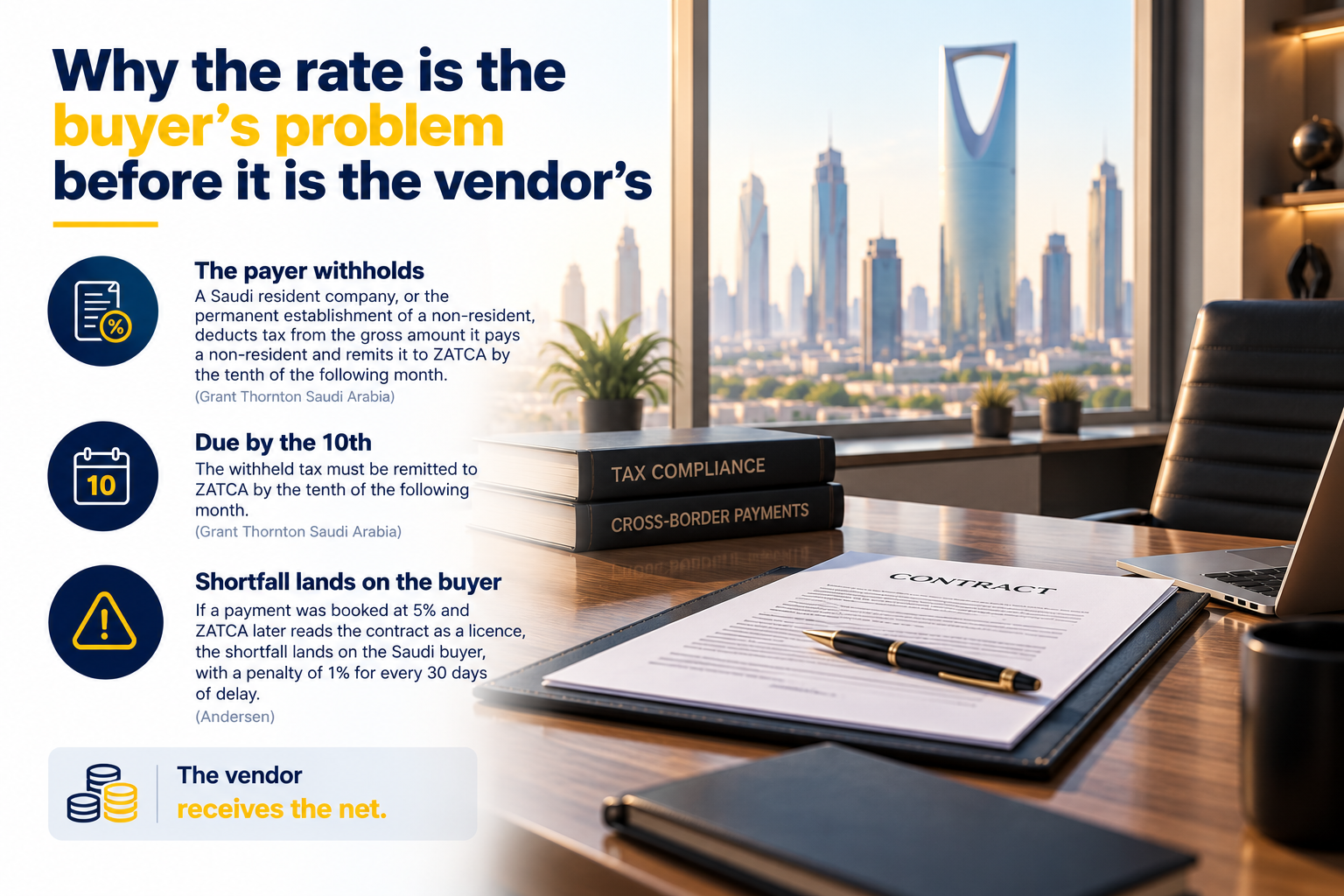
Under Saudi law the payer withholds. A Saudi resident company, or the permanent establishment of a non-resident, deducts tax from the gross amount it pays a non-resident and remits it to the Zakat, Tax and Customs Authority by the tenth of the following month, per Grant Thornton Saudi Arabia. The vendor receives the net.
That is why procurement raises tax in the second meeting, not the tenth. If a payment was booked at 5% and ZATCA later reads the contract as a licence, the shortfall lands on the Saudi buyer, with a penalty Andersen puts at 1% for every 30 days of delay. Priced net, that ten point jump comes out of the vendor instead.
The withholding tax rate card for software payments in Saudi Arabia
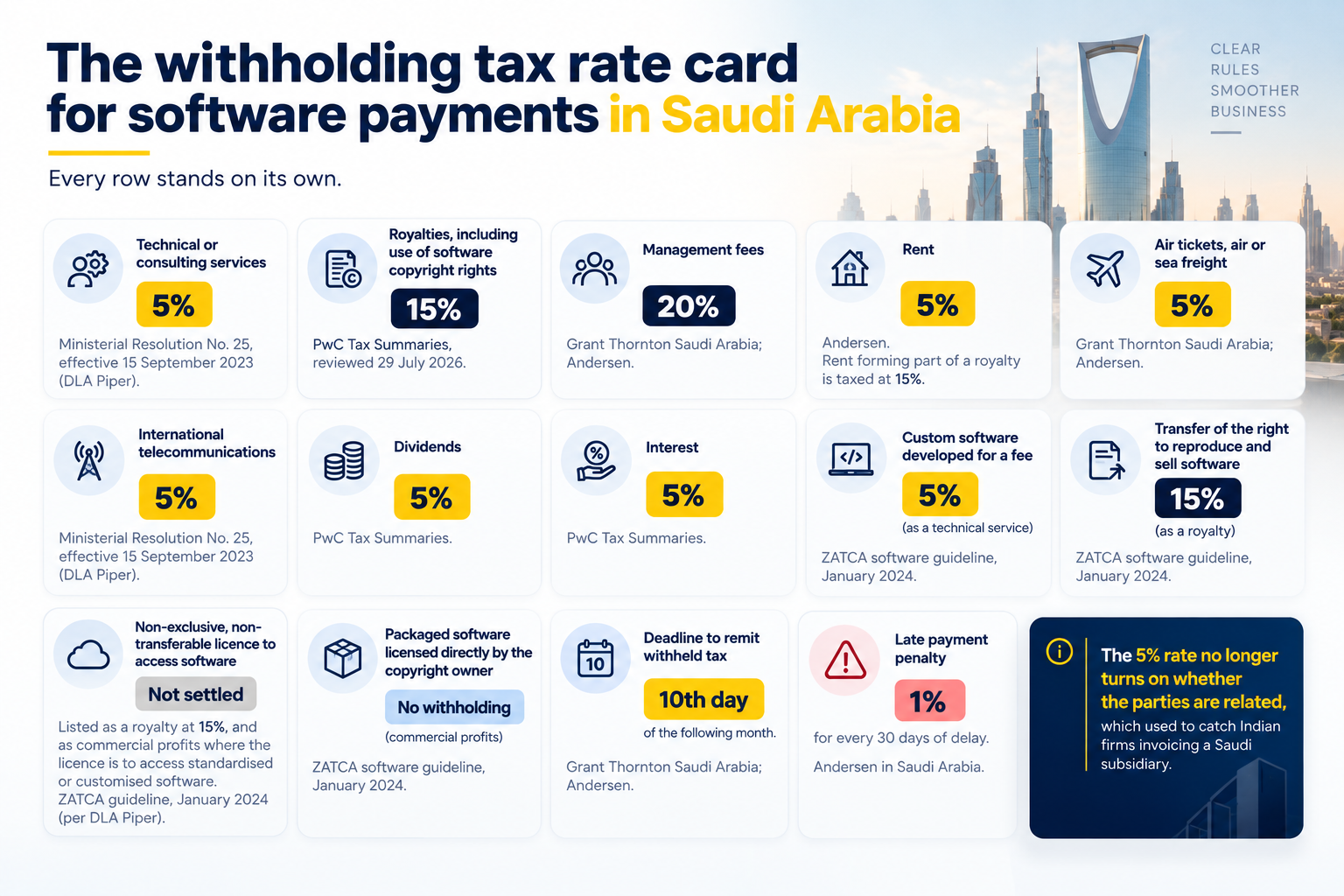
Every row stands on its own.
Technical or consulting services
Rate: 5%
Basis: Ministerial Resolution No. 25, effective 15 September 2023, cut this from 15% and applies it whether or not the recipient is related (DLA Piper).
Royalties, including use of software copyright rights
Rate: 15%
Basis: PwC Tax Summaries, reviewed 29 July 2026.
Management fees
Rate: 20%
Basis: Grant Thornton Saudi Arabia; Andersen.
Rent
Rate: 5%
Basis: Andersen. Rent forming part of a royalty is taxed at 15%.
Air tickets, air or sea freight
Rate: 5%
Basis: Grant Thornton Saudi Arabia; Andersen.
International telecommunications
Rate: 5%
Basis: Ministerial Resolution No. 25, effective 15 September 2023 (DLA Piper).
Dividends
Rate: 5%
Basis: PwC Tax Summaries.
Interest
Rate: 5%
Basis: PwC Tax Summaries.
Custom software developed for a fee, ownership passing to the customer
Rate: 5%, as a technical service.
Basis: ZATCA software guideline, January 2024.
Transfer of the right to reproduce and sell software
Rate: 15%, as a royalty.
Basis: ZATCA software guideline, January 2024.
Non-exclusive, non-transferable licence to access software for business use
Rate: Not settled.
It is listed as a royalty at 15%, and separately as commercial profits where the licence is to access standardised or customised software.
Basis: ZATCA guideline, January 2024, per DLA Piper, which sets out both readings.
Packaged software licensed directly by the copyright owner to the customer
Rate: No withholding, treated as commercial profits.
Basis: ZATCA software guideline, January 2024.
Deadline to remit withheld tax
Deadline: Tenth day of the following month.
Basis: Grant Thornton Saudi Arabia; Andersen.
Late payment penalty
Penalty: 1% for every 30 days of delay.
Basis: Andersen in Saudi Arabia.
The 5% rate no longer turns on whether the parties are related, which used to catch Indian firms invoicing a Saudi subsidiary.
What ZATCA's January 2024 software guideline actually says
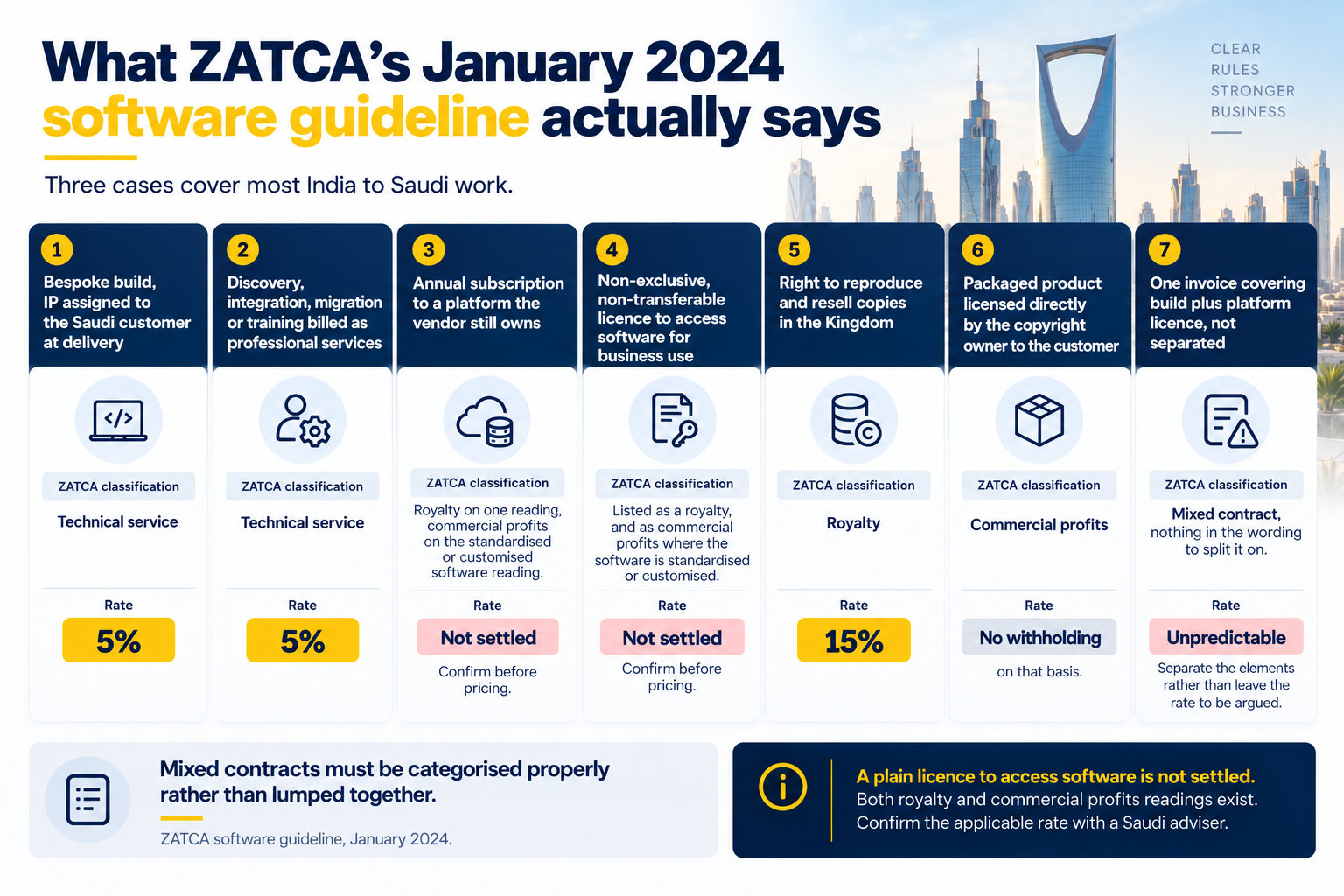
ZATCA published a guideline in January 2024 on taxing software payments under the domestic Income Tax Law. Three cases cover most India to Saudi work.
Software developed for a fee, where partial or full ownership passes to the customer, is a technical service at 5%.
A contract transferring exclusive or non-exclusive rights to reproduce and sell software is a royalty at 15%.
A plain licence to access software is the part that is not settled. DLA Piper's summary of the guideline lists a non-exclusive, non-transferable licence to access software for business use as a royalty, and separately lists a non-exclusive, non-transferable licence to access standardised or customised software for business use as commercial profits. Those two readings carry very different rates, and which one applies to a given subscription is a question for a Saudi adviser rather than something to assume in a proposal.
Packaged software where the end user licence runs directly between the copyright owner and the customer is commercial profits, with no withholding on that basis.
The guideline also says mixed contracts must be categorised properly rather than lumped together. That is the sentence that should change how you draft.
Bespoke build, IP assigned to the Saudi customer at delivery
ZATCA classification: Technical service
Rate: 5%
Discovery, integration, migration or training billed as professional services
ZATCA classification: Technical service
Rate: 5%
Annual subscription to a platform the vendor still owns
ZATCA classification: Royalty on one reading, commercial profits on the standardised or customised software reading.
Rate: Not settled. Confirm before pricing.
Non-exclusive, non-transferable licence to access software for business use
ZATCA classification: Listed as a royalty, and as commercial profits where the software is standardised or customised.
Rate: Not settled. Confirm before pricing.
Right to reproduce and resell copies in the Kingdom
ZATCA classification: Royalty
Rate: 15%
Packaged product licensed directly by the copyright owner to the customer
ZATCA classification: Commercial profits
Rate: No withholding on that basis.
One invoice covering build plus platform licence, not separated
ZATCA classification: Mixed contract, nothing in the wording to split it on.
Rate: Unpredictable. Separate the elements rather than leave the rate to be argued.
What this means when you draft
Start from what the buyer keeps.
If the Saudi customer ends up owning the code, the deal reads as a technical service at 5%. Write the IP assignment clause so it is obvious: name what transfers, name when, and tie it to acceptance rather than a vague completion date.
If the customer gets access to a platform you continue to own, you are in the licence band, and the published readings of that band run from a royalty at 15% down to commercial profits where the software counts as standardised or customised. Price for the higher rate, then get the classification confirmed. That is not a drafting failure. It is the shape of a subscription business.
The awkward case is the hybrid, the shape we see most in the Gulf. A bespoke ERP or field service build, plus a licence to the vendor's platform, plus annual support. Send that as one line on one invoice and you have handed ZATCA a mixed contract with no basis for splitting it.
Separate the elements, price each on its own, invoice them on separate lines, and match the split to your cost records. A split that lives only in the invoice layout will not survive.
Relabelling a real platform licence as a service fee to reach 5% misdescribes the supply. We would not recommend it.
The India and Saudi treaty position, stated carefully
The India and Saudi Arabia double taxation avoidance agreement sets royalties at 10%, interest at 10% and dividends at 5%, per the PwC Worldwide Tax Summaries treaty table.
Here is the part vendor decks get wrong. The treaty table publishes no separate fees for technical services rate for India. Do not assume one, and do not infer one from the royalty rate. If your deal turns on that point, ask a Saudi tax adviser.
On claiming relief, use the current position. KPMG reports that ZATCA issued a bulletin in January 2025 on applying withholding tax under tax treaties, updating guidance from 20 April 2022. Two routes exist.
Relief at source: Applies the treaty rate directly, supported by documents uploaded to ZATCA's portal: a tax residency certificate, a ZATCA approved request form, embassy attestation or an apostille, and an undertaking from the resident taxpayer.
Refund route: Withholds at domestic rates first and reclaims afterwards, within a five year window.
Relief at source depends on paperwork being ready before the first payment, and attestation takes time. If it is not ready you are on the refund route, and your cash sits with ZATCA until the claim clears.
VAT is a separate question, do not blend the two
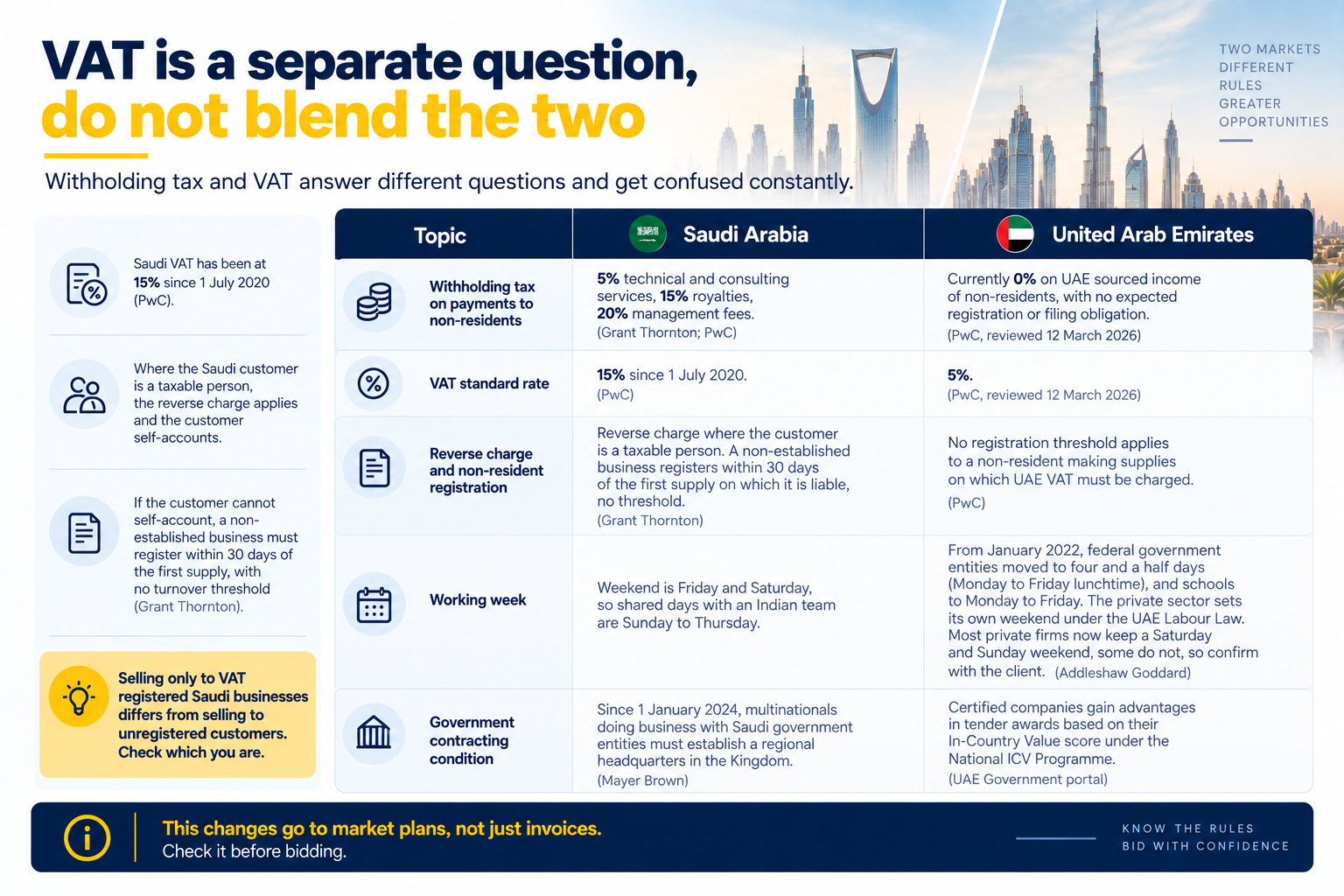
Withholding tax and VAT answer different questions and get confused constantly.
Saudi VAT has been at a standard rate of 15% since 1 July 2020, per PwC. Grant Thornton's indirect tax guide adds two points for a non-resident software supplier. Where the Saudi customer is a taxable person, the reverse charge applies and the customer self-accounts. Where the customer cannot self-account, a non-established business must register within 30 days of the first supply on which it is liable to charge VAT, with no turnover threshold.
Selling only to VAT registered Saudi businesses differs from selling to unregistered customers. Check which you are.
Saudi Arabia vs United Arab Emirates
Withholding tax on payments to non-residents
Saudi Arabia: 5% technical and consulting services, 15% royalties, 20% management fees (Grant Thornton; PwC).
United Arab Emirates: Currently 0% on UAE sourced income of non-residents, with no expected registration or filing obligation (PwC, reviewed 12 March 2026).
VAT standard rate
Saudi Arabia: 15% since 1 July 2020 (PwC).
United Arab Emirates: 5% (PwC, reviewed 12 March 2026).
Reverse charge and non-resident registration
Saudi Arabia: Reverse charge where the customer is a taxable person. A non-established business registers within 30 days of the first supply on which it is liable, no threshold (Grant Thornton).
United Arab Emirates: No registration threshold applies to a non-resident making supplies on which UAE VAT must be charged (PwC).
Working week
Saudi Arabia: Weekend is Friday and Saturday, so shared days with an Indian team are Sunday to Thursday.
United Arab Emirates: From January 2022 federal government entities moved to four and a half days, Monday to Friday lunchtime, and schools to Monday to Friday. The private sector was not required to change and sets its own weekend under the UAE Labour Law (Addleshaw Goddard). Most private firms now keep a Saturday and Sunday weekend, some do not, so confirm with the client.
Government contracting condition
Saudi Arabia: Since 1 January 2024, multinationals doing business with Saudi government entities must establish a regional headquarters in the Kingdom (Mayer Brown).
United Arab Emirates: Certified companies gain advantages in tender awards based on their In-Country Value score under the National ICV Programme (UAE Government portal).
That last row changes go to market plans, not just invoices. Check it before bidding.
A checklist for structuring a Saudi software contract
- Decide the classification before pricing. It sets net revenue.
- Name the IP outcome plainly: what is assigned, what is licensed, when each happens.
- Split hybrid deals into priced elements: build, licence, support, hosting, training.
- Make the split defensible in your cost records, not just the invoice layout.
- State the withholding tax treatment in the contract, including who bears it.
- Agree the gross-up position explicitly, or it becomes an argument at the first invoice.
- Start the tax residency certificate and attestation before the first payment date.
- Decide whether you claim relief at source or by refund, and plan cash flow for it.
- Check the customer's VAT registration status. It decides reverse charge or registration.
- For a state owned buyer, check the regional headquarters requirement before bidding.
- Keep the withholding tax certificates for foreign tax credit work in India.
- Have both sides' advisers confirm the classification in writing before signature.
Accucia's view
We are a software company, not a tax practice. We write about Saudi withholding tax because it stalls deals in the last mile.
Classification should follow commercial substance and nothing else. When a buyer asks us to restructure a platform subscription as a service fee so it lands at 5%, we say no. We have lost work over that answer. The alternative reads well for a quarter, then hands the buyer a penalty nobody priced.
We also say things that cost us margin. If what you need is packaged software licensed directly by the copyright owner, buy it that way. It takes revenue off our line. And do not accept a vendor structure that manufactures a licence you never asked for.
One disclosure. Accucia has no office, trade licence, tax registration or local team in Saudi Arabia or anywhere in the Gulf. We deliver from Pune, India, for Gulf clients including Triolift in Saudi Arabia. That is exactly why withholding tax applies to our contracts. How we handle IP, sub-processors and data residency is on our trust page; our Gulf delivery model is on the Gulf region hub.
Not tax advice, and what to do next
This article is general information about published Saudi rules, current at the publication date. It is not tax advice and not legal advice, and does not account for your facts, entity structure or contract. Rules change and guidance gets reinterpreted.
Both parties should take Saudi tax advice on the specific contract before signature. The buyer needs it because the buyer withholds and carries the exposure. The vendor needs it because net revenue and treaty relief turn on the same classification.
Raise the withholding tax clause in the first commercial meeting, not the last draft. To talk through how a build and licence contract should be split, get in touch.
Frequently Asked Questions
1. What is the withholding tax rate on software payments in Saudi Arabia?
It depends on classification. ZATCA's January 2024 guideline treats custom software developed for a fee with ownership transferred as a technical service at 5%. Rights to reproduce and sell software are a royalty at 15%. A plain access licence is not settled, so take Saudi advice on it.
2. Does a custom software development contract attract 5% or 15%?
5%, where the contract is genuine custom development for a fee and partial or full ownership passes to the customer. ZATCA classifies that as a technical service. Ministerial Resolution No. 25, effective 15 September 2023, set the technical services rate at 5%.
3. When is a software payment treated as a royalty in Saudi Arabia?
When the buyer pays for rights rather than for work. ZATCA's January 2024 guideline treats the transfer of exclusive or non-exclusive rights to reproduce and sell software as a royalty at 15%. A plain access licence is read as a royalty in some cases and as commercial profits in others, so take advice rather than assume.
4. Is packaged software subject to Saudi withholding tax?
Under ZATCA's January 2024 guideline, where packaged software is sold and the end user licence sits directly between the copyright owner and the customer, the payment is commercial profits rather than a royalty, so no withholding applies on that basis.
5. Who actually pays the withholding tax, the Saudi buyer or the foreign vendor?
The Saudi payer deducts and remits it, so the vendor receives a net amount. Who bears it commercially depends on the gross-up clause you agree. If the classification is corrected upward later, ZATCA looks to the Saudi payer for the shortfall, not the vendor.
6. When must the Saudi buyer remit withholding tax to ZATCA?
By the tenth day of the month following the payment, according to Grant Thornton Saudi Arabia, regardless of the commercial terms agreed with the recipient. Andersen in Saudi Arabia states a late payment penalty of 1% for every 30 days of delay.
7. What happens if the contract is classified incorrectly?
The exposure lands on the Saudi payer, who should have withheld at the correct rate. Andersen in Saudi Arabia reports a 1% penalty for every 30 days of delay, and a further 25% penalty where evasion through false information is proven.
8. Does the India and Saudi Arabia treaty reduce the rate on software fees?
The treaty table shows royalties at 10%, interest at 10% and dividends at 5%. It publishes no separate fees for technical services rate for India, so do not assume one and do not infer one from the royalty rate. Take Saudi advice.
9. Can the treaty rate be applied at source, or must a refund be claimed?
KPMG reports that ZATCA's January 2025 bulletin allows both. Relief at source needs a tax residency certificate, a ZATCA approved request form, embassy attestation or apostille, and an undertaking from the resident taxpayer. Otherwise domestic rates are withheld and reclaimed afterwards.
10. Does Saudi VAT apply on top of withholding tax?
They are separate taxes and both can apply. Saudi VAT has been 15% since 1 July 2020. Where the Saudi customer is a taxable person, the reverse charge applies and the customer self-accounts for VAT on the supply. Withholding tax is separate.
11. Do we need to register for Saudi VAT as a foreign software supplier?
Not if your Saudi customers are taxable persons who self-account under the reverse charge. If they cannot self-account, Grant Thornton's indirect tax guide states a non-established business must register within 30 days of the first supply on which it is liable.
12. How should a hybrid build and licence contract be handled?
Separate the elements. ZATCA's guideline requires mixed contracts to be categorised properly rather than treated as one supply. Price the build, licence, support and hosting separately in the contract and on the invoice, and match the split to your cost records.
Check Your Market Readiness