
RBI Digital Lending Directions 2025 With Spreadsheets?
Quick Answer
An NBFC can meet the RBI Digital Lending Directions 2025 with spreadsheets on a quiet month with a careful team. It cannot meet them reliably, because the Directions require things to happen in a fixed sequence for every loan, and spreadsheets depend on a person remembering the sequence. The requirements break first on leave days, during growth, and under audit, which is exactly when the regulator is looking. By Mr. Sumeet Katariya, Accucia Softwares Pvt. Ltd.
What the Directions actually ask an NBFC to do, operationally
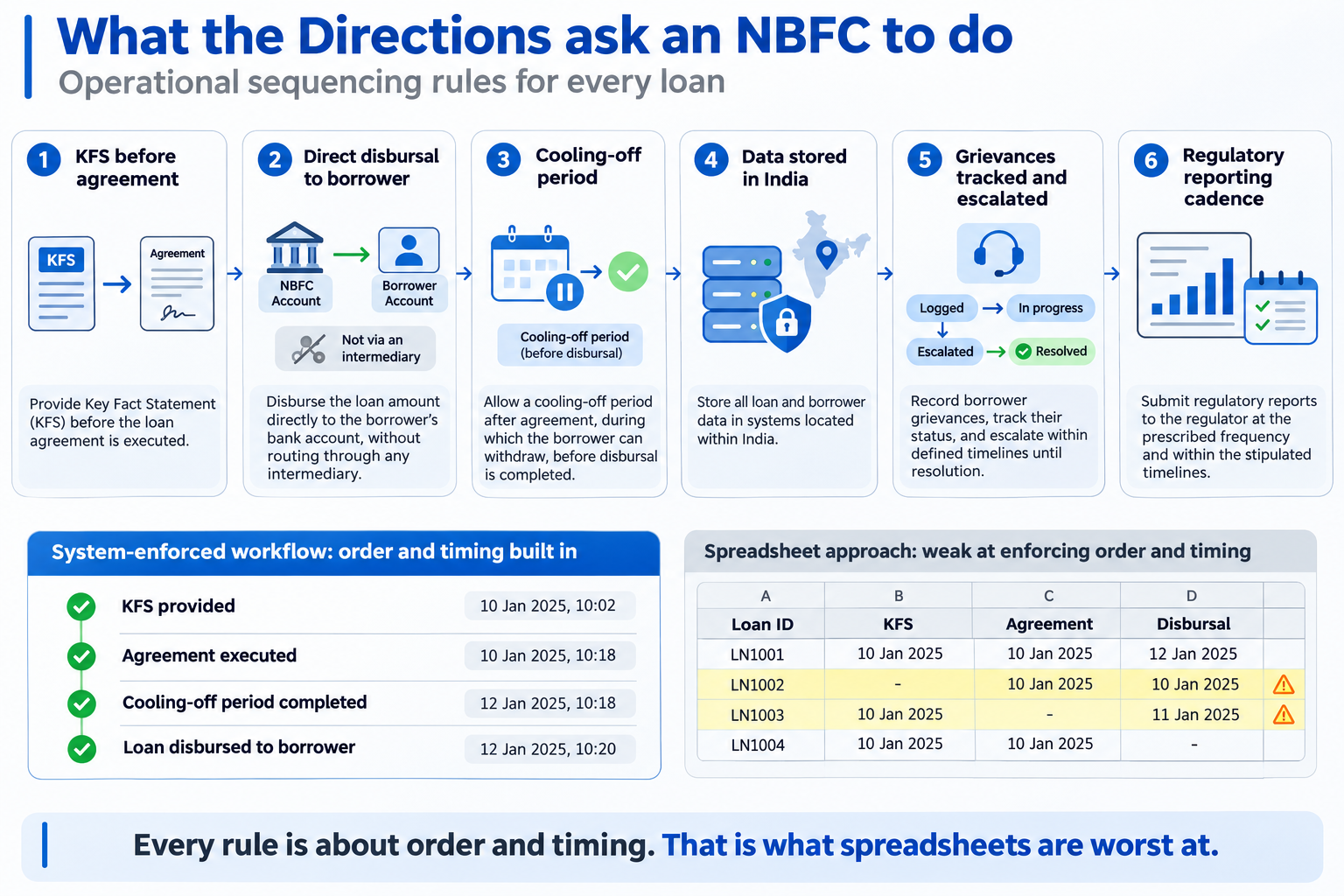
The Reserve Bank of India (Digital Lending) Directions, 2025, issued on 8 May 2025 as circular RBI/2025-26/36 (DOR.STR.REC.19/21.07.001/2025-26), read as policy. Translate it into what has to happen on a Tuesday afternoon in the operations team and it becomes a list of sequencing rules.
The Key Fact Statement has to be issued to the borrower, in the mandated format, before the loan agreement is executed. Not after, not alongside. Before.
Disbursal has to go directly to the borrower's bank account. It cannot pass through a lending service provider's account on the way.
A cooling-off period applies, during which the borrower can exit. Disbursal that ignores the window is a breach even if the borrower never objects.
Lending data has to be stored in India.
Grievances have to be registered, tracked and escalated to a designated officer within the required timelines.
Reporting to the regulator has to follow the prescribed shape and cadence.
Every one of these is a rule about order and timing applied to every single loan. That is the property spreadsheets are worst at.
The clauses, in the Directions' own words
Summaries soften rules. The operative wording is what the system has to enforce, so here it is, quoted from the 8 May 2025 notification with its paragraph numbers.
- Paragraph 9(i): "Disbursement of loan by the RE shall always be made into the bank account of the borrower." Paragraph 9(ii): "RE shall ensure that all loan servicing, repayment, etc. is executed by the borrower directly in the RE's bank account."
- Paragraph 8(i): "RE shall provide a Key Fact Statement (KFS), as per instructions contained in" the applicable circular.
- Paragraph 10(i): "The borrower shall be given an explicit option to exit a digital loan by paying the principal" and proportionate charges "without any penalty during an initial cooling-off period."
- Paragraph 12(i): "RE shall ensure that any collection of data by their DLA and DLA of their LSP is need-based" and carried out "with prior and explicit consent of the borrower having audit trail."
- Paragraph 11(i): "The RE, and the LSP which has an interface with the borrower, shall designate nodal grievance redressal officers."
- Paragraph 7(ii): "RE shall ensure that there is no automatic increase in credit limit unless an explicit request is received."
Notice the verbs. Shall always be made. Shall ensure. Shall be given. Each is a condition on a transaction, and a condition on a transaction is something a system can test before the transaction completes. A spreadsheet can only record that someone said it was tested.
Where spreadsheets hold and where they break
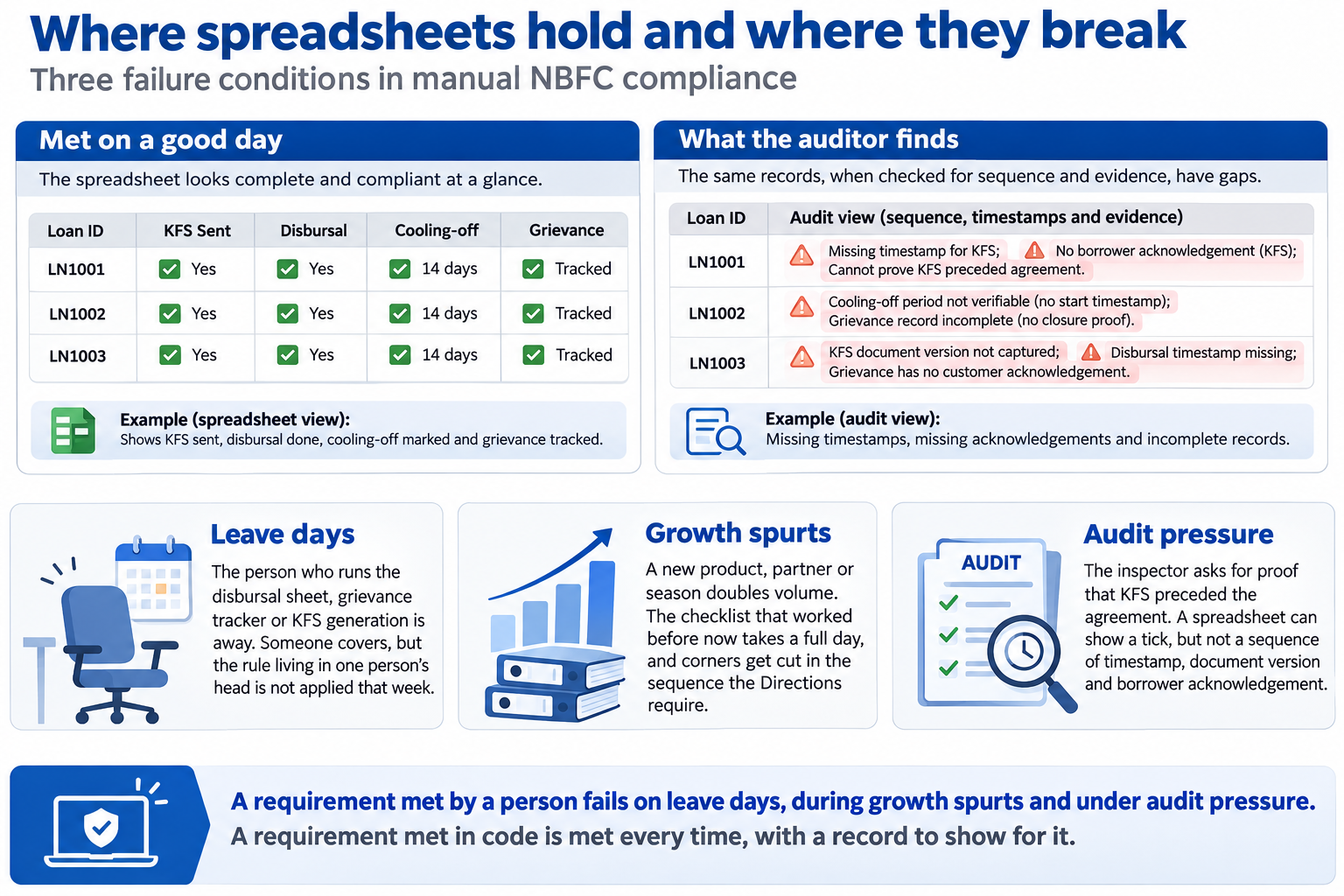
The left column is met on a good day. The right column is what the auditor finds.
The three failure conditions
Ask any NBFC operations head when their spreadsheet process last slipped and the answer falls into one of three situations.
Leave days. The person who runs the disbursal sheet, or the grievance tracker, or the KFS generation is away. Someone covers. The covering person does not know that row 214 is a construction loan with a different sequence. The rule that lived in one person's head is not applied that week.
Growth spurts. A new product, a new channel partner, a festival season. Volume doubles. The checklist that took ten minutes per loan now takes a team's whole day, and corners get cut in exactly the places the Directions care about: the KFS goes out with the agreement rather than before it, the cooling-off window is treated as a formality.
Audit pressure. The inspector asks for evidence that the KFS preceded the agreement on a sample of fifty loans. A spreadsheet can show a tick. It cannot show a timestamp, a document version, and a borrower acknowledgement in sequence. The reconstruction takes days and persuades nobody.
A requirement met by a person fails on leave days, during growth spurts and under audit pressure. A requirement met in code is met every time, with a record to show for it.
What compliance in code means in practice
It does not mean a compliance module bolted onto the side. It means the lending workflow itself refuses to proceed out of order.
In the lending systems we build, the loan agreement step cannot be reached until the KFS has been generated in the mandated format and issued to the borrower, with the timestamp on the record. Disbursal is blocked until the cooling-off window has elapsed without cancellation. The disbursal instruction carries the borrower's account and nothing else. Grievances are registered as records with owners and escalation timers, not emails. Reports are produced from the loan records, so they reconcile because they were never separate in the first place. Hosting is in India, which our trust page sets out.
None of this requires the operations team to remember anything. That is the point. We laid out the fuller argument in loan origination system versus lending automation, and the compliance checklist is the version to run against your own stack this quarter.
What to check in your own operation this week
- Pull ten recent loans and put the KFS timestamp next to the agreement timestamp. If either timestamp does not exist, that is the finding.
- Trace one disbursal from the sanction to the bank statement. Count the accounts it touched.
- Find the cooling-off end date for the same loan and the disbursal date. Then ask what, other than a person, would have stopped an early disbursal.
- Open the grievance tracker and check who owned it during the last period of leave. If the answer is nobody, the escalation clock was not running.
- Ask where the spreadsheet is synced. If the honest answer is a consumer cloud drive, find out which region it is in before someone else does.
Common mistakes in manual compliance
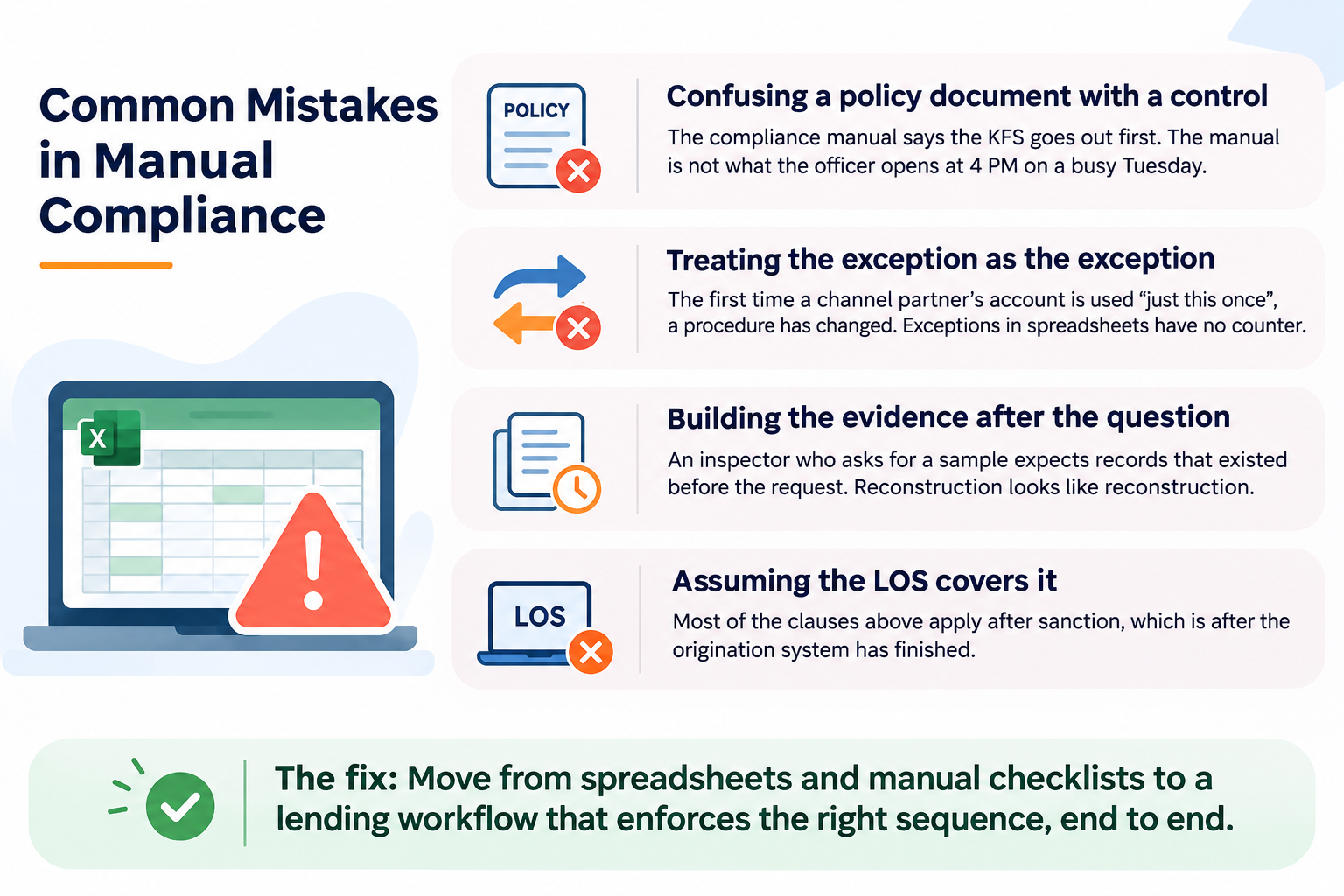
Confusing a policy document with a control. The compliance manual says the KFS goes out first. The manual is not what the officer opens at 4 PM on a busy Tuesday.
Treating the exception as the exception. The first time a channel partner's account is used "just this once", a procedure has changed. Exceptions in spreadsheets have no counter.
Building the evidence after the question. An inspector who asks for a sample expects records that existed before the request. Reconstruction looks like reconstruction.
Assuming the LOS covers it. Most of the clauses above apply after sanction, which is after the origination system has finished. We set that out in loan origination system versus lending automation.
What this looks like once the sequence lives in the system
Three months after the workflow starts enforcing the order, the ten-loan check in step one takes a minute, because every KFS carries a timestamp and the agreement step could not have been reached without it. Disbursal to any account other than the borrower's is impossible rather than discouraged. Early disbursal is blocked by the cooling-off clock. Grievances have owners and timers regardless of who is on leave. And the regulatory file is produced from the loan records, so the figures agree because they were never separate.
Accucia's view
Spreadsheets meet the Directions the way a careful driver meets the speed limit: usually, and with no proof afterwards. An NBFC that wants to pass an inspection on a bad week needs the sequence enforced by the system, with the evidence produced as a by-product of doing the work. Compliance that lives in code is cheaper than compliance that lives in a person, and it does not take leave.
Watch: Direct disbursal is a rule software should enforce, not remind you.
Read the edition: The Enterprise AI Edge, Ed.22, A requirement met by a person fails on leave days.
If you are reviewing your lending stack against the Directions this quarter, the free AI Readiness Assessment will show you where the manual effort is hiding.
FAQ
Can an NBFC comply with the RBI Digital Lending Directions 2025 using spreadsheets?
On a quiet month with a careful team, yes. Reliably, no. The Directions impose sequencing rules on every loan, such as the Key Fact Statement before the agreement and disbursal only after the cooling-off period, and spreadsheets depend on a person applying the sequence correctly every time. The process breaks on leave days, during growth and under audit.
Which requirements of the Directions break first in a manual process?
The timing rules: the Key Fact Statement issued before the agreement, the cooling-off window observed before disbursal, and grievance escalation within timelines. Each depends on a person acting in order, and each leaves no timestamped evidence when done by checklist.
What does compliance in code mean for an NBFC?
The lending workflow refuses to proceed out of order. The agreement step cannot be reached without a generated and issued KFS, disbursal is blocked until the cooling-off window elapses, the disbursal instruction carries only the borrower's account, grievances are records with owners and timers, and reports are produced from the same loan records.
Is the cooling-off period a system rule or a policy?
It should be both, but only the system rule holds under pressure. Paragraph 10(i) of the Directions gives the borrower an explicit option to exit during an initial cooling-off period. A lending system enforces that by blocking disbursal until the window has elapsed without cancellation, which removes the dependence on a calendar reminder and leaves a timestamped record.
What are the RBI Digital Lending Directions 2025?
The Reserve Bank of India (Digital Lending) Directions, 2025 were issued on 8 May 2025 as circular RBI/2025-26/36 (DOR.STR.REC.19/21.07.001/2025-26). They consolidate the requirements NBFCs and other regulated entities must meet in digital lending, including the Key Fact Statement, direct disbursal, the cooling-off period, need-based data collection with consent and grievance redressal.
Automate NBFC Compliance. Book Your Free Assessment Today!