Quotation Automation Case Study: Utech Waterproofing
Quick Answer
Utech Waterproofing, an India based client of Accucia Softwares Pvt. Ltd., cut quotation turnaround from days to minutes using a custom quoting and approval system built around its own pricing rules. The same platform later carried the company into multiple United States locations. This quotation automation manufacturing case study covers year seven of that partnership. By Mr. Sumeet Katariya, CEO Accucia Softwares
Ask an operations heavy business where it loses revenue and you will hear about pricing and competition. Sit with the same business for a week and you find an earlier, quieter leak. The quotation that took four days to send.
Utech Waterproofing, an India based client, closed that leak. Quotation turnaround fell from days to minutes. Then something more useful happened. The same platform carried the company into multiple United States locations, and the working relationship is now in its seventh year.
We are naming the client because they have cleared it. Named work is the only kind a buyer can actually check.
The quotation bottleneck at Utech Waterproofing
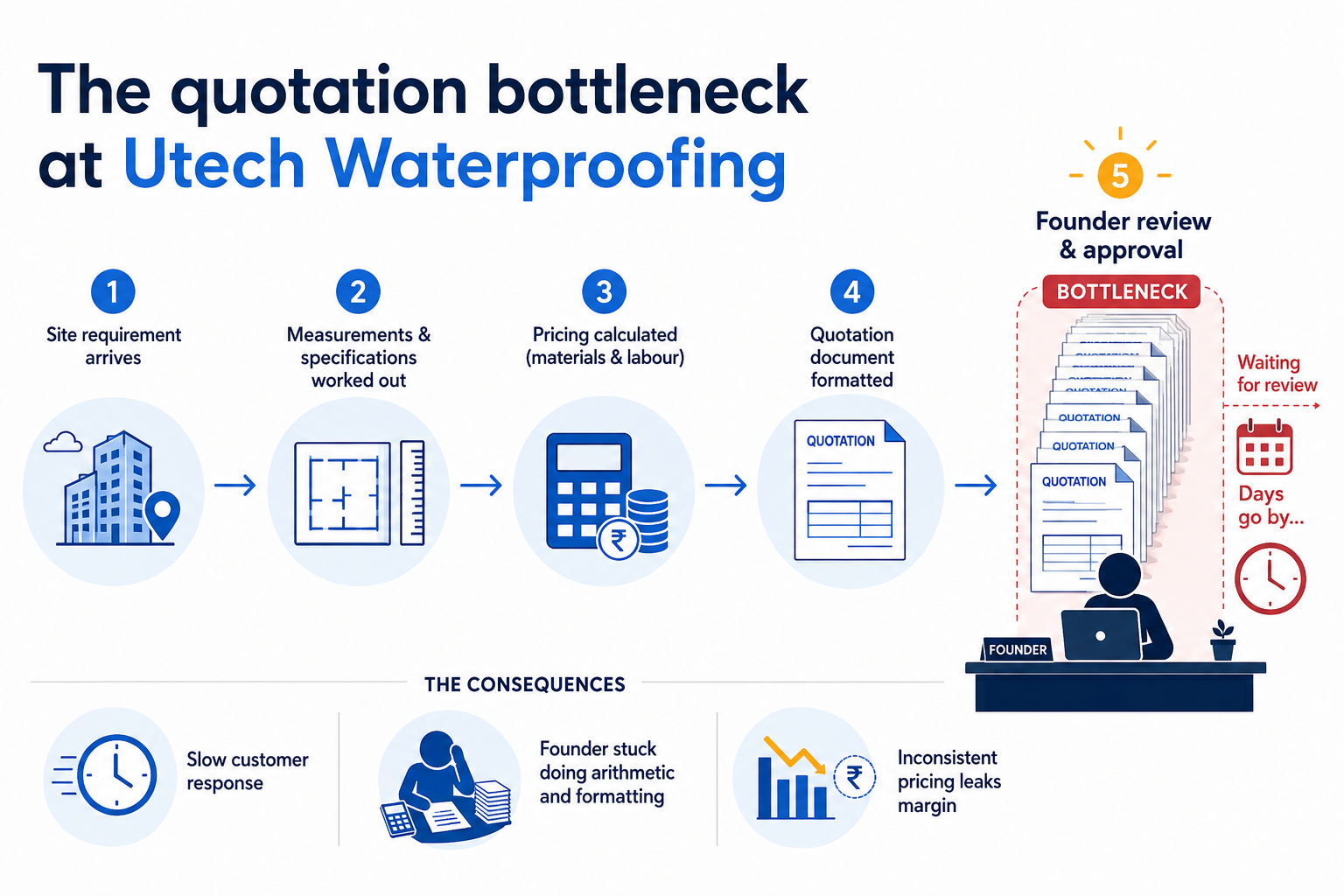
Before the rebuild, Utech's quoting process looked like most of the trade's. A site requirement arrives. Someone works out measurements and specifications. Pricing gets calculated against materials and labour. A document gets formatted. Then it waits for the founder.
That last step was the real constraint. Almost every quotation flowed through one person, because the pricing knowledge lived in his head. As enquiry volume grew, the queue grew with it. Days passed.
Two costs came out of that, and only one of them was obvious. The obvious cost was slow response to customers. The quiet cost was what the founder was doing with those hours: arithmetic and formatting, instead of running the company.
There was a third cost nobody logs. Pricing built under time pressure drifts. Two similar jobs get quoted differently by different people in different weeks, and margin leaks through that gap for years before anyone notices.
What a slow quotation actually costs
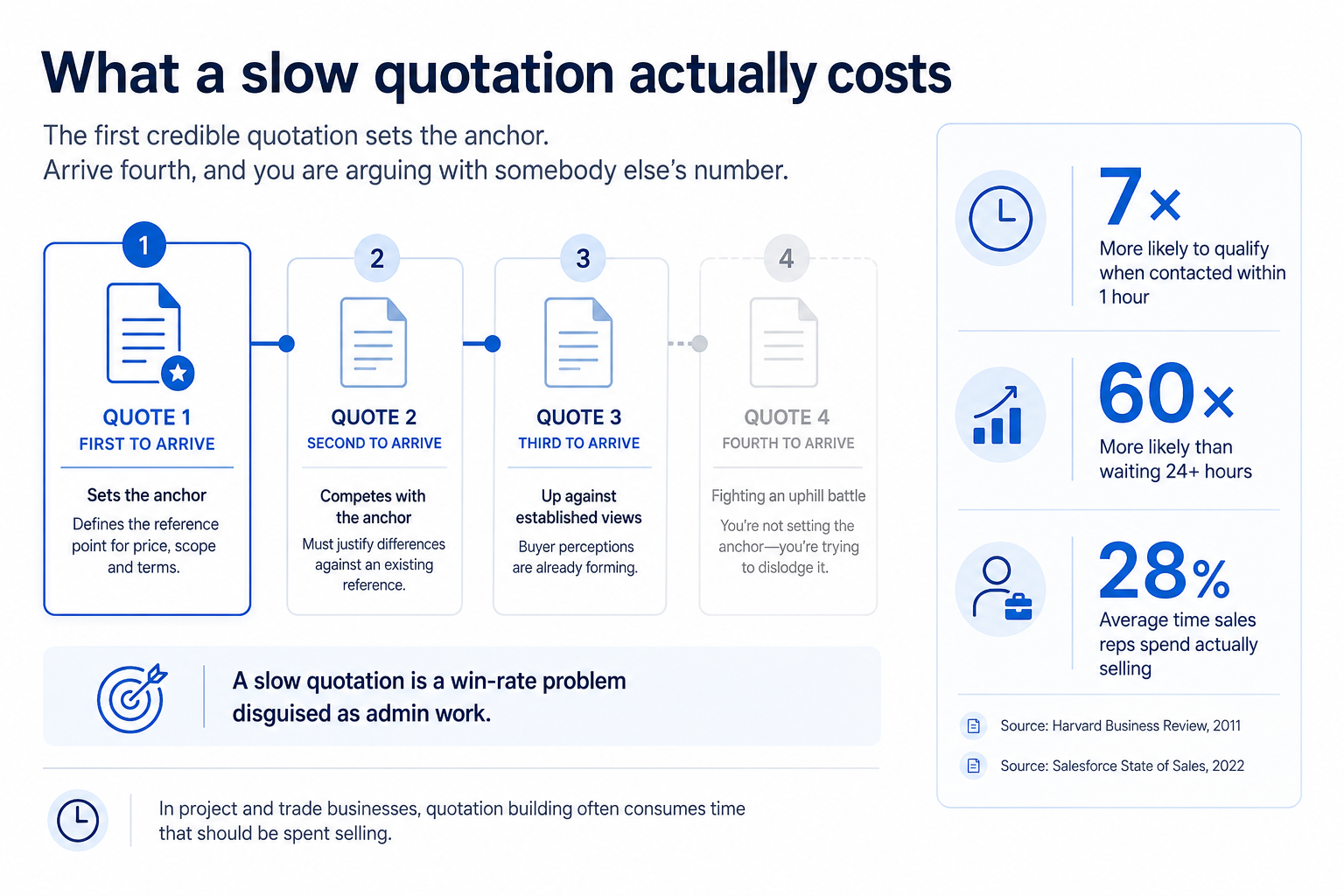
A slow quotation is a win rate problem wearing an admin costume. The first credible quotation sets the anchor the customer negotiates against. Arrive fourth, and you are arguing with somebody else's number.
The research on response speed is old and still holds. Writing in Harvard Business Review in March 2011, James Oldroyd, Kristina McElheran and David Elkington studied 1.25 million sales leads across 42 United States companies. Firms that tried to contact a potential customer within an hour of the enquiry were nearly seven times as likely to qualify the lead as those that tried an hour later, and more than 60 times as likely as companies that waited 24 hours or longer.
The internal side has been measured too. Salesforce's State of Sales report, fifth edition, published in December 2022 from 7,775 responses across 38 countries, found sales representatives spend just 28 percent of their week actually selling. The rest goes to deal management and data entry. In project and trade businesses, quotation building is a large slice of that remainder.
What Accucia built
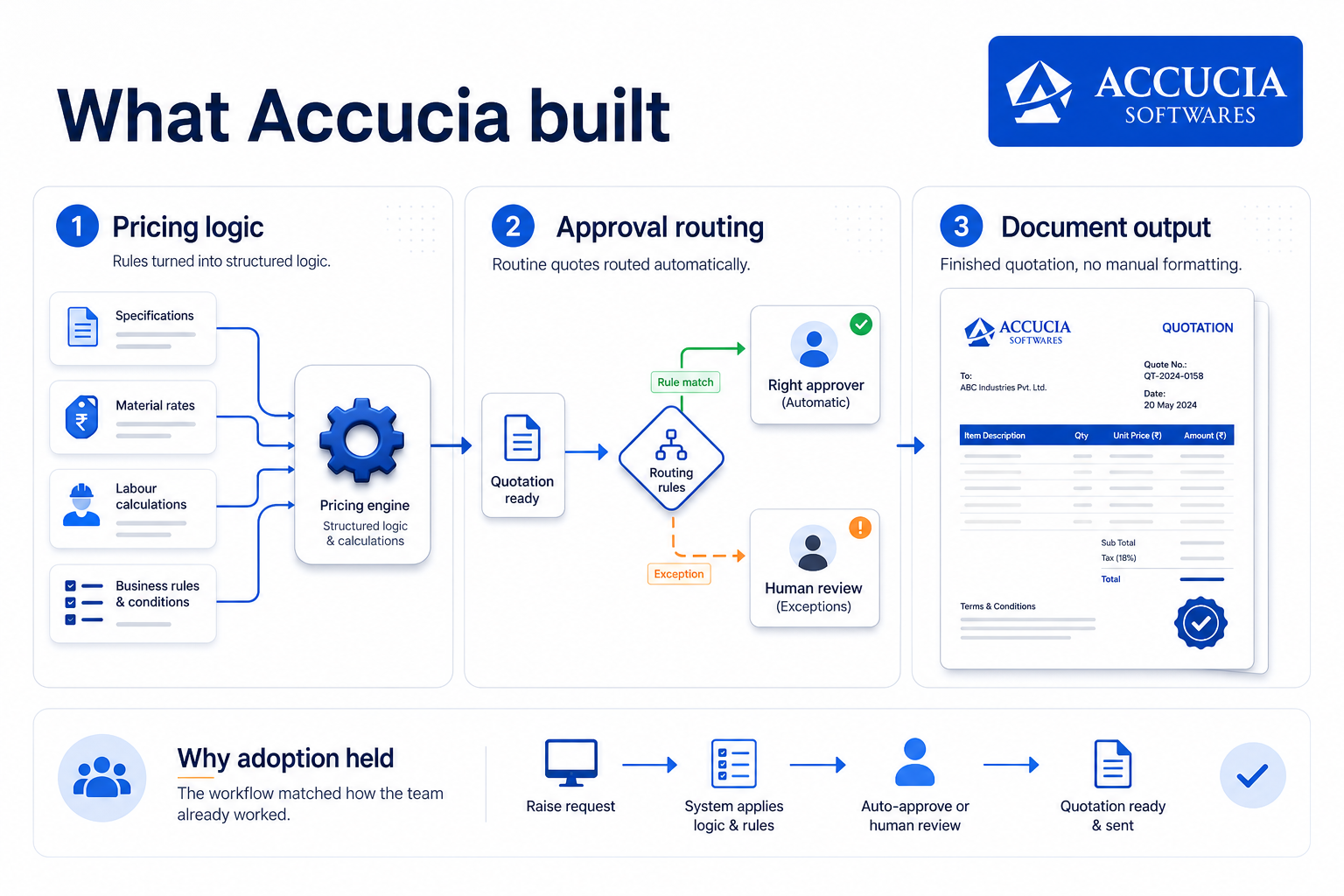
We did not sell Utech a generic quoting tool. We mapped how Utech actually prices work, then encoded it. Three parts mattered.
Pricing logic. Specifications, material rates, labour calculations and the rules connecting them were written into the system as structured logic, instead of staying in one person's memory.
Approval routing. Approvals were routed by rule to whoever needed to see a given quotation, rather than queuing in the founder's inbox. Exceptions still reach a human. Routine work does not.
Document output. Formatting stopped being a manual step. The quotation comes out finished.
Adoption went smoothly for an unglamorous reason. The workflow matched what the team already did, so nobody had to learn a new way of working in order to use the software. That is the part most quoting rollouts get wrong. A system that is technically correct and behaviourally foreign gets quietly abandoned in month three.
Days to minutes: what changed
Quotation turnaround fell from days to minutes.
Quote turnaround
Before: Days
After: Minutes
Dependency
Before: Founder had to be available
After: Rules run without him
Pricing consistency
Before: Varied by person and by week
After: Same logic every time
Founder's role
Before: Built the quotations
After: Reviews the exceptions
Approvals
Before: Queued in one inbox
After: Routed by rule
An enquiry could now be answered while the customer was still thinking about it. The founder stopped being the bottleneck and became the reviewer of exceptions. Pricing became consistent, which is the benefit nobody writes into a requirements document and everybody feels a year later.
Then the platform travelled
As Utech expanded into multiple locations in the United States, the operation ran on the same platform. New sites inherited the quotation logic, the approval rules and the document standards on day one, instead of inventing local versions that someone has to reconcile later.
That matters more than it sounds. Multi location businesses usually fragment first and standardise painfully afterwards. Carrying the standard into the new site is far cheaper than retrofitting it into four of them.
It also settles a question international buyers ask us quietly. Can a system built in India run operations in the United States, across time zones? Here, for seven years, yes. India's technology industry reached an estimated US$ 283 billion in FY25, with US$ 224 billion of that from exports, on nasscom figures published through the Press Information Bureau. Delivery from India at that size is not an experiment. In our experience the deciding factor was never geography. It is whether the partner stays through adoption and iteration, or disappears at handover.
We say plainly that Utech is an India based client. If the work holds up here, it holds up anywhere.
Year seven: what a partnership compounds
Utech's engagement with Accucia is past its seventh year, and that number is the real case study.
Systems that are delivered and abandoned decay. The business changes, the software does not, and the gap widens until somebody calls the tool outdated and starts a replacement cycle. Three rounds of that cost more than most companies ever add up, and each round burns a year of staff attention on migration instead of on customers.
A continuing relationship compounds instead. The platform grew as the business grew. New needs became new modules on a foundation already fitted to the company. Institutional knowledge accumulated inside the system rather than walking out with staff.
Accucia has delivered 730+ projects across 25+ industry verticals in eight years. The engagements that produced the most value for the client are almost never the ones with the cleverest architecture. They are the ones we were still working on in year four.
How to spot the same bottleneck in your business
Look for work that is repetitive, slow, and routed through one or two people. Quoting. Approvals. Onboarding. Month end reporting. If one named individual going on leave stalls the process, you have found it.
Then ask one question. Is the delay caused by thinking, or by fetching and formatting? Thinking should stay with humans. Fetching and formatting should not. That line is where the automation belongs.
We would not recommend starting with your most complicated process. Start with the one that runs most often.
Accucia's view
Quotation speed is the most under priced sales weapon in operations heavy businesses, and partnership length is the most under priced number in software buying.
When you evaluate a system, ask what it does to your enquiry to quote time. When you evaluate a vendor, ask how old their longest running client relationship is, then ask to speak to that client. The first number predicts your win rate. The second predicts whether what you buy this year still fits your business in year five.
This next part costs us sales, so we will say it anyway. If your quoting is slow because your pricing rules are genuinely unsettled, do not buy software yet. Settle the rules on paper first. Software encodes decisions, it cannot make them for you. We have walked away from projects for exactly this reason, and the clients who fixed their rules first came back with something we could build properly.
Frequently Asked Questions
How did Utech Waterproofing cut quotation time from days to minutes?
Utech Waterproofing, an India based client, worked with Accucia Softwares to encode its own pricing logic, material and labour rules, and approval routing into a custom system. Quotations that once waited on the founder now generate in minutes, with senior staff reviewing exceptions instead of building every document by hand.
Why does quotation speed matter commercially?
The first credible quotation sets the anchor a customer negotiates against, so a slow quote argues against a competitor's number. Harvard Business Review research published in March 2011 found firms contacting a lead within an hour were nearly seven times as likely to qualify it as those responding an hour later.
Can a system built in India run operations in the United States?
Yes. Utech Waterproofing's multiple United States locations run on the platform Accucia built in India, across time zones, in a relationship now past its seventh year. The deciding factor is delivery and adoption discipline, not geography. India exported an estimated US$ 224 billion of technology services in FY25.
What is a long term technology partnership worth compared with one off project delivery?
A system that keeps being worked on tracks the business as it changes. A delivered and abandoned system decays until someone funds a replacement. Utech Waterproofing has run one evolving platform for over seven years, adding modules as it expanded, instead of paying for repeated rebuilds and data migrations.
Will an automated quotation system fit our existing pricing rules?
It should, because custom development starts from your rules rather than from a template. Accucia maps how your team actually prices work, including exceptions and approval thresholds, then encodes that logic. If your pricing rules are genuinely unsettled, fix them on paper before commissioning any software.
How do I know whether quotation automation is the right first project?
Check whether quoting is slow because of thinking or because of fetching and formatting. Fetching and formatting should be automated. Then check whether one person's absence stalls quotes. Single person dependency plus high frequency is the strongest signal that quoting is the right place to start.
Ready to automate your quotation process? Talk to Accucia.