
Pharma Mobile Apps: Lessons from 250+ Doctor Engagement Builds
Quick Answer
Pharma brand apps succeed when they serve doctors between rep visits: product information on demand, launch content timed to the field cycle, and answers that arrive faster than a callback. Across 250+ mobile and web builds for pharma engagement, what separates used apps from installed ones is usefulness in the doctor's actual working minute. By Mr. Sumeet Katariya, Accucia Softwares Pvt. Ltd.
A pharma brand app competes with every other icon on a doctor's phone. 250+ builds taught us what survives the first month, and most of it contradicts what the first stakeholder meeting usually asks for.
What pharma apps are actually for

Strip away the feature wishlists and pharma apps earn their place doing three jobs.
Brand engagement is the first. A doctor's relationship with a pharma brand used to exist only in the minutes a representative could get in a crowded clinic. An app extends that relationship into the hours when no rep is present, which is nearly all of them. The brand that answers a product question at ten at night, when the doctor is reading up after a long OPD, occupies different ground from the brand that exists only as a visit.
Product launches are the second. A launch is a coordinated burst: new molecule or formulation, field force briefed, doctors informed, questions flowing back. The app becomes the channel where launch content lands in a doctor's hand the same week it matters, consistently presented, instead of travelling at the speed of individual rep visits.
Doctor communication is the third and the one that compounds. Updates, clinical content, responses to queries. Done well, the app becomes the standing line between brand and prescriber. Done badly, it becomes shelf-ware with a push-notification habit that gets it uninstalled.
Notice what is not on this list. These are commercial and brand systems, the territory our pharma industry work covers. They live or die on whether a busy clinician finds them worth thirty seconds.
What gets used versus what gets installed
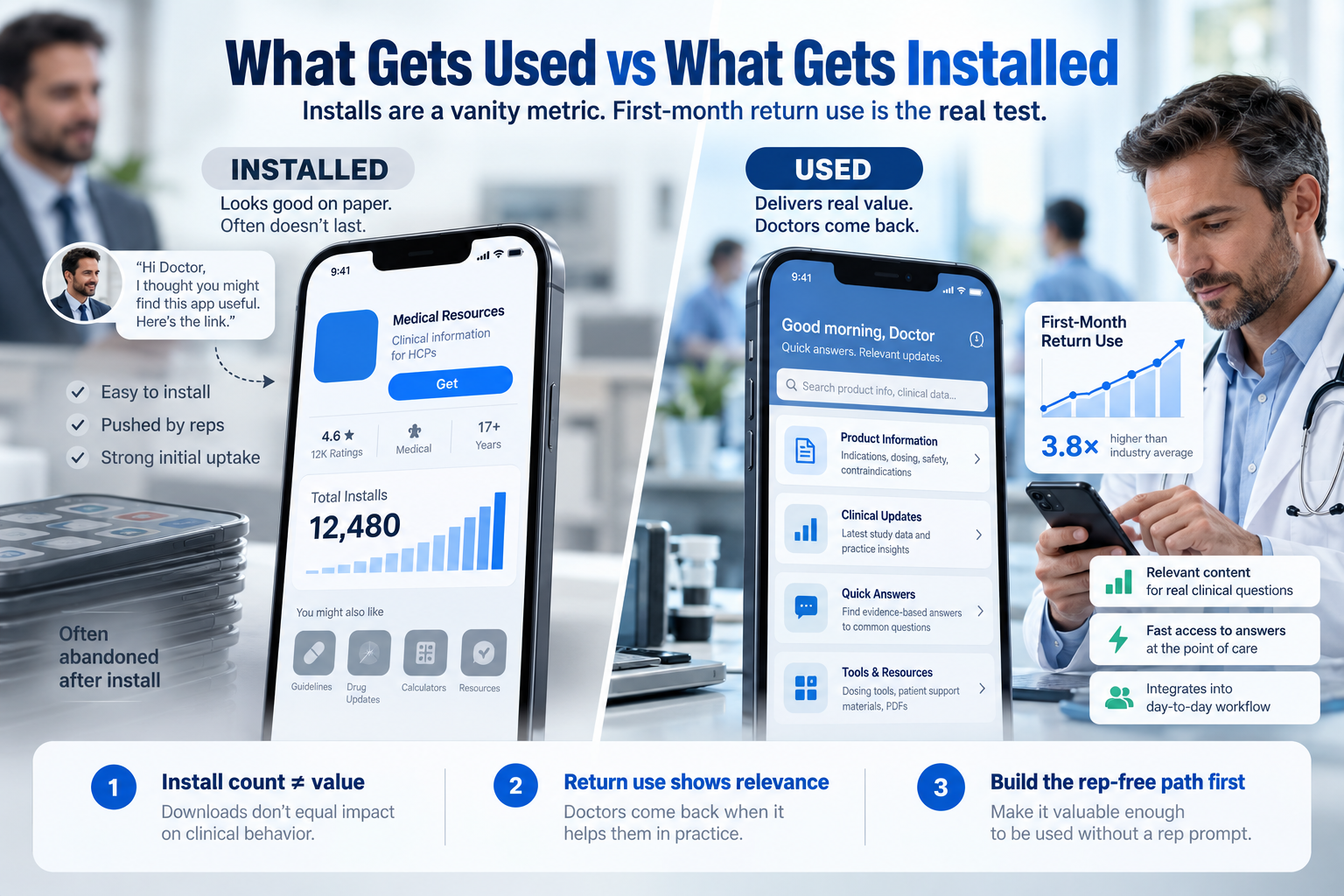
Install counts are the vanity metric of pharma app projects. A field force can drive installs; reps ask, doctors oblige. The install number climbs, the dashboard looks healthy, and none of it says whether the app matters.
What survives the first month is the honest test. A doctor opens the app once because a rep asked. Whether they come back unprompted depends entirely on whether the first visit was worth anything, and that return visit is the signal we watch on every build.
The pattern across our builds is consistent. Apps built around what the brand wants to say get installed and abandoned. Apps built around what the doctor needs in a working moment get reopened. The difference shows in small design decisions: how many taps from opening the app to the product information a doctor actually wants, whether content reads like regulatory-approved brochure copy or like the answer to a question, whether anything about the app respects that the user has forty patients waiting.
One rule we hold on every engagement, covered in depth on our mobile app development page: build the rep-free path first. If the app only makes sense as an accessory to a rep visit, it will not survive between visits. The doctor must be able to arrive with a question and leave with an answer, alone, at any hour.
What an AI layer did inside one pharma app
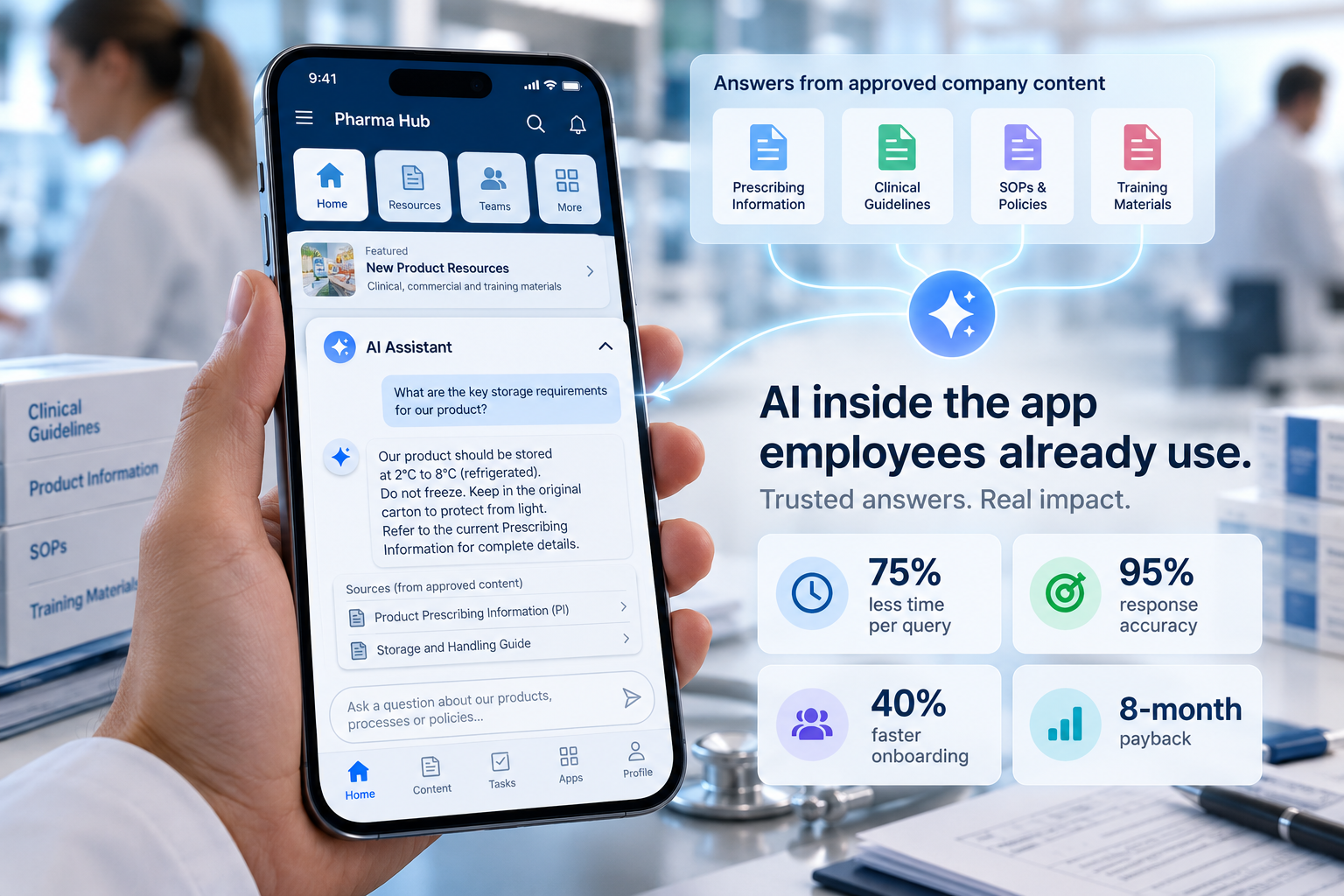
The sharpest version of that arrive-with-a-question principle came from an engagement with a large Indian pharmaceutical company. The problem was internal rather than doctor-facing, and it is instructive for both audiences: employees needed product and process information that existed in the company's documents, and finding it meant searching, asking seniors or waiting on callbacks.
We embedded an AI chatbot inside the app employees already used. No new icon to adopt, no new habit to train. The assistant was simply there, in the tool already open on their phones, and it answered from the company's own approved content.
The measured results from that build: 75% less time per query, 95% accuracy on responses, 40% faster onboarding for new joiners, and payback on the investment in 8 months. The full write-up is in the pharma client AI chatbot case study.
The transferable lesson sits in the placement. The chatbot worked because it lived inside software people already opened daily. The same logic governs doctor-facing builds: intelligence added to an app a doctor already uses beats a new app asking for a fresh habit. Add the answer where the person already is.
What launch timing does to adoption
Pharma runs on launch cycles, and the app's fate is tied to them more tightly than most project plans admit.
An app that goes live alongside a product launch inherits the launch's energy. The field force has a reason to show it, the doctor has a reason to open it, and the content inside is new by definition. First impressions form around usefulness.
An app that ships in a quiet period arrives with nothing to say. The homepage is the same next week. The doctor's first visit finds no reason for a second, and no later content push fully recovers a dead first impression. We have watched technically excellent builds underperform for this reason alone, which is why we now treat the release calendar as a design input, not a deployment detail. The question what will be new in the app this quarter belongs in the first scoping workshop.
Platform choice follows the same practical logic. Doctor audiences in India are reached overwhelmingly through Android devices, which keeps Android app development at the centre of most pharma engagement builds, with the wider stack shaped by where the specific prescriber base actually is.
Accucia's view
A pharma brand app is a commercial instrument, and it should be judged like one: on whether doctors return to it unprompted and on what it does for the brand between rep visits. Accucia Softwares Pvt. Ltd. has built 250+ mobile and web apps for pharma doctor and brand engagement from Pune, where we have been headquartered since our founding in 2018, and our position is settled. Build the rep-free path first, time the launch to the brand calendar, put intelligence inside the app rather than beside it, and measure return use, not installs.
Book a free AI Readiness Assessment for your pharma engagement stack on WhatsApp: https://wa.link/1bwdd2
FAQ
What should a pharma brand app include for doctors?
Product information reachable in a few taps, launch content that is current, and a way to get questions answered without waiting for a rep visit. Everything else is secondary. The test for each proposed feature is whether a doctor with a full waiting room would use it unassisted in under a minute.
How do you measure whether a pharma app is working?
Watch return use rather than installs. A field force can drive installs on request, so that number mostly measures rep effort. Doctors reopening the app unprompted after the first month is the signal that it earned a place in their routine, and every content decision should serve that.
When should a pharma app launch?
Alongside a product launch or another moment when the brand has something genuinely new to say. An app released in a quiet period makes its first impression with stale content, and first impressions with doctors are hard to reverse. Plan the release calendar into the app's scope from the beginning.
See how AI can fit inside your existing pharma app.