Manufacturing ERP Software India: Cost Drivers & Timeline
Quick Answer
Manufacturing ERP software in India is one system covering production planning, MRP, inventory and batch traceability, quality and NCR, plant maintenance, purchase, and dispatch with GST e-invoicing and e-way bills. A single-unit plant should plan a 12 to 16 week rollout. Cost is set by module count, plant count and integration depth. By Mr. Sumeet Katariya, CEO, Accucia Softwares Pvt. Ltd.
Most Indian manufacturers do not need a new ERP.
They need the one they already run to talk to the shop floor, and they need to know what that costs before they sign anything.
Accucia has built enterprise software from Pune since 2018, and much of that work sits inside plants across auto components, industrial equipment and elevators.
The pattern repeats.
Finance is computerised.
Production runs on a whiteboard and three spreadsheets.
Quality data lives in a hardbound register.
Somebody retypes the same numbers into two systems every evening.
Manufacturing gross value added grew 9.1% at constant prices in Q2 of 2025–26, according to the Ministry of Statistics and Programme Implementation.
The Seven Modules That Actually Get Used
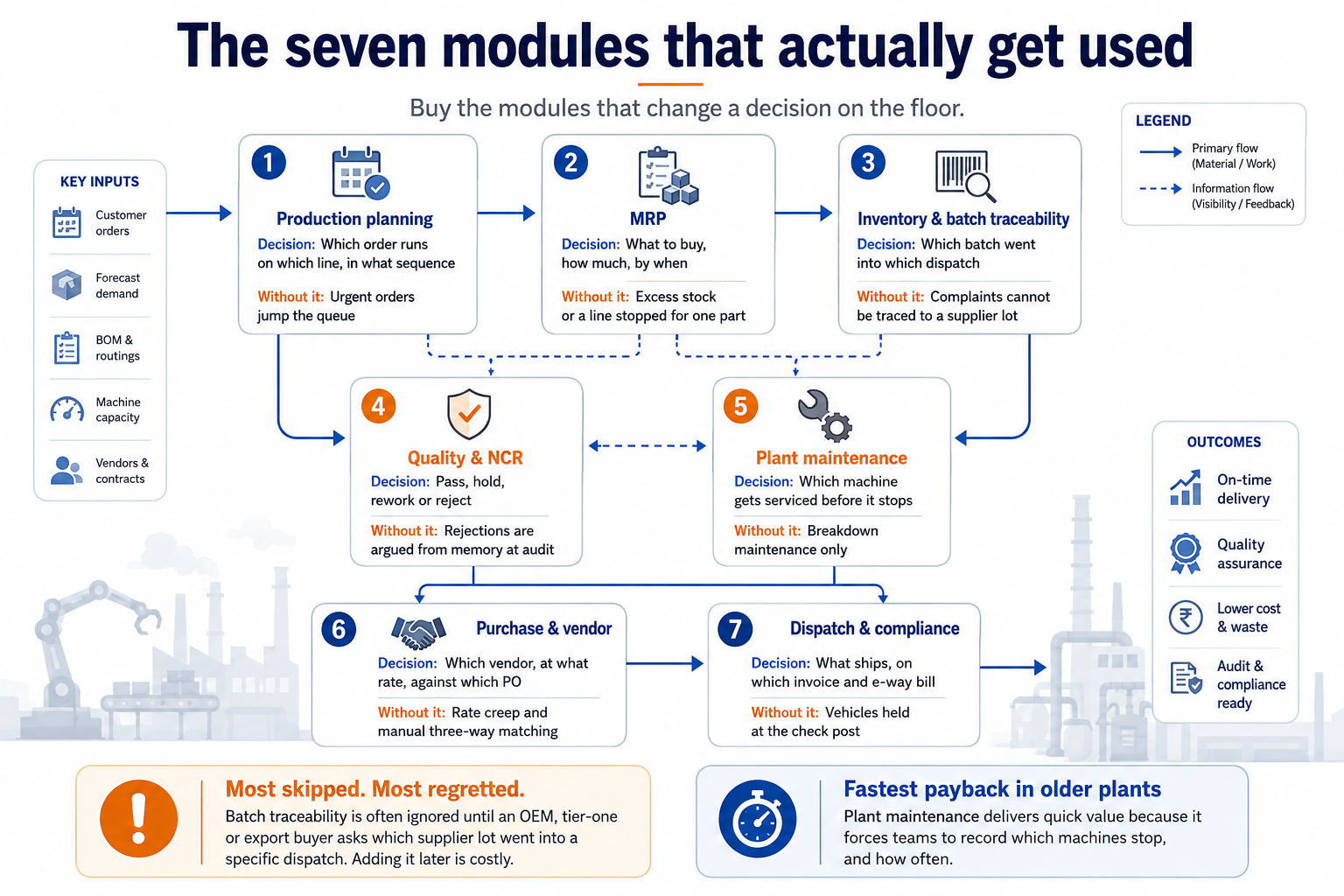
Buy the modules that change a decision on the floor.
In our implementations, seven do the work.
1. Production Planning
Decision it owns: Which order runs on which line, and in what sequence.
Without it: The urgent order jumps the queue.
2. MRP
Decision it owns: What to buy, how much to buy and by when.
Without it: You either carry excess stock or stop a line because one part is missing.
3. Inventory and Batch Traceability
Decision it owns: Which batch went into which despatch.
Without it: Complaints cannot be traced back to a supplier lot.
4. Quality and NCR
Decision it owns: Whether material is passed, held, reworked or rejected, and who approved the decision.
Without it: Rejections get argued from memory during an audit.
5. Plant Maintenance
Decision it owns: Which machine gets serviced before it stops.
Without it: Maintenance becomes breakdown-driven.
6. Purchase and Vendor
Decision it owns: Which vendor to buy from, at what rate and against which PO.
Without it: Rate creep and manual three-way matching become normal.
7. Dispatch and Compliance
Decision it owns: What ships, against which invoice and e-way bill.
Without it: Vehicles can end up waiting at a check post.
Batch traceability is the module Indian manufacturers most often skip and later regret.
If you supply an OEM, tier-one company or export buyer, somebody will eventually ask which supplier lot went into a specific despatch.
Adding traceability later often means re-coding the item master, which creates expensive ERP rework.
Plant maintenance also tends to pay back quickly in older plants, not because the software is clever, but because it forces the organisation to record which machines stop and how often.
What GST, E-Invoicing and E-Way Bills Add to the Scope
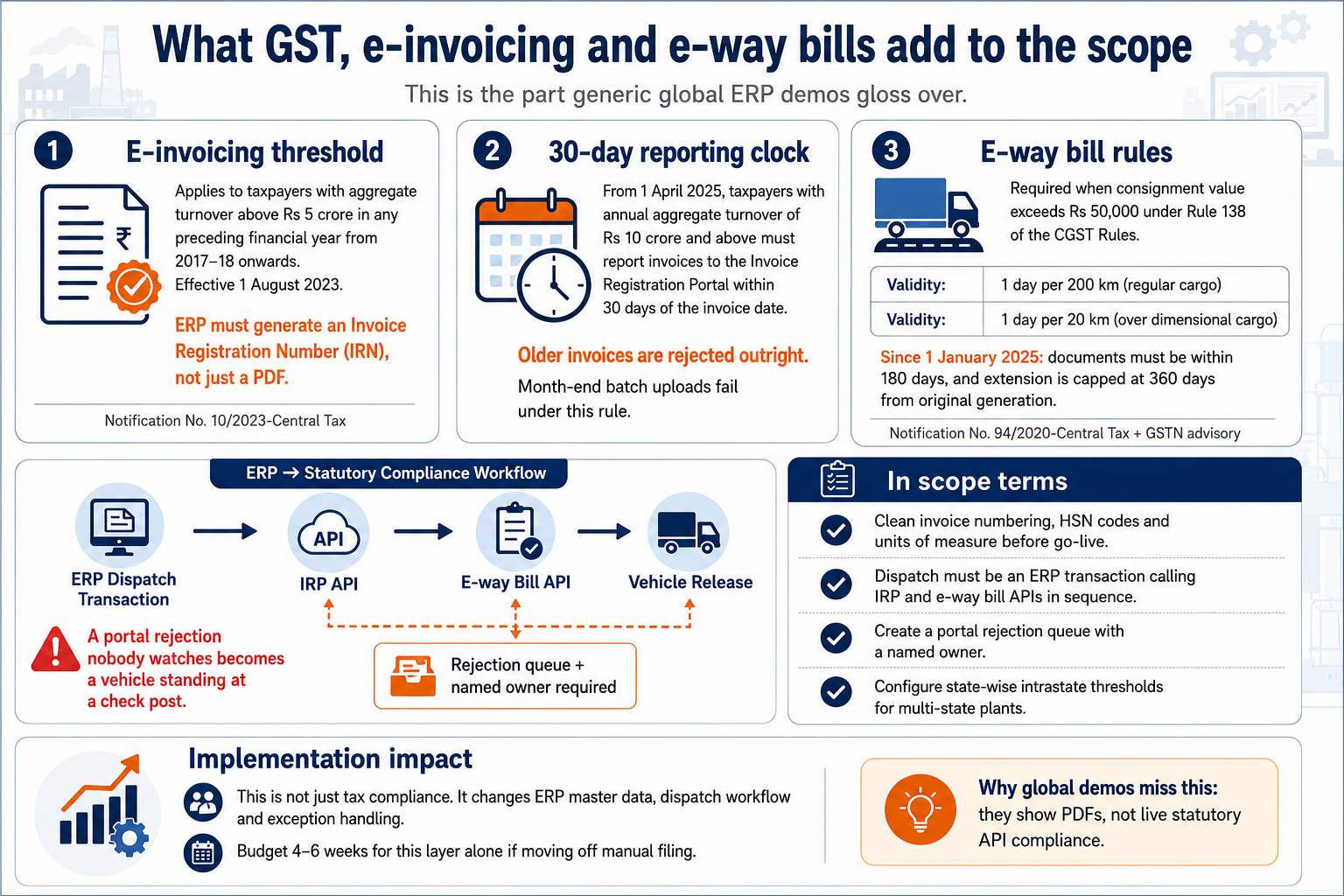
This is the part generic global ERP demos often gloss over.
E-invoicing applies to taxpayers with aggregate turnover exceeding ₹5 crore in any preceding financial year from 2017–18 onwards, effective 1 August 2023 under Notification No. 10/2023-Central Tax.
Above that threshold, your ERP needs to support the Invoice Registration Number process rather than simply generating a PDF invoice.
There is also a reporting deadline.
From 1 April 2025, taxpayers with annual aggregate turnover of ₹10 crore and above must report invoices to the Invoice Registration Portal within 30 days of the invoice date.
Invoices older than that window are rejected.
Any ERP that queues invoices for a month-end batch upload can therefore create a serious operational problem.
E-way bills add another rulebook.
Under Rule 138 of the CGST Rules, an e-way bill is required where consignment value exceeds ₹50,000.
For regular cargo, validity is one day for every 200 km.
For over-dimensional cargo, it is one day for every 20 km.
Since 1 January 2025, a GSTN advisory also restricts generation to documents dated within 180 days and caps extension at 360 days from the original generation date.
What This Means for Your ERP Scope
Invoice Master Data
Invoice numbering, HSN codes and units of measure need to be clean before go-live.
Dispatch Integration
Dispatch should become an ERP transaction that calls the IRP and e-way bill APIs in sequence rather than a manual activity at the gate.
Rejection Handling
You need a portal rejection queue with a named owner.
A rejected invoice that nobody monitors can become a vehicle sitting at a check post.
Multi-State Configuration
Plants operating across states need state-wise intrastate thresholds configured correctly.
Budget roughly four to six weeks for this compliance layer alone if you are moving away from manual filing.
What Drives the Cost of Manufacturing ERP Software in India
Cost follows scope and data complexity more than user licences.
We do not publish one headline implementation price because every plant looks different once the item master, integrations and production processes are examined.
Single Unit, One Legal Entity
Sensible phase one:
Inventory and batch traceability, purchase and vendor management, dispatch and compliance.
What moves the cost most:
Item master quality, legacy systems that need integration, and whether machine data is entered manually or read from PLCs.
Multi-Unit, One Legal Entity
Sensible phase one:
Everything above, plus production planning, MRP and quality.
What moves the cost most:
Whether plants share one process template, inter-unit transfer rules and the number of shop-floor devices.
Multi-Location or Multiple Legal Entities
Sensible phase one:
All seven modules plus consolidated reporting.
What moves the cost most:
GSTIN count, inter-company transactions, export documentation and cloud versus on-premise deployment.
Five other factors commonly move the quote:
- Integrations with existing software
- Custom reports and approval workflows
- Rugged tablet interfaces
- Volume of historical data being migrated
- Whether a security audit is included in scope
Infrastructure is billed at cost rather than marked up.
The Rollout Timeline, Week by Week
Sixteen weeks is realistic for a single-unit plant with clean master data.
Multi-unit deployments usually add four to six weeks per additional plant once the first implementation template is stable.
Weeks 1–2: Discovery
The team walks through the real process on the shop floor rather than relying only on meeting-room discussions.
The item master is audited and the compliance scope is frozen.
Weeks 3–4: Master Data Clean-Up
Duplicate item codes are merged.
Units of measure are standardised.
Bills of material are reconciled against current drawings.
Weeks 5–8: Configuration and Build
ERP modules and workflows are configured.
E-invoice and e-way bill integrations are tested against the portal sandbox.
Weeks 9–10: Migration and Dry Run
Opening stock, open purchase orders and work orders are loaded.
The plant runs the new system alongside the existing process for a short parallel period.
Weeks 11–12: Pilot Line
One line and one product family go live end-to-end.
Weeks 13–14: Full Cutover
Remaining production lines, stores and dispatch move onto the new system.
Legacy processes are retired.
Weeks 15–16: Hypercare
The project moves into daily stand-ups, rapid defect triage and written exit criteria.
The two weeks buyers often try to remove are the master data clean-up weeks.
Do not cut them.
Skipping those two weeks does not necessarily save time. It often creates much larger delays during pilot.
Buy New, or Extend What You Already Run?
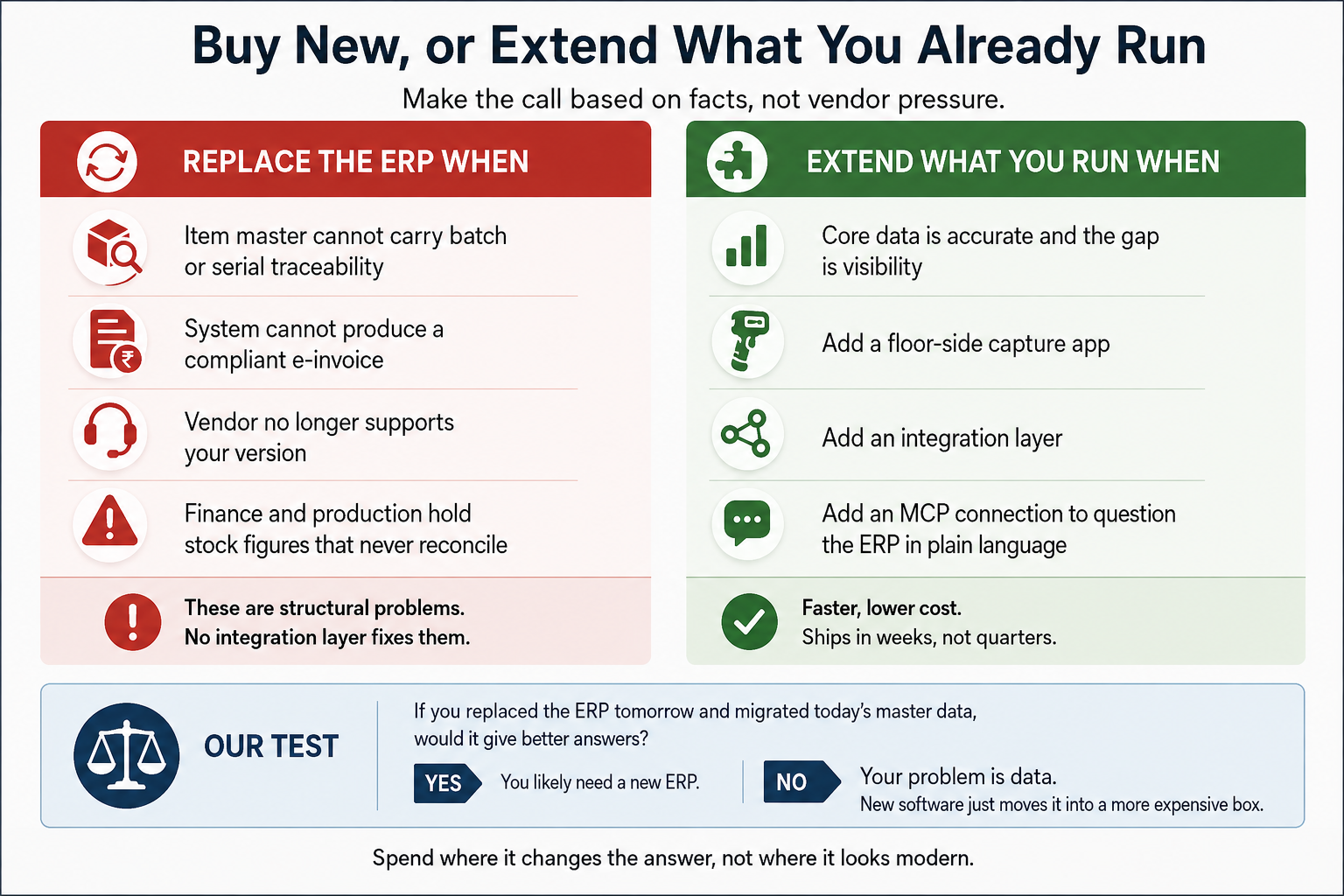
This is where we frequently talk ourselves out of a larger contract.
Replace the ERP when the item master cannot carry batch or serial traceability, when the system cannot produce compliant e-invoices, when the vendor no longer supports your version, or when finance and production maintain stock figures that never reconcile.
Those are structural problems.
An integration layer will not fix them.
Extend the system you already run when the core data is accurate and the real gap is visibility or shop-floor capture.
That extension might be:
- A floor-side capture application
- An integration layer
- An MCP connection that lets teams query the existing ERP in natural language
These options can cost a fraction of a replacement and ship much faster.
A useful test is simple:
If you replaced the ERP tomorrow and migrated today's master data, would the new ERP give you better answers?
If the answer is no, your real problem is data.
New software would simply move that bad data into a more expensive system.
What We Have Built for Manufacturers
Star Engineering, an India-based manufacturer, and Force Motors, the Indian commercial vehicle and engine maker, are Accucia clients.
Our published work with Force Motors includes an owner community platform built around the Force Gurkha.
In the elevator sector, we have also built and implemented service and operations ERP systems for Middle East operators.
Those systems cover:
- Installation projects
- Annual maintenance contracts
- Breakdown calls
- Technician scheduling
- Spare parts
Clients include EPIC ME Technical Works LLC in the UAE, Triolift in Saudi Arabia and Gulf Integrated Vertical Solutions in Bahrain.
We also work with organisations that require anonymity, including a large Indian pharmaceutical company and a government organisation in Maharashtra.
We do not name clients without permission.
What Goes Wrong
Master Data
Duplicate item codes.
Units of measure that disagree between purchase and production.
Material bought in kilograms but consumed in metres.
Bills of material that were never updated after an engineering change.
It sounds boring.
It is also one of the biggest determinants of whether an ERP rollout finishes on time.
Shop-Floor Adoption
Operators will not use a system that adds keystrokes and gives them nothing back.
Ask for eleven fields and return nothing useful, and the data starts getting entered at shift end from memory.
At that point, your “live” production data becomes fiction.
Design shop-floor screens around four fields and one scan wherever possible.
The Person Who Keeps the Excel Sheet
Almost every plant has one.
Usually senior.
Usually the only person who understands how the planning sheet really works.
Leave that person out of discovery and their spreadsheet may outlive the ERP.
Put them on the project team and give them ownership of the planning module.
How to Shortlist a Manufacturing ERP Vendor
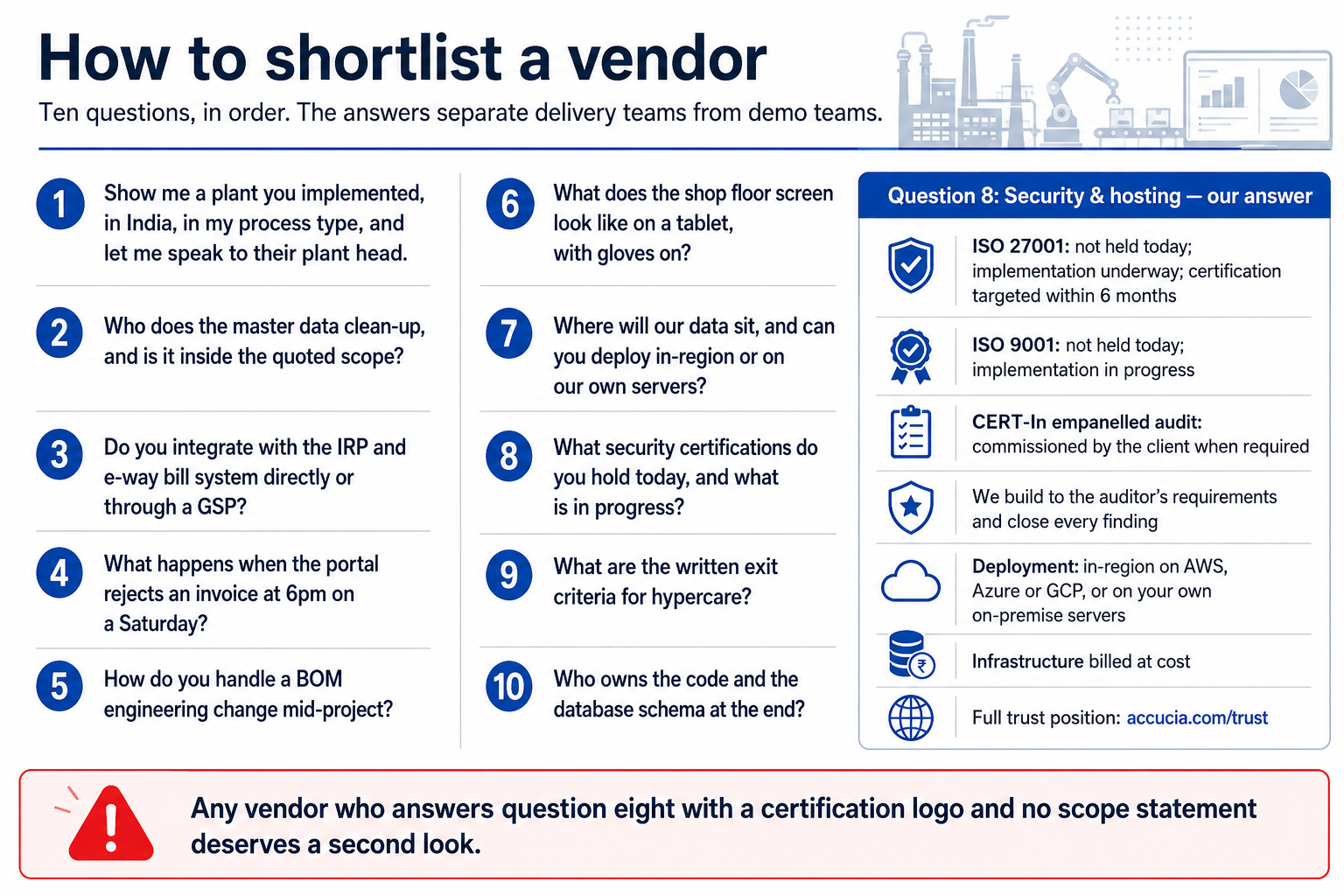
Ask these ten questions in order.
The answers quickly separate delivery teams from demo teams.
1. Show me a plant you implemented in India, in my process type?
2. Who owns the master data clean-up?
3. Do you integrate directly with the IRP and e-way bill system?
4. What happens when the portal rejects an invoice at 6 PM on a Saturday?
5. How do you handle a BOM engineering change in the middle of the project?
6. What does the shop-floor screen look like on a tablet while an operator is wearing gloves?
7. Where will our data sit?
8. What security certifications do you hold today?
9. What are the written exit criteria for hypercare?
10. Who owns the code and the database schema at the end?
Our Security Position
Accucia does not currently hold ISO 27001 certification.
Implementation is underway and certification is targeted within six months.
ISO 9001 is also in progress.
Where a CERT-In empanelled security audit is required, the client commissions the audit.
We build to the auditor's requirements and implement findings until they are closed.
Deployments can run in-region on AWS, Azure or GCP, or on the client's own on-premise servers.
Any vendor who answers a security question with only a certification logo and no scope statement deserves a second look.
Accucia's View
Our position costs us business regularly:
Most Indian mid-market plants should not replace their ERP this year.
Spend six weeks fixing the item master and bills of material.
Put a simple capture layer on the shop floor.
Connect dispatch properly to e-invoicing and e-way bills.
Then decide whether the core ERP is actually the constraint.
In roughly half the assessments we run, the honest recommendation is an integration project rather than a full replacement.
There is also a valid counter-position.
Once your item master cannot express traceability, no amount of clever integration can rescue the underlying system.
Every month of delay can make the eventual migration larger.
That is a structural decision, not simply a financial one.
Work out which side of that line you are on before you take a single ERP demo.
Frequently Asked Questions
What is manufacturing ERP software?
Manufacturing ERP software is one system that plans production, calculates material requirements, tracks inventory and batches, records quality decisions, schedules plant maintenance, manages purchase orders and produces dispatch documents.
In India, it also needs to support GST e-invoices and e-way bills without staff re-entering the same data.
What does manufacturing ERP software cost in India?
Cost is primarily driven by:
- Modules included in phase one
- Number of plants
- Number of legal entities
- Legacy system integrations
- Historical data migration
- Cloud versus on-premise hosting
User count is often one of the smaller cost drivers.
How long does a manufacturing ERP rollout take?
A single-unit plant with reasonably clean master data typically takes around 12 to 16 weeks from discovery through hypercare.
Multi-unit deployments may add around four to six weeks per additional plant once the first rollout template is stable.
Poor master data is one of the most common causes of delay.
Which modules should phase one include?
Start with:
- Inventory and batch traceability
- Purchase and vendor management
- Dispatch and compliance
These modules create the clean transaction data needed by production planning, MRP, quality and maintenance.
Adding those later can reduce rework.
Does manufacturing ERP software need to handle GST e-invoicing?
Yes, above the applicable threshold.
E-invoicing applies to taxpayers with aggregate turnover exceeding ₹5 crore in any preceding financial year from 2017–18 onwards, effective from 1 August 2023.
Taxpayers with turnover of ₹10 crore and above must also report invoices within 30 days.
What is the e-way bill threshold and validity in India?
An e-way bill is required where consignment value exceeds ₹50,000 under Rule 138 of the CGST Rules.
Validity is one day for every 200 km for regular cargo and one day for every 20 km for over-dimensional cargo.
Should we replace our existing ERP or extend it?
Extend when finance and inventory data are accurate and the real gap is shop-floor visibility, capture or reporting.
Replace when the item master cannot carry required traceability or when the system cannot produce compliant e-invoices.
In many assessments, extension and integration are the better first step.
Can manufacturing ERP run on our own servers?
Yes.
Accucia can deploy in-region on AWS, Azure or GCP, or on the client's own on-premise servers.
Is Accucia ISO 27001 certified?
No.
Accucia does not hold ISO 27001 certification today.
Implementation is underway and certification is targeted within six months.
ISO 9001 is also in progress.
What is the biggest reason manufacturing ERP rollouts fail?
Master data.
Duplicate item codes, inconsistent units of measure and outdated bills of material create more problems than software configuration itself.
Plants that clean the item master before implementation are far more likely to finish on schedule.
Final Takeaway
Do not start by asking:
“Which ERP should we buy?”
Start by asking:
“What decision on our shop floor is currently being made from incomplete, duplicated or late information?”
Fix that workflow first.
Clean the data underneath it.
Connect compliance properly.
Prove one line.
Then expand.
And only replace the ERP when the system itself is genuinely the constraint.
Choose proof over promises.