Maharashtra's AI Policy: What It Actually Means for Department Heads
Quick Answer
Maharashtra's AI Policy 2026, approved by the state cabinet on 29 April 2026, sets a target of at least one AI use case in every administrative department, or 50 across the state, plus an annual AI readiness audit of all departments. In practice, government departments need AI citizen channels, transfer-proof knowledge systems, live dashboards and Marathi-first interfaces. By Mr. Sumeet Katariya, CEO, Accucia Softwares Pvt. Ltd.
Policy documents arrive in departments as PDFs and leave as questions. What are we supposed to do, with this budget, before the next review?
Maharashtra now has an answer on paper. The state cabinet approved the Maharashtra AI Policy 2026 on 29 April 2026, and the Electronics, Information Technology and Artificial Intelligence Department published it in May 2026 under Government Resolution POLICY-2026/C.R.64/IT. It stays in force for a minimum of five years from issue, or until a new policy replaces it. The coverage went to the money: over Rs 10,000 crore of expected investment by 2031, more than 1.5 lakh jobs, six AI centres of excellence, five AI innovation cities and 2,000 GPUs for shared compute.
None of that is your problem if you run a department. Four much smaller provisions are. What follows is written from the delivery side, from building and running software inside a government organisation in Maharashtra.
What the Maharashtra AI policy asks of government departments
The document sets a departmental adoption target, not just a state investment target. Translated from the Marathi original, the objective is to implement at least one artificial intelligence use case in every administrative department in Maharashtra, or collectively develop at least 50 AI use cases at state level.
Then it adds a check: an artificial intelligence readiness audit will be carried out annually in all administrative departments of the state.
Section 6.2 says the state will encourage departments to adopt AI in citizen service delivery, grievance redressal, inspections and compliance, decision support, forecasting and planning, records management, and workflow automation. The same section provides for selective pilots of agentic AI systems to automate multi-level, rule-based, high-volume government workflows.
And it sets conditions. Privacy, data security and data sovereignty are described as integral to the creation and collection of datasets. Marathi and tribal dialect datasets are named as a priority, to support voice interfaces, conversational AI, automated grievance redressal and digital public services.
The working brief:
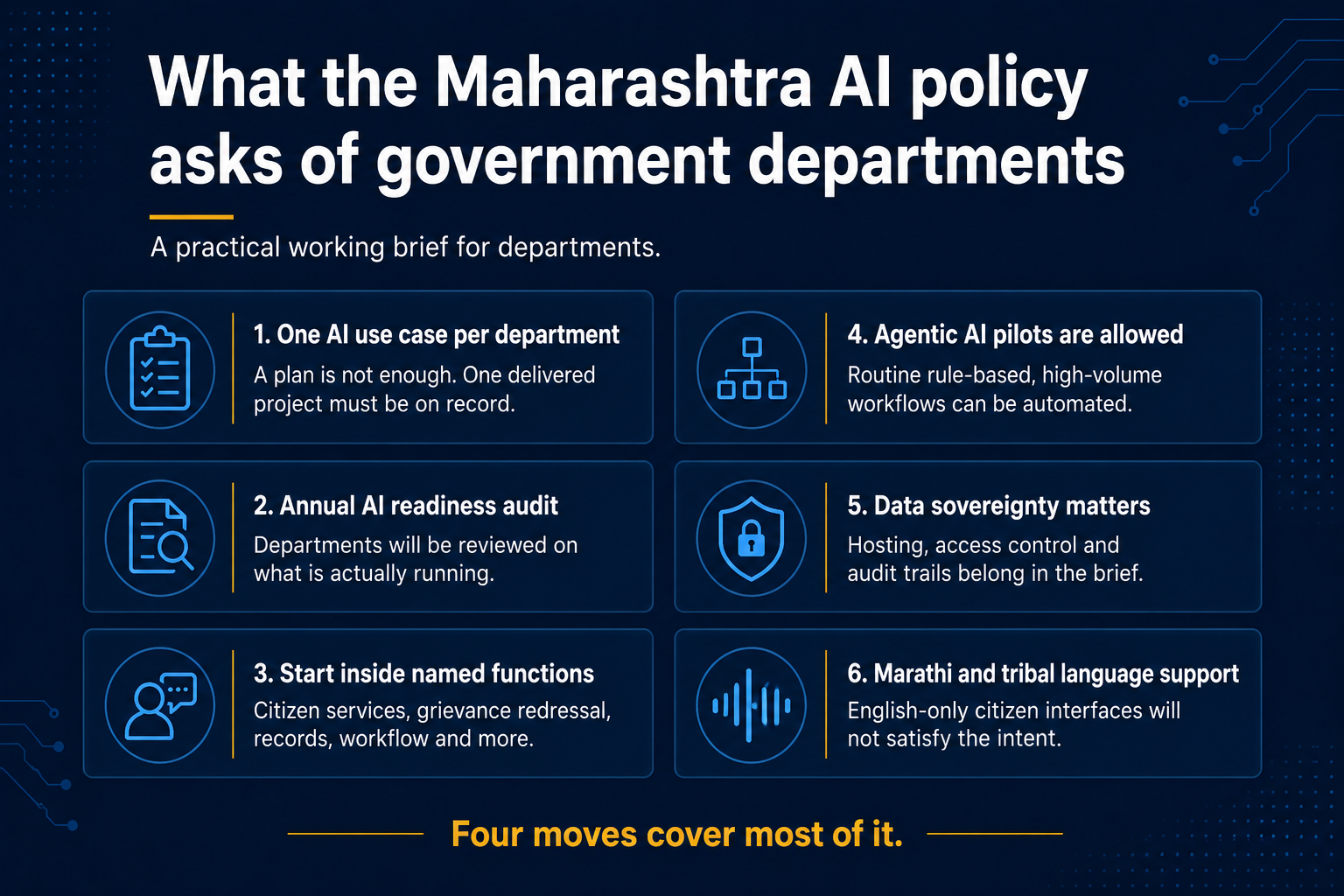
One AI use case per administrative department, or 50 across the state
You need one delivered project on record. A plan will not count
Annual AI readiness audit in all administrative departments
Someone asks what you have running, every year
AI named for seven functions, from citizen service delivery to workflow automation
Your first use case should sit inside one of them
Selective pilots of agentic AI for rule-based, high-volume workflows
Automating routine file movement is sanctioned, not experimental
Data sovereignty integral to dataset creation
Hosting, access control and audit trails belong in the brief
Marathi and tribal dialect datasets for voice and conversational AI
An English-only portal will not satisfy the intent
Officer capacity building with YASHADA, MCAT and iGOT
Training is funded and expected
Four moves cover most of it.
Move 1: Put routine citizen interactions on AI channels
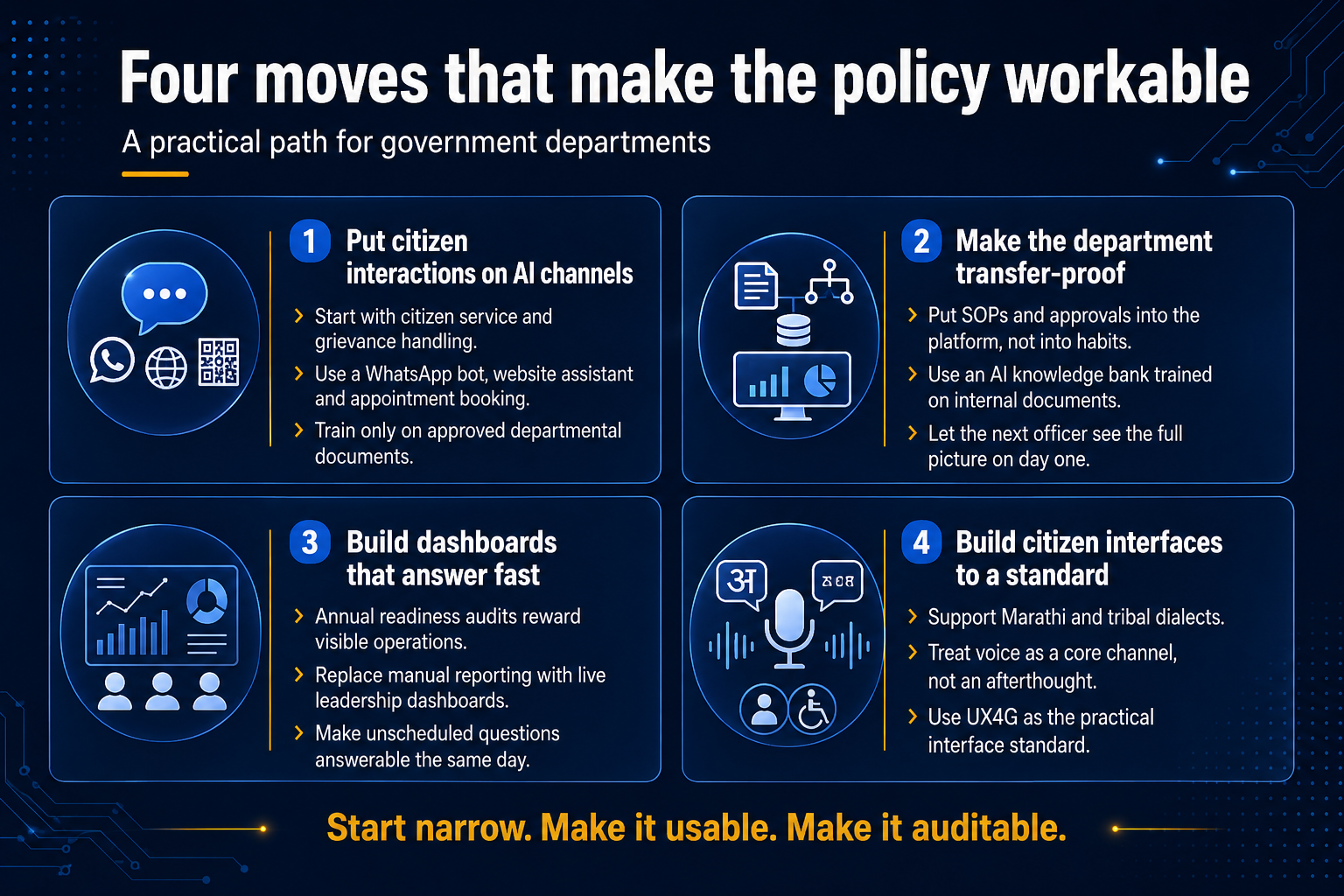
Start here. Citizens feel it first, and it maps to two named functions, citizen service delivery and grievance redressal.
The shape is a WhatsApp bot and a website assistant handling status enquiries, document guidance and appointment booking. One design rule matters most: train the assistant only on approved departmental documents. Not the open web, not an officer's notes. If an answer cannot be traced to a signed-off document, the assistant should say so and route the citizen to a human.
We run this pattern for a government organisation in Maharashtra, a WhatsApp citizen-service bot alongside a website assistant restricted to approved internal content. The same logic applies to physical queues. One deployment replaced walk-ins with a QR appointment flow and took daily footfall from over 2,000 to under 700, delivered in under 45 days.
Move 2: Make the department transfer-proof
Every department head knows this failure. A capable officer is transferred, the digital programme stalls, because the knowledge left with the officer.
The policy's answer is officer capacity building through YASHADA, MCAT and the iGOT platform. That helps, but training a person leaves the knowledge in the person.
The systems answer is to put it in the platform. SOPs and approval workflows built into the software rather than into habits. An AI knowledge bank trained on internal documents, so routine questions get answered without occupying senior staff. One deployment we delivered pairs a watch, learn, assess and certify workflow with a chatbot trained on internal SOPs, which freed experienced officers from answering the same questions on rotation.
The test: the incoming officer opens a dashboard on day one and sees the true state of operations without asking anyone.
Move 3: Dashboards that work the day the Minister asks
The annual readiness audit changes the economics of reporting. A department that assembles its numbers by email will spend a fortnight preparing for an audit it could pass in an afternoon.
Live leadership dashboards make the work visible upward continuously. We run this across a connected portfolio of projects for a government organisation in Maharashtra. The chart is the least of it. What matters is that an unscheduled question gets a same-day answer, with the records one click away.
Move 4: Build citizen interfaces to a standard
Be accurate here. The AI Policy 2026 does not name UX4G. What it requires is citizen-facing AI in Marathi and tribal dialects, with voice as a first-class channel rather than an accessibility footnote.
UX4G is the standard that already exists for the interface layer. In the words of the Digital India programme, "User Experience for Government Applications (UX4G) is an initiative under the Digital India Programme, being implemented by the National e-Governance Division (NeGD) under the Ministry of Electronics and Information Technology (MeitY), Government of India, to render digital applications more user-friendly and make the experience enjoyable for end-users."
It is published and free. Building to it costs almost nothing at design time and is expensive to retrofit.
The delivery discipline that decides everything
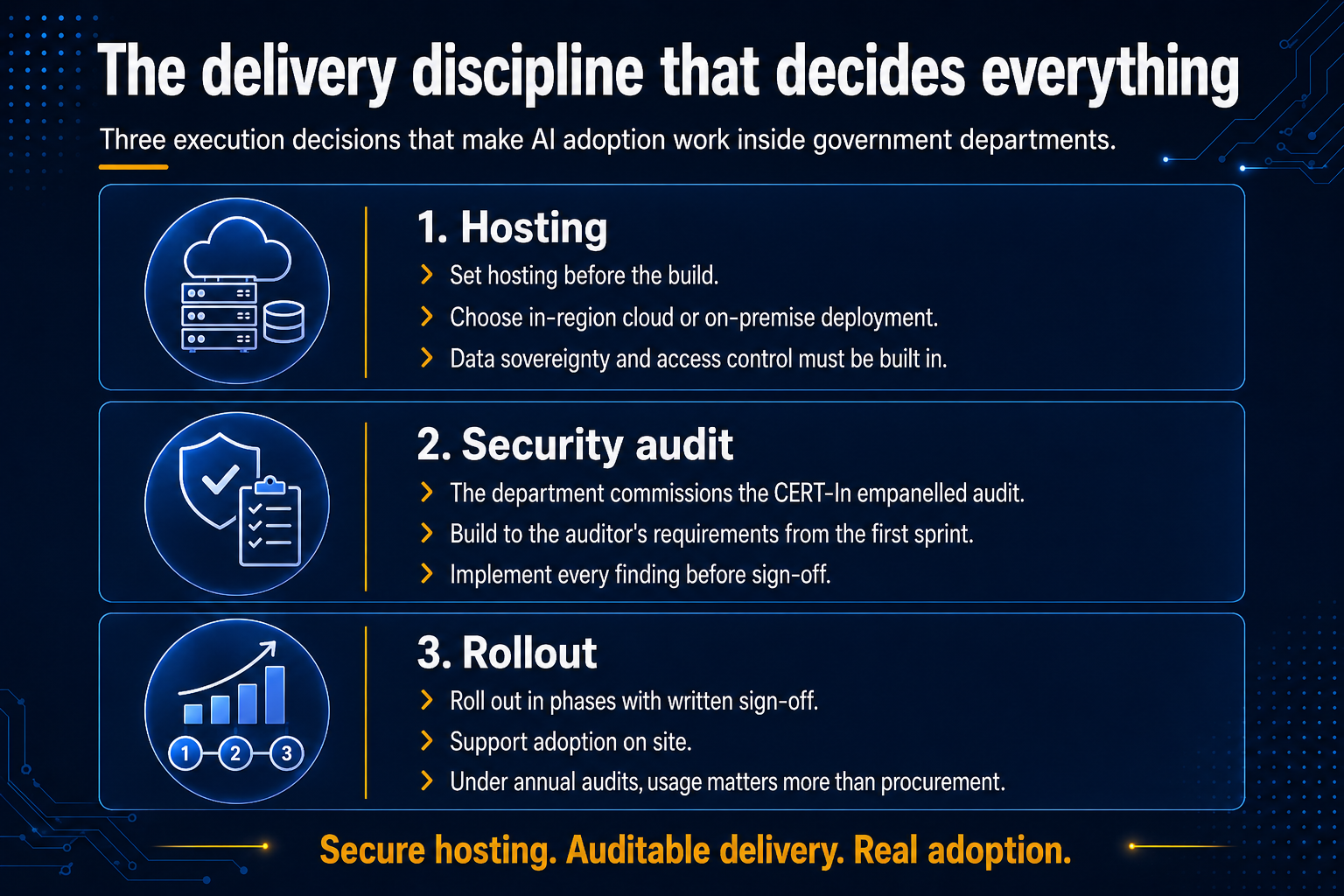
Hosting. Because the policy treats data sovereignty as integral, settle hosting before the build. Accucia deploys in-region on request across AWS, Azure or GCP, region chosen to meet the department's requirement and infrastructure billed to the client at cost, or on the department's own on-premise servers.
Security audit. The department commissions the CERT-In empanelled audit. We do not hold that empanelment ourselves. We build to the auditor's requirements from the first sprint and implement every finding. On certifications we are equally plain: Accucia does not hold ISO 27001 or ISO 9001. Implementation work for both is underway, and we will not claim either until a certificate is actually issued.
Rollout. Phased, with written sign-off at each stage, and on-site support through adoption. A department cannot pause service delivery for a migration. Software delivered but unused was an invisible failure. Under an annual readiness audit it is a visible one, because the audit asks about usage, not procurement.
Accucia's view
Compliance here will be settled by demonstration, not documentation. Departments that treat the policy as a drafting exercise will fail the first audit with a very tidy file.
Our position, including where it costs us work: if your core records are still on paper or in disconnected spreadsheets, do not commission an AI project this year. Commission the digitisation. An assistant trained on an incomplete record set gives confident wrong answers to citizens, which is worse than the counter queue you already have.
We would also turn down a department-wide AI platform as a first project. The policy asks for one use case, not a programme. Pick the most visible citizen friction, attach a number to it, deliver inside a single administrative season, then let the audit find something real. Accucia has built this way since 2018, eight years, and the departments that move fastest started narrow.
Cost depends on the number of workflows, the state of your records, integration with departmental systems, hosting choice and the audit regime. We set out how we scope, phase and sign off that work at https://www.accucia.com/how-we-work. Our public sector practice sits at https://www.accucia.com/services/ai-for-government, and the readiness review the policy now makes an annual event is described at https://www.accucia.com/ai-readiness-audit.
Frequently Asked Questions
What does Maharashtra's AI policy mean for government departments in practice?
Maharashtra's AI Policy 2026 sets a target of at least one AI use case in every administrative department, or 50 across the state, and an annual AI readiness audit. In practice departments need one delivered project on record, in a function the policy names, hosted and access-controlled to state standards.
Which functions does the Maharashtra AI Policy 2026 name for AI adoption?
The policy names citizen service delivery, grievance redressal, inspections and compliance, decision support, forecasting and planning, records management, and workflow automation. It also provides for selective pilots of agentic AI systems in multi-level, rule-based, high-volume government workflows. A department's first use case should sit inside one of these areas.
What does a transfer-proof government department mean?
It means the department's operating knowledge lives in the system rather than in individual officers. SOPs and approval workflows are built into the platform, an AI knowledge bank is trained on internal documents, and an incoming officer opens a dashboard on day one and sees the full state of operations.
Does the Maharashtra AI policy require UX4G compliance?
No. The AI Policy 2026 does not name UX4G. It does call for Marathi and tribal dialect datasets so voice interfaces and conversational AI work for citizens. UX4G is the separate national design system run by NeGD under MeitY, and it remains the practical standard for government interfaces.
Turn policy into measurable AI delivery.