
IT Staff Augmentation vs Fixed Scope: How to Choose in 2026
Quick Answer
IT staff augmentation services place vendor engineers inside your team, on your backlog, under your management. The model beats a fixed scope project when you have a strong internal technical lead and a roadmap that keeps moving. Without that lead, the lower day rate gets eaten by rework, idle time and management hours nobody invoiced you for. By Mr. Sanjay Katariya, Vice President, AI & Digital Solutions, Accucia Softwares Pvt. Ltd.
The one condition that decides the model
Choose augmentation only if someone on your payroll can run engineers day to day. That is the condition. Everything else is preference.
Across eight years, 730+ projects and 500+ clients worldwide, the pattern is consistent. Where the client had a capable tech lead, augmentation was cheaper and faster than a fixed scope build. Where there was a product owner but no technical manager, the same contract went sideways by month two. Tickets arrived half specified, engineers waited, and the client paid for the waiting.
Day rate is the number people compare, and it is the wrong number. The right one is day rate plus the hours your own people spend directing the work, and that second figure never appears on an invoice.
The three models side by side
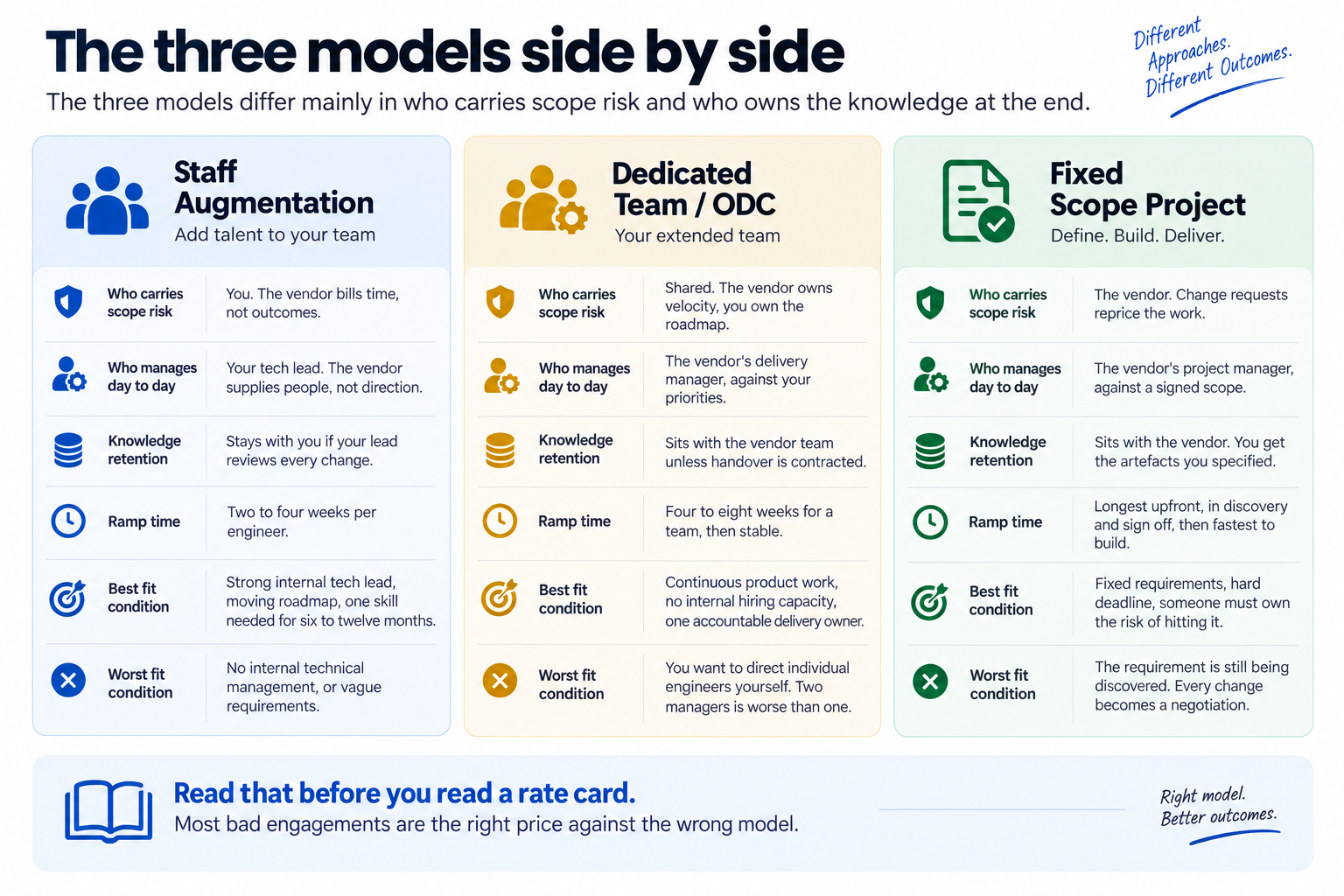
The three models differ mainly in who carries scope risk and who owns the knowledge at the end.
Staff Augmentation
Who carries scope risk: You. The vendor bills time, not outcomes.
Who manages day to day: Your tech lead. The vendor supplies people, not direction.
Knowledge retention: Stays with you if your lead reviews every change.
Ramp time: Two to four weeks per engineer.
Best fit condition: Strong internal tech lead, moving roadmap, one skill needed for six to twelve months.
Worst fit condition: No internal technical management, or vague requirements.
Dedicated Team / ODC
Who carries scope risk: Shared. The vendor owns velocity, you own the roadmap.
Who manages day to day: The vendor's delivery manager, against your priorities.
Knowledge retention: Sits with the vendor team unless handover is contracted.
Ramp time: Four to eight weeks for a team, then stable.
Best fit condition: Continuous product work, no internal hiring capacity, one accountable delivery owner.
Worst fit condition: You want to direct individual engineers yourself. Two managers is worse than one.
Fixed Scope Project
Who carries scope risk: The vendor. Change requests reprice the work.
Who manages day to day: The vendor's project manager, against a signed scope.
Knowledge retention: Sits with the vendor. You get the artefacts you specified.
Ramp time: Longest upfront, in discovery and sign off, then fastest to build.
Best fit condition: Fixed requirements, hard deadline, someone must own the risk of hitting it.
Worst fit condition: The requirement is still being discovered. Every change becomes a negotiation.
Read that before you read a rate card. Most bad engagements are the right price against the wrong model.
When staff augmentation wins
Four situations, narrower than most vendor sites admit.
You have a strong internal tech lead. Someone who writes tickets an outsider can act on, reviews pull requests within a day, and decides without a committee. If you have that, augmentation gives you capacity without a hiring cycle.
The roadmap changes often. If priorities shift every two or three sprints, a fixed scope contract becomes a change request queue. You spend more time repricing than building.
You need one specific skill for six to twelve months. A payments integration, a data migration, an embedded firmware bridge. Hiring permanently for a temporary need is how teams carry salary they cannot justify in year two.
You are protecting institutional knowledge in house. If the system is the business, you want your people reviewing every change and the architecture decisions staying on your side. A fixed scope build, by design, does not do that.
When it quietly costs more
Three cases, and the loss is rarely visible in month one.
No internal technical management. Without a lead, engineers work on whatever looks busy. You get output, not progress. We have watched clients spend three months on features that were later deleted, at a day rate they were pleased with.
Requirements are still being discovered. Augmentation charges you for the discovery, at engineering rates, with no fixed end. A short paid discovery followed by a fixed scope build is usually cheaper.
A genuinely fixed deliverable with a hard deadline. A regulator's date, a trade show, a go live tied to a financial year. Somebody has to own the risk of missing it, and under augmentation that somebody is you. If you would rather it were the vendor, buy a fixed scope project and accept the change control that comes with it.
Our note on custom build versus off the shelf software applies the same logic on the product side.
The management cost nobody prices
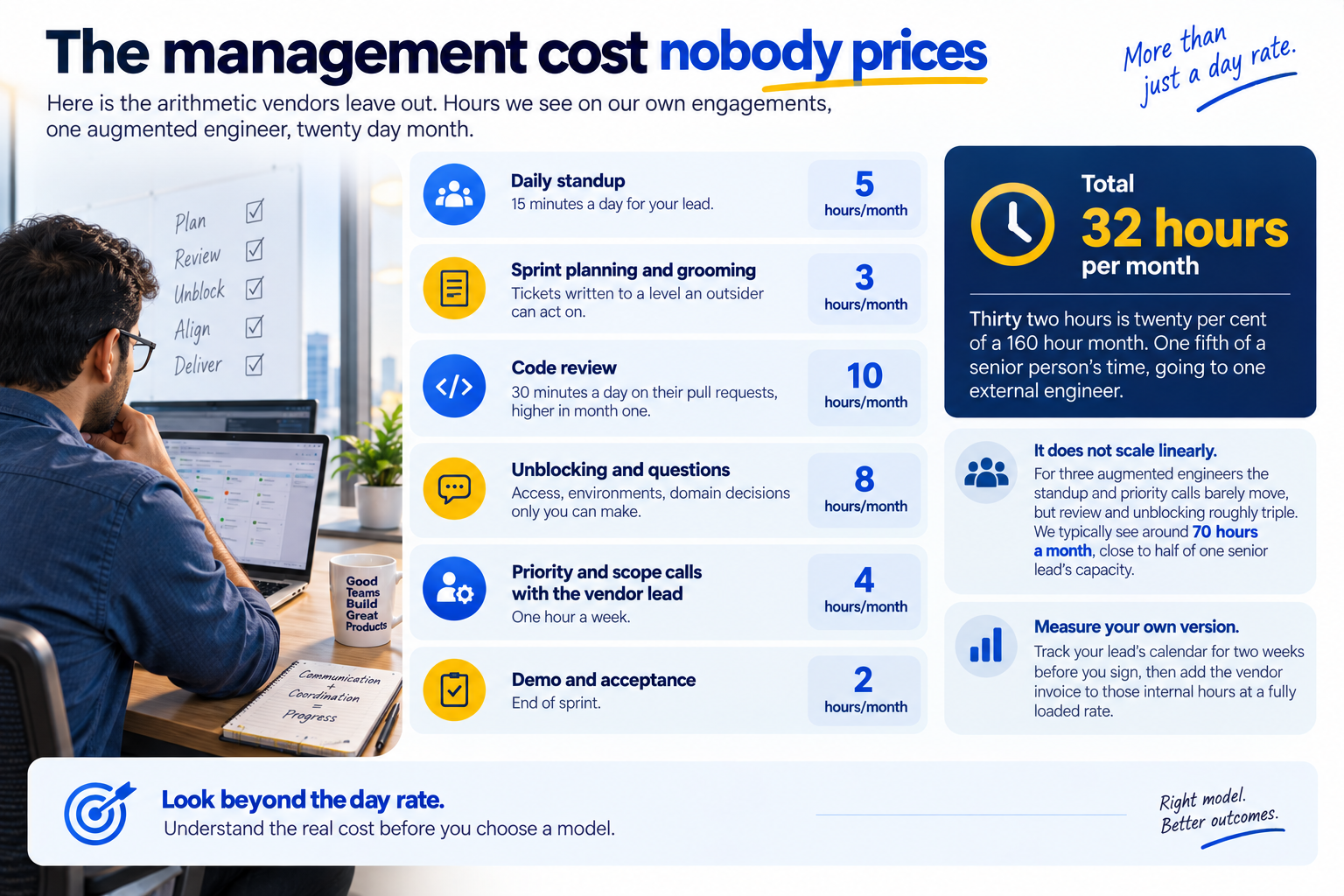
Here is the arithmetic vendors leave out. Hours we see on our own engagements, one augmented engineer, twenty day month.
Daily standup
What you are actually counting: 15 minutes a day for your lead.
Hours per month, one engineer: 5 hours.
Sprint planning and grooming
What you are actually counting: Tickets written to a level an outsider can act on.
Hours per month, one engineer: 3 hours.
Code review
What you are actually counting: 30 minutes a day on their pull requests, higher in month one.
Hours per month, one engineer: 10 hours.
Unblocking and questions
What you are actually counting: Access, environments, domain decisions only you can make.
Hours per month, one engineer: 8 hours.
Priority and scope calls with the vendor lead
What you are actually counting: One hour a week.
Hours per month, one engineer: 4 hours.
Demo and acceptance
What you are actually counting: End of sprint.
Hours per month, one engineer: 2 hours.
Total: 32 hours per month
Thirty two hours is twenty per cent of a 160 hour month. One fifth of a senior person's time, going to one external engineer.
It does not scale linearly. For three augmented engineers the standup and priority calls barely move, but review and unblocking roughly triple. We typically see around 70 hours a month, close to half of one senior lead's capacity.
Measure your own version. Track your lead's calendar for two weeks before you sign, then add the vendor invoice to those internal hours at a fully loaded rate. For what drives price in each model, see how we work.
Ramp time, and how to shorten it
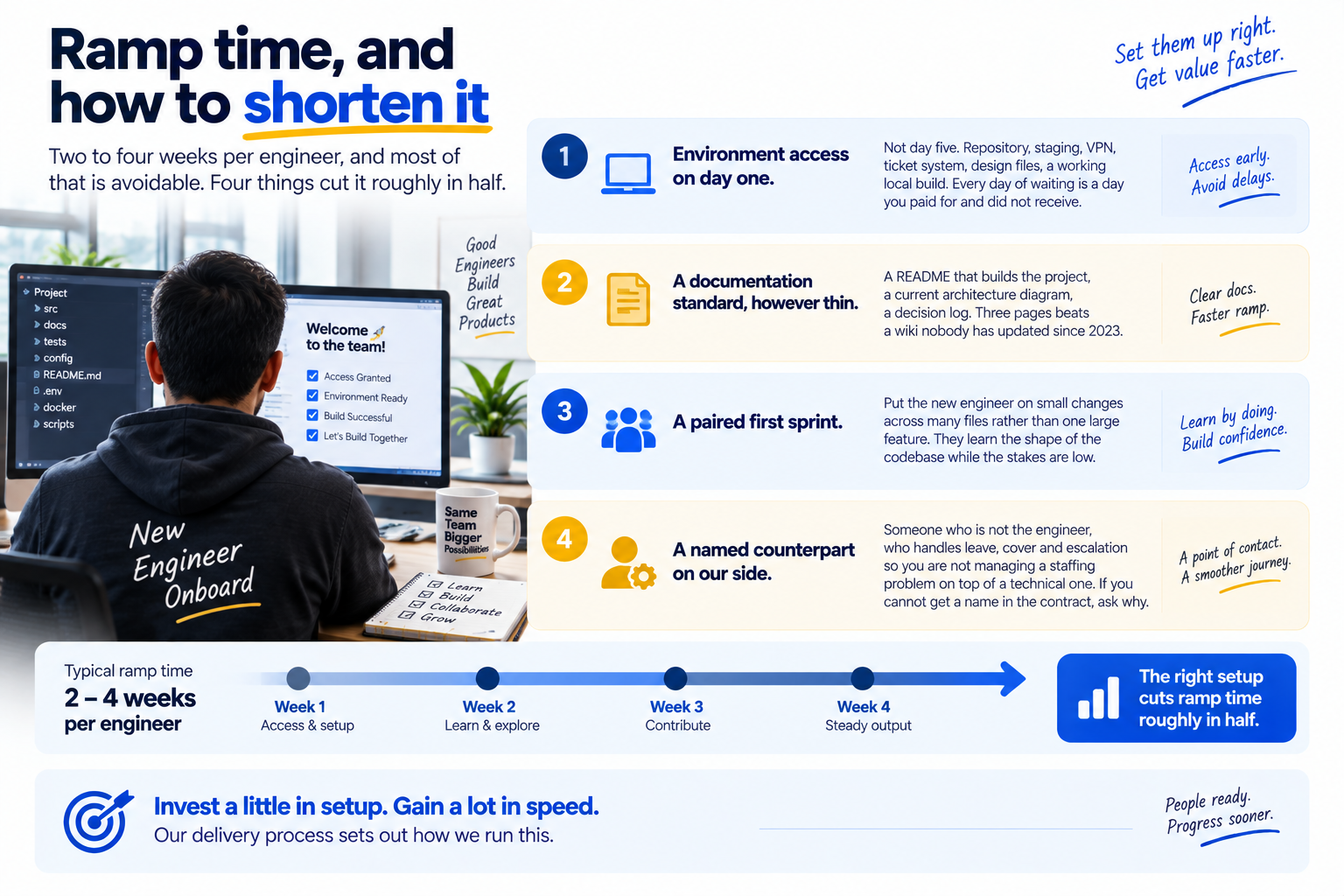
Two to four weeks per engineer, and most of that is avoidable. Four things cut it roughly in half.
Environment access on day one. Not day five. Repository, staging, VPN, ticket system, design files, a working local build. Every day of waiting is a day you paid for and did not receive.
A documentation standard, however thin. A README that builds the project, a current architecture diagram, a decision log. Three pages beats a wiki nobody has updated since 2023.
A paired first sprint. Put the new engineer on small changes across many files rather than one large feature. They learn the shape of the codebase while the stakes are low.
A named counterpart on our side. Someone who is not the engineer, who handles leave, cover and escalation so you are not managing a staffing problem on top of a technical one. If you cannot get a name in the contract, ask why. Our delivery process sets out how we run this.
Retention and continuity when an engineer rotates off
People leave, and the numbers are public. For the quarter ended 30 June 2026, TCS reported last twelve month IT services attrition of 13.6 per cent across a workforce of 593,798, and Infosys reported 13.0 per cent voluntary attrition across 328,062 employees.
Any vendor promising you zero rotation is either new or not telling you the truth. So contract for it instead of hoping.
Put four things in writing.
A minimum overlap period: The outgoing engineer works alongside the replacement rather than sending a document.
Your repository and ticket system: All work lands in your systems, never the vendor's.
A replacement obligation: Define the replacement window and specify no ramp charge for the new person.
A named backup: Someone who has already touched the codebase.
If a single person leaving would hurt you, that is a design fault in the engagement, not bad luck.
Commercials, answered honestly
Ask for these in writing, from us or anyone else.
Notice and minimum term
Most augmentation runs on a one to three month minimum, then 30 days notice either way. We agree the term per engagement and put it in the contract.
Be wary of long lock ins on a model sold to you as flexible.
Client non-solicit
About your clients, one way, and fixed at 24 months.
We sign your non-solicitation agreement as written and we do not negotiate it down. For the duration of our work together and for 24 months afterwards, we will not solicit, accept or service work from any client you introduce us to.
Staff non-solicit
About people, and mutual.
We also carry a mutual staff non-solicit, set at either 12 or 24 months depending on what the two parties agree for that engagement.
It runs both ways: we do not approach your people, you do not approach ours. Whatever term we agree goes into the contract in writing, and we hold to it.
We publish both terms because most delivery partners will not put a number on either. If a vendor protects its own staff from you but leaves yours exposed, the clause is not about fairness.
Under Section 27 of the Indian Contract Act 1872, every agreement restraining someone from exercising a lawful profession, trade or business is void to that extent, so a broad restraint on an individual engineer is not the protection either side thinks it is. Draft it company to company.
Hosting and data
We deploy in region on request, on AWS, Azure or Google Cloud Platform, with the region chosen to meet your requirement, or onto your own on premise servers.
Infrastructure is billed to you at cost.
Sub-processors
Named in the agreement, and we tell you before that list changes.
Today they are AWS, Azure, GCP or your own on premise environment, plus error and performance monitoring, analytics and product telemetry, and helpdesk tooling.
UK GDPR Article 28(2) states that a processor "shall not engage another processor without prior specific or general written authorisation of the controller".
Hold every vendor to that standard, whatever your jurisdiction.
Certifications, stated plainly
Accucia is implementing an ISO 27001 information security management system. An auditor has been appointed and certification is targeted for Q1 2027.
We are not certified today and we will not claim otherwise.
We will publish the certificate number and scope on this page the day it is issued.
ISO 9001 is also in progress and not held.
We are not CERT-In empanelled: where an empanelled audit is required, you commission it, we build to the auditor's requirements and implement every finding.
ISO/IEC 27001:2022 is the current edition, published in October 2022, so check the year on any certificate you are shown.
Our security and compliance position is public for the same reason.
Rate card structure
Rates move by seniority and scarcity, not by how hard you negotiate on the first call.
Engineer
What you are actually buying: Execution against written tickets.
What moves the band: Stack, and how much review your lead must do.
Mid-level engineer
What you are actually buying: Feature ownership, light supervision.
What moves the band: Domain familiarity, testing discipline.
Senior engineer
What you are actually buying: Design decisions, review, mentoring.
What moves the band: Depth in your stack, production on call experience.
Tech lead or architect
What you are actually buying: System design, estimates you can plan against.
What moves the band: Breadth across integrations, client facing ability.
Specialist — AI/ML, DevOps, security
What you are actually buying: A skill you cannot hire quickly.
What moves the band: Market scarcity, regulated domain experience.
Bands only, deliberately. Anyone quoting a firm day rate before seeing your codebase is guessing.
How we run IT staff augmentation services
We are in Pune, India, founded in 2018, with eight years of delivery across 25+ industry verticals and products of our own in production, including ElevatorPlus with 2,000+ users.
We staff from that bench, not from a recruitment pipeline started after you sign.
For agencies and consultancies reselling capacity under their own brand, the terms, escalation path and non-solicit position sit on our partner page.
Accucia's view
We turn augmentation work away, and it costs us.
When a prospect has no internal technical lead, augmentation is the wrong sale even though it is the better recurring revenue for us.
We say so, and we recommend either a fixed scope build where we carry the risk, or a dedicated team with our own delivery manager.
Some of those conversations end with the client buying augmentation from someone else. That is fine. The alternative is a bad six months and a reference we cannot use.
Second position, less popular.
Augmentation is not a way to reduce management effort. It is a way to add capacity to management you already have.
Any vendor telling you otherwise is selling you a project and calling it a resource.
Third.
Ask every vendor, including us, what they do not hold. The answer tells you more than the case studies do.
Start a conversation and ask us the awkward questions first.
Frequently Asked Questions
What is IT staff augmentation?
IT staff augmentation is a model where vendor engineers join your team and work on your backlog under your management.
You direct the work and carry scope risk. The vendor supplies vetted people, cover and replacement.
You buy capacity and skills, not a fixed price deliverable.
What is the difference between staff augmentation and outsourcing?
Under staff augmentation you manage the engineers and own the outcome.
Under outsourcing, or fixed scope delivery, the vendor manages the work and owns delivery against a signed scope.
The practical test: whoever writes the tickets and sets priorities each week is running the project.
When is a fixed scope project cheaper?
When requirements are genuinely settled, there is a hard deadline, and you want the vendor to carry the risk of hitting it.
The fixed price then includes management you would otherwise supply yourself.
It stops being cheaper the moment requirements change, because each change is repriced.
Who manages augmented engineers day to day?
You do, through your own technical lead.
The vendor supplies people, cover and escalation, not direction.
If nobody on your payroll can write actionable tickets and review pull requests within a day, augmentation underperforms whatever the day rate.
Choose a dedicated team or fixed scope project instead.
How long does ramp up take?
Expect two to four weeks per engineer to useful output.
You can cut that roughly in half with environment access on day one, a README that builds the project, a current architecture diagram, and a paired first sprint on small changes rather than one large feature.
What notice period is normal?
Most augmentation contracts run a one to three month minimum term, then 30 days notice either way.
We agree the exact term per engagement and record it in writing.
Treat long lock in periods with caution on a model sold on the ability to scale up and down.
What does a fair non-solicit look like?
Two clauses, not one.
Our client non-solicit runs one way and is fixed at 24 months: we will not solicit, accept or service work from any client you introduce us to.
Our staff non-solicit is mutual, at 12 or 24 months agreed per engagement, always in writing.
We publish both.
Can a non-solicit clause be enforced in India?
Section 27 of the Indian Contract Act 1872 makes every agreement void to the extent it restrains someone from exercising a lawful profession, trade or business.
That is why sensible clauses bind the two companies to each other rather than restraining an individual engineer's right to work.
What happens when an augmented engineer rotates off?
Contract for it in advance.
Insist on a minimum overlap so outgoing and incoming engineers work together, a replacement obligation with a defined window, no ramp charge for the new person, and a named backup who already knows the codebase.
All work should live in your repository.
Where is our data and code hosted?
We deploy in region on request, on AWS, Azure or Google Cloud Platform, with the region chosen to meet your requirement, or onto your own on premise servers.
Infrastructure is billed at cost.
Sub-processors are named in the agreement and we tell you before that list changes.
Do you hold ISO 27001 or CERT-In empanelment?
No.
ISO 27001 implementation is underway, an auditor has been appointed and certification is targeted for Q1 2027.
ISO 9001 is in progress. Neither is held today.
We are not CERT-In empanelled.
Where an empanelled audit is required, you commission it, we build to the auditor's requirements and implement every finding.
How much does IT staff augmentation cost?
Rates move with seniority, stack scarcity and how much review your team must supply, so any figure quoted before someone has seen your codebase is a guess.
The cost drivers for each engagement model are set out in full on the Accucia how-we-work page.
Cut Ramp Time. Get Productive Faster.