
ISO 27001 Cost in India: Audit Days and Timeline, 2026
Quick Answer
ISO 27001 certification cost in India sits mostly in internal effort. Audit fees are the smaller line. An accredited certification body bills audit days set by ISO/IEC 27006-1, roughly 10 on-site days for a 50 person scope. Your own engineering and management hours are usually the larger number. Expect nine to twelve months from decision to certificate. By Mr. Sumeet Katariya, CEO, Accucia Softwares Pvt. Ltd.
Most published ISO 27001 cost figures quote only the certification body's fee. That is usually the smallest line in the total.
We are writing this while our own implementation is running, which is a different vantage point from desk research. One rule here: no rupee bands we cannot evidence. Certification body day rates in India are quoted privately, so where a figure is published you get it, and where none is, you get the driver.
ISO 27001 Certification Cost in India: The Five Lines
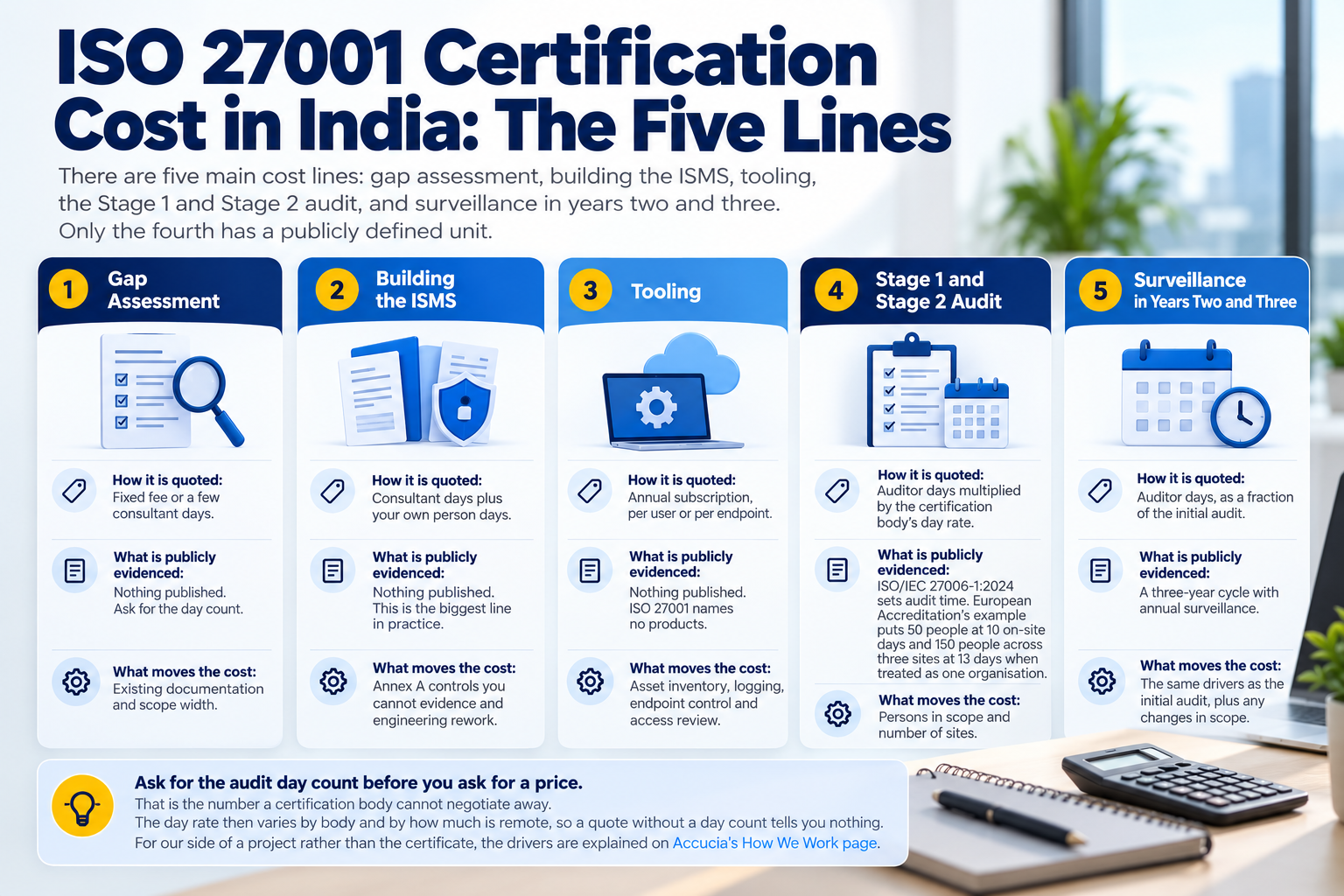
There are five main cost lines: gap assessment, building the ISMS, tooling, the Stage 1 and Stage 2 audit, and surveillance in years two and three.
Only the fourth has a publicly defined unit.
1. Gap Assessment
How it is quoted: Fixed fee or a few consultant days.
What is publicly evidenced: Nothing published. Ask for the day count.
What moves the cost: Existing documentation and scope width.
2. Building the ISMS
How it is quoted: Consultant days plus your own person days.
What is publicly evidenced: Nothing published. This is the biggest line in practice.
What moves the cost: Annex A controls you cannot evidence and engineering rework.
3. Tooling
How it is quoted: Annual subscription, per user or per endpoint.
What is publicly evidenced: Nothing published. ISO 27001 names no products.
What moves the cost: Asset inventory, logging, endpoint control and access review.
4. Stage 1 and Stage 2 Audit
How it is quoted: Auditor days multiplied by the certification body's day rate.
What is publicly evidenced: ISO/IEC 27006-1:2024 sets audit time. European Accreditation's example puts 50 people at 10 on-site days and 150 people across three sites at 13 days when treated as one organisation.
What moves the cost: Persons in scope and number of sites.
5. Surveillance in Years Two and Three
How it is quoted: Auditor days, as a fraction of the initial audit.
What is publicly evidenced: A three-year cycle with annual surveillance.
What moves the cost: The same drivers as the initial audit, plus any changes in scope.
Ask for the audit day count before you ask for a price. That is the number a certification body cannot negotiate away.
The day rate then varies by body and by how much is remote, so a quote without a day count tells you nothing.
For our side of a project rather than the certificate, the drivers are explained on Accucia's How We Work page.
The Line Nobody Quotes: Your Own People's Time
The largest cost is engineering and management hours, and no consultant puts it in a proposal because it is not their revenue.
ISO/IEC 27001:2022 Annex A contains 93 controls in four themes. Every one of the 93 has to be decided on and justified in your Statement of Applicability, whether you apply it or exclude it.
That is a fixed floor of work at any company size.
This is the model we plan against for a 60 to 150 person software company. We use it to size our own programme. It has not been benchmarked against industry data.
Scoping and gap assessment, with your team in the room: 5 to 10 person days.
Risk assessment and risk treatment plan: 10 to 15 person days.
Writing and approving 20 to 30 policy and procedure documents: 20 to 30 person days.
Closing control gaps in engineering: 30 to 60 person days. This includes access reviews, logging, secure development practice, supplier reviews and tested restores. It is the widest range here.
Evidence collection in the three months before Stage 2: 10 to 20 person days.
Internal audit, corrective actions and management review: 5 to 10 person days.
Awareness training: About two hours per employee.
That is roughly 80 to 145 person days of your own people across nine months.
At Indian software salary levels, it is routinely larger than the certification body invoice.
A proposal that does not mention it is incomplete.
What Drives the Number Up or Down
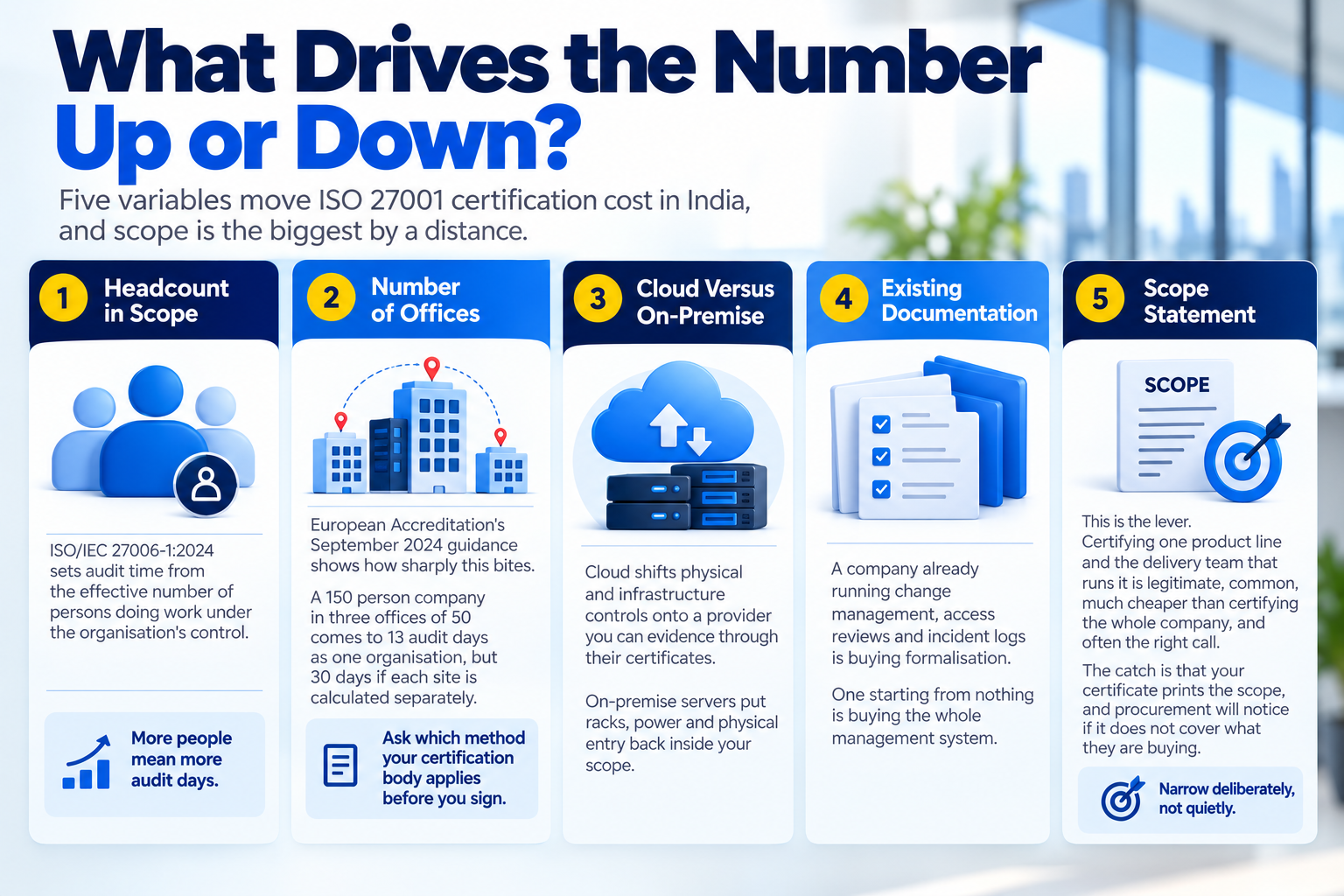
Five variables move ISO 27001 certification cost in India, and scope is the biggest by a distance.
Headcount in Scope
ISO/IEC 27006-1:2024 sets audit time from the effective number of persons doing work under the organisation's control.
More people mean more audit days.
Number of Offices
European Accreditation's September 2024 guidance shows how sharply this bites.
A 150 person company in three offices of 50 comes to 13 audit days as one organisation, but 30 days if each site is calculated separately.
Ask which method your certification body applies before you sign.
Cloud Versus On-Premise
Cloud shifts physical and infrastructure controls onto a provider you can evidence through their certificates.
On-premise servers put racks, power and physical entry back inside your scope.
Existing Documentation
A company already running change management, access reviews and incident logs is buying formalisation.
One starting from nothing is buying the whole management system.
Scope Statement
This is the lever.
Certifying one product line and the delivery team that runs it is legitimate, common, much cheaper than certifying the whole company, and often the right call.
The catch is that your certificate prints the scope, and procurement will notice if it does not cover what they are buying.
Narrow deliberately, not quietly.
The Realistic Timeline from Decision to Certificate
Nine to twelve months is realistic for a first certification with a genuine scope.
Under six months usually means a narrow scope, an existing management system, or both.
Month 0 to 1
What happens: Scope decision, budget, shortlist accredited bodies, and gap assessment against the 93 controls.
Where the effort sits: Management and consultant.
Month 1 to 2
What happens: Risk assessment, treatment plan and Statement of Applicability.
Where the effort sits: Security lead and management.
Month 2 to 5
What happens: Policy set is written and approved while engineering closes control gaps.
Where the effort sits: Engineering. This is the heaviest load.
Month 4 to 6
What happens: Awareness training, supplier reviews and evidence accumulation.
Where the effort sits: Everyone.
Month 6 to 7
What happens: Internal audit, corrective actions and management review.
Where the effort sits: Internal auditor, independent of the work being audited.
Month 8 to 9
What happens: Stage 1 audit on documentation and readiness, followed by closing findings.
Where the effort sits: Certification body and internal team.
Month 9 to 11
What happens: Stage 2 audit on implementation and effectiveness, closure of nonconformities and certificate issuance.
Where the effort sits: Certification body and internal team.
Years 2 and 3
What happens: Annual surveillance, followed by recertification at three years.
Where the effort sits: Certification body.
The constraint people underestimate is evidence age.
Stage 2 tests whether controls operate. A written policy set on its own does not clear it.
You need months of access review records, incident logs, training records and a completed internal audit before an auditor can conclude anything.
More consultants will not compress that.
One timing note: certification bodies had to move to ISO/IEC 27006-1:2024 within 24 months of publication, and ANAB set 31 March 2026 as the deadline for its accredited bodies.
Any quote issued before that date was calculated under the superseded edition, so ask for it to be restated.
ISO 27001 Versus SOC 2
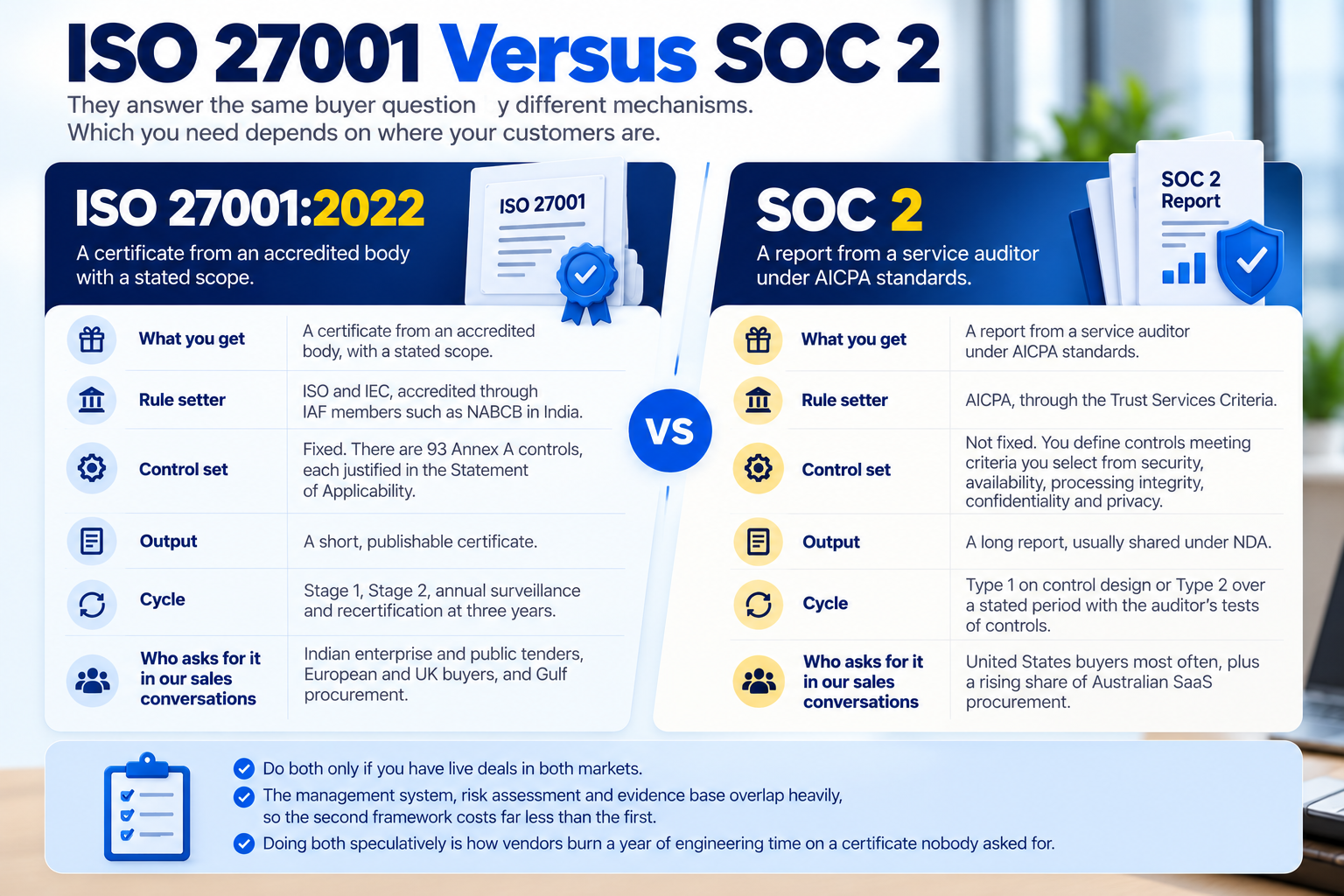
They answer the same buyer question by different mechanisms.
Which you need depends on where your customers are.
ISO 27001:2022
What you get: A certificate from an accredited body, with a stated scope.
Rule setter: ISO and IEC, accredited through IAF members such as NABCB in India.
Control set: Fixed. There are 93 Annex A controls, each justified in the Statement of Applicability.
Output: A short, publishable certificate.
Cycle: Stage 1, Stage 2, annual surveillance and recertification at three years.
Who asks for it in our sales conversations: Indian enterprise and public tenders, European and UK buyers, and Gulf procurement.
SOC 2
What you get: A report from a service auditor under AICPA standards.
Rule setter: AICPA, through the Trust Services Criteria.
Control set: Not fixed. You define controls meeting criteria you select from security, availability, processing integrity, confidentiality and privacy.
Output: A long report, usually shared under NDA.
Cycle: Type 1 on control design or Type 2 over a stated period with the auditor's tests of controls.
Who asks for it in our sales conversations: United States buyers most often, plus a rising share of Australian SaaS procurement.
Do both only if you have live deals in both markets.
The management system, risk assessment and evidence base overlap heavily, so the second framework costs far less than the first.
Doing both speculatively is how vendors burn a year of engineering time on a certificate nobody asked for.
Where ISO 27001 Does Not Help
It is a management system certificate.
It is not a licence, and it is not a location.
It Does Not Satisfy CERT-In Empanelment
CERT-In empanelment is a separate scheme run by the Indian Computer Emergency Response Team, with its own published list of empanelled auditing organisations.
If a tender asks for an audit by an empanelled auditor, an ISO 27001 certificate does not substitute.
The client commissions that audit directly, and we build to the auditor's requirements and implement every finding.
It Is Not a Data Residency Answer Either
CERT-In's directions of 28 April 2022 require logs of all ICT systems to be kept for a rolling 180 days and, in the wording of the direction, "the same shall be maintained within the Indian jurisdiction", alongside a six-hour incident reporting window.
An ISMS certificate says you manage information security.
It says nothing about where your data sits.
Residency is a hosting and contract decision.
We deploy in-region on request across AWS, Azure or Google Cloud Platform, with the region chosen to meet the client's requirement, or to the client's own on-premise servers, with infrastructure billed at cost.
Our control set, sub-processor list and certification status are available on the Accucia Trust page.
Is It Worth It for a Mid-Size Indian Vendor?
It is worth it if you can name the deals it wins you.
It is not worth it as a statement of quality.
Run the test.
Of the last eight to twelve enterprise opportunities you lost or stalled, in how many did a security questionnaire or certificate requirement actually stop you?
Three or more, and it pays for itself on one deal.
Zero, and you are about to spend nine months and 100 person days on a footer logo.
It reliably matters in banking and financial services, insurance, healthcare, and public tenders that name it in eligibility criteria.
In regulated finance, the questionnaire arrives before the commercial conversation, the pattern across our banking and financial services engagements.
It also matters when a larger integrator onboards you as a subcontractor, since their own certificate obliges them to assess you, which is why it surfaces in partner conversations more than in direct sales.
Accucia's View
We are eight years into building software, and our position is this.
Accucia is implementing an ISO 27001 information security management system.
An auditor has been appointed and certification is targeted for Q1 2027, January to March.
We are not certified today and we will not claim otherwise.
ISO 9001 is also in progress and not held.
We will publish the certificate number and scope on this page the day it is issued.
We are publishing this from inside the process, not after it.
The position that costs us work: we tell prospects not to start an ISMS programme if what their tender actually requires is a CERT-In empanelled audit or Indian data residency.
Those are different problems with cheaper answers, and saying so loses us the consulting engagement more often than it wins us anything.
We would rather lose it than sell nine months of work against the wrong requirement.
To test your own case against an implementation in progress, talk to us.
Frequently Asked Questions
What Does ISO 27001 Certification Cost in India?
There is no published rupee figure, because certification body day rates in India are quoted privately.
Ask for the audit day count first, since ISO/IEC 27006-1 sets it and it cannot be negotiated.
Then add consultant days, tooling and your own internal person days.
How Long Does ISO 27001 Certification Take?
Nine to twelve months is realistic for a first certification with a meaningful scope.
The binding constraint is evidence age.
Stage 2 auditors test whether controls actually operate, so you need months of access reviews, logs, training records and a completed internal audit first.
How Many Audit Days Will the Certification Body Charge?
ISO/IEC 27006-1:2024 sets audit time from the effective number of persons in scope.
European Accreditation's worked example puts 50 people at 10 on-site days and 150 people spread across three offices at 13 days when the whole organisation is calculated together.
Is the Certification Body Fee the Biggest Cost?
Usually not.
The largest line is internal engineering and management time, which no consultant proposal includes because it is not their revenue.
Budget roughly 80 to 145 person days of your own staff for a 60 to 150 person software company.
Can We Cut the Cost by Narrowing the Scope?
Yes, and it is often the right call.
Certifying one product line and the team that runs it is legitimate and much cheaper than certifying the whole company.
The catch is that your certificate prints the scope, and procurement teams read it.
Do We Actually Need a Consultant?
Not necessarily, but you need someone who has been through a Stage 2 audit.
The risk of doing it entirely in house is writing a policy set that fails on evidence.
If you have an experienced lead implementer in house, buy only a gap assessment and a mock audit.
What Tooling Does ISO 27001 Require?
None specifically.
The standard names no products.
The gaps that usually force a purchase are asset inventory, centralised logging, endpoint control and access review evidence.
Buy against a gap you have identified, not a vendor checklist.
Automation platforms save time but do not replace the work.
What Happens in Years Two and Three?
Certificates run on a three-year cycle.
You have a surveillance audit in each of years two and three, shorter than the initial audit but driven by the same variables, then a recertification audit at three years.
Nonconformities raised at surveillance can suspend a certificate.
Is ISO 27001 the Same as SOC 2?
No.
ISO 27001 is a certification against an international standard, issued by an accredited certification body against a fixed set of 93 Annex A controls.
SOC 2 is a report from a service auditor under AICPA standards, against criteria you select and controls you define.
Does ISO 27001 Satisfy a CERT-In Empanelment Requirement?
No.
CERT-In empanelment is a separate scheme with its own published list of empanelled information security auditing organisations.
If a tender requires an audit by an empanelled auditor, the client commissions that audit directly.
An ISO 27001 certificate held by your vendor does not substitute.
Does ISO 27001 Mean Our Data Stays in India?
No.
ISO 27001 certifies how you manage information security, not where data sits.
Residency comes from your hosting region and your contract.
CERT-In's 2022 directions separately require ICT system logs to be kept for a rolling 180 days within Indian jurisdiction.
Does Accucia Hold ISO 27001?
No.
Accucia is implementing an ISO 27001 information security management system.
An auditor has been appointed and certification is targeted for Q1 2027.
We are not certified today and we will not claim otherwise.
ISO 9001 is also in progress and not held.
We do not hold CERT-In empanelment either.
Compare Your Needs Before You Certify.