How to Evaluate a Custom Software Development Company
Quick Answer
To evaluate a custom software development company, ignore the portfolio page and verify four things instead: proof the work runs in production, code ownership agreed in writing before work starts, a delivery rhythm you can observe during the project, and a clear answer for who maintains the system afterward, including exit and handover terms. By Mr. Sumeet Katariya, Accucia Softwares Pvt. Ltd.
Every portfolio page looks identical. The same industries, the same glowing logos, the same screenshots that could belong to anyone. If you have shortlisted three vendors, you have almost certainly read three versions of the same website.
The difference between them shows up in four questions most buyers never ask. This article is the due-diligence sequence we would want a buyer to run on us, written down so you can run it on anyone.
Why the portfolio page tells you nothing
A portfolio is a marketing artifact. It tells you what a company wants you to believe about its past, filtered through a copywriter. It cannot tell you whether the systems shown are still running, whether the team that built them still works there, or whether the client would pick up the phone and say good things.
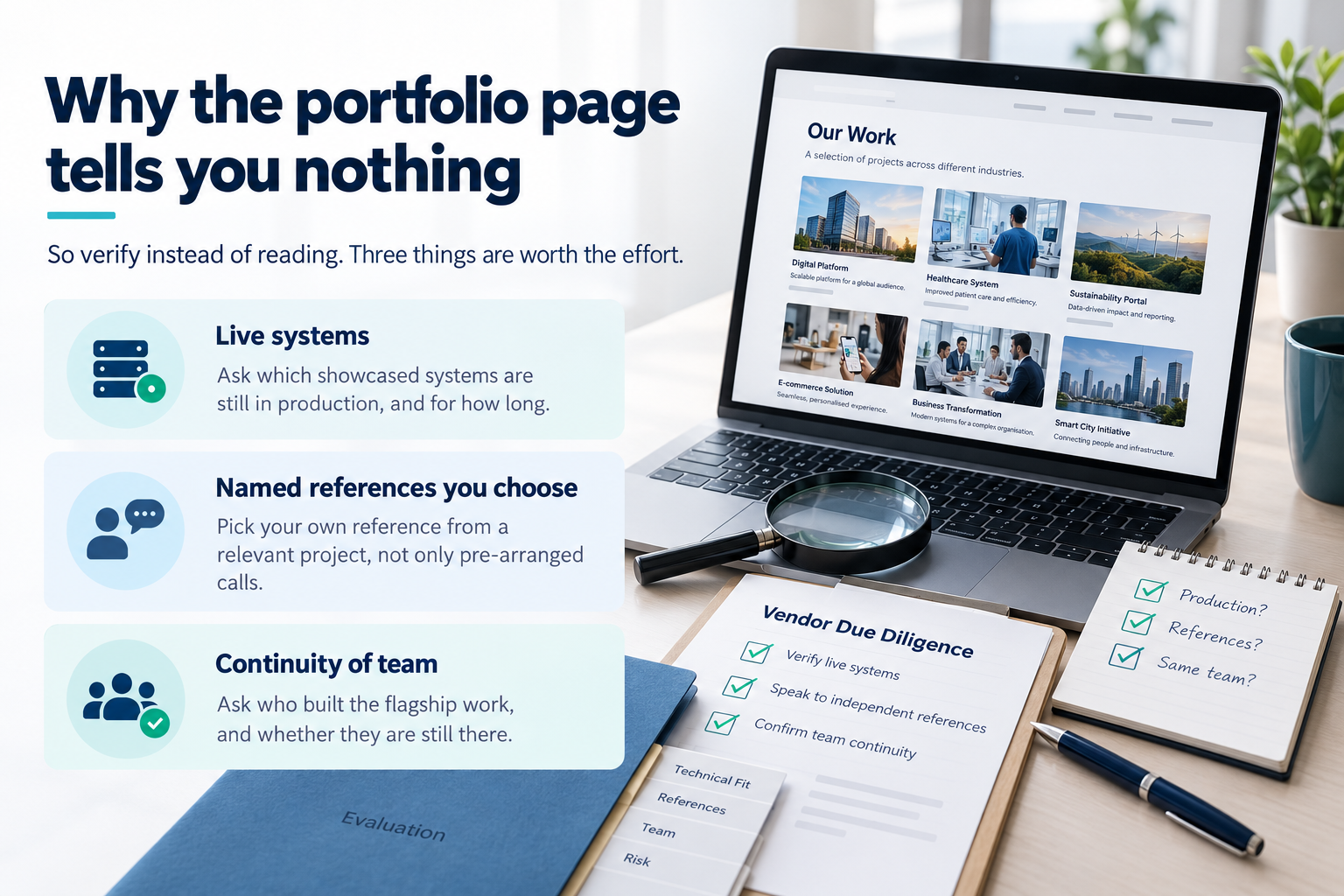
So verify instead of reading. Three things are worth the effort.
Live systems. Ask which of the showcased systems are in production today, and for how long. A system that launched and died within a year is a very different credential from one still processing transactions in year five. Vendors know the difference; portfolio pages are designed to blur it. Ours is at accucia.com/portfolio, and the question we would expect from a serious buyer is exactly this one: which of these are live right now?
Named references you choose. Any vendor can produce two happy clients. Ask instead for a reference from a project similar to yours in size and sector, and ask to pick from a list rather than accepting the pre-arranged call. Then ask that reference the unglamorous questions: what happened when something went wrong, how were change requests handled, did the team that started finish?
Continuity of team. Ask who, by name, built the flagship projects on the portfolio page, and whether those people are still with the company. A company that cannot keep its builders cannot give you continuity, no matter what the contract says. Staff tenure is a quieter signal than any case study and much harder to fake.
One aside from our side of the table: when a prospect asks these questions, the sales conversation gets better, not worse. The vendors who resent verification are telling you something useful.
The due-diligence sequence
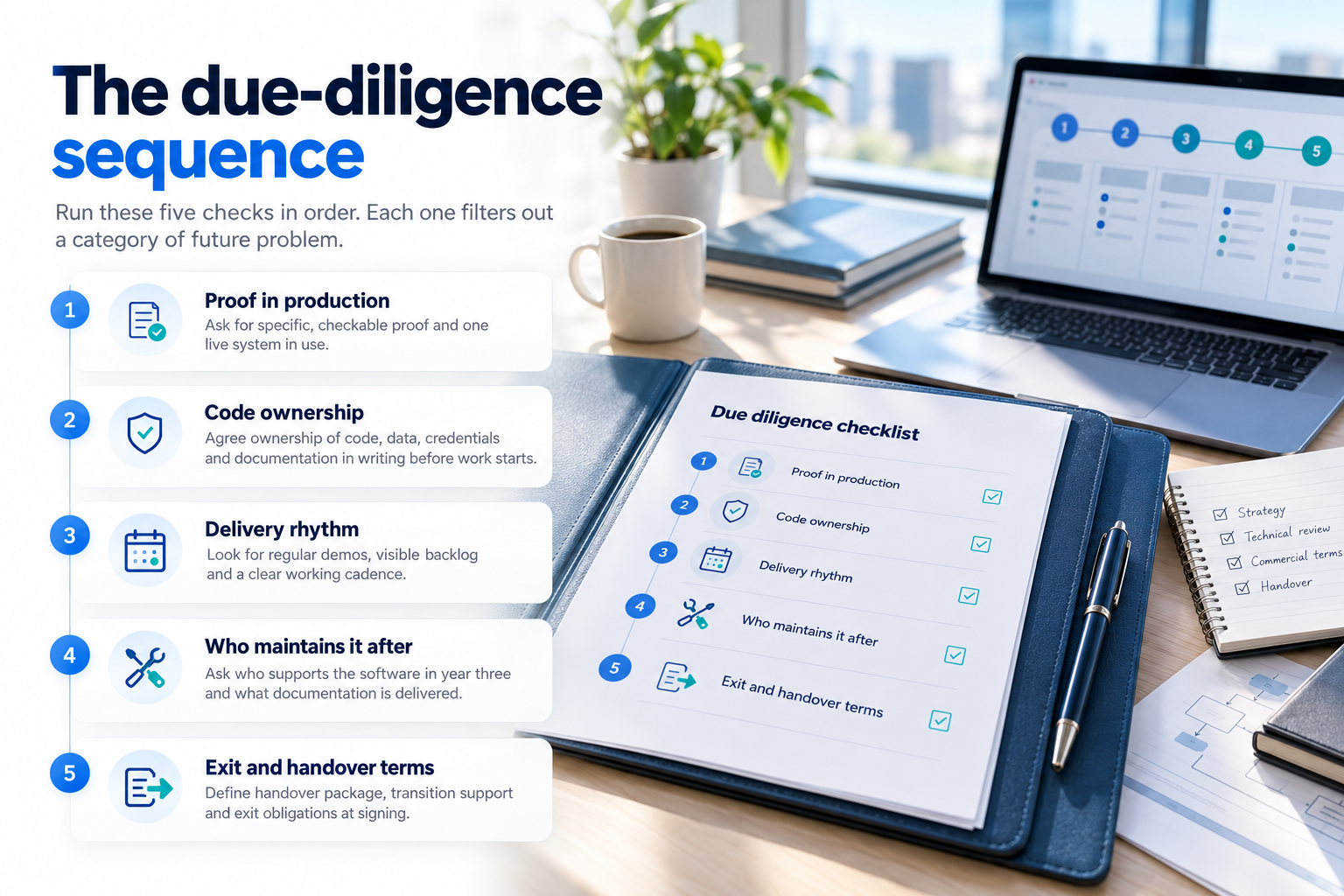
Run these five checks in order. Each one filters out a category of future problem.
1. Proof in production
Credentials should be specific and checkable. Ours, stated plainly: Accucia Softwares Pvt. Ltd. was founded in 2018 by Mr. Sumeet Katariya, has spent 8 years in software delivery, and has 730+ software projects delivered since 2018. A claim like that invites verification, which is the point. When a vendor's claims are rounded and vague ("hundreds of clients", "global presence"), ask for the specifics and watch what happens.
Beyond the numbers, ask to see one system similar to yours, running, with the client's permission. Ten minutes of watching real software in use beats an hour of slides.
2. Code ownership, agreed in writing, before work starts
This is the check that saves companies from the worst outcomes. Who owns the source code, the repositories, the deployment configurations, the documentation? Under what conditions can you take everything and walk away?
Be wary of any vendor that answers with a blanket reassurance. "Of course you own everything" is not a term; it is a mood. The correct answer is that ownership terms are agreed in writing before work starts, specific to your engagement, covering code, data, credentials and documentation. That is how we handle it, and the reasoning is laid out in our note on the client question behind white-label software development, where ownership and attribution questions come up in their sharpest form.
If a vendor hesitates on this question in the sales conversation, imagine the same conversation in year two, with leverage reversed.
3. Delivery rhythm and demo cadence
How will you know the project is on track in week six, not month six? The honest answer involves rhythm: working software demonstrated at a fixed cadence, a visible backlog, decisions recorded where you can see them.
Ask the vendor to describe their last project's cadence in concrete terms. How often did the client see running software? What happened when a sprint missed? Who attended the demos? Companies with a real rhythm answer instantly, because they are describing habit rather than aspiration. Our own process is published at accucia.com/how-we-work, including how discovery leads into delivery. On that subject: discovery is not a delay. A vendor who wants to start coding on day one is not saving you time, they are skipping the part where your problem gets understood.
4. Who maintains it after
The build is a season; the system is a decade. Ask who maintains the software after launch, under what model, with which named people. Ask what proportion of the vendor's current clients are past year three. A vendor whose business is built entirely on new projects has no structural incentive to care about your year three, and incentives beat promises over any multi-year horizon.
Ask also about documentation as a deliverable, not a courtesy: runbooks, architecture notes, data dictionaries. These are what make the next check meaningful.
5. Exit and handover terms
The final check is the one that feels pessimistic and is actually just professional. If the relationship ends, what exactly happens? What gets handed over, in what format, in what timeframe, with what support during transition? Could another competent team pick up the system from the handover package alone?
A vendor confident in its work has no reason to make leaving difficult. Exit terms that are vague or punitive tell you the vendor plans to keep you by friction rather than by performance. Get the handover obligations in writing at signing, when goodwill is at its maximum.
Red flags in the first meeting
Some problems announce themselves early, if you are watching.
A quote arrives before anyone has asked you a hard question. Estimating software without understanding the problem is either guesswork or a sales tactic, and you will pay for it either way in change requests.
Every answer is yes. Real delivery teams push back, because real projects involve trade-offs. A vendor who agrees with everything in the sales meeting is deferring the disagreements to the build, where they cost more.
You never meet anyone technical. If the entire courtship is handled by sales, ask directly to speak with the people who would build your system. The quality of that conversation predicts the project better than any proposal document.
Ownership and exit questions get deflected to "the standard agreement". Standard for whom? Terms that matter get discussed, not referenced.
And the subtle one: no questions about your business. A vendor planning to understand your problem interrogates it. A vendor planning to bill hours does not need to.
Where the company is based matters less than how it works
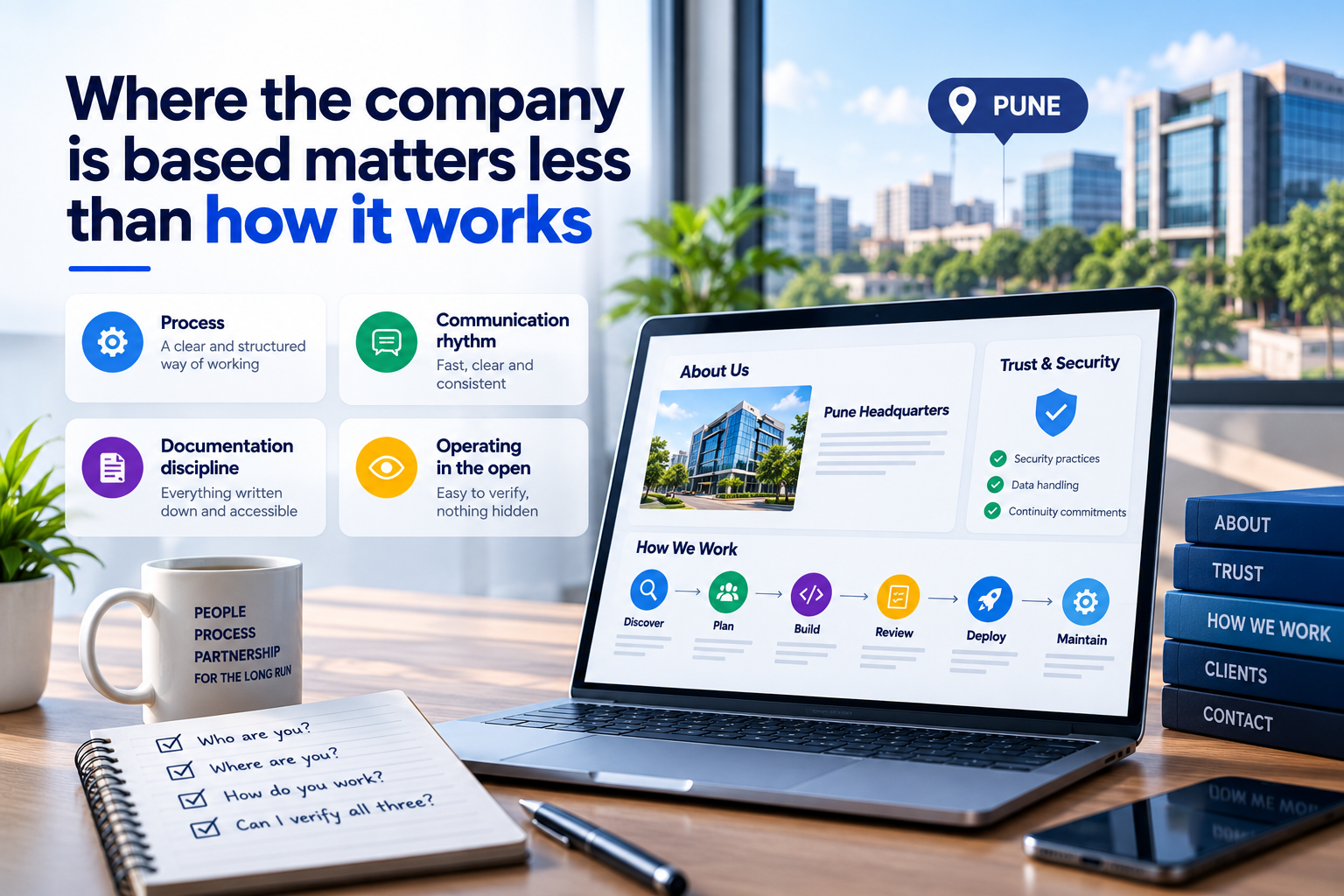
Buyers sometimes treat location as a proxy for quality, in both directions. It is a weak proxy. What matters is observable: process, communication rhythm, documentation discipline, and whether the company operates in the open.
We state our Pune headquarters openly, on our about page and everywhere else, because a company asking for a multi-year relationship should be easy to locate and easy to inspect. The same logic drives our trust page, where security practices, data handling and continuity commitments are published rather than produced on request. Wherever a vendor sits on the map, ask for the same transparency: who are you, where are you, how do you work, and can I verify all three without taking your word for it.
The practical test is simpler than it sounds. Across a two-week evaluation, notice how the vendor communicates when nothing is being sold: how fast questions get answered, how clearly, by whom. That texture is what the next two years will feel like.
Accucia's view
Most software vendor evaluations fail because they evaluate the proposal instead of the company. The proposal is a document; the company is a set of habits, and habits are verifiable. Insist on production proof, ownership in writing before work starts, a delivery rhythm you can watch, a named answer for maintenance, and exit terms agreed while everyone is still friendly. Any vendor worth signing will pass all five checks without flinching. We built Accucia to pass them, since 2018, from Pune, in the open.
If you want a second opinion on a shortlist or a proposal you have in hand, message us on WhatsApp at https://wa.link/1bwdd2.
FAQ
What should I look for in a custom software development company?
Verify four things: proof that past work is running in production, code ownership terms agreed in writing before work starts, a delivery rhythm with regular demos of working software, and a concrete answer for post-launch maintenance including exit and handover terms. Portfolio pages and proposals cannot substitute for these checks.
How do I verify a software vendor's portfolio claims?
Ask which showcased systems are in production today and for how long. Request references from projects similar to yours and choose from a list rather than accepting pre-arranged calls. Ask whether the people who built the flagship projects still work at the company. Specific, checkable claims beat impressive-sounding rounded ones.
Who owns the source code in a custom software project?
Ownership should be agreed in writing before work starts, covering source code, repositories, documentation, data and credentials. Treat blanket verbal reassurances as a warning sign. The agreement should also state what gets handed over if the relationship ends, so ownership is practical rather than theoretical.
What are red flags when choosing a software development company?
A detailed quote before anyone has understood your problem, a sales process where you never meet technical people, a vendor who agrees with everything, deflection of ownership and exit questions to a standard agreement, and no curiosity about your business. Each predicts a specific failure during the build.
Does it matter where a software development company is located?
Less than how it works. Judge process, communication rhythm, documentation discipline and transparency: a company should state where it is based, publish how it works, and make its claims verifiable. Those habits predict project outcomes far better than the address on the contract.
Choose a software partner you can trust.