Hospital Management Software: 2026 Buyer's Comparison Guide
Quick Answer
Hospital management software runs patient registration, OPD and IPD, operation theatre scheduling, pharmacy, lab, radiology, billing and discharge on one patient record. In India in 2026, a shortlist must also prove ABDM and ABHA linking, NABH-ready audit trails, and correct GST on taxable items. The common mistake is buying modules before checking machine integrations. By Mr. Sumeet Katariya, CEO, Accucia Softwares Pvt. Ltd.
A hospital does not buy software once. It buys a system that has to survive the next NABH audit, the next branch, and the next lab machine nobody told IT about.
That is why demos mislead. Every product looks capable when a salesperson drives it with clean data. Problems arrive eight months later, at 2 am when the discharge summary will not print, or at month end when stock in the system and stock on the shelf disagree by a number nobody can explain.
We have built and integrated business systems since 2018, eight years, including hospital and diagnostic work in India.
What hospital management software has to cover
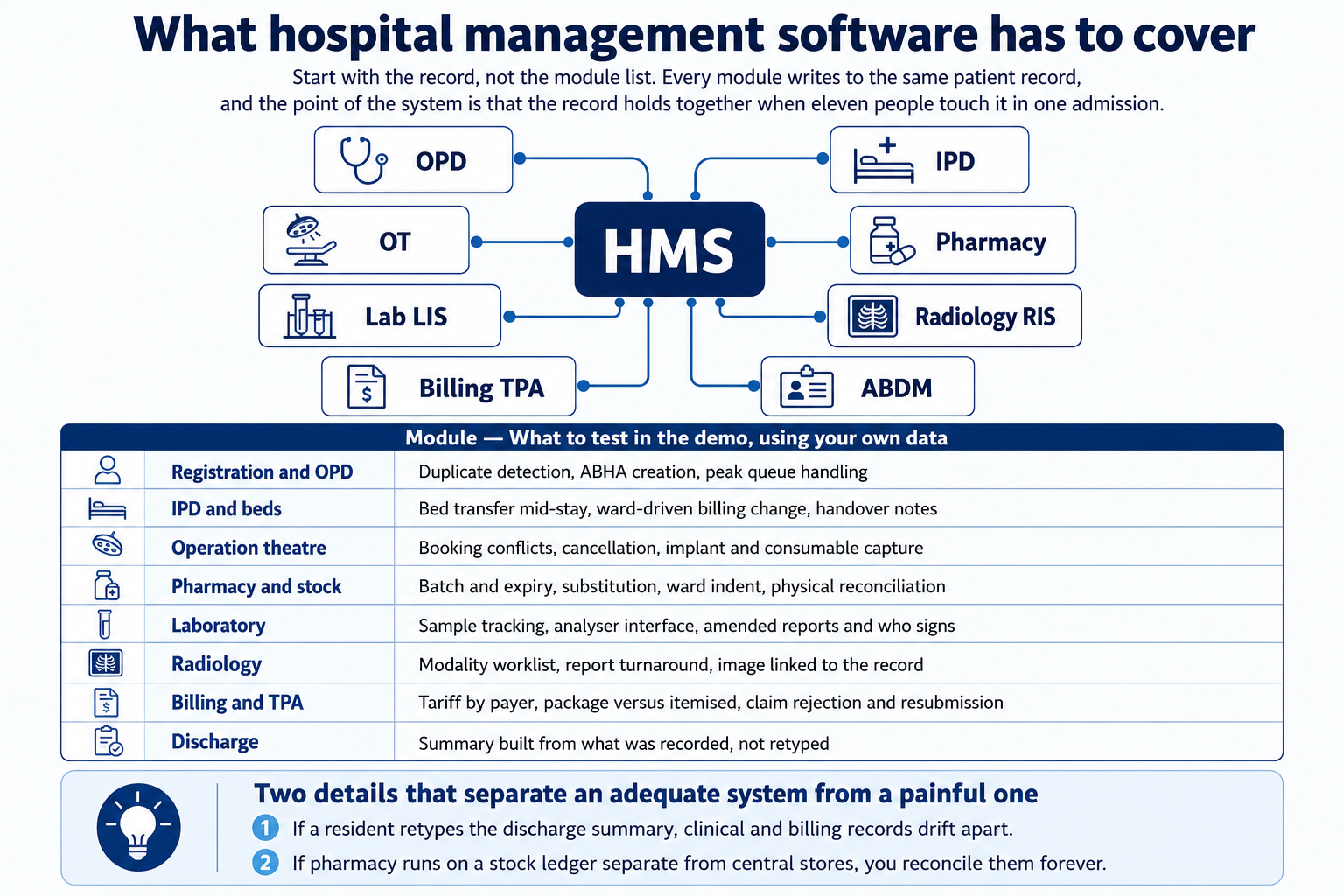
Start with the record, not the module list. Every module writes to the same patient record, and the point of the system is that the record holds together when eleven people touch it in one admission.
[Diagram: module map, a central HMS box connected to labelled boxes for OPD, IPD, OT, Pharmacy, Lab LIS, Radiology RIS, Billing TPA and ABDM. See Inline Media Notes for the generation prompt.]
Module — What to test in the demo, using your own data
Registration and OPD — Duplicate detection, ABHA creation, peak queue handling
IPD and beds — Bed transfer mid-stay, ward-driven billing change, handover notes
Operation theatre — Booking conflicts, cancellation, implant and consumable capture
Pharmacy and stock — Batch and expiry, substitution, ward indent, physical reconciliation
Laboratory — Sample tracking, analyser interface, amended reports and who signs
Radiology — Modality worklist, report turnaround, image linked to the record
Billing and TPA — Tariff by payer, package versus itemised, claim rejection and resubmission
Discharge — Summary built from what was recorded, not retyped
Two details separate an adequate system from a painful one. If a resident retypes the discharge summary, clinical and billing records drift apart. If pharmacy runs on a stock ledger separate from central stores, you reconcile them forever.
The India-specific requirements that decide your shortlist
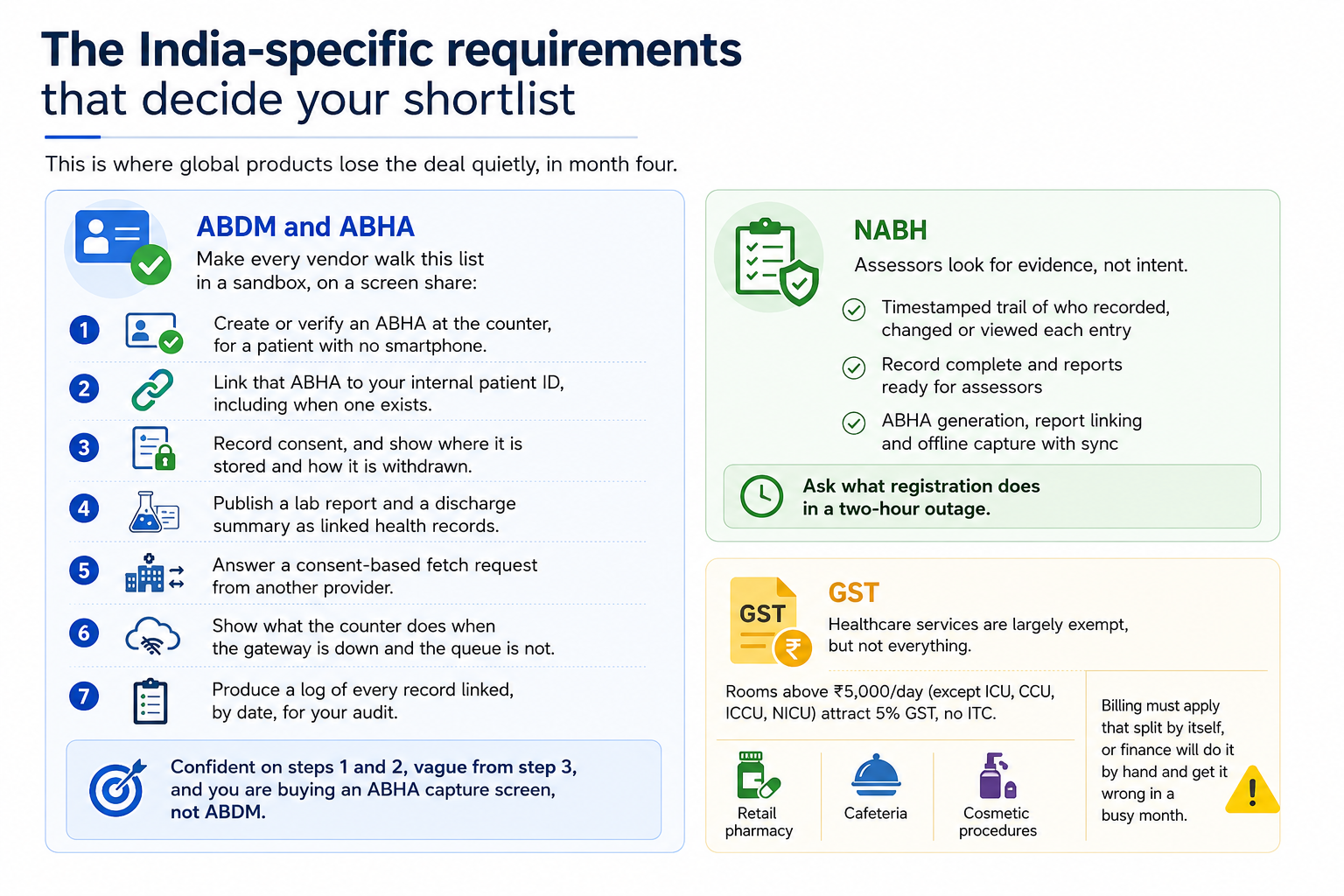
This is where global products lose the deal quietly, in month four.
ABDM and ABHA. The Ayushman Bharat Health Account is now the default patient identity layer in India. ABHA accounts crossed 90 crore in May 2026, up from 14.7 crore in 2021 (PIB). Provider-side adoption is real too. As of February 2025, 3,63,520 facilities sat in the Health Facility Registry and 1,59,020 used ABDM enabled software (PIB).
Make every vendor walk this list in a sandbox, on a screen share:
- Create or verify an ABHA at the counter, for a patient with no smartphone.
- Link that ABHA to your internal patient ID, including when one exists.
- Record consent, and show where it is stored and how it is withdrawn.
- Publish a lab report and a discharge summary as linked health records.
- Answer a consent-based fetch request from another provider.
- Show what the counter does when the gateway is down and the queue is not.
- Produce a log of every record linked, by date, for your audit.
Confident on steps 1 and 2, vague from step 3, and you are buying an ABHA capture screen, not ABDM.
NABH. Assessors look for evidence, not intent. The system must hold a timestamped trail of who recorded, changed or viewed each entry, keep the record complete, and produce assessor reports without a week of manual assembly. NABH's second edition draft Digital Health Standards, September 2025, asks for ABHA generation and capture, lab and radiology reports linked to the patient's ABHA, and offline capture that syncs when connectivity returns (NABH). Ask what registration does in a two-hour outage.
GST. Healthcare services by a clinical establishment are largely exempt, but not everything is. Under Notification No. 03/2022-Central Tax (Rate) dated 13 July 2022, rooms other than ICU, CCU, ICCU and NICU charged above Rs 5,000 per day attract GST at 5 per cent with no input tax credit (CBIC). Add retail pharmacy sales, cafeteria and cosmetic procedures. Billing must apply that split by itself, or finance will do it by hand and get it wrong in a busy month.
Data residency and consent: what to demand in writing
Get this into the contract, not the sales deck.
The Digital Personal Data Protection Rules were notified on 14 November 2025 with an eighteen-month phased compliance period (PIB). A data fiduciary must give a separate consent notice, clear and easy to understand, explaining the specific purpose of collection, and must tell affected individuals about a breach without delay in plain language. Consent managers must be Indian companies. Board reporting runs as an initial intimation, then a detailed report within 72 hours (India Briefing).
Four clauses worth insisting on:
- Where the data sits. Name the cloud region or the on-premise servers. We deploy in-region on AWS, Azure or GCP, region chosen to meet your requirement, or on your own servers, infrastructure billed at cost. Those are our only sub-processors.
- Who else touches it. A written sub-processor list, updated when it changes.
- Exit. Full export in a documented format, deletion certified in writing.
- Audit. If you need a CERT-In empanelled audit, you commission it. We build to the auditor's requirements and implement every finding. We do not hold empanelment ourselves, and be sceptical of anyone who claims to.
On our own posture, plainly: ISO 27001 is not held, implementation is underway with certification targeted within six months. ISO 9001 is not held and is in progress. Details sit on our trust page. A vendor who cannot state certification status this precisely is guessing.
Off the shelf, custom build, or extend what you already run
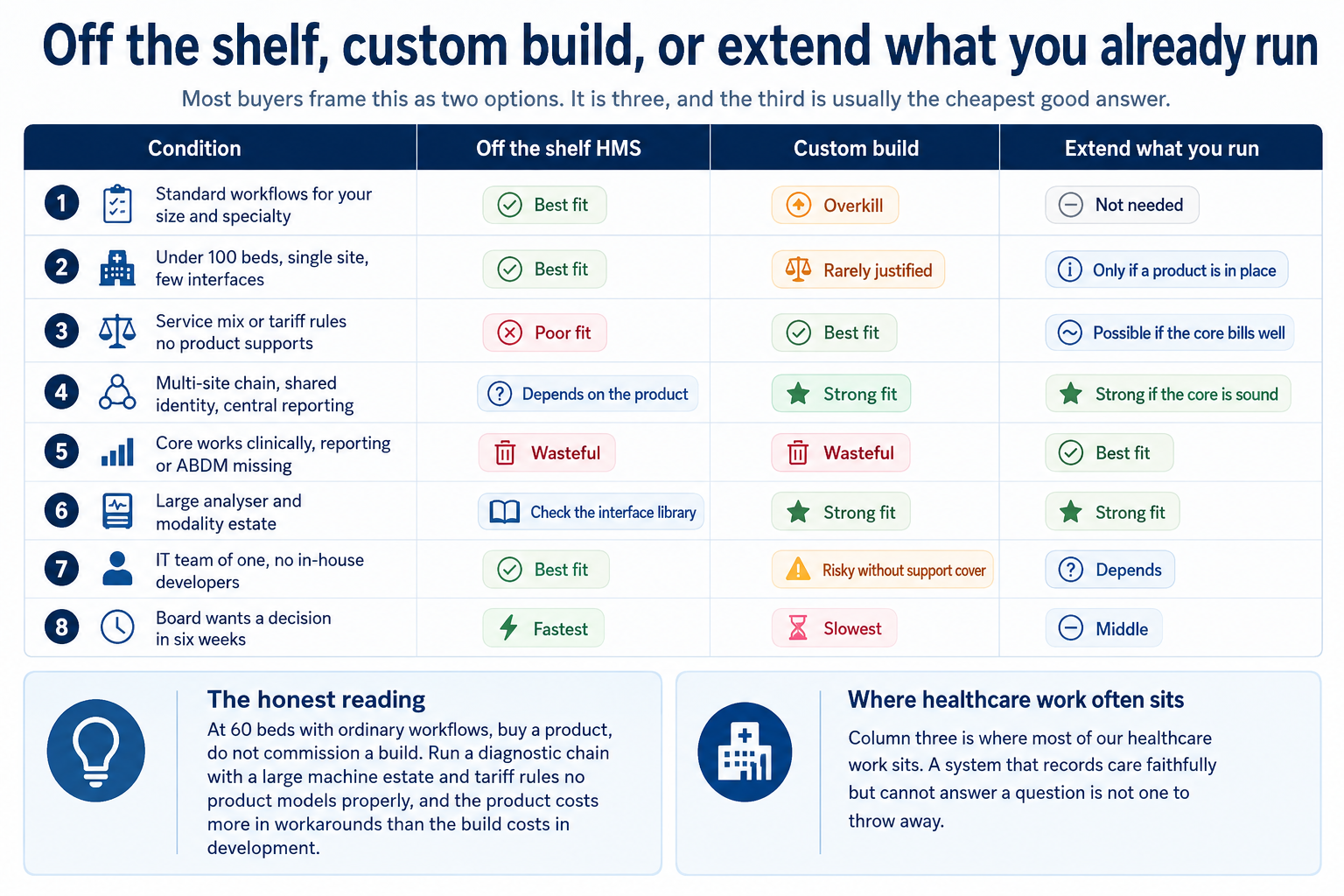
Most buyers frame this as two options. It is three, and the third is usually the cheapest good answer.
Condition — Off the shelf HMS — Custom build — Extend what you run
Standard workflows for your size and specialty — Best fit — Overkill — Not needed
Under 100 beds, single site, few interfaces — Best fit — Rarely justified — Only if a product is in place
Service mix or tariff rules no product supports — Poor fit — Best fit — Possible if the core bills well
Multi-site chain, shared identity, central reporting — Depends on the product — Strong fit — Strong if the core is sound
Core works clinically, reporting or ABDM missing — Wasteful — Wasteful — Best fit
Large analyser and modality estate — Check the interface library — Strong fit — Strong fit
IT team of one, no in-house developers — Best fit — Risky without support cover — Depends
Board wants a decision in six weeks — Fastest — Slowest — Middle
The honest reading: at 60 beds with ordinary workflows, buy a product, do not commission a build. Run a diagnostic chain with a large machine estate and tariff rules no product models properly, and the product costs more in workarounds than the build costs in development.
Column three is where most of our healthcare work sits. A system that records care faithfully but cannot answer a question is not one to throw away. Our healthcare practice page sets out how we scope that layer.
What breaks when clinic two opens
Patient identity breaks first.
The same person registers at both sites and collects two record numbers. Their history splits, repeat-visit reporting goes wrong, and the ABHA linkage you were proud of points at half a record. Then tariffs diverge because each site edited its own master. Then stock is invisible across locations, so one branch runs out of a reagent the next branch is about to expire. Then consolidation becomes a person with a spreadsheet. The same four failures every time, and all four cost less to prevent than to unwind.
Lotus Imaging in India runs six clinics on one platform. The point was never the count of clinics. It was that identity, tariff and reporting decisions were made once, centrally, before the estate grew, so adding a site became a rollout instead of a rebuild. Full write-up: Lotus Imaging, six clinics on one platform, with the ERP side in our Lotus hospital ERP portfolio. Matruseva Women's Hospital in India runs a patient care management app we built.
If a second or third location is anywhere in your five-year plan, settle identity, tariff masters and consolidated reporting while it is still a design conversation.
Integration reality: HL7, DICOM, and the modality nobody mapped
Machine interfaces delay these projects more than anything else, and they are rarely in the proposal.
Analysers exchange results using HL7, a family of health data exchange standards, with FHIR the current REST-based generation (HL7). Imaging equipment speaks DICOM, published by the National Electrical Manufacturers Association and updated several times a year, covering modality worklists, storage and display (DICOM). Both are standards. Neither guarantees that a 2013 biochemistry analyser with a serial port will talk to a 2026 laboratory module without a driver somebody has to write.
Before you sign, not after:
- List every analyser and modality by make, model and year, including the two in the basement.
- For each, record the interface supported, one-way or two-way, and whether the vendor has done that model before.
- Name the driver owner in writing. Yours, the software vendor's, or the equipment vendor's.
- Price the ones with no driver separately and put them on the critical path.
The modality nobody mapped turns a four-month go-live into a seven-month one. It surfaces in week three, and stays someone else's problem until the contract says otherwise.
What actually drives cost and timeline
We do not publish prices in blog posts. We would rather say what moves the number.
Cost and duration follow module count, machine and third-party interface count, how much historical data migrates and how clean it is, the number of sites and whether they share masters, ABDM scope, and whether you need in-region cloud or on-premise deployment. Two hospitals of the same bed count can differ threefold on the interface list alone.
Migration is the line buyers underestimate most. Five years of records in three formats with inconsistent identifiers is a project inside a project. Scope it separately. Current bands sit on our cost page.
The selection checklist for your vendor meeting
Ask every shortlisted vendor the same eleven things, in order, and write the answers down.
- Generate a discharge summary from data captured during the stay, not retyped.
- Run a bed transfer mid-stay and show billing follow correctly.
- Show pharmacy and central stores on one stock ledger, with batch and expiry.
- Do the seven-step ABDM walkthrough above, live, in a sandbox.
- Apply GST to a room above Rs 5,000 a day and a retail pharmacy sale in one bill run.
- Produce the audit trail for one record, every view and every edit.
- Give a written interface list for our exact analysers and modalities, with driver ownership.
- State hosting region, sub-processor list, exit and deletion terms.
- Show one patient registered at two sites resolving to a single record.
- Name three reference hospitals of our size, and let us call them without you present.
- Tell us what your product does badly. If the answer is nothing, end the meeting.
Accucia's view
Our position is that most Indian hospitals buy too much software and integrate too little of it, and we will say so even when it costs us the build. Under 100 beds with ordinary workflows, buy a product off the shelf and spend the saved budget on the interface list and on training. If your existing system records care correctly but cannot answer a question, do not replace it. Put a reporting and integration layer over it. The deployments we see fail in India almost never fail because a module was missing. They fail because patient identity was never resolved across sites, because a machine interface surfaced in week three instead of week minus three, and because nobody wrote hosting and exit terms into the contract while there was room to negotiate. Fix those three and the module comparison takes care of itself. If you want a second opinion on a shortlist you have already built, talk to us. We are content to tell you the product you found is the right one.
Frequently Asked Questions
What is hospital management software?
Hospital management software is one system that runs patient registration, outpatient and inpatient care, operation theatre scheduling, pharmacy, laboratory, radiology, billing and discharge on a single patient record. In India it must also link records to ABHA numbers, hold an audit trail for NABH, and apply GST correctly.
What modules should a hospital management system include?
At minimum: registration and OPD, IPD with bed and ward management, operation theatre scheduling, pharmacy with batch and expiry tracking, laboratory and radiology with LIS and RIS interfaces, billing with TPA claims, and discharge summaries. Anything missing becomes a spreadsheet, and spreadsheets are where audit trails go to die.
Is ABDM integration mandatory for hospitals in India?
ABDM adoption is voluntary, not legally mandatory, but it is becoming a practical requirement. As of February 2025 the government reported 1,59,020 health facilities already using ABDM enabled software. Buyers should treat ABDM capability as a shortlist filter, because retrofitting it later costs more than specifying it upfront.
What is ABHA and how does it connect to hospital software?
ABHA is the Ayushman Bharat Health Account, a health identity number for patients. Hospital software creates or verifies an ABHA at registration, then links records such as prescriptions, lab reports and discharge summaries to it, so patients can retrieve them. India crossed 90 crore ABHA accounts by May 2026.
Should we buy an off the shelf HMS or build a custom one?
Buy off the shelf if your workflows are ordinary and your integration list is short. Build custom if your service mix, tariffs or multi site rules fit no product. Extend what you run if the core is sound and only reporting, patient access or ABDM linking is missing.
How does hospital management software support NABH requirements?
NABH assessors look for evidence, not intent. The software must keep a timestamped audit trail of who recorded, changed or accessed each entry, hold complete medical records, and produce assessor reports without manual assembly. NABH published a second edition draft of its Digital Health Standards in September 2025.
Is GST applicable on hospital room rent, and must the software handle it?
Healthcare services by a clinical establishment are largely GST exempt, but under Notification 3/2022-Central Tax (Rate) dated 13 July 2022, rooms other than ICU, CCU, ICCU and NICU charged above Rs 5,000 per day attract 5 per cent GST without input tax credit. Billing must apply that split automatically.
Where should our patient data be stored?
Ask for it in writing. A hospital should specify the cloud region or on premise servers, who the sub-processors are, how backups are held, and what happens at contract exit. Accucia deploys in-region on AWS, Azure or GCP, or on the hospital's own servers, with infrastructure billed at cost.
What does the DPDP framework mean for hospital systems?
The Digital Personal Data Protection Rules were notified on 14 November 2025 with an eighteen month phased compliance period. Hospitals need clear consent notices stating purpose, defined retention and erasure, security safeguards, and breach notification to affected individuals without delay. Your software has to support all four, not just store data.
How long does a hospital management software rollout take?
It depends on module count, how many machines and third party systems must be interfaced, and how much historical data has to migrate. A single site going live module by module is a different project from a five site chain with lab and imaging interfaces. Cost and timeline drivers are set out on the Accucia cost page.
What breaks when a hospital opens a second location?
Patient identity breaks first. The same person gets two record numbers at two sites. Then tariffs diverge, stock cannot be seen across locations, and reporting has to be stitched by hand every month. Fix identity, tariff masters and consolidated reporting before the second location opens, not after.
Which integrations delay hospital software projects most?
Machine interfaces. Analysers speak HL7 in vendor specific ways, imaging modalities speak DICOM, and one old analyser with a serial port can hold a go live for weeks. Ask every vendor for a written interface list with make, model, protocol and driver ownership before you sign.
Find the right hospital software for your needs.