Digital Independence: How to Free Your Business From People-Dependency
Quick Answer
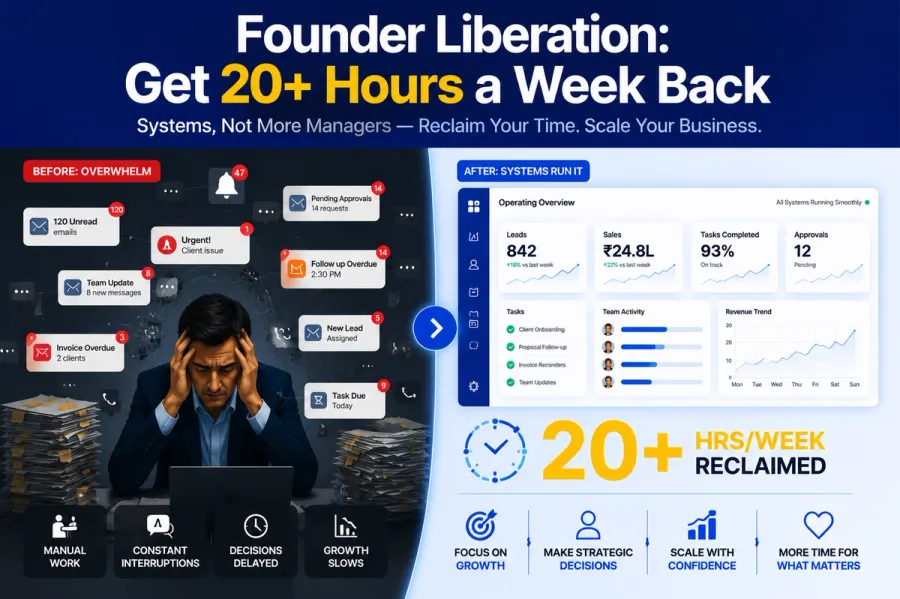
People-dependency is the condition where a business cannot run without specific individuals, because approvals, knowledge, follow-ups and reporting live in their heads rather than in systems. It is reduced by moving each dependency into structured workflows: automated approval routing, documented processes built into the platform, system-enforced follow-ups, and self-generating reports. Businesses that make this shift report 20+ hours a week returned to leadership and operations that continue smoothly through absences, exits and expansion. By Mr. Sumeet Katariya, CEO, Accucia Softwares Pvt. Ltd.
Tomorrow, India celebrates 79 years of independence. A good day, I think, to talk about a different kind of freedom, one most founders quietly do not have.
Here is the uncomfortable test. If you switched your phone off for two weeks, what would break? If the honest answer is "quite a lot," the business has a dependency problem. And its name is you.
The four dependencies that hold a business hostage
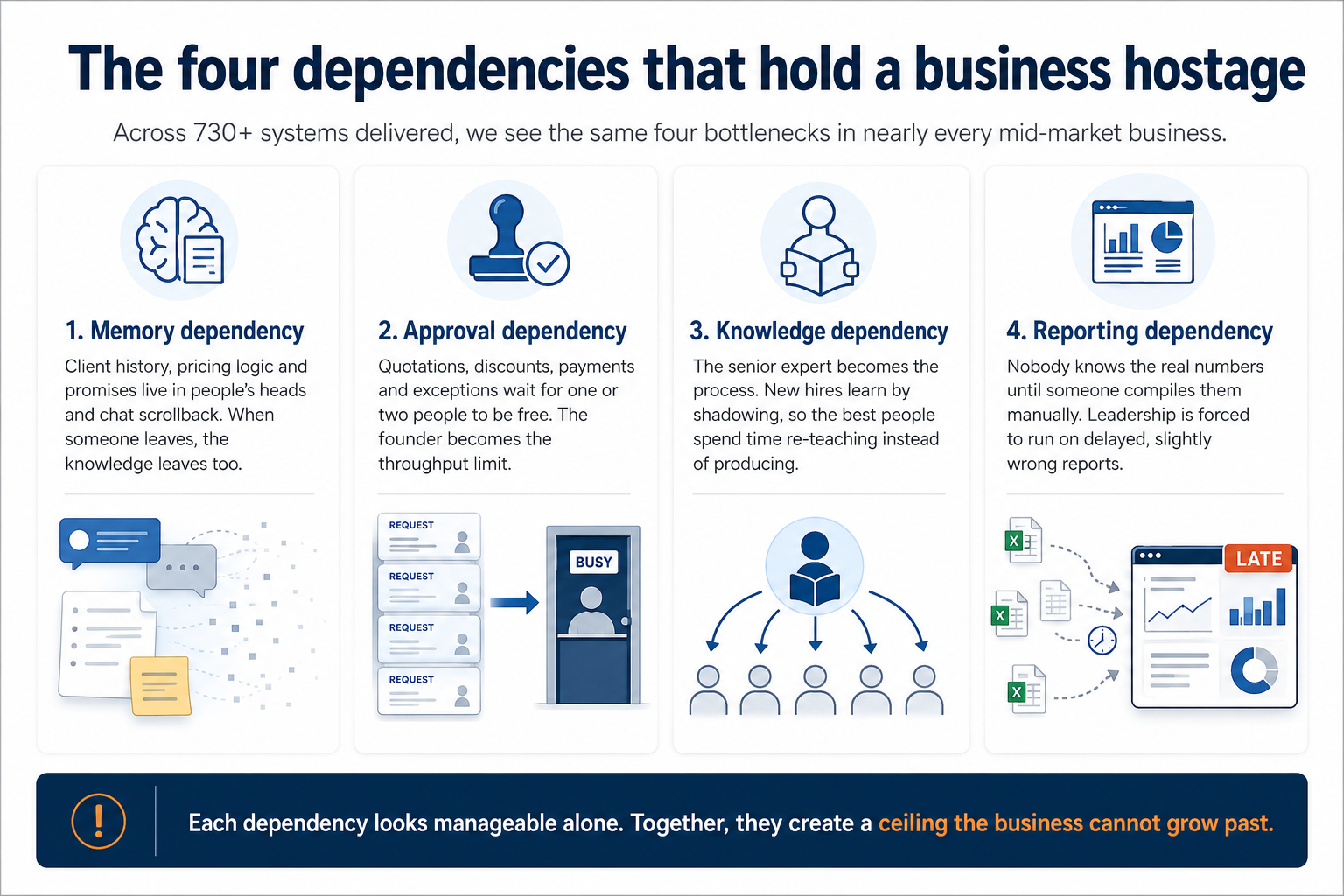
Across 730+ systems delivered, we meet the same four dependencies in nearly every mid-market business, in slightly different costumes.
1. Memory dependency
Client history, pricing logic, the thing the customer was promised in March. It all lives in people's heads and chat scrollback. When the person leaves, the knowledge resigns with them. Nothing was ever written down because "everyone knows," until the day nobody does.
2. Approval dependency
Every quotation, discount, payment and exception waits for one of two or three people to be free. The queue outside the founder's attention is the company's real throughput limit. Growth adds to the queue. It cannot widen it.
3. Knowledge dependency
The senior engineer who is the only one who knows the process. The ops head who is the documentation. New hires learn by shadowing, which means your best people spend their week re-teaching instead of producing. It feels like mentorship. At scale, it is a bottleneck with good intentions.
4. Reporting dependency
Nobody knows the real numbers until someone compiles them. Leadership flies the business on instruments that update monthly, assembled by hand, slightly wrong.
Each of these feels like dedication from the inside. Compounded, they form a ceiling: the business can never grow past what its critical people can personally hold together.
What independence actually looks like
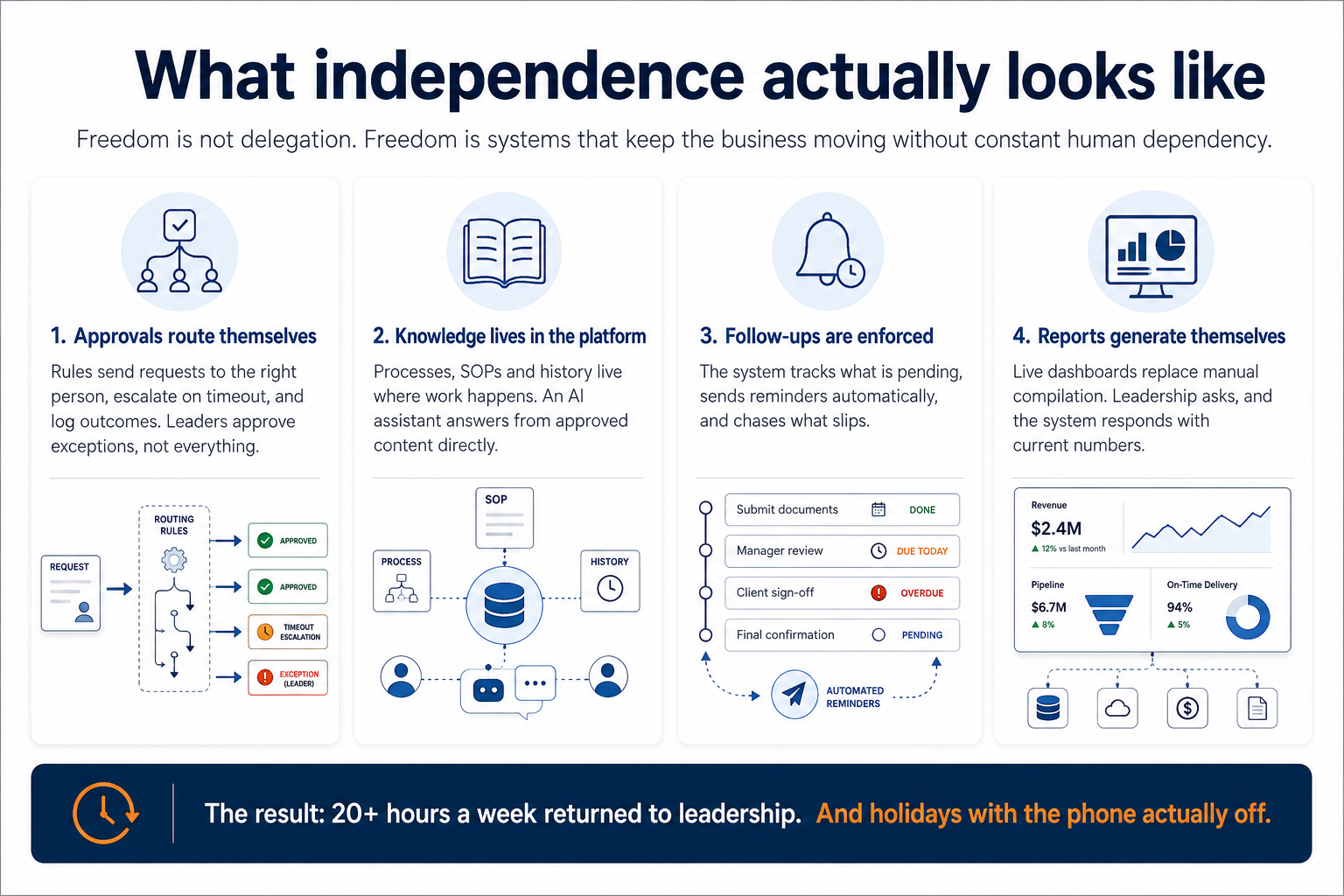
Freedom here is not delegation. Delegation just moves the dependency to a different person. Freedom is systems.
- Approvals route themselves. Rules move requests to the right person, escalate on timeout, and log the outcome. The founder approves exceptions, not everything.
- Knowledge lives in the platform. Processes, SOPs and history sit in the system where work happens. Increasingly, an AI assistant answers from that approved content directly, the pattern that cut answer-time 75% at a pharma enterprise.
- Follow-ups are enforced, not remembered. The system tracks what is pending and chases it. Humans handle only what escapes.
- Reports generate themselves. Live dashboards replace the monthly compilation ritual. With an AI layer on your existing systems, leadership simply asks.
The outcome our clients report most consistently is 20+ hours a week returned to leadership. The outcome they mention with more feeling is quieter: holidays actually taken, with the phone actually off.
The Independence Day question
Political independence was not won by working harder inside the old structure. It required changing the structure. A founder trapped in daily firefighting faces a miniature of the same truth. No amount of personal effort ends the dependency. Only structural change does.
So this August 15th, alongside the flag hoisting, run the two-week phone-off test on paper. List what would break. That list is your dependency map, and every item on it can be moved into a system. Not all at once, and not overnight. One workflow at a time is how every one of our clients did it.
Accucia's view
Accucia's view is that people-dependency is the single most under-priced risk on a mid-market balance sheet. It never appears in the accounts, yet it caps growth, discounts company valuation, and turns every resignation into a small crisis. The fix is neither heroic nor sudden. One workflow at a time, moved from heads into systems, until the founder's presence becomes a choice rather than a requirement. Freedom, for a business, is when growth is a decision, not a gamble on how much more its key people can carry.
Frequently Asked Questions
What is people-dependency in a business?
The condition where operations cannot run without specific individuals, because approvals, knowledge, follow-ups and reporting live in their heads rather than in systems. It caps growth and makes every absence or exit an operational risk.
How do you reduce dependency on key employees?
Move each dependency into structure: automated approval routing with escalation rules, processes and SOPs documented inside the platform where work happens, system-enforced follow-ups, and self-generating reports. Then support the team through adoption until the new way holds.
How much time does removing people-dependency save leadership?
Clients of Accucia Softwares Pvt. Ltd. consistently report 20+ hours a week returned to leadership once approvals, reporting and follow-up chasing move into systems.
Where should a business start?
With the two-week test: list what would break if key people were unreachable for a fortnight. Rank the list by cost, and systematise the most expensive dependency first.
Build systems. Free your time.