App Development Cost in India 2026: The Real Drivers
Quick Answer
App development cost in India in 2026 is set by scope, not by hourly rate. The single biggest variable is the number of distinct user roles the app must serve, because each role adds screens, permissions, test cases and support load. Two quotes differing four times usually differ on scope, not skill. By Mr. Sumeet Katariya, CEO, Accucia Softwares Pvt. Ltd.
Two quotes for the same app can differ by four times. Usually neither vendor is lying. They are pricing different scopes, and only one of them wrote it down. This guide is about how to tell which one.
We have built and handed over software since 2018, across 730+ projects. The pattern almost never changes. Buyers compare the total at the bottom of the page. The money is decided by six things much further up.
The six things that move app development cost in India
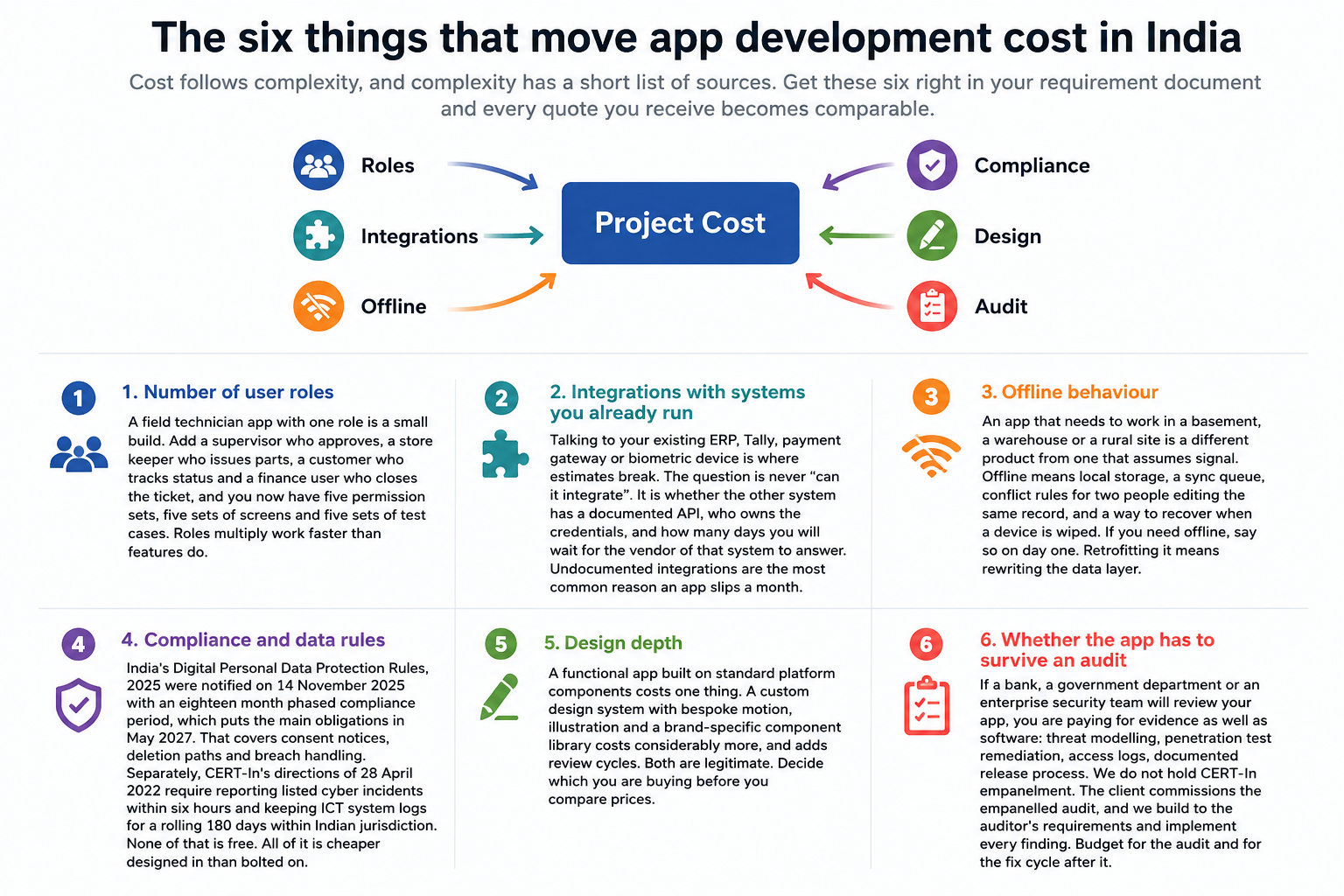
Cost follows complexity, and complexity has a short list of sources. Get these six right in your requirement document and every quote you receive becomes comparable.
[Diagram: central box labelled Project Cost with six labelled input arrows for Roles, Integrations, Offline, Compliance, Design and Audit.]
1. Number of user roles
A field technician app with one role is a small build. Add a supervisor who approves, a store keeper who issues parts, a customer who tracks status and a finance user who closes the ticket, and you now have five permission sets, five sets of screens and five sets of test cases. Roles multiply work faster than features do.
2. Integrations with systems you already run
Talking to your existing ERP, Tally, payment gateway or biometric device is where estimates break. The question is never "can it integrate". It is whether the other system has a documented API, who owns the credentials, and how many days you will wait for the vendor of that system to answer. Undocumented integrations are the most common reason an app slips a month.
3. Offline behaviour
An app that needs to work in a basement, a warehouse or a rural site is a different product from one that assumes signal. Offline means local storage, a sync queue, conflict rules for two people editing the same record, and a way to recover when a device is wiped. If you need offline, say so on day one. Retrofitting it means rewriting the data layer.
4. Compliance and data rules
India's Digital Personal Data Protection Rules, 2025 were notified on 14 November 2025 with an eighteen month phased compliance period, which puts the main obligations in May 2027. That covers consent notices, deletion paths and breach handling. Separately, CERT-In's directions of 28 April 2022 require reporting listed cyber incidents within six hours and keeping ICT system logs for a rolling 180 days within Indian jurisdiction. None of that is free. All of it is cheaper designed in than bolted on.
5. Design depth
A functional app built on standard platform components costs one thing. A custom design system with bespoke motion, illustration and a brand-specific component library costs considerably more, and adds review cycles. Both are legitimate. Decide which you are buying before you compare prices.
6. Whether the app has to survive an audit
If a bank, a government department or an enterprise security team will review your app, you are paying for evidence as well as software: threat modelling, penetration test remediation, access logs, documented release process. We do not hold CERT-In empanelment. The client commissions the empanelled audit, and we build to the auditor's requirements and implement every finding. Budget for the audit and for the fix cycle after it.
What a cheap quote usually leaves out
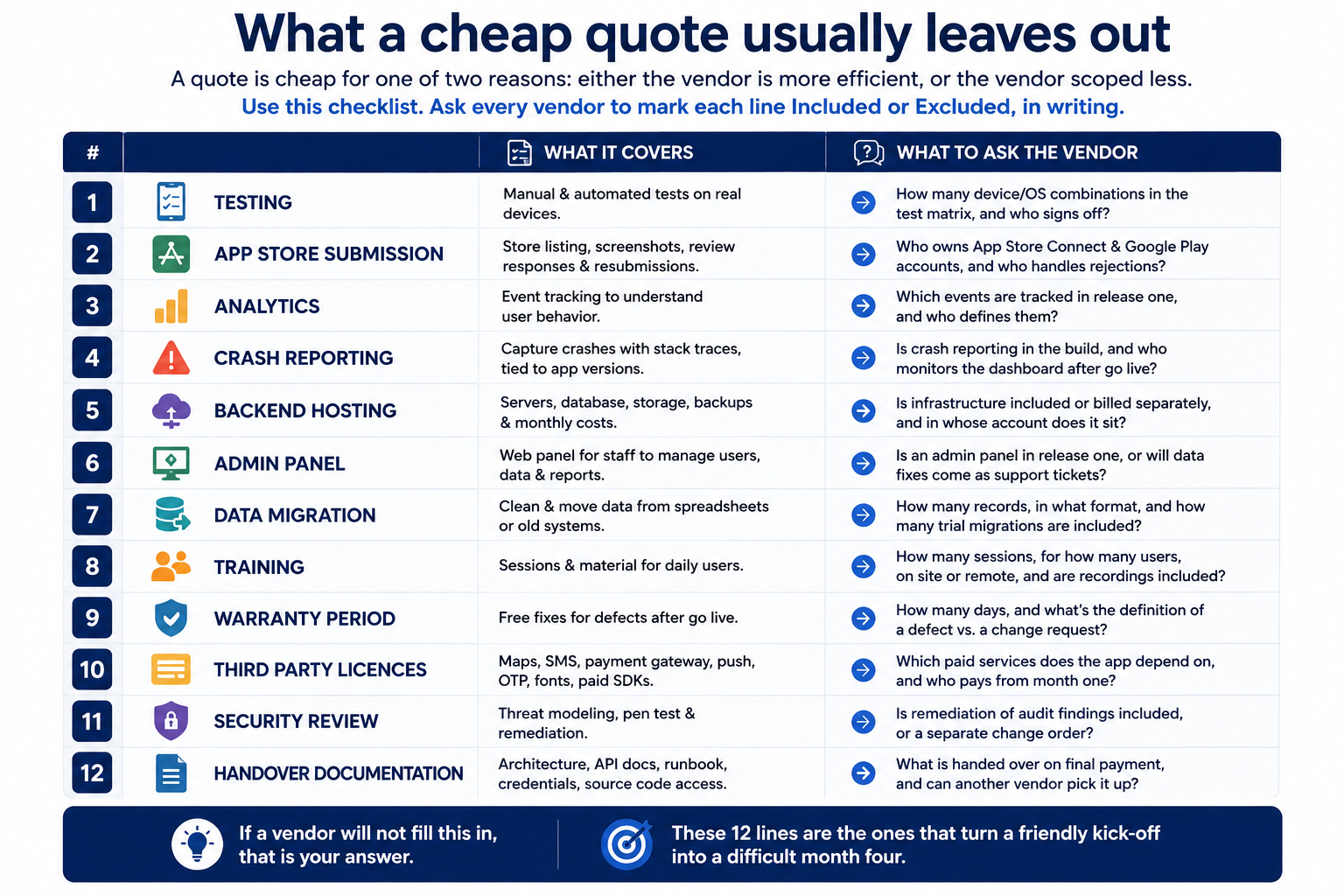
A quote is cheap for one of two reasons. Either the vendor is more efficient, or the vendor scoped less. This checklist separates the two. Send it to every vendor and ask them to mark each line included or excluded, in writing.
Testing — Manual and automated test passes on real devices, not just the developer's phone. Ask the vendor: How many device and OS combinations are in the test matrix, and who signs off?
App store submission — Store listings, privacy declarations, screenshots, review responses and resubmissions. Ask the vendor: Who owns the App Store Connect and Google Play accounts, and who handles a rejection?
Analytics — Event tracking so you can see what users actually do after launch. Ask the vendor: Which events are instrumented in release one, and who defines them?
Crash reporting — Automatic capture of crashes with stack traces, tied to app versions. Ask the vendor: Is crash reporting in the build, and who watches the dashboard after go live?
Backend hosting — Servers, database, storage, backups and the monthly bill for all of it. Ask the vendor: Is infrastructure inside your price or billed separately, and in whose account does it sit?
Admin panel — The web screen where your own staff add users, fix records and pull reports. Ask the vendor: Is an admin panel in release one, or will routine data fixes come to you as support tickets?
Data migration — Moving existing records out of spreadsheets or the old system, cleaned and mapped. Ask the vendor: How many records, in what format, and how many trial migrations are included?
Training — Sessions and material for the people who have to use this every day. Ask the vendor: How many sessions, for how many users, on site or remote, and are recordings included?
Warranty period — Free correction of defects against the agreed scope after go live. Ask the vendor: How many days, and what is the written definition of a defect versus a change request?
Third party licences — Maps, SMS, payment gateway, push, OTP, fonts, any paid SDK. Ask the vendor: Which paid services does the app depend on, and who pays for them from month one?
Security review — Threat modelling, penetration testing and the remediation work after the report. Ask the vendor: Is remediation of audit findings inside the price, or a separate change order?
Handover documentation — Architecture notes, API docs, deployment runbook, credential list, source repository access. Ask the vendor: What exactly is handed over on final payment, and can a different vendor pick it up?
If a vendor will not fill this in, that is your answer. On our own projects, the twelve lines above are the ones that turn a friendly kick-off into a difficult month four.
Pricing models compared
There is no honest "best" model. Each protects somebody. Pick the one that matches how well you actually know what you want.
Fixed scope — Agreed deliverables, agreed price, change requests priced separately.
It protects the buyer when the scope is written, signed and genuinely stable. It protects the vendor when the scope is vague, so every ambiguity becomes a paid change request.
Time and material — You pay for effort at an agreed rate, with sprint-level reporting.
It protects the buyer when you are still discovering requirements and want to stop at any sprint. It protects the vendor when the work drifts with no ceiling and no one is tracking burn.
Retained squad — A named team is reserved for you for a fixed period each month.
It protects the buyer when you have a continuous roadmap and want the same people to keep the context. It protects the vendor when your roadmap is empty and you are paying for reserved capacity you do not use.
Build and transfer — Vendor builds, then hands the codebase and knowledge to your in-house team.
It protects the buyer when you intend to hire your own team and want a clean exit written in from the start. It protects the vendor when the transfer criteria are undefined, so handover never formally completes.
Our usual recommendation: fixed scope for a first release that has been properly specified, then a retained squad once you have live users and a roadmap. What we would not recommend is a fixed price on a scope neither side can describe in a paragraph. That contract turns into an argument about wording instead of a working app.
Where the money goes, month by month
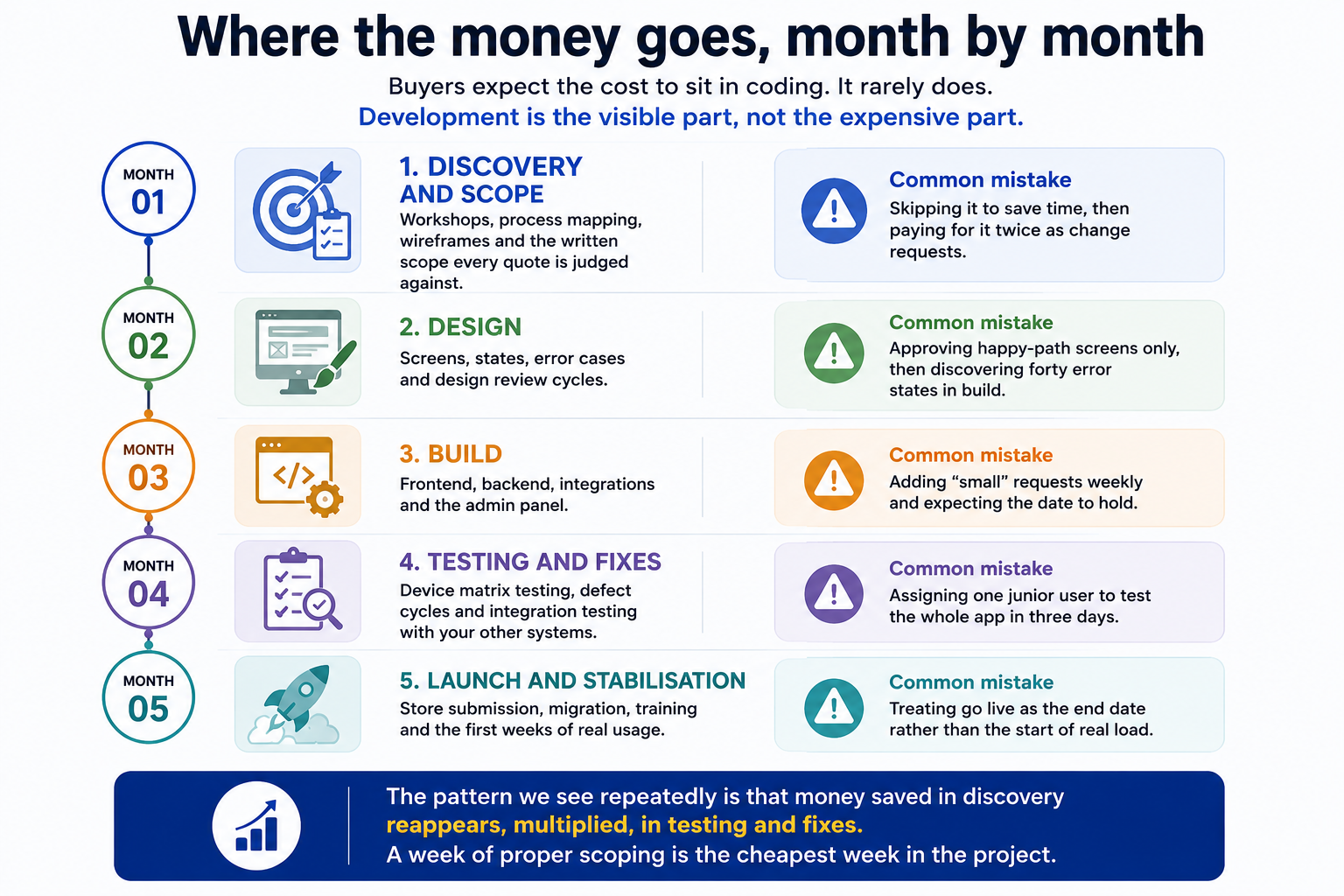
Buyers expect the cost to sit in coding. It rarely does. Development is the visible part, not the expensive part.
Discovery and scope — You are paying for workshops, process mapping, wireframes and the written scope every quote is judged against. The mistake buyers make here is skipping it to save time, then paying for it twice as change requests.
Design — You are paying for screens, states, error cases and design review cycles. The mistake buyers make here is approving happy-path screens only, then discovering forty error states in build.
Build — You are paying for frontend, backend, integrations and the admin panel. The mistake buyers make here is adding "small" requests weekly and expecting the date to hold.
Testing and fixes — You are paying for device matrix testing, defect cycles and integration testing with your other systems. The mistake buyers make here is assigning one junior user to test the whole app in three days.
Launch and stabilisation — You are paying for store submission, migration, training and the first weeks of real usage. The mistake buyers make here is treating go live as the end date rather than the start of real load.
The pattern we see repeatedly is that money saved in discovery reappears, multiplied, in testing and fixes. A week of proper scoping is the cheapest week in the project.
What we publish, and what we do not
We publish one fixed price, and we will not publish a build price. That is a deliberate position, and you should know why.
Our AI Readiness Audit is a fixed scope engagement at Rs 2 to 5 lakh, delivered in two weeks. You get a written assessment of your current systems, data and integration points, an honest view of what is buildable now, and a scoped plan you can take to any vendor, including ones that are not us. It is the entry point precisely because it removes the guessing that makes quotes incomparable.
A build price is different. Any firm that publishes a single band for "a mobile app" is quoting a scope you have not described yet. We would rather show you the drivers. Every cost variable in this guide, and how each one moves the number, sits on our cost page. If you want the delivery side of it, how we work sets out the process the price pays for.
How to compare two proposals fairly
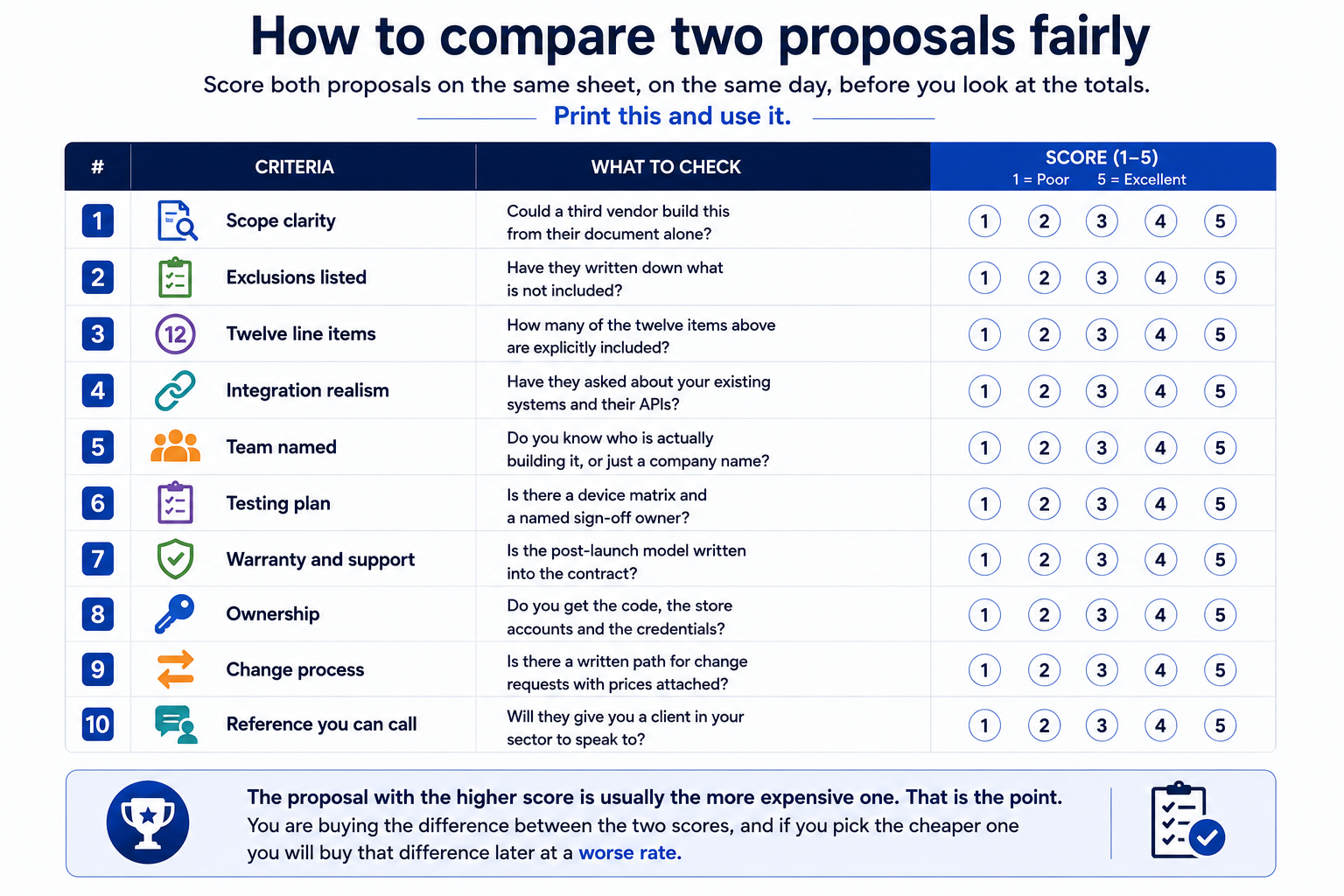
Score both proposals on the same sheet, on the same day, before you look at the totals. Print this and use it.
Scope clarity — Could a third vendor build this from their document alone? Score it from 1 to 5.
Exclusions listed — Have they written down what is not included? Score it from 1 to 5.
Twelve line items — How many of the twelve items above are explicitly included? Score it from 1 to 5.
Integration realism — Have they asked about your existing systems and their APIs? Score it from 1 to 5.
Team named — Do you know who is actually building it, or just a company name? Score it from 1 to 5.
Testing plan — Is there a device matrix and a named sign-off owner? Score it from 1 to 5.
Warranty and support — Is the post-launch model written into the contract? Score it from 1 to 5.
Ownership — Do you get the code, the store accounts and the credentials? Score it from 1 to 5.
Change process — Is there a written path for change requests with prices attached? Score it from 1 to 5.
Reference you can call — Will they give you a client in your sector to speak to? Score it from 1 to 5.
The proposal with the higher score is usually the more expensive one. That is the point. You are buying the difference between the two scores, and if you pick the cheaper one you will buy that difference later at a worse rate.
The cost nobody prices: the second year
Year two is where budgets get embarrassed. Three things arrive whether or not you planned for them.
Operating system churn. These are hard, published deadlines, not opinions. Google Play requires apps and updates to target Android 16 (API level 36) from 31 August 2026, with extensions available to 1 November 2026, and apps below the required level stop being discoverable to users on newer Android versions. Apple requires everything uploaded to App Store Connect from 28 April 2026 to be built with the iOS 26 SDK or later. Miss these and your app does not break dramatically. It quietly stops reaching new users.
Policy and platform work. Google Play requires apps that let users create an account to offer both an in-app deletion path and a web link for deletion requests, and requires a completed Data safety declaration. Platform fees are small and predictable: 99 US dollars a year for the Apple Developer Program, a one time 25 US dollar registration for Google Play. The engineering around them is not.
The person who leaves. The single largest hidden cost in year two is the developer who held the context walking out. This is why handover documentation is on the checklist above, and why we push clients to insist on it even when it slows the final invoice.
Plan the second year as a standing line in the budget, agreed before go live while you still have negotiating room. Once you are live and dependent, your position is weaker.
Accucia's view
We would rather lose a deal at the quote stage than win it and argue in month four.
Three positions, including the ones that cost us work. First, if your process is standard and a good SaaS product already does it, buy the SaaS product. We say so, and it costs us sales. Where the two genuinely differ is set out in custom versus SaaS. Second, framework debates are oversold. Whether you go native or hybrid, or Flutter or React Native, matters far less to your app development cost in India than how many roles and integrations you have. Third, we will not quote a fixed price on a scope that has not been written. We will offer discovery instead, and some buyers walk. We accept that.
On infrastructure, we deploy in-region on request across AWS, Azure or Google Cloud Platform, with the region chosen to meet your requirement and infrastructure billed to you at cost, or we deploy to your own on-premise servers. We do not mark up cloud. On certification, ISO 27001 is not held and implementation is underway. ISO 9001 is not held and is in progress. We say that plainly rather than let a logo imply otherwise.
If you want to see the delivery side, mobile app development covers what we build and how. If you want the number for your specific case, talk to us or start with the two week audit.
Frequently Asked Questions
What does app development cost in India in 2026?
There is no honest single number. Cost in India in 2026 is set by how many user roles the app serves, how many existing systems it must talk to, and whether it has to survive an audit. Fix the scope document first, then compare quotes against that document line by line.
Why do two quotes for the same app differ by four times?
Almost always because they price different scopes. One vendor included testing, an admin panel, analytics, store submission and a warranty period. The other quoted the screens only and will raise change requests later. Ask both to list what is excluded. The gap in the exclusions is the gap in the price.
Is a fixed price safer than time and material?
Fixed price is safer only when the scope is genuinely fixed and written down. If requirements are still moving, a fixed price pushes the vendor to argue about interpretation instead of building. Time and material is safer for discovery work, provided you get a weekly burn report and can stop at any sprint boundary.
Does choosing Flutter or React Native change the cost?
Framework choice moves the number less than buyers expect. One codebase for two platforms saves build effort on standard screens. It saves little on backend work, integrations, testing on real devices or store compliance. Pick the framework for your maintenance plan and hiring pool, not as a cost lever.
What does a low quote usually leave out?
The twelve items in this guide. The common omissions are quality assurance time, the admin panel, data migration from your current system, analytics and crash reporting, third party licence fees, user training, and handover documentation. Each one still has to be paid for. It just arrives as a change request.
What do the app stores themselves charge?
Apple charges 99 US dollars a year for the Apple Developer Program. Google Play charges a one time registration fee of 25 US dollars. Those are the platform fees only. The engineering work of preparing builds, privacy declarations, screenshots and review responses sits in your project budget, not theirs.
Do I need a separate admin panel?
Almost always, yes. Somebody in your office has to add users, correct bad records, change master data and pull reports. Without an admin panel that work lands on your vendor as paid support tickets. Scope the panel in the first release and it costs far less than retrofitting it.
What does compliance add to an app budget?
It adds design time, engineering time and audit time. Under India's DPDP Rules 2025 you will need consent notices, deletion paths and breach handling. CERT-In directions require six hour incident reporting and 180 days of logs held in India. Decide early, because retrofitting consent and logging is expensive.
How long should the warranty period be?
Ask for 90 days after go live as a minimum, covering defects against the agreed scope at no charge. Get the definition of a defect in writing, separate from a change request. A vendor who will not put a warranty period in the contract is telling you something about their testing.
What should I budget for the second year?
Treat it as a standing line, not a surprise. The second year carries operating system deadlines, store policy changes, cloud and licence renewals, small feature work and the handover risk when the developer who knew the code leaves. Agree the support model before go live, while you still have negotiating room.
Can I start smaller than a full build?
Yes. Our AI Readiness Audit is a fixed scope engagement at Rs 2 to 5 lakh over two weeks. You get a written assessment of your systems, data and integration points, plus a scoped build plan you can take to any vendor. It is the cheapest way to stop guessing.
Who should own the code and the store accounts?
You should. Insist the App Store Connect and Google Play accounts are registered to your company, not the vendor's, and that source code sits in a repository you own. Assignment of intellectual property on final payment should be written into the contract. This single clause protects every rupee you spend.
Start with a clear scope. Build with confidence.