AI Agent Development Company: How to Choose One in 2026
Quick Answer
An AI agent development company builds software agents that read from and act inside your existing systems, not just chatbots. The one question that separates real builders from demo shops is how they measure accuracy: ask for the evaluation set, the pass threshold and the rollback plan before signing anything. By Mr. Sumeet Katariya, CEO, Accucia Softwares Pvt. Ltd.
What an AI agent development company actually does
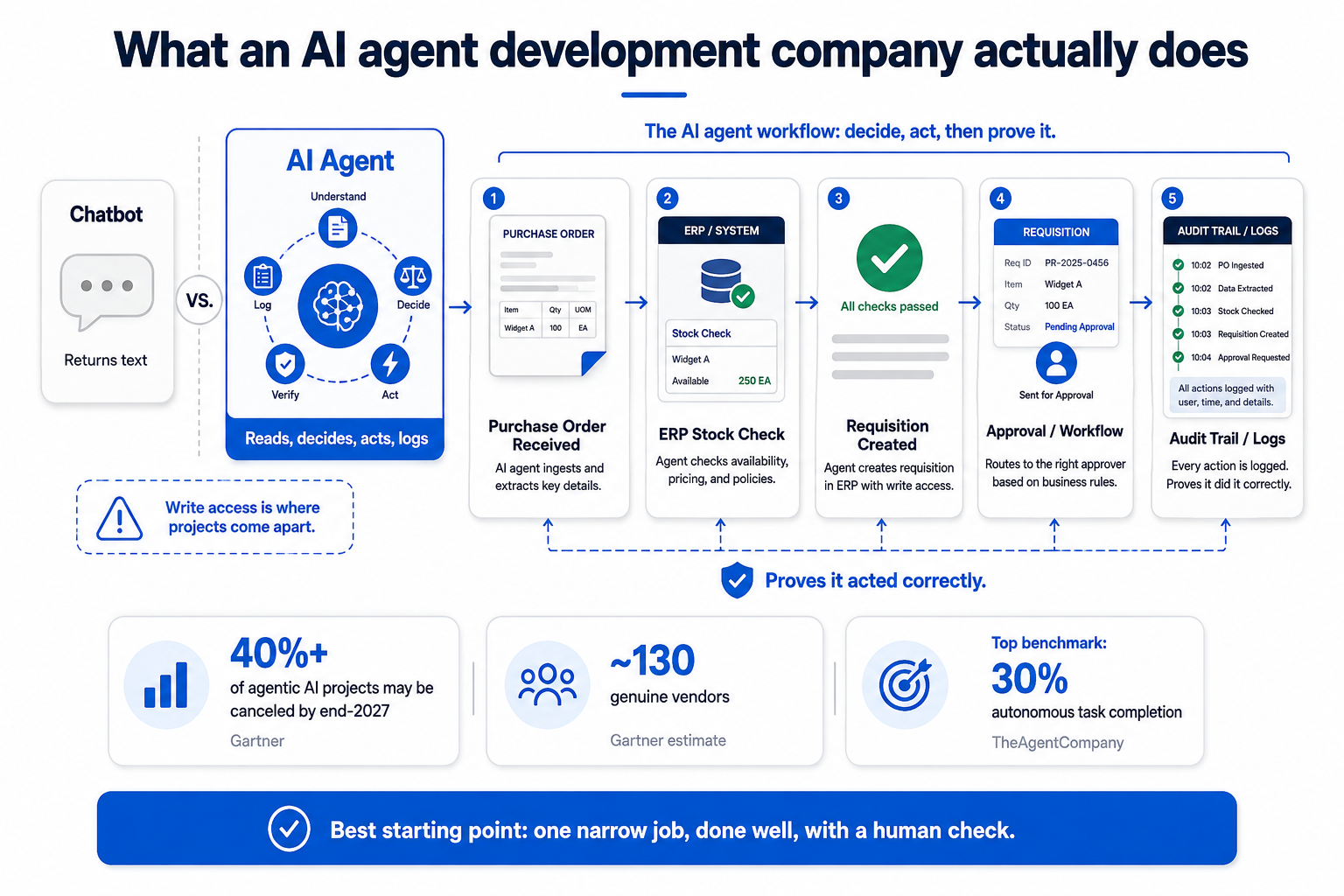
An AI agent development company builds software that decides and acts, then proves it acted correctly. A chatbot returns text. An agent reads a purchase order, checks stock in your ERP, raises a requisition and leaves an audit trail. Write access is where projects come apart.
Gartner predicted on 25 June 2025 that "over 40% of agentic AI projects will be canceled by the end of 2027, due to escalating costs, unclear business value or inadequate risk controls". It also estimates only about 130 agentic AI vendors are genuine among the thousands using the label. Anushree Verma, Senior Director Analyst at Gartner, said most such projects are "early stage experiments or proof of concepts that are mostly driven by hype and are often misapplied".
Benchmarks agree. In TheAgentCompany, which sets agents realistic tasks inside a simulated software firm, the most competitive agent completed 30% of tasks autonomously. Scope accordingly: one narrow job, done well, with a human check.
Three kinds of agent, priced very differently
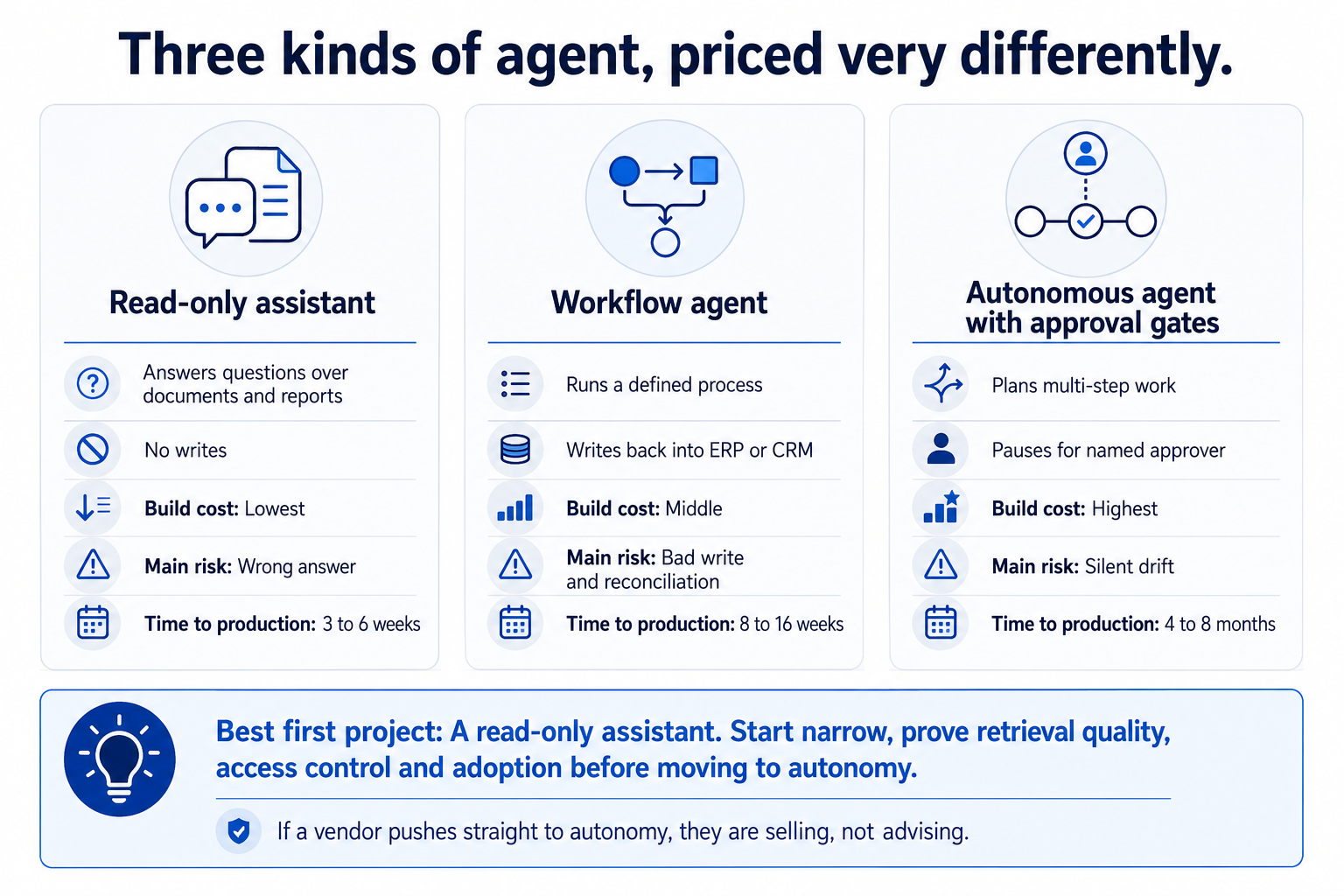
Most buyers ask for "an AI agent" and mean one of three different things. The gap comes from permissions, not cleverness.
Read-only assistant
What it does: Answers questions over your documents and reports. No writes.
Relative build cost: Lowest
Main risk: A wrong answer, contained because no record changes
Time to first production use (our delivery experience): 3 to 6 weeks
Workflow agent
What it does: Runs a defined process and writes back into ERP or CRM
Relative build cost: Middle
Main risk: A bad write, plus the work to reconcile it
Time to first production use (our delivery experience): 8 to 16 weeks
Autonomous agent with approval gates
What it does: Plans multi-step work, pausing at checkpoints for a named approver
Relative build cost: Highest
Main risk: Silent drift across many small decisions
Time to first production use (our delivery experience): 4 to 8 months, after a workflow agent is stable
A read-only assistant is the right first project for almost everyone. It hands you retrieval quality, access control and adoption in one go, with no risk of a wrong ledger entry. A vendor who pushes you straight to autonomy is selling, not advising.
The nine questions to ask an AI agent development company
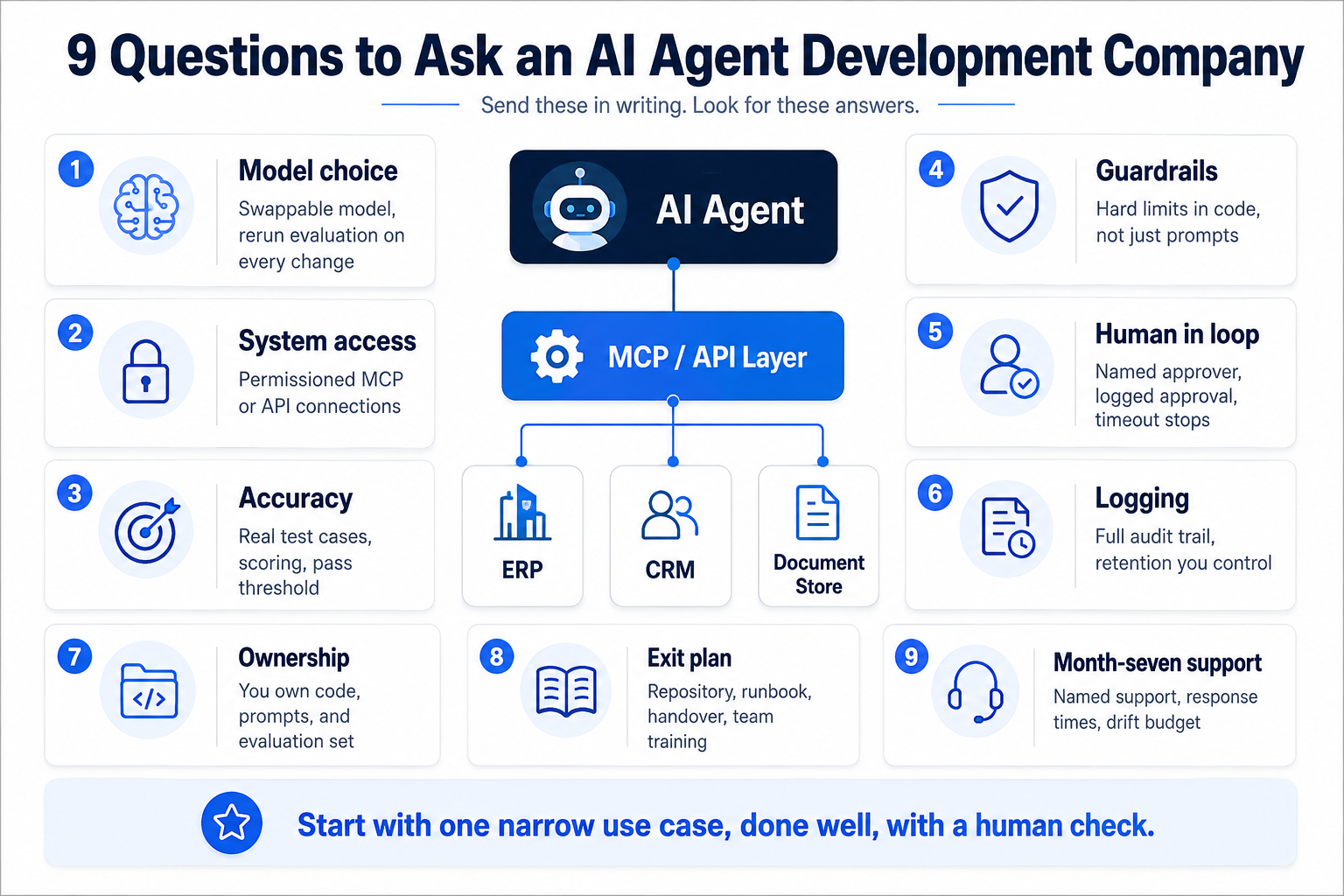
Send these to every shortlisted vendor in writing. The answer you want is under each one.
- Which model are you using, and what happens when it changes?
Wanted: the model sits behind an internal interface and is swappable, chosen per task rather than per brand, with the evaluation set rerun on every version change. Vendors locked to one model bill you for a rewrite later.
- How will the agent reach our systems?
Wanted: documented, permissioned interfaces, preferably Model Context Protocol servers or existing APIs, with a named owner per connection. Not screen scraping, not direct database writes, not a shared admin credential.
- How do you prove accuracy before go-live?
Wanted: a fixed set of real cases from your business with known correct outputs, a scoring method, a pass threshold agreed before build, and a rerun on every change. "We tested it manually" is not an evaluation method.
- What do the guardrails block, and where are they enforced?
Wanted: hard limits in code, not in a prompt. Value caps, allowed record types, allowed actions, allowed hours, blocked fields. Prompt instructions are guidance, not control.
- Where does a human stay in the loop?
Wanted: a named role approves defined classes of action, the approval is logged with the approver's identity, and the agent stops when approval times out. The India AI Governance Guidelines, released by MeitY in November 2025, state that "humans should, as far as possible, have final control over AI systems".
- What gets logged, and for how long?
Wanted: every input, tool call, decision, output and approver, stored in your tenancy, queryable by your team, for a retention period you set. The same guidelines recommend "regular monitoring and testing, audit trails, and reporting protocols". Logs held only by the vendor leave you unable to investigate an incident.
- Who owns the code, the prompts and the evaluation set?
Wanted: you own all three, on a written assignment, delivered into your repository from week one. Prompts are the product in agent work. A vendor who keeps them is keeping the part you paid to learn.
- What is the exit plan?
Wanted: a documented handover covering repository access, environment variables, deployment runbook, evaluation instructions and a training session for your team. Agree it at contract stage, not at exit.
- Who supports this in month seven?
Wanted: a named support model with response times, a change budget for model and API drift, and one person from the build team. Month one is easy. Month seven is when an upstream API changes and nobody remembers why a rule exists.
[Diagram: Agent connected to ERP, CRM and Document Store through a middle MCP layer. See Inline Media Notes for the generation prompt.]
Integration is the real cost, not the model
Model calls are a small line item. The work sits in reaching your systems safely, and in the state of the data you find there.
Model Context Protocol, released by Anthropic on 25 November 2024, is an open standard for connecting AI systems to the places data lives. It turns integration into a reusable server per system: build one MCP server for your ERP, and every future agent, and every model you swap in, reaches it the same way. In December 2025 it was donated to the Agentic AI Foundation under the Linux Foundation, with reported figures of over 97 million monthly SDK downloads and 10,000 active servers.
For most Indian mid-market buyers this is the cheaper route: keep the ERP you already paid for and add a controlled interface on top. We set that out in MCP for ERP, and we run MCP integration separately from agent build.
Data quality is the other half. If your item master holds four spellings of the same part, the agent will not fix that. It will act on all four. Retrieval has the same problem, which is why enterprise RAG work starts with document cleanup, not model selection.
AI agent development cost: what actually moves the number
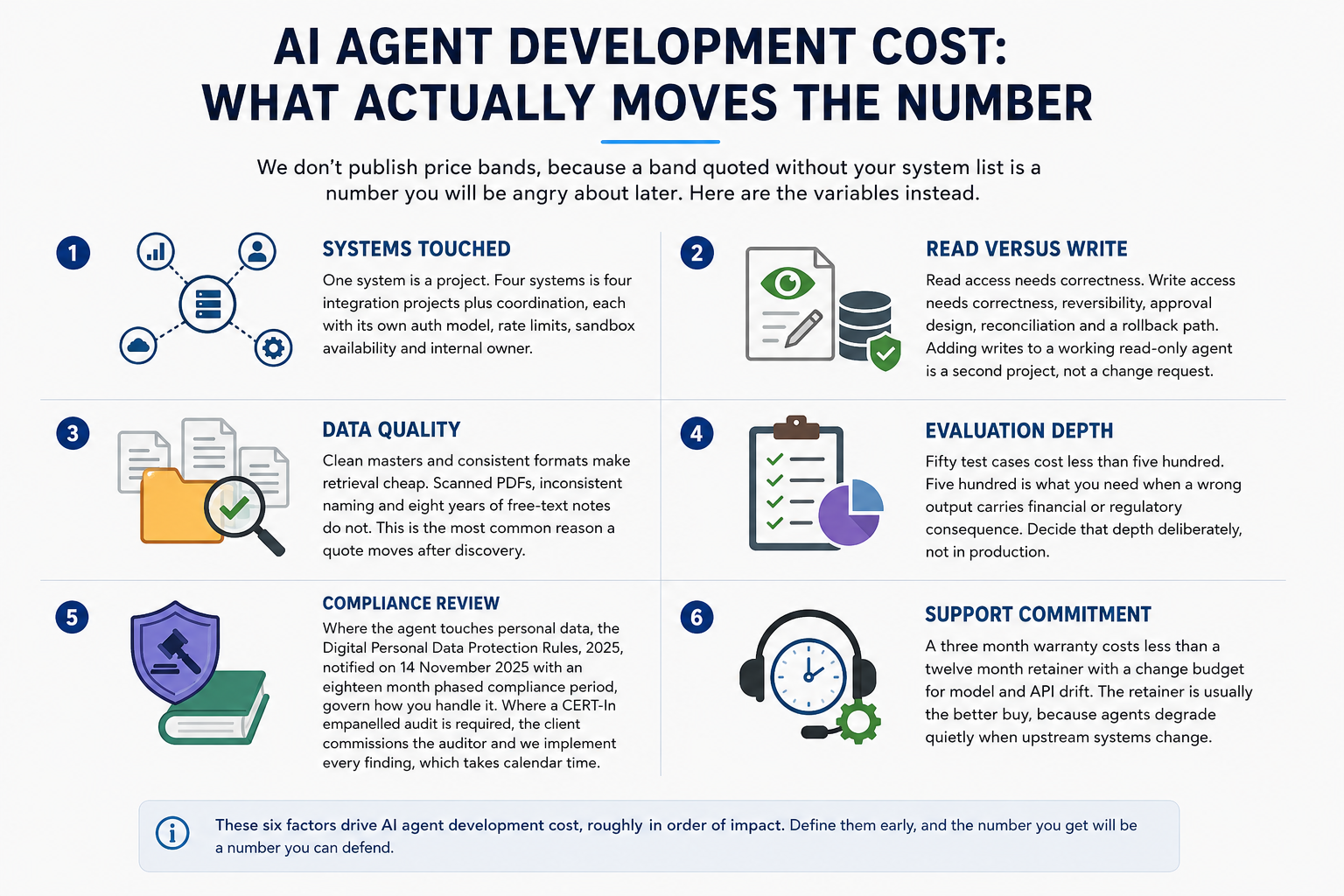
We do not publish price bands, because a band quoted without your system list is a number you will be angry about later. Here are the variables instead. See our cost page.
Six things drive ai agent development cost, roughly in order of impact.
Systems touched. One system is a project. Four systems is four integration projects plus coordination, each with its own auth model, rate limits, sandbox availability and internal owner.
Read versus write. Read access needs correctness. Write access needs correctness, reversibility, approval design, reconciliation and a rollback path. Adding writes to a working read-only agent is a second project, not a change request.
Data quality. Clean masters and consistent formats make retrieval cheap. Scanned PDFs, inconsistent naming and eight years of free-text notes do not. This is the most common reason a quote moves after discovery.
Evaluation depth. Fifty test cases cost less than five hundred. Five hundred is what you need when a wrong output carries financial or regulatory consequence. Decide that depth deliberately, not in production.
Compliance review. Where the agent touches personal data, the Digital Personal Data Protection Rules, 2025, notified on 14 November 2025 with an eighteen month phased compliance period, govern how you handle it. Where a CERT-In empanelled audit is required, the client commissions the auditor and we implement every finding, which takes calendar time.
Support commitment. A three month warranty costs less than a twelve month retainer with a change budget for model and API drift. The retainer is usually the better buy, because agents degrade quietly when upstream systems change.
Engagement models, and what each one suits
Fixed scope pilot
What it is: One agent, one process, agreed evaluation threshold
Best for: A first project needing board approval
Watch out for: Scope creep. Freeze the process definition first
Retained squad
What it is: A standing team running several agents against a roadmap
Best for: Three or more processes queued, with an internal owner
Watch out for: Paying for capacity you cannot feed. It needs a real backlog
Build and transfer
What it is: Vendor builds, documents, trains your team, hands over ownership
Best for: In-house engineers who want the capability
Watch out for: A handover on paper only. Put the training sessions in the contract
Most first-time buyers should take a fixed scope pilot on a read-only assistant. It is the cheapest way to find out whether your data is ready.
Red flags
Accuracy claimed with no evaluation set. "It is 95% accurate" means nothing without the test cases, the scoring method and who wrote them.
No rollback plan. If the agent writes to a system of record, there must be a defined way to reverse what it wrote.
Refusal to hand over prompts. Prompts and the evaluation set hold your process knowledge. Withholding them is lock-in, and the second project gets priced that way.
Pricing per agent rather than per outcome. That rewards a vendor for splitting one workflow into five agents. Price the outcome and the systems in scope.
A demo on the vendor's own data. Ask for it on your documents, with your terminology and edge cases. A refusal means the demo does not generalise.
How we work
Accucia Softwares was founded in Pune in 2018, so there are eight years of delivery behind this, most of it ERP, workflow and integration work rather than AI demos. Full scope is on our AI agents service page. Our own product Sellora is the working proof: one agent reading and acting on real HR data through MCP, in production.
On hosting, we deploy in-region on request, on AWS, Azure or GCP with the region chosen to meet your requirement and infrastructure billed to you at cost, or on your own on-premise servers. Our sub-processors are AWS, Azure, GCP and client on-premise infrastructure, and nothing else.
On certifications we will be exact. We do not hold ISO 27001. Implementation is underway, an auditor has been appointed, and we are targeting certification for Q1 2027, January to March. We do not hold ISO 9001. That is in progress. Where a CERT-In empanelled audit is required, you commission the auditor. We are not empanelled ourselves.
Accucia's view
Most organisations asking for an AI agent should buy a data cleanup and a read-only assistant first, and we say so even when it costs us the larger project. We have declined write-access scope on first engagements more than once, because the client's master data could not support it and shipping anyway would have produced a wrong ledger entry with our name on it.
Second, integration standards matter more than model choice. Pick MCP or documented APIs, keep the model swappable, and you still own something useful in three years. A proprietary connector layer is a rewrite you have not scheduled.
Third, if a vendor will not give you the evaluation set, the prompts and the logs, the price does not matter. You are renting a black box that touches your systems of record. If you want to argue the point, talk to our team and bring your system list.
Frequently Asked Questions
What does an AI agent development company do?
It builds software agents that act inside your business systems, not just answer questions: process definition, integration to ERP or CRM, guardrails, an evaluation set with a pass threshold, logging and support. Integration and evaluation usually cost more than the model work.
How is an AI agent different from a chatbot?
A chatbot returns text. An agent acts: it reads records, calls tools, writes updates into systems and leaves an audit trail. That write capability is the whole difference in cost and risk. A wrong chatbot answer wastes time. A wrong agent write creates reconciliation work.
What drives ai agent development cost?
Six factors: how many systems the agent touches, whether it writes or only reads, master data quality, how many evaluation cases you need, whether a compliance audit is required, and the length of the support commitment. Write access and data quality move it most.
How long does an AI agent take to build?
In our delivery experience, a read-only assistant reaches production in three to six weeks. A workflow agent writing into ERP or CRM takes eight to sixteen weeks. An autonomous agent with approval gates takes four to eight months, and only after a workflow agent is stable.
Do we need MCP to build an agent?
No, documented APIs also work. Model Context Protocol is worth choosing when several agents reach the same system, because you build one server per system instead of custom plumbing per agent. Anthropic released it in November 2024 and it moved to the Agentic AI Foundation in December 2025.
Who should own the code and the prompts?
You should, in writing, from week one, including prompts and evaluation cases, delivered into your own repository. Prompts encode your process knowledge and the evaluation set your definition of correct. A vendor who retains either is building a switching cost you will pay for later.
How do you measure whether an agent is accurate enough?
With an evaluation set: real cases from your business with known correct outputs, a defined scoring method and a pass threshold agreed before build starts. Rerun it on every change, including model version changes. Any accuracy figure quoted without those three things is not verifiable.
Should an agent be allowed to write into our ERP?
Only after a read-only version has run in production with stable evaluation scores, and only with hard limits enforced in code, an approval step for defined action classes, full logging and a tested rollback path. Start with the lowest-value, highest-volume transaction type.
What happens when the agent makes a mistake?
A properly built agent logs every input, tool call, decision and approver, so you can find the mistake, see what caused it, reverse the write using the rollback path and add that case to the evaluation set. No reversal answer means no production readiness.
Can the agent run on our own servers in India?
Yes. We deploy on your own on-premise servers, or in-region on AWS, Azure or GCP with the region chosen to meet your requirement and infrastructure billed to you at cost. Data residency is decided before build starts, not changed afterwards.
What is the right first agent to build?
A read-only assistant over a document set or reporting layer that a real team uses daily. It surfaces your retrieval quality, access control and adoption problems within weeks, with no risk to a system of record. Pick a high-volume process with clear correct answers.
How do we avoid being one of the cancelled projects?
Gartner predicts over 40% of agentic AI projects will be cancelled by the end of 2027 due to escalating costs, unclear business value or inadequate risk controls. Counter all three: scope one process, agree an evaluation threshold before build, and price the support year upfront.
Ready to build a production-ready AI agent? Talk to Accucia.