Agentic AI vs Generative AI: Key Differences (2026)
Quick Answer
Agentic AI is software that takes a goal, plans the steps, uses tools and business systems to carry them out, and adjusts based on results, with limited human prompting. Generative AI creates content, such as text, images or code, in response to a prompt. Generative AI produces an output; agentic AI completes a task. By Mr. Sumeet Katariya, Accucia Softwares Pvt. Ltd.
What is agentic AI?
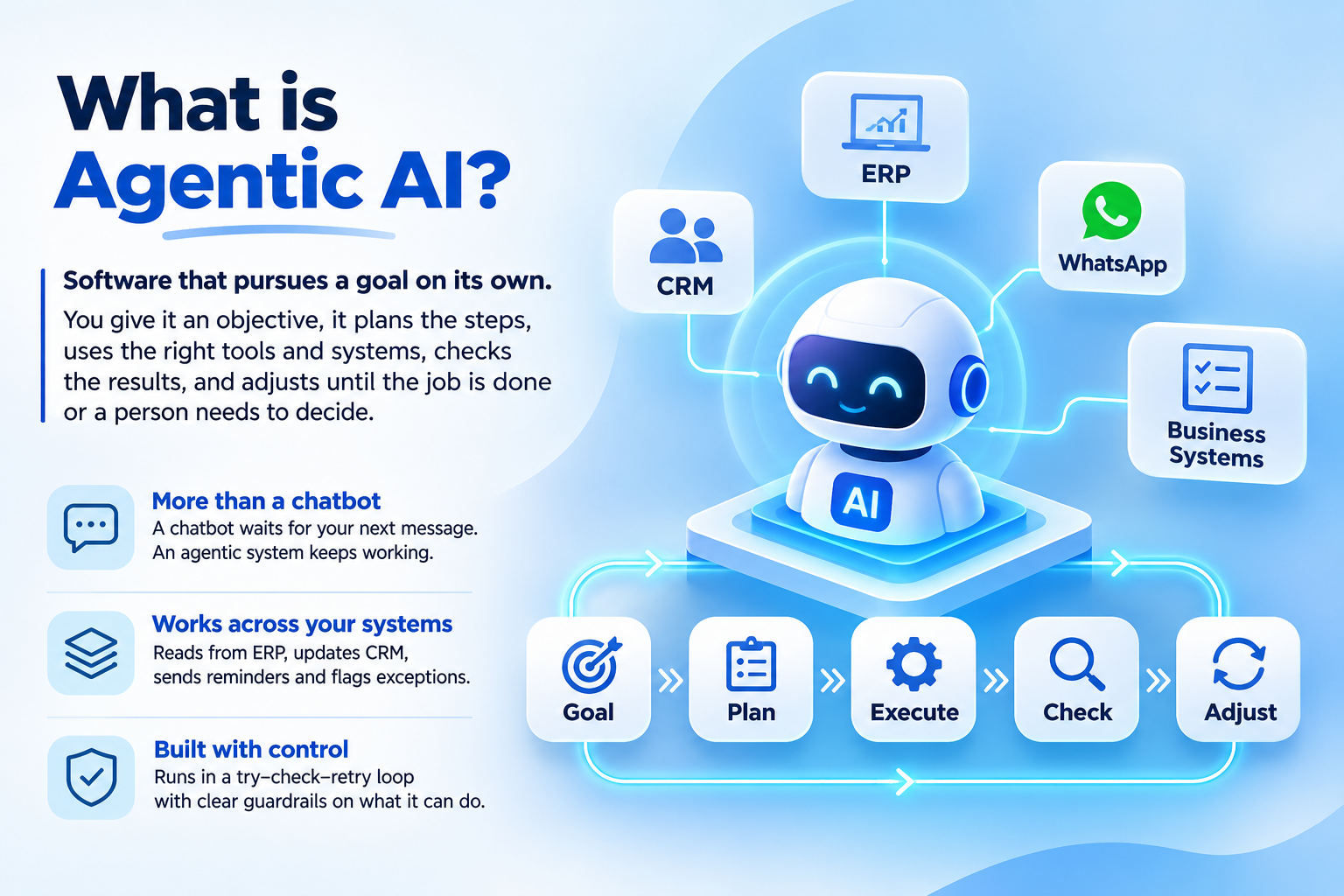
Agentic AI is software that pursues a goal on its own. You give it an objective, such as "clear this week's purchase approvals," and it plans the steps, calls the tools and business systems it needs, checks the results, and adjusts until the job is done or a person needs to decide.
The word that matters is agency. A chatbot waits for your next message. An agentic system keeps working between messages. It reads from your ERP, writes to your CRM, sends the WhatsApp reminder, and flags the one case it isn't sure about.
Most agentic systems still run on a large language model, which handles the reasoning. What changes is everything around it: memory, access to tools, a loop that lets the system try, check and retry, and guardrails that decide what it may do without asking.
What is generative AI?
Generative AI is a model that creates new content, such as text, images, code, audio or video, from a prompt. ChatGPT, Claude, Gemini and Midjourney are familiar examples. You ask, it produces an output, and the exchange ends.
That's useful. A sales head can get a first draft of a proposal in seconds. But the model doesn't send the proposal, check it against the price list in your ERP, or follow up in three days. A person does all of that. Generative AI makes the draft; people still carry the work.
Agentic AI vs generative AI: what is the difference?
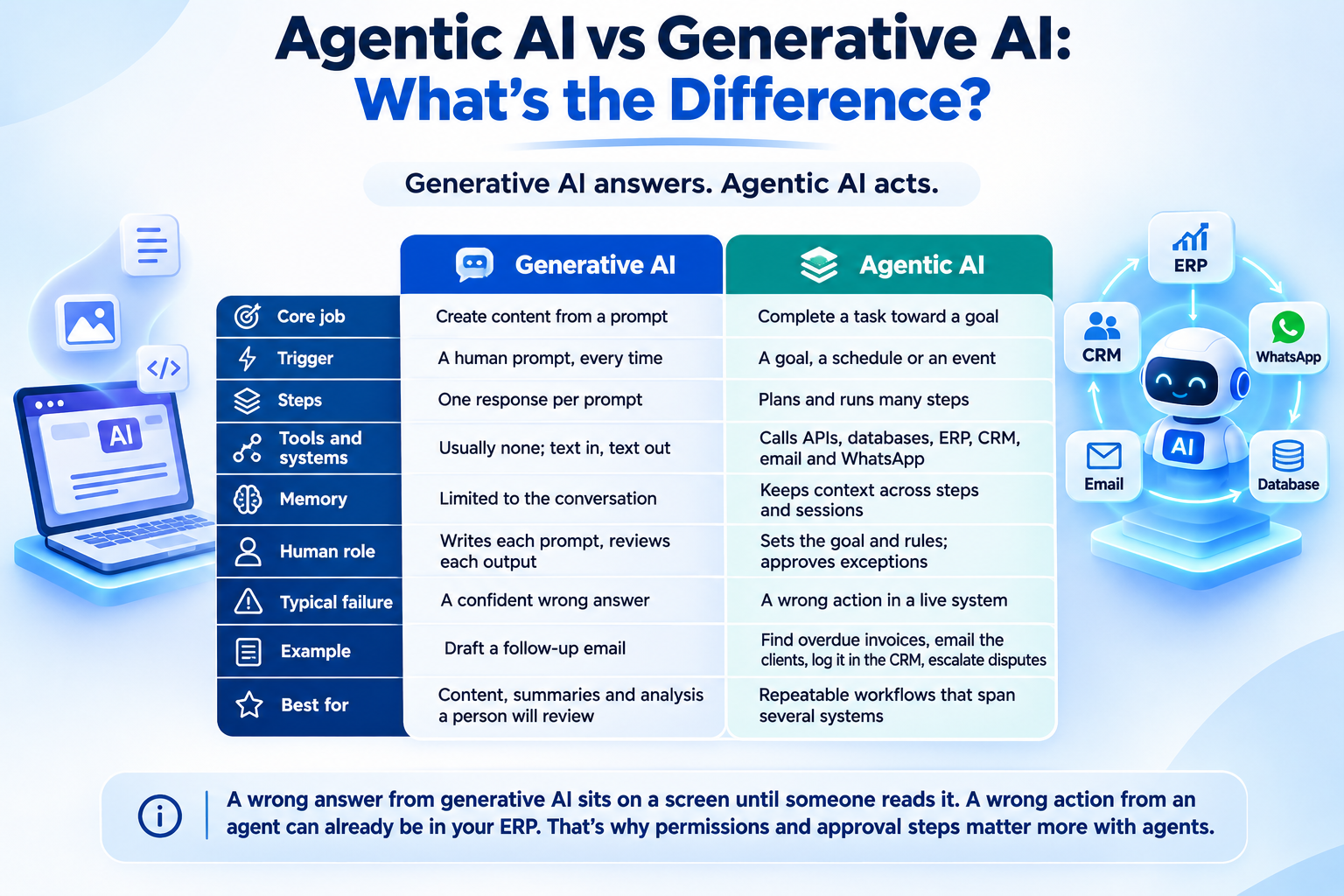
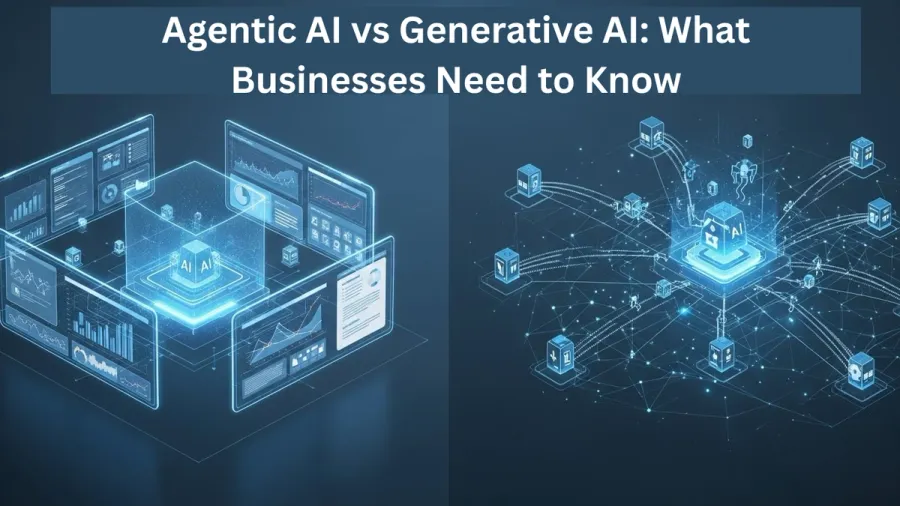
The core difference: generative AI produces content when prompted, while agentic AI pursues a goal across multiple steps and systems. Generative AI answers. Agentic AI acts.
Core job
Generative AI: Create content from a prompt
Agentic AI: Complete a task toward a goal
Trigger
Generative AI: A human prompt, every time
Agentic AI: A goal, a schedule or an event
Steps
Generative AI: One response per prompt
Agentic AI: Plans and runs many steps
Tools and systems
Generative AI: Usually none; text in, text out
Agentic AI: Calls APIs, databases, ERP, CRM, email and WhatsApp
Memory
Generative AI: Limited to the conversation
Agentic AI: Keeps context across steps and sessions
Human role
Generative AI: Writes each prompt, reviews each output
Agentic AI: Sets the goal and rules; approves exceptions
Typical failure
Generative AI: A confident wrong answer
Agentic AI: A wrong action in a live system
Example
Generative AI: Draft a follow-up email
Agentic AI: Find overdue invoices, email the clients, log it in the CRM, escalate disputes
Best for
Generative AI: Content, summaries and analysis a person will review
Agentic AI: Repeatable workflows that span several systems
The failure row deserves attention. A wrong answer from generative AI sits on a screen until someone reads it. A wrong action from an agent can already be in your ERP. That's why permissions and approval steps matter more with agents than with chatbots.
How does agentic AI work?
Agentic AI works in a loop: it takes a goal, plans the steps, acts through connected tools, checks the result, and repeats until the task is complete or a person needs to decide.
- Goal. A person or a trigger supplies the objective and the limits. For example: "Match today's dispatches to invoices and flag any mismatch."
- Plan. The model breaks the goal into steps and picks the tools for each one.
- Act. The agent calls APIs, queries databases, updates records and sends messages.
- Check. It reads what happened and compares it with the goal. If a step failed, it retries or takes another route.
- Finish or hand off. Done means the action is logged. Unsure, or above its authority limit, means it asks a human.
One agent can run this loop alone. Several specialised agents can run it together, with an orchestrator passing work between them. We cover that design in our guide to multi-agent systems.
What does agentic AI look like in a real business?
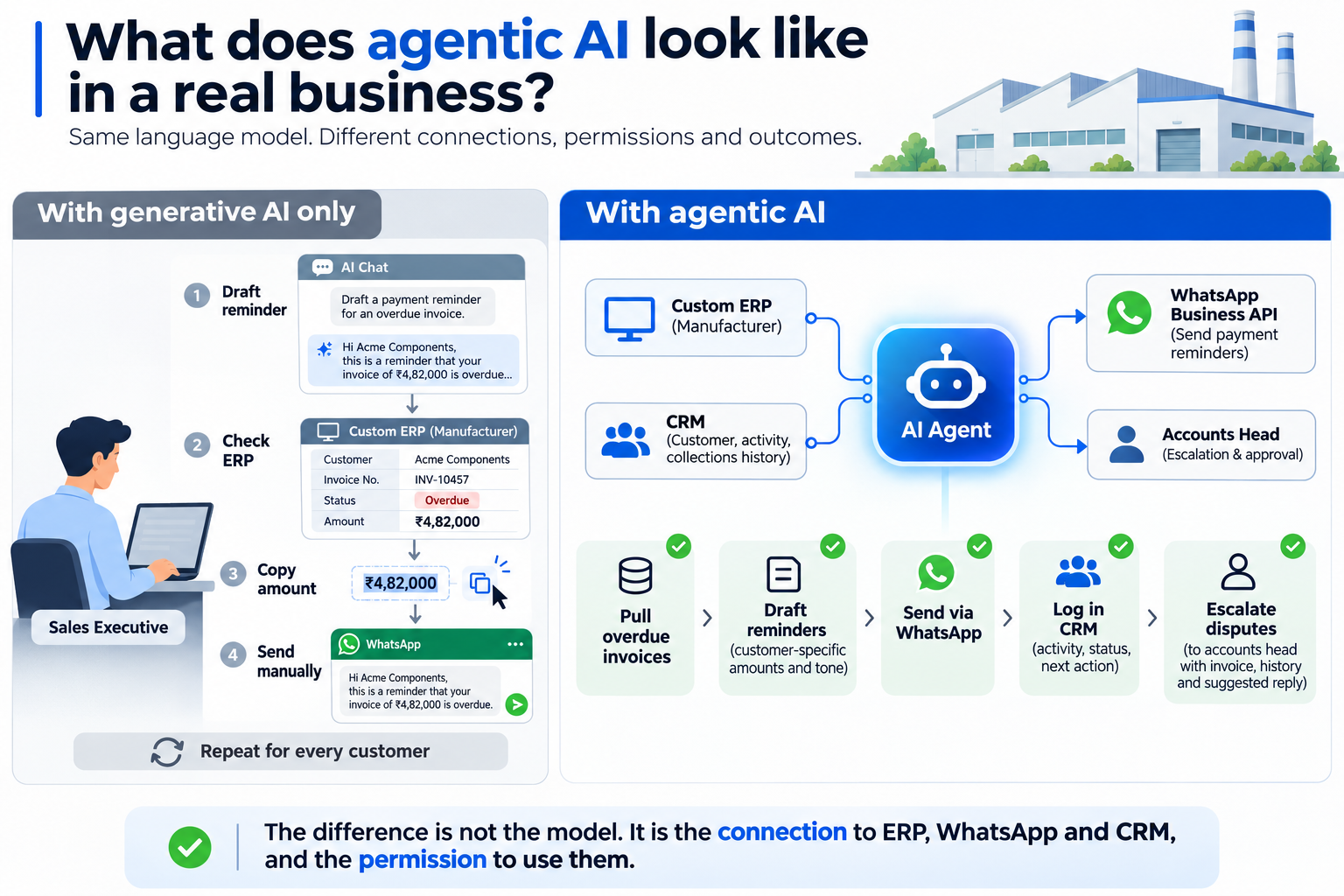
Take a manufacturer with a custom ERP and a sales team that lives on WhatsApp. This is an illustrative scenario, not a client case.
With generative AI only. A sales executive asks the AI to draft a payment reminder. Then they open the ERP, find the outstanding amount, paste it into the draft, and send it by hand. Repeat for every customer.
With agentic AI. Every morning the agent pulls overdue invoices from the ERP. It drafts a reminder for each customer, using the right amount and a tone that fits their payment history. It sends the message through the WhatsApp Business API and records it in the CRM. Disputes go to the accounts head with the invoice, the history and a suggested reply. People handle only the cases that need judgment.
The language model underneath is the same in both versions. The difference is the connection to the ERP, WhatsApp and CRM, and the permission to use them. That connection is an integration job before it is an AI job, which is why legacy systems often decide how fast an agent can go live.
Is agentic AI better than generative AI?
No. They solve different problems, and most agentic systems contain a generative model. Generative AI supplies the reasoning and the language. Agentic AI is the system built around it that turns that reasoning into action.
A short way to remember it: generative AI is a skill, and agentic AI is a job. If a person needs to read and approve the output anyway, generative AI alone is usually enough. If the work means moving information between systems and acting on it, you need the agent.
What are the risks of agentic AI?
The main risks are rising costs, unclear business value and weak risk controls. Gartner predicts that more than 40% of agentic AI projects will be cancelled by the end of 2027 for those three reasons.
Gartner also flags "agent washing," where vendors rebrand chatbots, assistants and RPA tools as agentic. Of the thousands of vendors claiming agentic products, it estimates only about 130 offer genuine agentic features. Its senior director analyst Anushree Verma put the buyer's problem plainly: "Many use cases positioned as agentic today don't require agentic implementations."
The same pattern shows up one level down. MIT's NANDA research found that 95% of enterprise generative AI pilots delivered no measurable return. We break down why AI pilots fail and what the few that scale do differently.
Four controls cut most of the risk:
- Scoped permissions. The agent can read and write only what its task needs.
- Approval thresholds. Payments, customer-facing messages and compliance filings wait for a person.
- Audit logs. Every action is recorded and traceable.
- A named owner. One person is accountable for results, not just for the launch.
When should a business use agentic AI instead of generative AI?
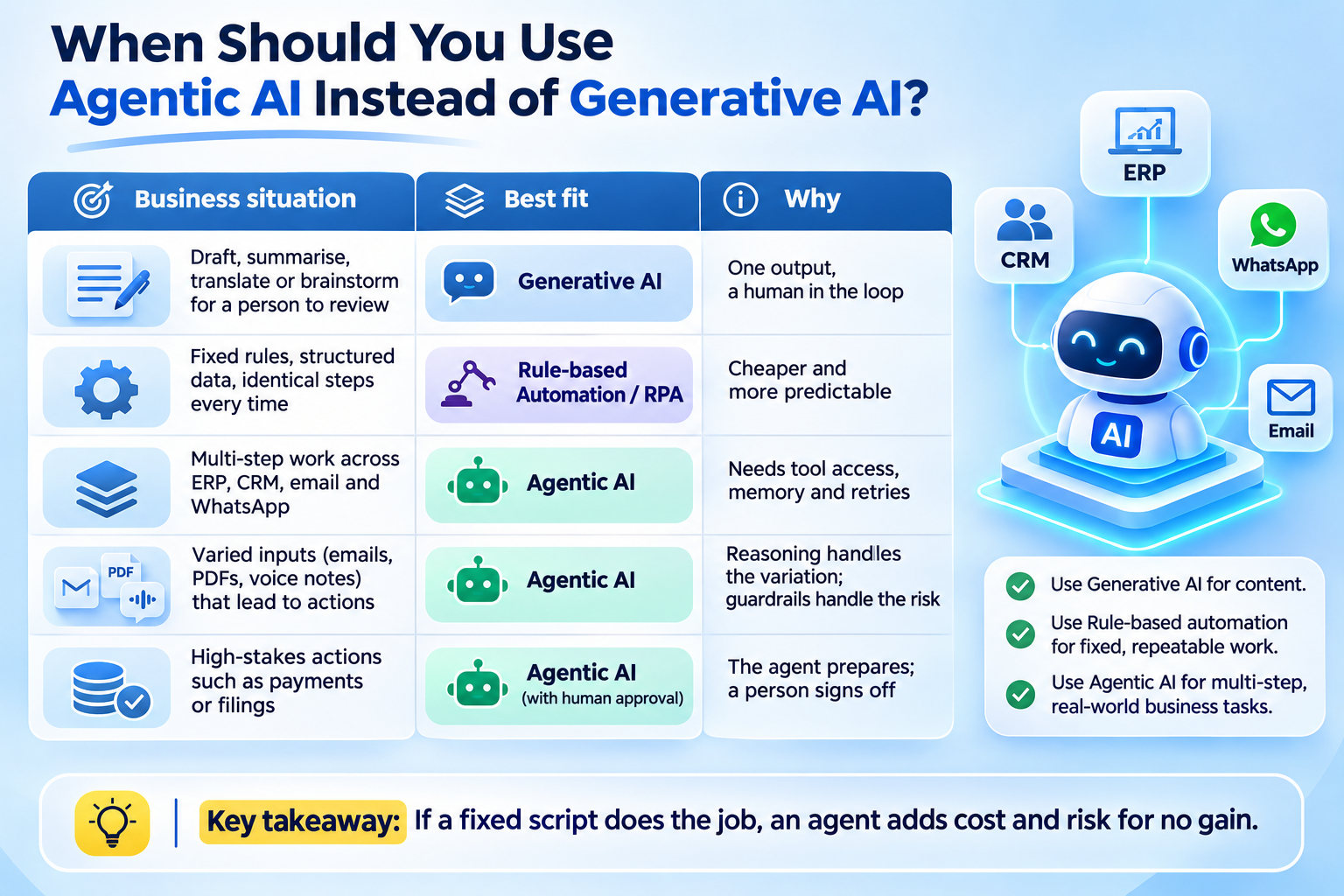
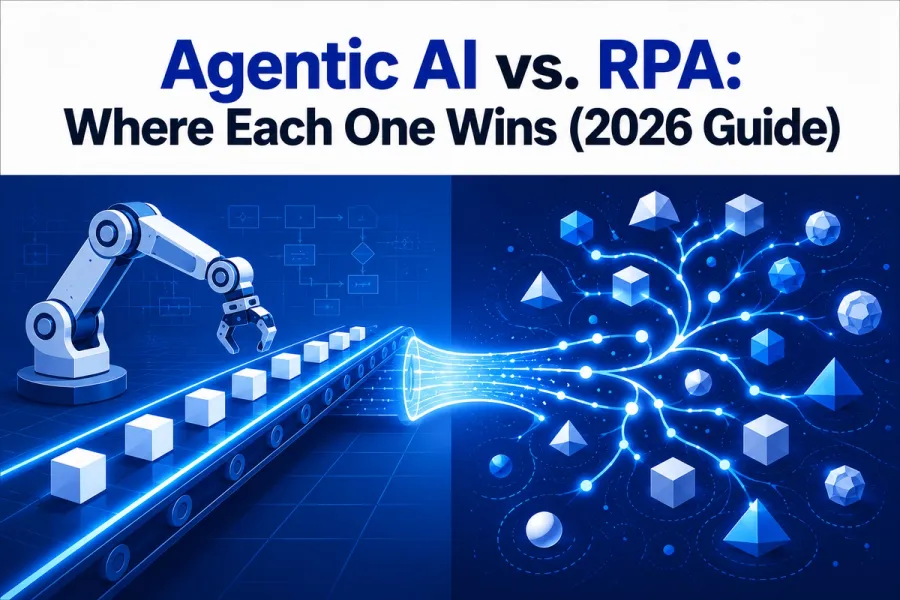
Use agentic AI when a task spans several systems, needs more than one step, and repeats often enough to justify building it. Use generative AI when the output is content a person will review. Use plain automation when the rules never change.
1. Draft, summarise, translate or brainstorm for a person to review
Best fit: Generative AI
Why: One output, a human in the loop
2. Fixed rules, structured data, identical steps every time
Best fit: Rule-based automation or RPA
Why: Cheaper and more predictable
3. Multi-step work across ERP, CRM, email and WhatsApp
Best fit: Agentic AI
Why: Needs tool access, memory and retries
4. Varied inputs (emails, PDFs, voice notes) that lead to actions
Best fit: Agentic AI
Why: Reasoning handles the variation; guardrails handle the risk
5. High-stakes actions such as payments or filings
Best fit: Agentic AI with human approval
Why: The agent prepares; a person signs off
The second row is the one buyers skip. If a fixed script does the job, an agent adds cost and risk for no gain.
How do you start with agentic AI?
Start with one workflow, one owner and one number to move. Then widen the agent's autonomy as the data earns it.
- Pick one workflow. Choose work that is repetitive, spans systems, and has a measurable result such as hours spent, days to collect payment or error rate.
- Map it before you automate it. Write down every step and every system it touches. Fix broken steps first. Automation makes a messy process faster, not better.
- Check your systems can talk. The agent needs APIs or an integration layer into your ERP, CRM and messaging tools. With a legacy system, this step often takes longer than the AI itself.
- Let the agent propose, and a person approve. Move to autonomy only where accuracy data supports it.
- Measure from week one. Compare against the baseline you recorded in step 1, then expand to the next workflow.
Frequently asked questions
Is ChatGPT agentic AI?
In its basic chat form, ChatGPT is generative AI: it responds to prompts. Products built on the same kind of model become agentic when they're given tools, memory and permission to complete multi-step tasks, such as running code, browsing or operating business software. The label depends on the system around the model, not on the model itself.
Are AI agents and agentic AI the same thing?
Close, but not identical. An AI agent is a single system that performs tasks toward a goal. Agentic AI is the broader approach, which can use one agent or several coordinated agents, known as a multi-agent system.
Will agentic AI replace generative AI?
No. Most agents run on a generative model, so the two work together. Generative AI supplies the reasoning and language; the agentic layer adds goals, tools, memory and action.
What are examples of agentic AI in business?
Common examples are overdue-invoice follow-up, routing WhatsApp enquiries into the CRM with a qualified-lead summary, matching purchase orders to invoices, triaging support tickets, and reordering stock when inventory drops below a set level.
Is agentic AI safe for enterprise use?
It can be, when it's tightly scoped. Safe deployments limit what the agent can read and write, set approval thresholds for money and customer-facing actions, log every action, and keep a named human owner. Gartner links cancelled agentic projects partly to inadequate risk controls.
How much does it cost to build an agentic AI system?
Cost depends on how many systems the agent connects to, how much it can do without approval, and how clean your data is. A single-workflow agent costs far less than a multi-system platform. Accucia scopes it in a complimentary 30-minute discovery call and follows with a written, fixed-scope proposal within five working days.
Build agentic AI that connects to your existing systems
Accucia Softwares is an enterprise software development company in Pune, founded in 2018 by Sumeet Katariya. It has delivered 730+ projects across 8 sectors, and it builds AI agents that plug into the ERP, CRM and apps a business already runs. The team stays through adoption, not just delivery.
Ready to Implement AI in Your Business?